
The worst time to care about your surgical case log is after the ABS tells you it is short.
You’re in senior year. The margin for error is gone. Programs will say “quality over quantity,” but when the Clinical Competency Committee and PD scroll your ACGME case logs, they are absolutely counting.
Here’s how you stop hoping and start running your senior year like a case-acquisition project. Month-by-month, then week-by-week, then day-by-day.
Big Picture: Where You Should Be Entering Senior Year
At this point (start of PGY-5 for categorical general surgery; adjust one year for integrated subspecialties):
You should already know:
- Your total major cases to date
- Your key categories (ABD, BREAST, ENDO, VASC, THOR, PEDS, etc.) that are weak
- Your chief year rotation schedule for the whole year
If you don’t, your first job is a reality check.
| Case Category | ABS Minimum* | Where You Want To Be Entering PGY-5 |
|---|---|---|
| Total Major | 850–900 | 650–750 |
| Endoscopy (EGD/Colonoscopy) | 85+ | 40–60 |
| Vascular | 44+ | 25–35 |
| Thoracic | 20+ | 10–15 |
| Complex Abdomen/Hernia | Program-dependent | 60–80 |
*Numbers change periodically; check current ABS booklet. I’m giving you realistic ballparks, not fantasy.
If you’re well above those “entering PGY-5” ranges, you’re playing with cushion. If you’re below, you’re already in gap-closing mode and cannot coast.
Month-by-Month: From July to Graduation
Think in quarters. Senior year is four three‑month sprints.
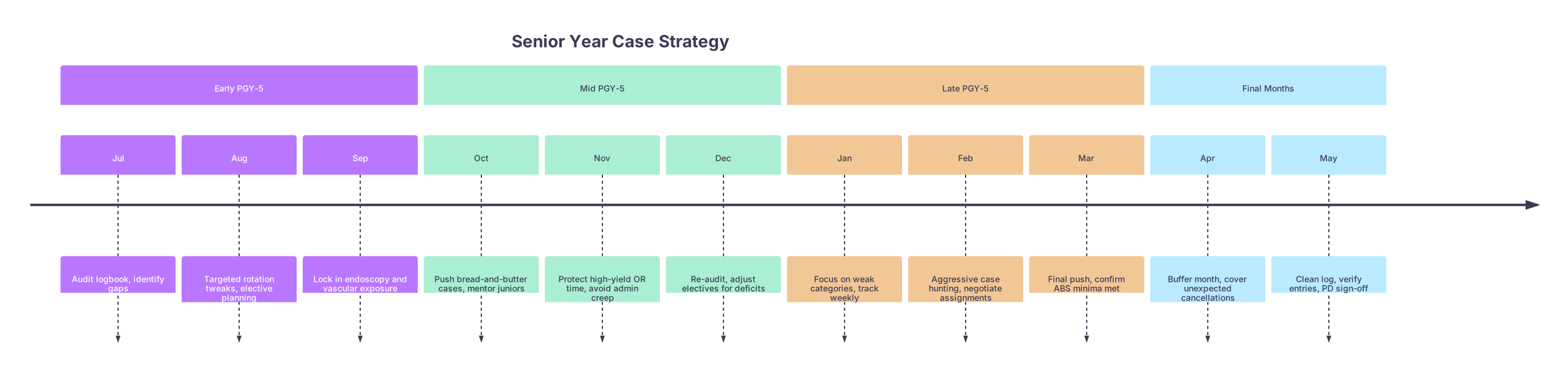
| Period | Event |
|---|---|
| Early PGY-5 - Jul | Audit logbook, identify gaps |
| Early PGY-5 - Aug | Targeted rotation tweaks, elective planning |
| Early PGY-5 - Sep | Lock in endoscopy and vascular exposure |
| Mid PGY-5 - Oct | Push bread-and-butter cases, mentor juniors |
| Mid PGY-5 - Nov | Protect high-yield OR time, avoid admin creep |
| Mid PGY-5 - Dec | Re-audit, adjust electives for deficits |
| Late PGY-5 - Jan | Focus on weak categories, track weekly |
| Late PGY-5 - Feb | Aggressive case hunting, negotiate assignments |
| Late PGY-5 - Mar | Final push, confirm ABS minima met |
| Final Months - Apr | Buffer month, cover unexpected cancellations |
| Final Months - May | Clean log, verify entries, PD sign-off |
July–September: The Brutal Audit and Early Fixes
July: Hard reality month
By now you should:
- Pull full ACGME case report (category and role breakdown)
- Print or export to PDF. Mark three colors:
- Green: at/above pace
- Yellow: borderline
- Red: clearly under target
Look specifically at:
- Endoscopy (EGD, colonoscopy separately)
- Vascular recon vs access
- Thoracic (especially lung resections)
- Laparoscopic vs open ratios
In the first two weeks of July, you should:
Book a 20–30 minute meeting with:
- Program Director
- Or APD in charge of rotations/education
Walk in with:
- Highlighted case summary
- This year’s rotation calendar
- A simple one-page “gap plan”:
- “I need ~25 more colonoscopies, ~10 more EGDs.”
- “I’m short 10–15 vascular cases, 5 thoracic.”
Ask for targeted adjustments:
- Swap a research/clinic-heavy month for endoscopy or vascular exposure
- Shift an elective to a service with missing case types
Programs are much more willing to fix gaps in July than in February. I’ve watched seniors beg for an extra endoscopy month in March and get told, “Schedule is locked.”
August: Lock in endoscopy and vascular
At this point you should:
- Have confirmed any schedule changes in writing (e-mail)
- Know exactly which months are your “procedural gold mines”:
- Dedicated endoscopy rotations
- Vascular-heavy services
- Thoracic or foregut months
August is prime time to:
- Introduce yourself (or re-introduce) to:
- Endoscopy nurse manager
- Vascular attendings
- Clinic schedulers
And say something like:
“I’m a senior this year and need to solidify my endoscopy/vascular numbers. I’m very motivated to scope/operate whenever there’s an opportunity. If there are add-ons or open slots, I’d really appreciate being looped in.”
People remember that. Especially charge nurses.
September: Start living inside your logbook
This month you transition from yearly thinking to quarterly quotas.
You should:
- Run your case log report every 2 weeks
- Track against simple targets, for example:
- “By end of September I want: +15 endoscopies, +5 vascular, +1–2 thoracic.”
If you’re not hitting those numbers, you don’t “hope” the rest of the year saves you. You start trading:
- Swap a clinic half-day to cover endoscopy or OR
- Trade a ward day with a junior for OR time (but do the notes remotely if possible)
October–December: The Bread-and-Butter Push
Now you’re deep into chief responsibilities. The trap here is administrative creep.
October: Protect your OR time
At this point you should:
- Clearly know which days you must be in the OR:
- Service main OR block days
- Endoscopy days
- High-yield add-on days
You start saying “no” more:
- “No, I can’t come to clinic that morning, I’m booked to scope.”
- “No, I can’t sit in this 90-minute QI meeting; I’m post-call and have two cases.”
You can be polite, but if you always volunteer for the hallway work, your juniors will do your cases and your log will pay the price.
Weekly in October, do this 10-minute review:
- Look at next week’s OR schedule
- Identify:
- 2–3 “must-attend” cases (needed categories, complex index cases)
- 1–2 “nice but optional” cases (things you already have tons of)
If the service is overloaded and someone’s getting bumped, volunteer to give up the “nice but optional” first. Guard the “must-attend” ruthlessly.
November: Start thinking like a solo surgeon
By November, you should:
- Be taking primary role in most bread-and-butter:
- Laparoscopic cholecystectomy
- Inguinal/ventral hernia
- Uncomplicated colectomy, appendectomy
Why it matters for your logbook: senior year is where primary surgeon numbers climb. Too many chiefs stay in the “assistant comfort zone” and end the year with a weak primary/assistant ratio in key procedures.
Track:
- For your top 5 bread-and-butter operations, how many are you logging as:
- Surgeon Junior
- Surgeon Chief
- Assistant
If you’re still assistant on basic lap choles as a chief, that’s a problem. Talk to your attendings directly:
“I’m tracking my primary case numbers. For straightforward choles/hernia, I’d like to be primary unless there’s a specific teaching goal for the junior.”
Most reasonable attendings will respect that if you’re prepared and safe.
December: Mid-year mini-audit
At this point you should:
- Run a full case log report again
- Compare to your July plan
- Mark anything still red
Common problem spots mid-year:
- Endoscopy (especially if the first endoscopy month was chaotic)
- Vascular (if you were on non-op or clinic-heavy vascular weeks)
- Thoracic (elective cases cancelled for COVID/ICU overload, etc.)
December is your last realistic chance to:
- Adjust spring electives
- Request an extra endoscopy week
- Swap an administrative month for an OR-heavy one
Being specific helps. Don’t say “I need more cases.” Say:
“I’m currently at 22 colonoscopies and 14 EGDs. To feel comfortable and satisfy ABS expectations, I need roughly 25–30 more scopes. Any chance of adding a week in endoscopy in February or March?”
January–March: Aggressive Gap Filling
The clock is loud now. This is when you stop being “polite passive” and become “polite persistent.”
January: Turn monthly goals into weekly quotas
Pull your current numbers. For each weak category, build a mini-forecast. Example:
- Colonoscopies:
- Current: 35
- Goal: 60
- Remaining: 25
- Months left with real access: Jan–Apr (≈16 weeks)
- Target: ~2 scopes per week
Do that for every red/yellow area. Then you treat those numbers like your gym plan.
Each Sunday, you:
- Look at your week’s assignments
- Ask:
- Where are my 2 scopes?
- Where are my 1–2 vascular cases?
- Any potential thoracic?
If they’re not obvious, you start:
- E-mailing or texting attendings:
- “I saw you have block on Wednesday. If there are any endoscopy add-ons, I’d love to join.”
- Calling the OR board or endoscopy charge nurse:
- “If you get any unscheduled add-ons and have an extra slot, please page me.”
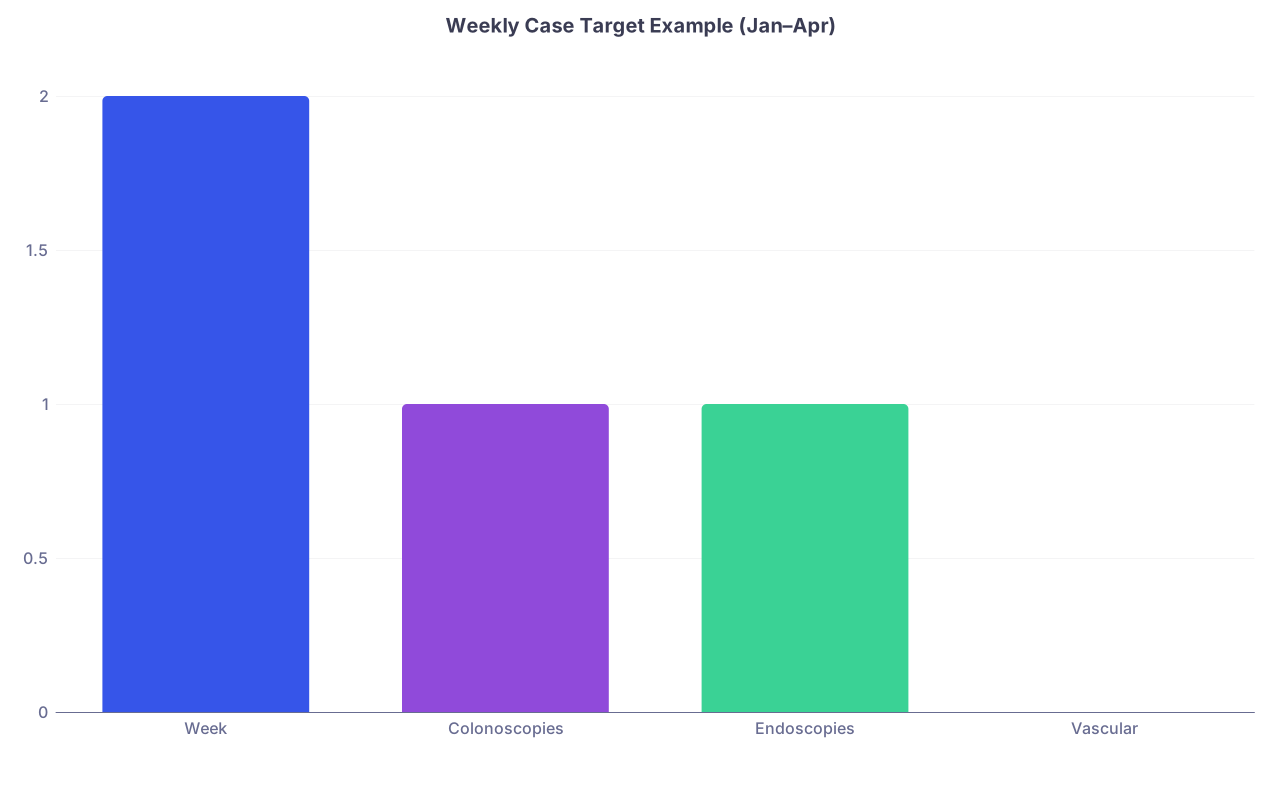
| Category | Value |
|---|---|
| Week | 2 |
| Colonoscopies | 1 |
| Endoscopies | 1 |
| Vascular | undefined |
You’re not begging. You’re planning.
February: Negotiate assignments like your career depends on it (because it does)
At this point you should:
- Know which juniors are hungry vs checked-out
- Know which attendings are case hoarders vs sharers
You start playing the game smart:
- When a big, rare case shows up (open AAA, big thoracic, unusual oncologic resection):
- Tell the chief/attending early: “This is a key gap for me; can I be on that case?”
- Trade strategically:
- Give your junior an extra lap appendectomy to secure your spot on the thoracotomy
- Offer to cover extra night float in exchange for an endoscopy half-day
I’ve seen seniors literally pick up an extra call shift to get invited to an attending’s block day. That’s how much it can matter.
March: The final hard push
At this point you should be:
- Running weekly full log reports
- Emailing yourself PDFs so you have a paper trail (and sanity check)
Anything still in the red in March? Treat it like an emergency:
- If you’re still significantly short in:
- Endoscopy: camp in endoscopy on any open time
- Vascular: show up early to vascular conferences and be visible; tell them your numbers
- Thoracic: same approach; be the person always ready, always on time, always prepped
If your program leadership isn’t responsive, loop in:
- Chief residents (legacy chiefs will tell you which levers to pull)
- Coordinator (they often know schedule flex points better than the PD)
April–May: Buffer, Clean-Up, and Future-Proofing
April: Buffer month
By now, your major numbers should be there or within striking distance. April is your insurance policy.
At this point you should:
- Have already confirmed you meet (or will meet) ABS minima by:
- Total major cases
- Key subspecialty categories
If you’re already solid:
- Shift focus to:
- Defensible documentation (accurate roles)
- Ensuring complex cases are correctly categorized
- Mentoring juniors while still getting primary role where it matters
If you’re still slightly short:
- Use April to:
- Aggressively pick up any relevant cases
- Avoid getting stuck in non-op roles unless absolutely mandatory
May: Final verification and log grooming
Before graduation you should:
Pull your final case log summary and:
- Check every category against ABS minimums
- Confirm primary/assistant balance makes sense
Spot-clean your entries:
- Combine accidentally duplicated procedures
- Fix obvious mis-categorizations (e.g., mis-logged thoracic as general)
- Ensure endoscopy cases are correctly labeled (EGD vs colonoscopy vs ERCP)
Sit down with:
- PD or APD
- Show them your final log and say:
“This is where my log stands. I’m comfortable with my experience in X/Y/Z, and I know I’m light in A/B. I plan to focus on that in fellowship/early practice.”
That level of awareness reassures them far more than raw numbers.
Week-by-Week: Running Your Senior Year Like a Case Project
Let’s zoom in. Here’s what your standard senior week should look like when you’re serious about filling logbook gaps.
Sunday Night: 15-Minute Planning Ritual
At this point each week you should:
- Open:
- Next week’s OR schedule
- Your latest case log summary (even if it’s a week old)
Ask three questions:
- Which of my weak categories have solid opportunities this week?
- Which days are non-negotiable OR/endoscopy for me?
- Where am I at risk of being pulled into low-yield tasks?
Then:
- E-mail or text key attendings:
- “I’m looking forward to Tuesday’s block; I’ll prep X case and be there early.”
- Coordinate with juniors:
- “You take Wednesday clinic; I’ll cover your post-op checks if you let me take the lap colectomy.”
Write down (yes, actually write) your weekly case targets on a sticky note at your desk:
- +3 major
- +2 scopes
- +1 vascular/thoracic (or whatever your gaps are)
Monday–Thursday: Daily Micro-Adjustments
Each day, before cases start, you should:
- Check the board for:
- Add-ons in your target categories
- Cancelled cases you can replace with something else
Then:
Talk to the charge nurse:
- “If there’s a case without a designated resident, please page me. Especially endoscopy/vascular today.”
Re-balance on the fly:
- If your key case is delayed 3 hours, don’t vanish to clinic. Stay physically present near the OR or endoscopy. People call on who they can see.
After cases (5-minute habit):
- Log all cases that day while details are fresh
- Glance at your sticky note targets:
- “I aimed for +2 scopes; I’ve only got 1. Need to find another by Thursday.”
You’re not obsessing. You’re just not lying to yourself about “Oh yeah, I’m sure I’m fine.”
Friday or Post-Call Day: End-of-Week Reality Check
By end of week you should:
- Know if you hit your micro-targets:
- Did you actually get the +2 scopes, +1 vascular, etc.?
If yes:
- Adjust next week’s targets upward slightly if you’re still below overall goals.
If no:
- Identify why:
- Cases cancelled?
- You got pulled to ward disasters?
- You just didn’t ask early enough?
Then plan one concrete behavioral change for the next week:
- “I will talk to charge nurse every morning before 7:15.”
- “I will email my gap numbers to my endoscopy attending Sunday night.”
Tiny improvements, repeated 10–12 weeks, change your final logbook.
Day-by-Day Mindset: How to Behave When You’re Behind
Senior year case planning isn’t just calendars and reports. It’s how you show up every single day.
At this point, especially if you’re behind, you should:
- Be early to any OR/endoscopy day. Attending sees: “This resident cares and is reliable.” That turns into invitations.
- Be over-prepared on cases you want:
- Know anatomy, steps, patient specifics cold
- Bring your own templated op notes, positioning plans, etc.
People hand over the knife to the one who’s ready, not the one with the saddest logbook.
When something cancels:
- Do not disappear to your call room and scroll your phone. You:
- Walk to endoscopy
- Ask the board if there are unassigned cases
- Check with another service for add-on opportunities
The residents who end up short at graduation are almost always the ones who went back to their room “while we wait” and never came back.
The Future-of-Medicine Twist: Logbook vs Real-World Readiness
One last thing. The ABS minima are not the ceiling. They’re the bare floor.
With more robotics, more endovascular, and more subspecialization, future attendings and employers are starting to look at:
- Bread-and-butter independence, not just counts
- Laparoscopic-to-open balance
- Comfort with endoscopy as a true operator, not someone who’s “seen a lot”
So you should use this senior-year timeline not just to “clear the bar,” but to:
- Overbuild where future practice demands it (endoscopy, laparoscopy, emergency general surgery)
- Accept and name where you’re light so you can address it in fellowship or early practice
You’re not gaming a spreadsheet. You’re building the only evidence you really have, on paper, that you’re ready to cut.


Quick Recap: What Actually Matters
Three points to walk away with:
- Audit early, not late. By July you should know your gaps cold and have negotiated schedule changes. Waiting until March is how people graduate short.
- Break big goals into weekly quotas. “I need 25 colonoscopies” becomes “I need 2 scopes per week for 12 weeks.” Then you guard those opportunities.
- Behave like the person who deserves the case. Show up early, be prepared, and ask clearly for what you need. The logbook follows the behavior, not the other way around.
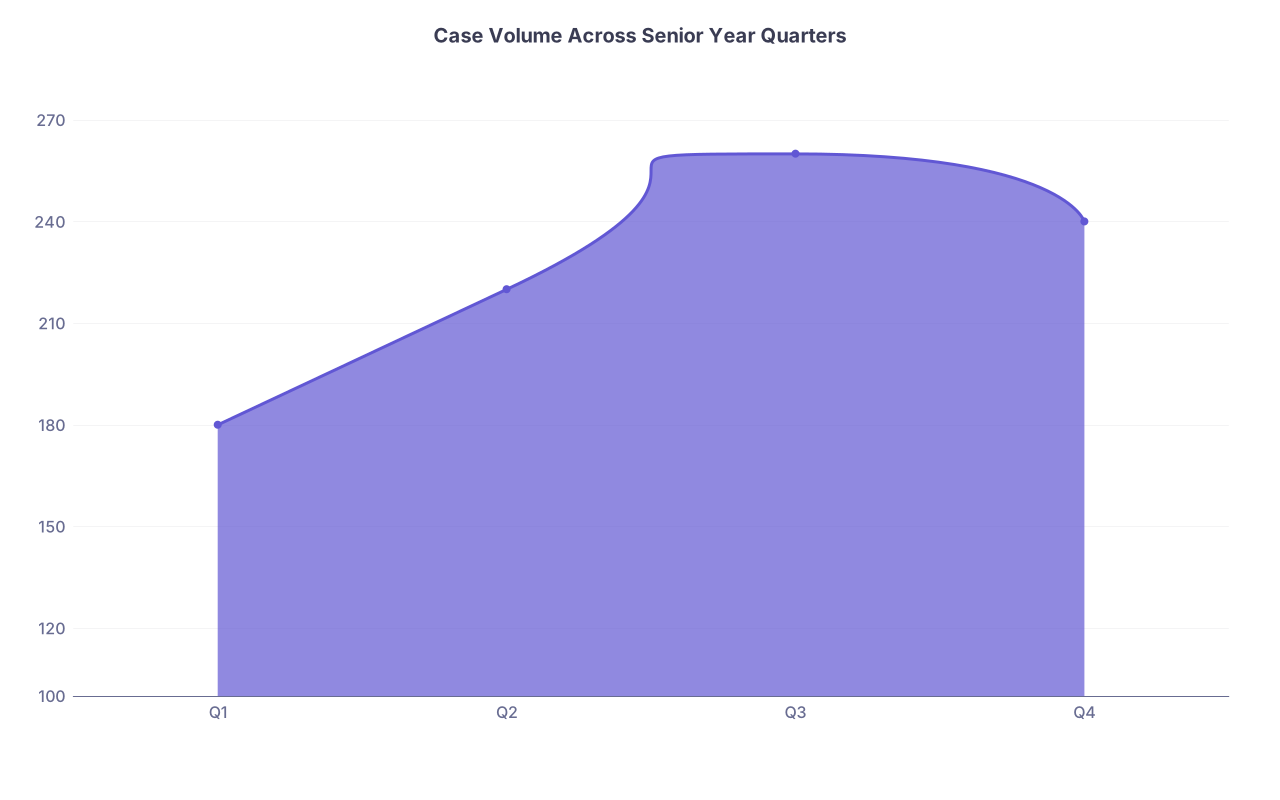
| Category | Value |
|---|---|
| Q1 | 180 |
| Q2 | 220 |
| Q3 | 260 |
| Q4 | 240 |