What if doing more cases in residency doesn’t actually make you more likely to pass your boards?
That’s the question nobody wants to ask out loud on a surgery service. Because the dogma is simple: more cases → better surgeon → higher board pass rate. Program directors use it. Applicants believe it. Residents cling to it as justification for 80-hour weeks.
The problem is: when you actually look for solid evidence that higher case volume in training improves board exam performance, the link is weak, inconsistent, or just not there.
Let’s unpack that.
The Core Myth: “High-Volume Programs Have Better Board Pass Rates”
In almost every surgical specialty, you’ll see some version of this sales pitch on program websites or from chiefs at pre-interview dinners:
“We have one of the highest case volumes in the region, which is why our board pass rates are excellent.”
Sounds good. Intuitive. Also largely unproven.
Here’s what the data actually shows when you separate procedural skill from written exam performance:
- Board exams (written and oral) test:
- Clinical reasoning
- Guideline-based management
- Pattern recognition
- Communication and safe decision-making
- Case volume in residency primarily builds:
- Technical skills
- Efficiency
- Comfort in the OR
- Team coordination
Do you need a minimum volume to be safe? Absolutely. Do you need more senior-level, graduated responsibility? Yes. But that’s a different question from: “Does more case volume linearly improve board pass rates?”
That correlation? Much weaker than most people think.
What the Evidence Actually Shows (Across Specialties)
Let’s be specific and not hand-wave here.
Across multiple specialties, when people have tried to correlate logged case volume with board exam outcomes, here’s the pattern:
- Minimal or no correlation between total logged cases and written board pass rates
- Weak or inconsistent correlation even for oral boards
- Stronger predictors of board performance:
- In-training exam (ITE) scores
- Didactic quality and structure
- Program-level culture of remediation and feedback
- Resident study behavior and discipline
You see this repeated in surgery, OB/GYN, orthopedics, anesthesia, and others. The story’s the same: technical exposure and exam success are related, but they’re not the same variable.
Here’s a simplified version of what often comes out of these analyses:
| Factor | Strength of Association with Board Pass Rates |
|---|---|
| In-training exam performance | Strong |
| Structured didactics / curriculum | Moderate to strong |
| Resident case volume (within typical ranges) | Weak / inconsistent |
| Program remediation systems | Moderate |
| Duty hour compliance | Mixed / weak |
That third row is the one that blows up the usual marketing pitch. Within the normal spread of cases that ACGME-compliant programs log, more does not automatically equal better board outcomes.
If you’re imagining a nice upward line—more cases, higher pass rates—the real scatterplot looks a lot messier.
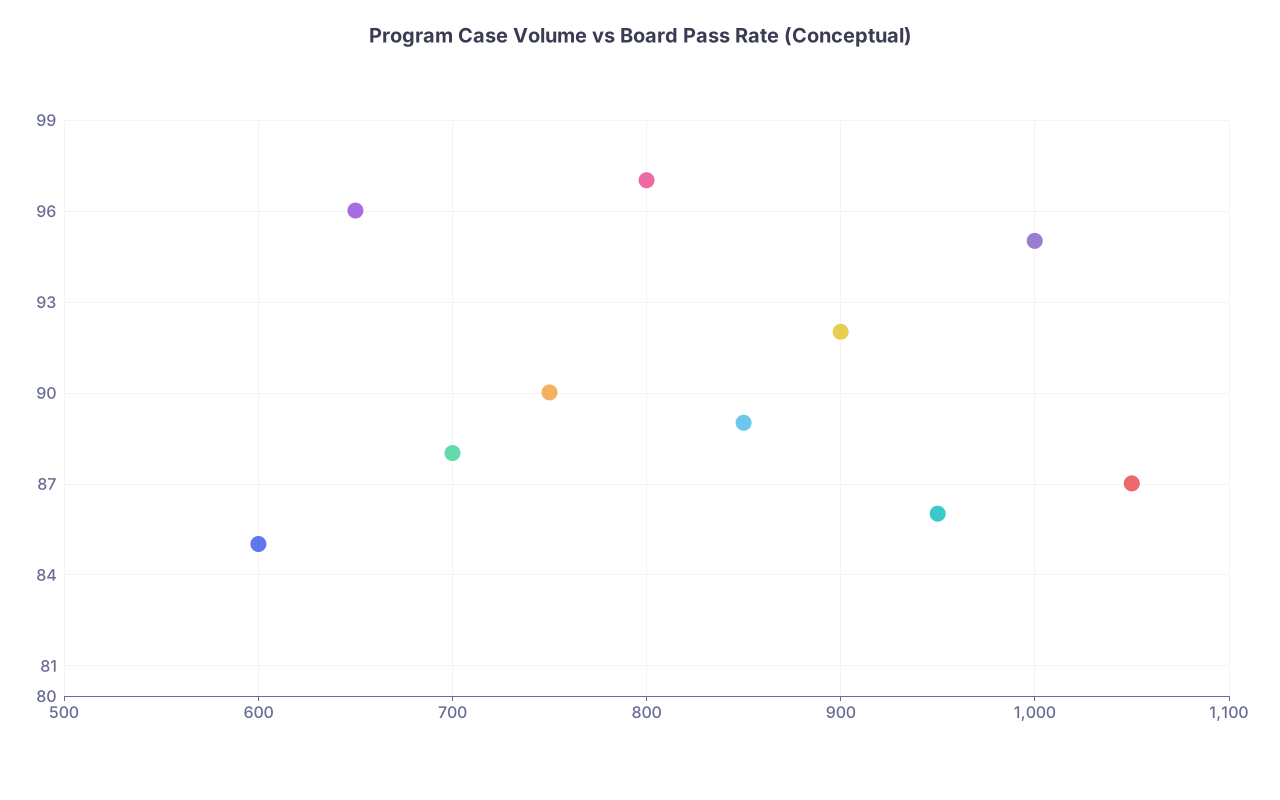
| Category | Value |
|---|---|
| Program 1 | 600,85 |
| Program 2 | 650,96 |
| Program 3 | 700,88 |
| Program 4 | 750,90 |
| Program 5 | 800,97 |
| Program 6 | 850,89 |
| Program 7 | 900,92 |
| Program 8 | 950,86 |
| Program 9 | 1000,95 |
| Program 10 | 1050,87 |
That’s the point: the spread is wide enough that “high volume” doesn’t guarantee “high pass rate,” and some mid-volume programs quietly beat the big names on exams.
Why Case Volume ≠ Knowledge
You intuitively know this if you’ve ever stood through your 10th lap chole in a week and retained exactly zero new facts.
Case volume helps you:
- Anticipate steps and complications
- Coordinate with anesthesia and staff
- Get comfortable under pressure
- Recognize real-world anatomy and pathology variance
But board exams hammer you on:
- Management of rare-but-testable conditions
- Guideline nuances
- Edge cases the board loves but your hospital almost never sees
- Details like “next best step,” not “how fast can you throw a knot”
You can do 900 appendectomies and still miss questions on the perioperative management of an obscure coagulopathy you’ve seen once. Your logbook doesn’t save you.
I’ve seen chiefs with monster case numbers go into oral boards and get shredded on fundamental principles they never sat down to systematically study, because they trusted the “my volume is my studying” fantasy. It isn’t.
And there’s a second problem: the case logs themselves are messy.
- Logging is inconsistent and sometimes… aspirational.
- Numbers don’t capture role (primary surgeon vs retracting vs watching from the corner).
- Numbers don’t capture teaching quality in the OR.
So we pretend a raw number equals experience, which equals knowledge, which equals board success. That’s three leaps of faith in a row.
What Actually Drives Board Pass Rates
Let me be blunt: if you care about passing boards, obsessing over a 10–20% difference in average case volume between programs is misplaced energy.
You should be looking at:
1. In-Training Exam (ITE) Culture
Not “do they take it,” but:
- Do they track scores by PGY and by resident?
- Do they meet with low performers early?
- Do they change rotations or reading plans based on results?
ITE scores are one of the strongest predictors of written board performance. Programs that pretend the ITE “doesn’t matter” often have mediocre board outcomes. Programs that treat ITEs as practice boards and aggressively intervene when residents slip usually do very well.
2. Didactics That Are Real, Not Cosmetic
There’s a huge difference between:
- A Thursday conference where attendings show one case and everyone zones out, and
- A structured, curriculum-mapped program that covers the exam blueprint over and over with expectations for prep and participation.
Ask residents honestly:
- “Do you actually learn for boards from conference?”
- “Does anyone quiz you or put you on the spot regularly?”
- “Does the program provide questions (e.g., SCORE, TrueLearn, UWorld) and protect time to use them?”
That’s exam fuel. Not whether the program did 900 vs 1100 lap cases last year.
3. Program Support for Exam Prep
Some programs basically say: “You’ll be fine, everyone passes eventually.” Translation: it’s on you.
Stronger programs:
- Track who fails the boards and actually change something.
- Provide review courses or pay for them.
- Pair struggling residents with faculty mentors specifically for exam prep.
- Normalize starting serious review early (PGY-3/4), not 3 months before graduation.
If a program’s 5-year board pass rate is hovering in the low 80s and nobody can tell you what they changed in response? That’s a red flag. And again, that’s not a case volume issue.
Where Case Volume Actually Does Matter
Now, do not misread this: case volume matters a ton for whether you feel like a competent surgeon on day one as attending. You absolutely can graduate too “light.”
Here is where volume is legitimately critical:
- Meeting and exceeding ACGME minimums in key index procedures
- Having enough repetition to develop fluid, safe technique
- Getting exposure to complexity—not just easy bread-and-butter cases
But even there, it’s not “more volume at all costs.” It’s:
- Are chiefs consistently performing the critical steps?
- Do juniors progress in autonomy each year?
- Are there bottlenecks where fellows cannibalize key cases?
You want enough volume and variety to get comfortable. You do not need to be in the absolute top percentile of national case numbers to pass boards. That assumption is just vanity dressed up as data.
The Hidden Cost of the “More Cases = Better Boards” Myth
The myth isn’t just wrong; it’s harmful.
Because it rationalizes:
- Overstuffed OR days where teaching gets thrown out the window because “we just need to get through the list.”
- Programs bragging about case totals while ignoring weak didactics and poor exam support.
- Residents burning out, thinking, “At least all this volume will guarantee I pass,” and then getting blindsided by marginal board performance.
Worse, it creates this false comfort:
“I’m at a high-volume place, so I don’t need to study as much. I’m learning in the OR.”
No. You’re building motor memory in the OR. Boards are testing conceptual schemas, guidelines, and decision trees. OR time is necessary but not sufficient.
Here’s the real balance:

| Step | Description |
|---|---|
| Step 1 | Residency Training |
| Step 2 | Clinical Cases |
| Step 3 | Structured Study |
| Step 4 | Exam Feedback |
| Step 5 | Technical Skill |
| Step 6 | Board Knowledge |
That dotted line? That’s the myth people keep trying to draw as a thick, solid arrow.
How You Should Actually Evaluate Programs (or Your Own Training)
If you’re choosing a residency, or you’re already in one and worried about boards, focus your energy on the variables that truly move the needle.
Ask these questions:
- What’s your 5-year rolling written and oral board pass rate?
- When someone fails, what specifically does the program do differently the next year?
- How seriously do you treat in-training exams? Is there real remediation?
- Do faculty regularly “pimp” on bread-and-butter board topics, or is it all case anecdotes?
- What structured resources are funded and encouraged? SCORE, TrueLearn, UWorld, courses?
Then—yes—confirm:
- Are your graduates meeting and exceeding ACGME case minima comfortably, not barely?
- Do seniors feel technically ready on day one as attendings?
But if you’re comparing two programs with similar pass rates and decent case exposure, and you’re obsessing because one averages 950 cases and the other 1100? You’re worrying about the wrong thing.
Here’s a cleaner way to think about it:
| Factor | Moderate Volume Program | Very High Volume Program |
|---|---|---|
| Case numbers vs ACGME | Adequate to strong | Very high |
| Teaching time in OR | Often better | Can be rushed |
| Protected didactic time | More likely respected | More likely sacrificed |
| Resident study bandwidth | Better | Often worse |
| Board pass rate advantage | Not consistently lower | Not consistently higher |
That last row is the punchline.
The Reality for the Future of Surgical Training
The future is moving away from the simplistic “count cases and declare victory” approach.
You’re seeing:
- Simulation-based assessments for basic technical skills
- Milestone-based evaluations of judgment, not just hands
- Entrustable professional activities (EPAs) that measure readiness across domains
- Better tracking of ITE, board performance, and targeted interventions
Case volume will remain a necessary foundation. It just will not be the main quality metric forever. Because when accrediting bodies and boards look at actual outcomes, the signal keeps coming from:
- Knowledge assessments
- Program educational structure
- Culture of accountability and feedback
Not brag sheets showing “Our residents average 1400 cases.”
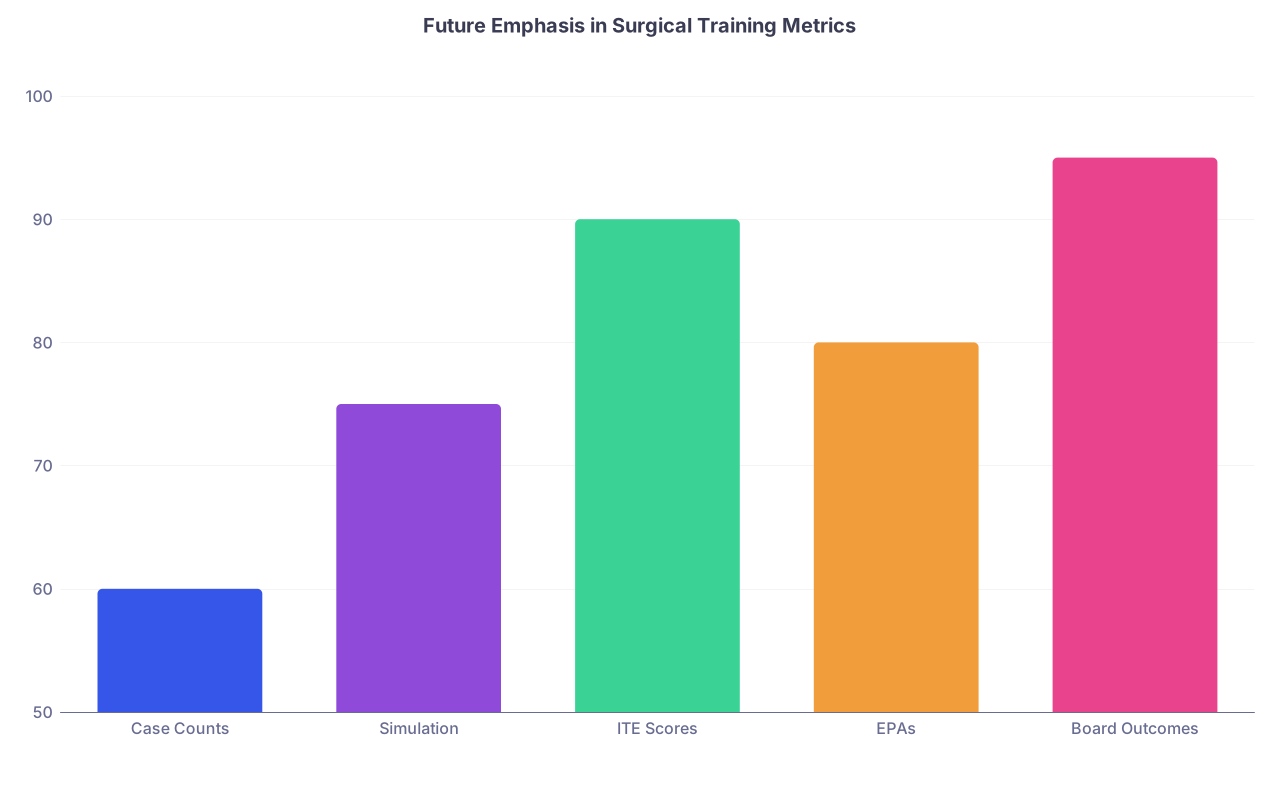
| Category | Value |
|---|---|
| Case Counts | 60 |
| Simulation | 75 |
| ITE Scores | 90 |
| EPAs | 80 |
| Board Outcomes | 95 |
That’s the direction the field is drifting: less blind worship of raw volume, more focus on provable competence.
If You’re a Resident Right Now
Here’s the uncomfortable truth: for your boards, your individual behavior will matter more than your program’s median case count.
If you want to actually pass the first time:
- Use ITEs as a serious diagnostic, not a hoop.
- Build a structured reading and question plan that is independent of your OR schedule.
- Treat board review as a PGY-3+ longitudinal project, not a PGY-5 panic sprint.
- Ask for feedback on your clinical reasoning, not just your suturing.
And if someone tries to reassure you with, “Don’t worry, we’re a high-volume shop, our residents always do fine,” be skeptical. Ask for the actual numbers. Over the last 5–10 years. Written and oral.
If they can’t give them to you, or they change the subject? That tells you more than their case logs ever will.