Understanding Case Volume in OB GYN Residency as a DO Graduate
For a DO graduate targeting an OB GYN residency, case volume is one of the most critical—and often misunderstood—factors in evaluating programs. Beyond brand name and location, what you actually do during four years of training will determine how competent and confident you are as an attending. That “what you do” is largely captured by case volume, surgical volume, and procedure numbers.
This article breaks down how to evaluate case volume in OB GYN residency programs specifically from the perspective of a DO graduate navigating the osteopathic residency match (now fully integrated into the NRMP Match) and competing alongside MD peers.
We’ll cover:
- What “good” case volume looks like in OB GYN
- How to interpret ACGME minimums vs. real-world expectations
- How DO graduates can assess and compare programs
- Red flags and green flags in surgical and obstetric exposure
- How to ask programs smart, targeted questions about volume
1. Why Case Volume Matters So Much in OB GYN
In obstetrics and gynecology, your comfort in the OR and on labor & delivery depends heavily on repetition. You will graduate into a specialty where:
- You manage emergencies (postpartum hemorrhage, shoulder dystocia, ruptured ectopic)
- You perform high‑risk, high‑stakes surgery (cesarean deliveries, hysterectomies, laparoscopic cases)
- You perform procedures that require fine motor skills and judgment developed only through hands‑on practice
Case Volume = Competence + Confidence
A high‑quality program doesn’t just meet minimums; it gives you:
- Breadth: A wide range of procedures—basic OB, complex OB, benign gynecology, gynecologic oncology, urogynecology, minimally invasive gynecologic surgery (MIGS), and reproductive endocrinology exposure.
- Depth: Enough repetitions that you’re not just “seeing” procedures, but driving them—first assist, then primary surgeon.
Surgical volume and procedure numbers matter because:
- OB GYN is a procedural and surgical specialty.
- Board certification and hospital privileging often assume that a graduating resident can independently perform core procedures safely.
- Fellowship applications (Gyn Onc, MFM, MIGS, REI) are strengthened by robust case logs.
For a DO graduate, demonstrating strong surgical training can also help counteract lingering misconceptions about osteopathic training quality, especially in historically MD‑dominant academic environments.
2. ACGME Minimums vs. Real-World Case Volume
What Do ACGME Minimums Actually Mean?
The ACGME sets minimum case numbers as a safety floor, not as a target. While specific numbers can change with updates, common categories include:
- Obstetrics:
- Spontaneous vaginal deliveries (SVDs)
- Operative vaginal deliveries (vacuum, forceps, if available)
- Cesarean deliveries (primary surgeon and assistant)
- Benign Gynecology:
- Hysterectomies (abdominal, vaginal, laparoscopic/robotic)
- Laparoscopic procedures (diagnostic laparoscopy, cystectomy, ectopic management, adnexal surgery)
- Dilatation and curettage (D&C), hysteroscopy
- Subspecialty exposures:
- Gynecologic oncology
- Urogynecology/pelvic floor surgery
- Family planning, including D&E procedures (depending on region/regulations)
The ACGME minimums are designed to ensure that no resident graduates with dangerously low exposure. However, most strong OB GYN residencies exceed these minimums comfortably.
Why “Just Meeting Minimums” Is Not Enough
When evaluating case logs or program claims, you want a program where graduating residents say things like:
- “I easily exceeded ACGME minimums.”
- “My surgical volume was strong enough that I felt ready for independent practice or fellowship.”
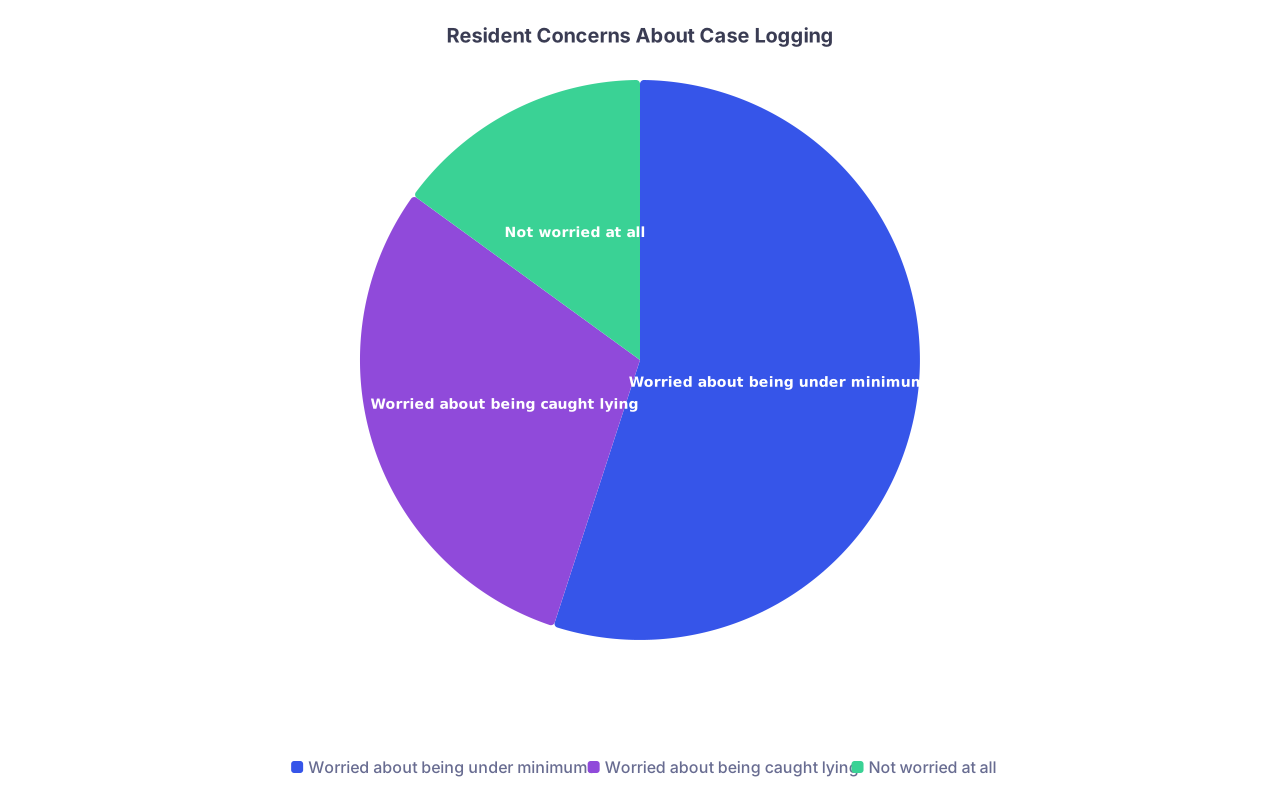
If residents’ case numbers are hovering barely above required minimums, that’s a red flag. It may reflect:
- Limited surgical opportunities
- Too many learners (residents, fellows, medical students) competing for the same cases
- Unbalanced service load (heavy scut or clinic with little OR time)
- Fragmented rotations with inadequate continuity
A strong OB GYN residency case volume should:
- Exceed ACGME minimums in every major category
- Offer steady exposure over four years, not just a single high‑volume rotation near the end
3. What “Good” Case Volume Looks Like in OB GYN
Every program is different, but there are patterns you can use to gauge whether a program’s obstetrics match and surgical training will truly prepare you.
A. Obstetric Volume: Deliveries and L&D Exposure
Ask or look for:
Annual delivery volume at the primary hospital(s):
- 2,000–3,000 births/year: Typically moderate volume
- 3,000–5,000 births/year: Strong volume
5,000 births/year: Very high volume
Resident involvement:
- Are residents primary on most uncomplicated deliveries?
- Are interns getting hands‑on SVDs from day one, or mostly “watching”?
- Is there competition with midwives or hospitalists that limits resident involvement?
You should clarify:
- Approx. number of SVDs per resident at graduation
- Approx. number of C‑sections as primary surgeon per resident
- Exposure to high‑risk OB: preeclampsia, hemorrhage, multiple gestation, VBAC, periviable deliveries
Strong programs often feature:
- Dedicated 24/7 resident coverage on L&D with graduated responsibility
- Clear attending support but real autonomy by PGY‑3/4 for routine C‑sections and complex deliveries
B. Gynecologic Surgical Volume
On the gynecology side, look at surgical volume and diversity:
Key procedures and questions:
Hysterectomy volume
- Vaginal, abdominal, laparoscopic, and robotic approaches
- Are residents primary on a reasonable number of each approach?
- Is one route over‑represented at the expense of others?
Minimally Invasive Surgery (MIS)
- Number of laparoscopic cases per resident
- Exposure to laparoscopic hysterectomy, salpingectomy, cystectomy, ectopic pregnancy management
- Access to robotic surgery:
- Do residents get console time, or only bedside assist?
- Formal robotic curriculum and certification?
Benign Gyn Procedures
- D&C, hysteroscopy, endometrial ablation, LEEP, vulvar procedures, tubal ligations
- Office procedures vs. OR-based procedures
Subspecialty Surgical Volume
- Gyn Onc: Debulking, radical hysterectomy, complex pelvic surgery
- Urogynecology: Sling procedures, prolapse repairs
- Family Planning: D&E volume, procedural abortion (where legally applicable)
You want a balanced surgical experience: strong benign gyn (since that’s most of general practice) plus meaningful exposure to subspecialty cases.
C. Resident Case Logs: How to Interpret Them
Some programs will share de-identified case logs or summary statistics for graduates. When reviewing:
- Look for consistency across residents in the same class.
- If one resident has robust numbers and another is barely meeting minimums, ask why.
- Compare across categories:
- Great hysterectomy numbers but very low C‑section numbers (or vice versa) may indicate an unbalanced program.
- Ask: “Do most residents exceed ACGME minimums by a comfortable margin?”
If the answer is hesitant or vague, that’s informative.
4. Specific Considerations for DO Graduates in the OB GYN Match
As a DO graduate in the now‑single NRMP Match, you are competing head‑to‑head with MD applicants for both community and academic OB GYN positions. Case volume evaluation is even more important for you because:
You may be particularly interested in:
- Programs with a history of training DOs (formally osteopathic or DO‑inclusive)
- Environments where DOs thrive in procedural specialties
You may carry:
- A desire to prove your surgical readiness equal to any MD graduate
- Interest in maintaining osteopathic principles (e.g., OMT) even in a surgical field
A. Former Osteopathic vs. Historically Allopathic Programs
Historically osteopathic OB GYN residencies (pre‑merger) often had:
- Strong autonomy and hands‑on learning
- High surgical volume, especially in community settings
- Less competition with fellows
Historically allopathic academic centers sometimes emphasize:
- Subspecialty exposure
- Research and fellowship pathways
- Presence of fellows—which can impact resident primary operator opportunities
As a DO applicant, neither is inherently better. But you should specifically ask:
In former osteopathic programs:
- “Have case volumes or autonomy changed since ACGME transition?”
- “Do fellows now participate, and if so, how are cases divided?”
In historically allopathic programs:
- “What percentage of current residents are DOs?”
- “How do DO graduates perform on boards and in fellowship placement?”
- “Do DO residents report any difference in opportunities or support?”
Well‑integrated programs can offer excellent case volume and inclusive culture for DO residents.
B. Board Exams and Case Volume
Board eligibility and performance link closely to case exposure:
- Strong OB case numbers help on oral boards and clinical decision‑making.
- Robust surgical volume supports confidence during MOC (maintenance of certification) and early attending years.
When residents do not get sufficient case volume, they may:
- Seek extra fellowship just to feel “ready”
- Struggle with real‑world, unsupervised practice early on
Ask programs directly:
- “How prepared did recent DO graduates feel for practice?”
- “Did anyone need to seek additional training purely because of low surgical volume?”

5. How to Evaluate Case Volume When Researching Programs
You won’t always see raw numbers on a website. But you can systematically assess residency case volume and procedure numbers using multiple sources.
A. Before You Apply: Pre-Interview Research
Program Websites & ACGME Data
- Look for:
- Number of hospital sites
- Whether the program is community, academic, or hybrid
- Annual delivery numbers if posted
- A large, busy hospital or multi-hospital system often correlates with stronger procedural exposure.
- Look for:
Resident Testimonials & Alumni Outcomes
- Do graduates:
- Enter general practice comfortably?
- Match into competitive fellowships (Gyn Onc, MFM, MIGS, Urogyn)?
- Alumni in competitive fellowships often reflects robust case and operative experience.
- Do graduates:
Social Media & Program Showcases
- Some programs highlight:
- Robotic training
- MIGS curriculum
- “Simulation to OR” pathways
- Some programs highlight:
This can give you a feel for how much they value surgical training, not just service.
B. During Interview Season: Questions to Ask About Case Volume
You should come to each interview with targeted, concrete questions. Ask these of both faculty and residents:
For Residents:
- “By PGY‑2, how independent do you feel with routine C‑sections?”
- “Do you feel you get enough OR time in gyn, or is it hard to get your numbers?”
- “Do residents ever compete with fellows or senior residents for key cases?”
- “Are there any rotations where you feel underutilized or more like a scut worker than a learner?”
For Program Leadership:
- “How do your graduates’ case logs typically compare to ACGME minimums?”
- “Can you describe how surgical cases are distributed between residents and fellows?”
- “Do any residents struggle to meet minimums in specific categories, and if so, how do you address that?”
- “How has your surgical or obstetric volume changed over the last 5 years?”
Pay attention to:
- Consistency between resident and program director answers
- Comfort level of residents when discussing autonomy and case opportunities
C. Evaluating Autonomy Alongside Numbers
Case volume alone doesn’t tell the full story. You also need meaningful participation:
- Are you first assist or primary surgeon, or mostly “holding retractors”?
- Do you get to close fascia and skin early in training?
- By PGY‑3/4, are you:
- Operating primary on multi‑port laparoscopy and abdominal hysterectomies?
- Managing labor progress and C‑section decisions with appropriate attending oversight?
Ask residents:
- “Do you feel the attending steps in too early, or allows you to work through the case safely?”
- “What was the first major surgery you performed primarily, and when?”
Programs that trust their residents while maintaining safety standards tend to produce stronger surgeons and clinicians.
6. Red Flags and Green Flags in OB GYN Case Volume
As you compare programs, keep an eye on patterns.
Red Flags
- No concrete data: Program leadership avoids answering direct questions about case numbers.
- Residents expressing concern:
- “We’re not sure if we’ll hit our laparoscopic numbers.”
- “There’s a lot of competition with fellows for oncology and MIS cases.”
- Single high‑volume hospital with many learners:
- Multiple residency programs sharing the same ORs and L&D
- Large numbers of fellows with unclear division of cases
- Heavy off‑service or non‑operative rotations:
- Long stretches in ICU, ED, or off‑specialty without clear benefit
- Unstable volume trends:
- Recent loss of key faculty or service lines (e.g., closing L&D units, losing gyn onc).
Green Flags
- Clear, confident answers to questions about:
- Delivery numbers
- Hysterectomy and laparoscopy exposure
- Graduates easily exceeding ACGME minimums
- Residents speaking positively and consistently:
- “We operate a lot.”
- “I feel very comfortable doing C‑sections and basic gyn cases now.”
- Strong surgical curriculum:
- SIM labs, suturing, laparoscopic trainers
- Formal robotic training pathway
- Balanced autonomy:
- Structured progression from junior assistant to primary surgeon
- Attendings who supervise but allow residents to perform key steps
7. Strategic Advice: Matching Your Goals to Case Volume
Different DO graduates may have different priorities. Your evaluation of OB GYN residency case volume should align with your career goals.
If You Want General OB GYN Practice
Prioritize programs where:
- Residents graduate with high numbers of SVDs and C‑sections
- Gyn experience includes:
- Abdominal and laparoscopic hysterectomies
- Common benign gynecologic surgeries and office procedures
- Graduates routinely enter practice without extra fellowship and report feeling ready
Ask specifically:
- “Where do most of your graduates practice?”
- “Do any recent grads feel under‑prepared in either OB or gyn surgery?”
If You’re Aiming for Fellowship (MFM, Gyn Onc, MIGS, Urogyn)
You’ll want:
- Strong subspecialty exposure and research opportunities
- Enough surgical volume to make you comfortable and attractive to fellowships
Ask:
- “What is your fellowship match like over the past 5 years?”
- “How are residents involved in complex cases with Gyn Onc or MFM?”
- “Do fellows enhance or limit resident case volume?”
If You Value Osteopathic Identity and Training Environment
As a DO graduate, you may prefer programs that:
- Have DO representation in the resident and faculty group
- Emphasize hands‑on, patient‑centered care
- Are open to integrating OMT where appropriate (even if only for patient comfort, back pain in pregnancy, etc.)
But even in the most osteopathically friendly program, do not compromise on:
- Adequate surgical volume
- Robust obstetric exposure
- Supportive environment for board prep and career planning
FAQs: Case Volume Evaluation for DO Graduates in OB GYN
1. What is considered a “good” surgical volume for an OB GYN residency?
Numbers vary by institution and ACGME era, but a strong program usually has graduates who:
- Comfortably exceed ACGME minimums in all categories
- Perform a large number of C‑sections as primary surgeon
- Have solid experience in:
- Abdominal, vaginal, and laparoscopic hysterectomies
- Common benign gyn procedures (D&C, hysteroscopy, hysteroscopic polypectomy/myomectomy, etc.)
- Report feeling confident to perform routine OB and gyn surgeries independently right after graduation
You should be most reassured by resident testimonials and consistent, above-minimum case logs, rather than any single numeric threshold.
2. As a DO graduate, should I prioritize former osteopathic programs to get better case volume?
Not necessarily. Many historically osteopathic programs do have strong surgical volume and autonomy, but:
- Some historically allopathic academic centers offer excellent case volume, especially in complex cases.
- The key is not the label, but:
- Actual case logs
- Resident satisfaction with surgical exposure
- Support for DO residents (e.g., prior DO graduates, inclusive culture)
You should evaluate each program individually based on case volume, training philosophy, and fit, rather than relying solely on pre‑merger labels.
3. How can I objectively compare residency case volume if programs don’t share exact numbers?
Use a combination of:
- Delivery numbers and surgical focus on the website
- Direct questions during interviews about:
- Typical C‑section and hysterectomy counts
- Laparoscopic/robotic exposure
- Percentage of residents easily exceeding minimums
- Resident feedback:
- Ask multiple residents at different PGY levels about autonomy and OR time
- Graduate outcomes:
- Strong fellowship matches and confident generalists are indirect but useful indicators of good case volume and training quality
While you may not get perfect comparability, consistent patterns in answers and resident experiences will allow you to form a reasonably accurate picture.
4. Can a lower-volume program still be a good fit for me?
Possibly, depending on your goals. A somewhat lower-volume program may still be acceptable if:
- You’re committed to a specific geographic area or personal situation
- The program offers excellent teaching, faculty accessibility, and strong clinical judgment training
- You’re proactive in seeking extra opportunities (electives, additional OR days, away rotations, or eventual fellowship)
However, you should be cautious if:
- Residents struggle to meet ACGME minimums
- Graduates routinely feel under‑prepared
- There’s limited ability for you to increase your surgical volume through electives or extra time in the OR
Even for a DO graduate prioritizing work‑life balance or location, do not ignore clear red flags in residency case volume or surgical exposure.
By approaching the OB GYN residency search with a structured focus on case volume, surgical volume, and procedure numbers, you as a DO graduate can identify programs that will not only match you successfully, but also prepare you to thrive as a confident, skilled obstetrician-gynecologist.