
It’s July 1. You just started your “protected” research year. Your badge still says PGY-3 in General Surgery, but your day looks nothing like last year. No 5 a.m. rounds. No pager meltdown at 6:30. No scramble to the OR.
Instead: quiet office, REDCap open, Outlook calendar full of “Zoom: Lab Meeting” and “Biostatistics Consult.” Your hands haven’t been in a belly in weeks.
And in the back of your mind there’s this gnawing thought: when I go back to clinical, am I going to be slow? Rusty? Behind my co-residents in operative volume and judgment?
You are not wrong to worry. I’ve watched residents come back from a heavy research year and absolutely crash into a surgical volume cliff. They’re suddenly the “slow chief,” the one quietly skipped for cases because faculty do not trust their tempo or decision-making anymore. It is painful to watch and even worse to live.
The good news: you do not have to let that happen. But you cannot be passive. If you just “see what happens,” you will lose ground. A heavy research year in residency is survivable — and can even be a career accelerant — if you treat it like another rotation that needs an explicit plan for skill maintenance.
Let’s build that plan.
Step 1: Be Honest About Your Risk Profile
Before you start making schedules and deals, you need a realistic sense of where you stand.
Ask yourself three blunt questions:
- What is my current operative baseline?
- What will I lose fastest if I step away?
- What do I need to look like when I return?
If you’re a gen surg PGY-3 going into lab after a solid junior year—few hundred cases, lots of bread-and-butter lap choles, appys, hernias—you have something to protect. If you’re at 120 cases and struggled for reps because of service volume or co-residents, you do not have “extra” to lose; you’re already behind.
Take 30–45 minutes and do this now:
- Log into ACGME case log or your program’s tracking system.
- Export your numbers by category.
- Look at your last 6 months separately from “all time.” That’s your real current speed/comfort zone.
| Category | Total Cases | Last 6 Months |
|---|---|---|
| Basic laparoscopy | 75 | 40 |
| Hernia | 40 | 20 |
| Bowel resection | 25 | 10 |
| Endoscopy | 35 | 25 |
| Major cases (index) | 15 | 8 |
If your “last 6 months” looks thin, your priority during research year is not just maintenance. It’s actually catching up with deliberate practice.
Then, identify what decays fastest:
- Speed and flow in the OR
- Spatial/3D visualization (laparoscopic/robotic)
- Endoscopy feel and torque control
- Pre-op and post-op judgment — triage, when to operate, and when not to
- Situational awareness in a busy clinical environment
Motor memory comes back faster than judgment and pattern recognition. People worry about “my hands will be rusty.” That’s real but fixable. What burns you as a senior is poor judgment and slow, fragmented thinking.
Write down, literally on a note in your workspace:
“When I return, I need to be: [X] level in [Y] skills.”
For example: “Takes 45 minutes skin-to-skin on straightforward lap chole, independently able to do basic open hernia and endoscopy, comfortable running a busy consult service.”
That becomes your target.
Step 2: Negotiate Your Research Year Like a Rotation, Not a Vacation
The way you set expectations before or at the start of your research year will determine how much latitude you have to maintain clinical time.
Most people screw this up. They say “I’ll just see what my PI wants” and end up chained to a bench or office 60 hours a week, too exhausted to even think about cases.
Instead, you need a concrete framework and you present it professionally.
Have this conversation early
Sit down with:
- Your PD or APD in charge of research residents
- Your research mentor / PI
You say something like:
“I want to be very productive academically this year. I’m also nervous about losing operative and clinical skills during a full research year. My goal is to publish A, B, C and also return as a strong mid-level or senior resident who can function safely in the OR from day one. Here’s the structure I’m proposing…”
Then you lay out something like this:
| Component | Time Allocation |
|---|---|
| Research (desk/lab) | 35–45 hrs |
| OR/clinic sessions | 1–2 half-days |
| Simulation/skills | 2–3 hrs |
| Reading/education | 2–3 hrs |
Most reasonable PDs will be receptive if you frame it as patient safety and long-term training quality, not “I miss the OR.”
Make it easy for them to say yes:
- Suggest specific services: “I’d like to be in the OR on Tuesdays with the acute care surgery team” or “endoscopy lab on Friday mornings.”
- Commit to being low maintenance: “I won’t take call, I’ll scrub elective cases only, and I’ll stay within duty hours.”
- Clarify expectations with your PI: “I’ll be in lab/office every day by 9:30 a.m. after morning cases. I’ll stay late those days if needed.”
Document the agreement in an email. People have selective memory around workload.
Step 3: Build a Deliberate Clinical Maintenance Plan
“Scrub when it’s convenient” is not a plan. You need a structured, repeatable pattern.
1–2 regular half-days in the OR or clinic
Pick one of these set-ups and stick with it:
- Option A: OR anchored – Example: Tuesday and Thursday mornings are OR time. You scrub on a high-yield service (ACS, colorectal, MIS, whatever matches your track).
- Option B: Endoscopy + one OR session – One half-day weekly in endoscopy, one half-day in general OR.
- Option C: Clinic + targeted OR – One clinic half-day in your intended fellowship area (e.g., surg onc clinic), plus a flex OR half-day when high-yield cases are scheduled.
The point is repetition. Same attendings, same environment. They start expecting you. You’re not a random extra body; you’re the “research resident who still shows up.”
How much is “enough”?
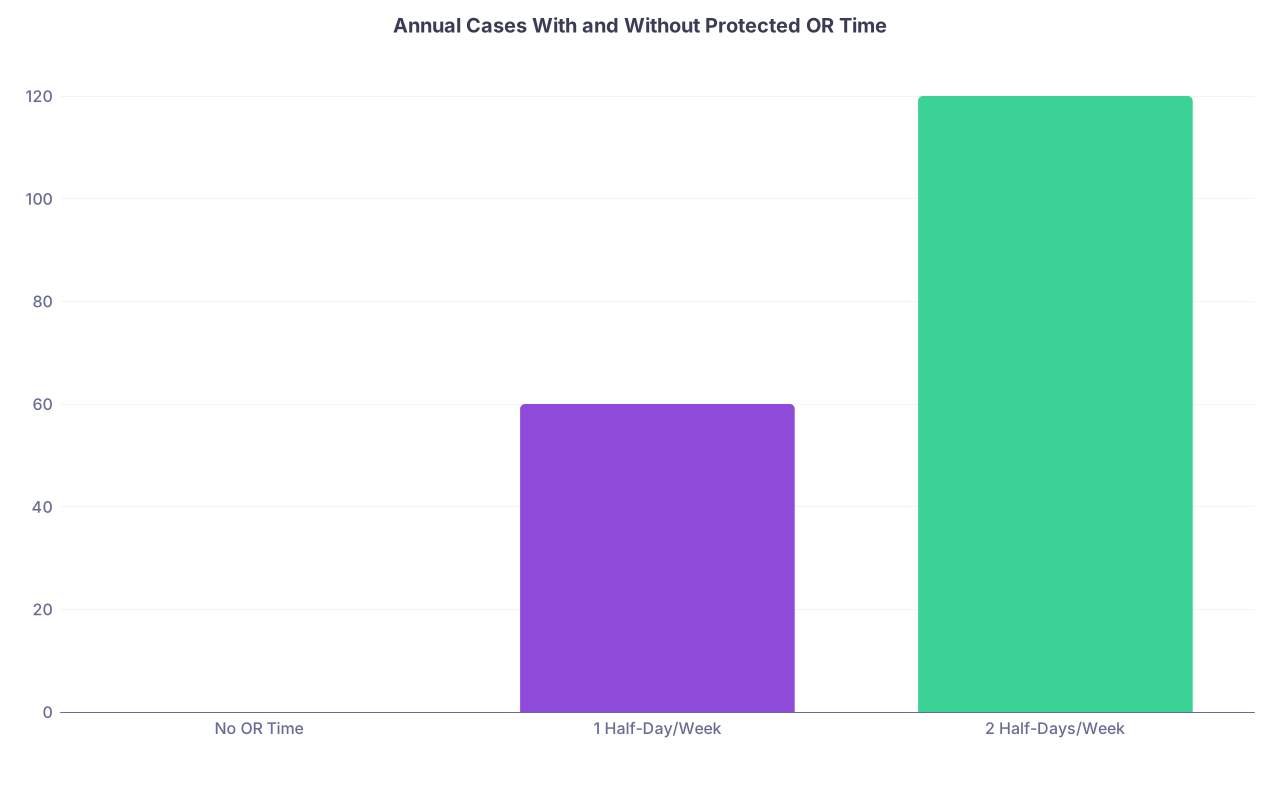
Is this as good as full-time clinical? Of course not. But a consistent 1–2 half-days/week can blunt the volume cliff dramatically.
Think of it this way:
| Category | Value |
|---|---|
| No OR Time | 0 |
| 1 Half-Day/Week | 60 |
| 2 Half-Days/Week | 120 |
Rough, yes. But 60–120 focused cases over a year is a huge difference from zero.
Prioritize:
- Laparoscopy/robotic time
- Endoscopy (if your field uses it)
- Bread-and-butter: choles, appys, hernias, bowel, ports
Ask explicitly for roles: “Can I be the primary on the next lap chole?” Don’t just stand there retracting.
Step 4: Use Simulation Like an Adult, Not a Checkbox
Most residents treat skills lab like a toy room. They wander in three times a year, do 10 minutes of suturing, snap some photos, leave. That’s useless.
You should treat sim time as your “OR when there is no OR.”
Set a bare-minimum weekly standard
Two realistic commitments:
- 30–60 minutes once during the week
- Optional bonus session on weekends when work is lighter
Structure matters. Do not show up and “do whatever.” Create a rotation of focused goals:
Week 1: Basic laparoscopy – peg transfer, pattern cutting, intracorporeal knot tying
Week 2: Advanced lap – suturing a simulated enterotomy or anastomosis
Week 3: Open skills – speed knot tying, vascular anastomosis on a model
Week 4: Stapler familiarity, stapled bowel anastomosis simulation
Then cycle.
Track metrics. Yes, like an athlete.
Time yourself:
- How long to place four intracorporeal knots?
- How long to complete a simulated two-layer bowel anastomosis?
- Error rate: number of dropped needles, torn tissue, misplaced bites.
Write your times on a whiteboard in the lab or in a simple note. If your next time is worse, don’t hand-wave it; ask why. Fatigue? Distraction? Technique issue?
If your program has VR lap trainers or robot simulators, treat them like scheduled cases: “Friday 4–5 p.m., robot sim: suturing and knot module.”
Step 5: Stay Mentally Inside the OR Even When You’re at a Desk
One of the worst hits during a research year is cognitive. You stop thinking like a surgeon because you’re thinking like a data analyst, coder, or bench scientist all day.
You can’t change that reality. But you can layer surgical thinking back into your week.
Read like you have a case tomorrow
Pick one high-yield area per month. Example plan:
- Month 1: Appendicitis and cholecystitis
- Month 2: Small bowel obstruction and perforated ulcers
- Month 3: Hernias and abdominal wall reconstruction
- Month 4: Colorectal cancer and diverticulitis
Then:
- Read 1–2 key review papers or guideline articles per week.
- Use actual operative reports (your old cases) and walk through them with the reading.
Ask yourself:
- “If this patient came into my ER tonight, what would I do? What labs, imaging, and why?”
- “At what point would I call the attending? What’s my default operative plan?”
You are rehearsing judgment.
Case videos and mental rehearsal
End of the day, you have 30–45 minutes you’d usually pour into Instagram or YouTube nonsense. Swap half of that for structured video review:
- Laparoscopic cholecystectomy, your attending’s videos if available, or well-vetted society sources.
- Watch once at normal speed, then again with pausing:
- Where is the critical view obtained?
- Where are the danger zones?
- What’s the bailout move?
You talk yourself through: “If I were holding the camera, I’d…” or “Right here I’d switch to a 30-degree scope.”
Mental rehearsal is real practice. Not equivalent to cutting, but far from zero.
Step 6: Protect Your Reputation While You’re “Out”
Here’s what nobody tells you: during your research year, attendings and co-residents are still forming opinions about you.
Are you the resident who disappeared, never shows up to conference, and ghosts the OR? Or are you the one who somehow attends M&M, gives a killer journal club talk, and still shows up scrubbed for a few tough cases?
Your reputation determines how much rope you get when you return clinically. That’s not fair, but it’s true.
At minimum, do this:
- Attend departmental conferences as if you were on service:
- Grand rounds
- M&M
- Resident teaching conferences
- Volunteer once or twice to present:
- M&M presenter
- Journal club on a topic related to your research
- Stay present in group chats:
- Don’t be that person who only resurfaces when they need vacation coverage
When you regularly show up, people mentally still see you as “one of us,” not “that research person who left.” That matters when they’re assigning complex cases 6–12 months from now.
Step 7: Six Months Before You Return — Switch Gears
The most dangerous part of the research year is not month 1. It’s months 10–12, when you are fully adapted to lab/office life and slightly dreading the chaos of the wards.
You cannot wait until your first day back in July to “gear up.”
Build a 6-month ramp
Use a simple mental model:
- Months –12 to –7: Heavy research focus, minimal but consistent clinical/sim time
- Months –6 to –3: Dual focus — research + increased clinical exposure
- Months –3 to 0: Clinical re-entry mode
Concretely:
Months –6 to –3:
- Increase OR/clinic to 2 predictable half-days/week if possible
- Do 1–2 full weekend call shifts as a supernumerary (depending on rules)
Ask: “Can I come in as an extra set of hands on ACS this Saturday? I’m not in the call pool.” - Start reading call-heavy topics:
- Bowel ischemia
- Trauma
- Post-op complications
Months –3 to 0:
- Meet with your PD and chief residents:
- “I’m back on service July 1. I’d like to hit the ground running. Any specific areas you’d like me to brush up on?”
- Do back-to-back full days in the OR when possible:
- Think of them as simulation for “intern/PGY-3 brain”
- Adjust your schedule:
- Wake up earlier.
- Reset your brain to ward timelines, not academic ones.
If your first week back is a shock to your system, fine. If it’s a complete blindside, you did not plan correctly.
Step 8: If You’re Forced Into Zero Clinical Time
Some programs or PIs truly shut down the idea of clinical work during research. “You’re here to do science, not scrub.”
Annoying. But not game over.
Your job then is to squeeze every drop of benefit from simulation, reading, and mental practice — and then front-load your return.
Here’s your minimum viable survival plan in a “pure research” year:
- 1–2 hours/week in sim lab, non-negotiable, on your own time
- Weekly:
- 1 surgical textbook chapter
- 1 operative technique video
- Monthly:
- One “call scenario” self-drill session:
- Make a list of 5 common consults (e.g., suspected appendicitis, SBO, GI bleed, post-op fever, gallstone pancreatitis)
- For each: work through history, exam, labs, imaging, plan — write it out or talk it through with co-resident
- One “call scenario” self-drill session:
Six weeks before you go back to clinical, take vacation or lighter research weeks and ask your PD explicitly to come in as supernumerary for:
- 3–4 days of inpatient service time
- 3–4 OR days
You will still be rusty. But you won’t be clueless.
Step 9: Handle the First 4–6 Weeks Back Clinically
Despite your best work, the first month back will feel rough. Your pager tolerance is down. Your brain is slower at juggling multiple patients. You feel behind your co-residents in flow.
This is where people panic and make it worse by hiding from hard stuff. Do the opposite.
Be honest, but not self-sabotaging
When you’re back in the OR with an attending who hasn’t worked with you in a year, say something like:
“I’m just coming back from my research year. I’ve been in the OR once or twice a week but not full-time. I’d really appreciate some feedback on my pace and technique as we go.”
This frames things correctly:
- You weren’t on vacation.
- You have been doing something clinically.
- You’re actively asking for coaching, not pretending you’re fine.
Pick your battles
You don’t need to be a hero in week 1.
- Focus on:
- Doing basics flawlessly: positioning, prepping, draping, exposure
- Being highly organized on rounds and notes
- Then start actively asking for cases:
- “If there’s an extra appendectomy or chole this afternoon, could I take it?”
Don’t turn down cases. Even if it means a later day. This is the re-entry tax.
Step 10: Use the Research Year Strategically for Your Surgical Future
Last piece: a heavy research year can actually help your surgical volume long-term if you align it with your clinical identity.
Examples:
You want MIS/foregut:
Do outcomes work in bariatric surgery, functional studies of reflux, or simulation research in laparoscopy. Attend the MIS conferences, scrub whenever your bariatric attendings operate.You want surg onc:
Get involved in trials or database work in colorectal, HPB, endocrine. Show up on those services regularly as the research liaison. You become “the colorectal research resident” who also scrubs their big rectal cancers.
Your name starts to circulate in those circles. When you come back as a senior, those attendings often send more complex, interesting cases your way because they see you as invested, not just rotating through.
Two Quick Reality Checks
You will lose something. That’s fine. There is no version of this where you take a whole year “off” from full-time clinical work and come back unchanged. The goal is not perfection; it’s avoiding a catastrophic cliff.
This is your responsibility. PDs, PIs, and co-residents have their own fires to put out. No one is going to design this plan for you. If you take ownership now, you’ll thank yourself every single call night as a senior.
Key Takeaways
- Treat your research year like a rotation that requires an explicit clinical maintenance plan: negotiate 1–2 predictable OR/clinic half-days per week, plus regular simulation.
- Six months before returning, ramp up clinical exposure and mental rehearsal so re-entry is a tough transition, not a blind crash.
- Protect your reputation and your future case volume by staying visible: conferences, OR presence, and focused work aligned with your eventual surgical niche.