
The way people talk about case volume in fellowship letters and phone calls is sanitized. The way program directors actually think about it is not.
You keep hearing, “quality over quantity,” “numbers don’t matter that much,” and “we look at the whole applicant.” That sounds nice on a panel. In a closed-door ranking meeting or a quiet back-channel phone call? Case volume is dissected, weaponized, and—sometimes—completely ignored when it suits the narrative.
Let me walk you through what really happens.
What Case Volume Really Signals To Fellowship Programs
On paper, “case volume” is the number of cases in your log or the tally your letter writer mentions. In reality, directors read it as a proxy for three things:
- Exposure
- Trust
- Trajectory
Not manual dexterity. Not surgical genius. Those come later, if at all.
When an attending writes, “She has performed over 300 cataract cases as primary surgeon,” that number is being reverse-engineered in a director’s head:
- What kind of program gives a resident that much volume?
- How early did they trust her as primary?
- What did they not write alongside that number?
If I see a PGY-5 general surgery resident with 1,200–1,400 total cases, I’m not impressed by the raw count alone. That’s expected at a half-decent program. What I care about:
How many were complex index cases in the subspecialty they’re applying to, and what does the letter writer say about their progression?
You know what a surgical fellowship PD really thinks when he sees low volume? He doesn’t immediately think “bad hands.” He thinks:
- Late autonomy
- Risk-averse faculty
- Possibly soft remediation
- Or a resident who always stood on the sidelines
Nobody will say this on a webinar. They absolutely say it on the phone.
The Game: Case Logs vs. What Gets Written
Here’s the uncomfortable truth: the official logs and the narrative in letters/phone calls often do not match. And everyone involved knows it.
Programs know logs are messy:
- Residents over-claim primary when they were “skin to skin… plus half the closure.”
- Some faculty are notorious for never logging.
- Certain rotations inflate numbers (every hernia is “complex,” every colon is “challenging”).
So fellowship PDs look for internal consistency:
Do the numbers in your log match the way your letter writer talks about you?
| Signal Type | What They Look For |
|---|---|
| Raw case numbers | Within expected range or an outlier |
| Complexity mix | Alignment with fellowship focus |
| Trend over time | Early vs late autonomy |
| Letter language | Matches or contradicts the log |
| Phone call comments | Confirms or rewrites the narrative |
Here’s how it plays out:
You’re an ortho resident applying for sports. Your log shows:
- High total volume
- But relatively few complex shoulder arthroscopy cases
Your letter from the sports attending says, “By the end of the rotation, she was independently performing standard ACL reconstructions and was primary on complex shoulder cases with appropriate supervision.”
On paper, that smooths over the low shoulder numbers. In reality, the PD at a busy sports fellowship will think:
- So the log doesn’t show shoulders, but the attending is vouching.
- Did they just give her the easier parts and call it “complex”?
- I need to call that attending.
That phone call decides whether the gap is forgiven or fatal.
Case Volume Thresholds: The Quiet Filters No One Publishes
Fellowship programs won’t publish minimum case numbers. But they absolutely carry mental thresholds—especially in procedural subspecialties.
I’ve sat in those meetings. I’ve heard the phrases:
- “He’s at the bottom of the distribution for laparoscopy. That’s going to be a problem for MIS.”
- “Her peds cataract numbers are outstanding; she’ll hit the ground running.”
- “Only 20 AV fistulas? For vascular? That’s light.”
Here’s a rough sense of the whispered thresholds people think about. Not official. But very real in conversations.
| Fellowship Area | Case Volume Thought Process |
|---|---|
| MIS / Bariatric | Laparoscopy and foregut numbers must be solid |
| Vascular | Open + endovascular both need meaningful volume |
| Ortho Sports | Shoulders/ACLs matter more than total arthros |
| Surgical Oncology | Complex cancer resections outweigh raw totals |
| Trauma/Critical | Enough major traumas, emergent cases, ICU time |
Programs don’t have a magical cutoff like “< X = reject,” but they use volume as a first-pass heuristic:
- If volume is clearly strong: they stop worrying about baseline competence.
- If volume is barely adequate: they start looking for letters that explicitly address skill and growth.
- If volume is clearly weak: they need a compelling story or a very strong endorsement… or you quietly slide down the rank list.
How Letters Actually Use Case Volume
Most residents misunderstand how specific case volume language in letters works. They think, “If my letter mentions that I’ve done 500 of X, I’m golden.”
Not quite.
Directors care less about the exact number and more about how courageously the writer pins you down.
There are three real tiers of volume language in letters:
- Vague fluff
- Contextualized comparisons
- Hard, anchored statements
Vague fluff
This is the stuff we all skim over:
- “Has excellent operative experience.”
- “Has had ample exposure to complex hepatobiliary cases.”
- “Comfortable in the operating room.”
This is basically worthless. It tells the PD the writer either:
- Doesn’t know your numbers
- Doesn’t want to commit
- Or doesn’t care enough to be specific
If all your letters talk about your “exposure” rather than your responsibility and autonomy, that’s a red flag to experienced readers.
Contextualized comparisons
Now the PD’s ears perk up:
- “Her thoracic case volume is in the top third of our graduates over the past decade.”
- “He has performed more bariatric primary cases than any resident I’ve trained in the last five years.”
- “Compared with our other residents who matched into vascular, his endovascular volume is modest but his open cases are very strong.”
This helps them normalize you against a reference they know. Programs like MD Anderson, Mayo, or high-volume county hospitals have reputations. If a letter ties your volume to historic or peer cohorts, that matters more than the raw number.
Hard, anchored statements
This is what makes people pick up the phone and say, “Tell me more.”
- “She performed over 150 primary laparoscopic colectomies during residency, many as the sole resident on the case.”
- “He has completed more than 300 cataract surgeries as primary surgeon, including complex cases typically reserved for fellows.”
- “By the end of PGY-4 he was functioning at the level of a graduating chief in terms of case complexity and independence.”
Those statements do three things at once:
- Give a raw sense of volume
- Tie it to autonomy
- Imply accelerated progression
But here’s the catch: any PD with a functioning brain knows those numbers can be embellished or framed. That’s where the phone call comes in.
Phone Calls: Where Case Volume Gets Translated (Or Excused)
The real power of case volume is not in the letter. It’s in the quiet 5‑minute call between two attendings who’ve known each other since fellowship.
You won’t hear this part. I have.
Picture this: You’ve applied to a competitive MIS fellowship. Your numbers are a little light on complex foregut. Good overall, but not spectacular. Your letter writer is someone with national name recognition.
The fellowship PD picks up the phone:
“Hey, I’m calling about your resident, Sharma. I see she’s got decent volume, but I’m trying to figure out how much of that was real primary work, especially the complex stuff.”
This is where the truth comes out. Or doesn’t.
If your letter was aggressive—“top 5%,” “incredible volume”—the PD is listening for congruence. The worst thing your writer can do on the phone is start walking it back:
- “Well, I mean, she’s very safe. We’re a pretty attending-driven program.”
- “She’s did a lot, but some of the really complex cases, we tended to keep tight.”
- “Great worker, great team player. Operatively… she’s solid.”
Translation: numbers inflated, autonomy limited. You drop on the list.
On the flip side, I’ve seen residents with thinner case logs rescued by a brutally honest but supportive phone call:
“Yeah, her bariatric numbers aren’t huge. We had a temporary volume dip and one attending out sick. But she did every single case we had. Technically, she’s outstanding. Of all my recent chiefs, I’d put her in the top two for raw operative skill.”
That statement can overcome mediocre volume. Because now the PD has a narrative: institutional limitations, not personal failure.
Why “Number-Chasing” Alone Backfires
Here’s the mistake junior people make: obsessing over pushing case numbers as high as possible without understanding how PDs smell desperation.
Directors can tell when residents are collecting easy cases to pad the log:
- The cholecystectomy hero with 350 routine gallbladders and almost no complex HPB cases.
- The ophthalmology resident with tons of simple cataracts but minimal complex anterior segment work.
- The ortho resident who somehow logged every knee scope as primary but is invisible in complex reconstructions.
On paper, they’re “high volume.” In discussion, they’re “unimpressive,” “never stepped up to the hard stuff,” or the quiet killer: “a technician, not a surgeon.”
What matters more than raw count is the shape of your volume:
- Do your numbers show increasing complexity each year?
- Do you have meaningful volume in the fellowship’s core index cases?
- Does someone credible explicitly say you used that volume to become independent, not just present?
High volume with no autonomy is like memorizing UWorld explanations without understanding the pathophysiology. People might be fooled early on. They are not fooled for long.
The Future: Case Volume Data Is Getting Less Forgiving
You’re entering an era where hand-waving is harder.
Several specialties are already:
- Aggregating national case logs
- Benchmarking residents against national medians
- Feeding this data back into accreditation and program review
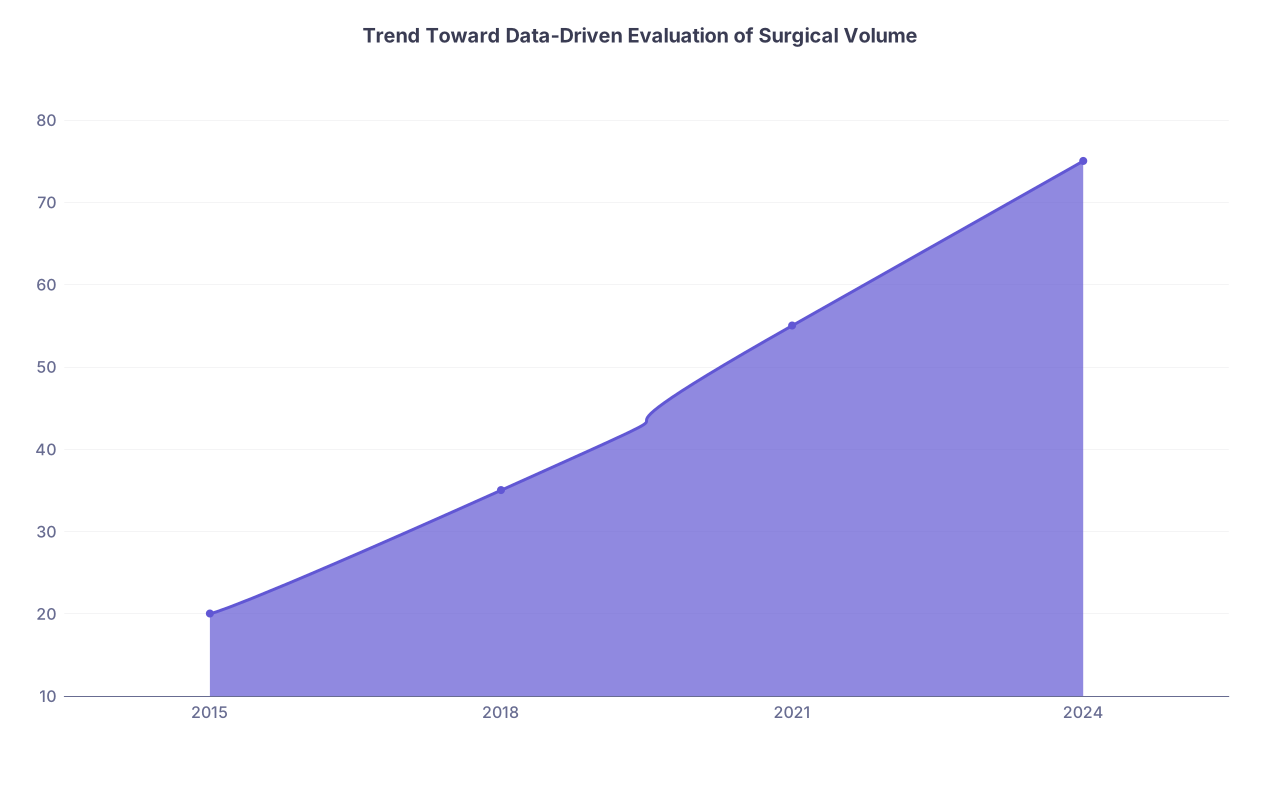
| Category | Value |
|---|---|
| 2015 | 20 |
| 2018 | 35 |
| 2021 | 55 |
| 2024 | 75 |
That line could represent the percentage of programs using comparative volume dashboards in their internal reviews. We’re not at 100% yet. But the direction is obvious.
As these tools spread, fellowship PDs will be able to see:
- Where your home program typically sits nationwide
- Whether your reported volume is wildly out of band
- How your class compares internally
That means:
- Inflated case logs will be easier to spot.
- Programs with chronically low volume will lose the ability to say, “We’re fine; our residents are strong despite the numbers.” They might be. Nobody will take it on faith.
What will not change: the importance of trusted voices. Data won’t kill the back-channel call. It’ll just frame it:
“Your resident’s endovascular volume is clearly lower than the national median on the report I’m looking at. Is that a program issue or a resident issue?”
You want the answer to that question to be instant and unequivocal in your favor.
How You Should Actually Think About Case Volume (Starting Now)
If you’re early in residency, here’s the mindset shift:
Stop asking, “How do I get the highest total number?” and start asking,
“How do I build a defensible story, backed by numbers, that someone I trust will swear to on the phone?”
That means:
Targeted volume
Seek out the key index cases for your desired fellowship: advanced laparoscopy for MIS, complex oncologic resections for surg onc, ACLs and shoulders for sports, etc. Better to have excellent, defendable volume in those than random scatter.Progression, not plateau
Your chiefs year should not look like PGY-2 plus more of the same. PDs notice trends. If your early volume was strong but senior-year complexity is flat, that reads as “stagnant,” even if totals are fine.Earn the right letter writer
The best case volume in the world is useless if your main subspecialty mentor writes a lukewarm letter or refuses to commit to specifics. You want the attending who:- Knows your actual numbers
- Is honest but clearly on your side
- Will answer the phone
Own the gaps with a real explanation
If your log has a soft spot—missed a rotation due to illness, a departing attending, COVID volume collapse—do not pretend it’s not there. That’s how people assume the worst. You, your PD, and your mentor should be telling the same story about why the gap exists and how you compensated.

| Step | Description |
|---|---|
| Step 1 | Residency Cases |
| Step 2 | Case Log Pattern |
| Step 3 | Letter Content |
| Step 4 | Phone Call Narrative |
| Step 5 | Fellowship Rank Position |
Everything you’re doing in the OR is feeding into that pipeline. Whether you realize it or not.
Common Misreads Residents Have About Volume
Let me dismantle a few myths I hear constantly.
“If my numbers are good, letters don’t matter as much.”
Wrong. Volume without advocacy is just a spreadsheet. Numbers get you in the door; a respected surgeon vouching for how you used that volume gets you ranked to match.
“Low volume means I’m doomed.”
Not always. If your entire class was low because of system factors, and a big-name attending is willing to tell a PD, “Despite that, this is the person you want,” you can still win. It’s harder, but not impossible.
“Everyone inflates logs, so I should too.”
Some do. Many do. But when your log says 80 complex cases and your attending, on the phone, says you did “a decent number,” that mismatch hurts you more than if you had been honest.
“I need to scrub into everything to chase numbers.”
No. You need to be the primary on the cases that matter, repeatedly, with increasing autonomy. PDs care more that your chief year shows mature, responsible independence than that you collected 40 extra skin-only cases.
A Quick Reality Check: What PDs Won’t Tell You Publicly
There are a few blunt truths that never make it into official statements:
- A resident from a high-volume, hard-driving program with average letters will often beat a resident from a “cushy,” low-volume program with glowing but vague letters.
- Some programs are known for serial grade inflation in letters. PDs discount their superlatives unless they’re backed by numbers and phone calls.
- Fellowship PDs talk. They remember, “The last time we took someone from that place, their logs looked amazing but they were slow in the OR.” That memory colors how they read the next applicant’s volume from the same program.
You’re not applying in a vacuum. You’re dragging your program’s reputation—good or bad—into every conversation, including the whispered ones.
FAQs
1. My case numbers are below my program’s average. How much will that hurt me?
It depends why. If you’re the only low-volume resident in a high-volume program, PDs assume it’s you, not the system. That’s damaging unless your letters aggressively counter that impression. If you were out for months (illness, family emergency) and your PD and mentors clearly document that, a lower number can be forgiven—especially if they emphasize rapid growth once you returned.
2. Should I ask my letter writer to include specific case numbers?
Yes, but only if they know your numbers and believe in them. Do not hand an attending a script like, “Please say I have the highest volume in the class” unless it’s actually true and they agree. The best ask is: “If you’re comfortable, could you comment specifically on my operative exposure and autonomy, maybe with some comparisons to prior grads?” That invites meaningful, defendable specifics.
3. How do I handle a weak area in my case log during fellowship interviews?
Do not dodge it. If asked, give a concise, honest explanation: “Our bariatric attending left halfway through my PGY‑4 year, so our volume dipped. I compensated by taking every case that did come in and focusing on advanced laparoscopy in other domains.” Then pivot to what you can do confidently. Interviewers are testing for self-awareness and integrity more than raw numbers.
4. Are fellowship PDs actually looking at full case logs, or just letters?
In competitive procedural fellowships, many do look at your log—especially for applicants they’re serious about ranking highly. They don’t memorize every CPT code, but they scan patterns: core procedures, complexity trend, and any glaring holes. Some skim; some dive deep. But assume a savvy person will see what you’re trying to hide.
5. My program’s overall volume is mediocre. What can I realistically do?
You can’t conjure cases out of thin air, but you can: prioritize the hardest, most relevant cases when they appear; seek elective rotations at higher-volume centers if allowed; document your progression clearly; and—most importantly—secure one or two letter writers with enough national credibility to say, “Despite middling program volume, this resident operates at or above the level of trainees we send to top fellowships.” That combination—honest numbers plus strong advocacy—wins more often than you think.
Key takeaways:
Case volume is a proxy, not a verdict. Fellowship PDs use it to ask better questions, not to score you like a board exam. If your numbers are honest, your complexity is real, and your mentors are willing to back you up with specific, gutsy letters and candid phone calls, you’ll be judged on who you are as a surgeon—not just on the length of your case log.