
The fastest way to look incompetent as a surgical trainee is not on rounds, not in the OR, and not on exams—it’s in your case log.
Program directors will quietly forgive a rough first cholecystectomy. They will not forgive a sloppy, dishonest, or obviously inflated case log. That’s how careers get stalled, letters get watered down, and in extreme cases, people get reported.
If you think your case log is “just paperwork,” you’re already making the first mistake.
The Hidden Reality: Your Case Log Is a Legal, Educational, and Professional Document
Your surgical case log is not a diary. It’s not a memory aid. It’s a legal, auditable record tied to:
- ACGME requirements
- Board eligibility
- Your program’s accreditation
- Hospital credentialing down the line
And it’s shockingly common to see residents and fellows treat it like a casual spreadsheet they update on the couch once a month from memory.
Here’s what people actually do that makes them look incompetent—and sometimes dishonest—and how you avoid being one of them.
Mistake #1: Logging From Memory Weeks Later
This one is epidemic. Residents swear they’ll “catch up this weekend.” Then it’s three months, multiple rotations, and hundreds of cases later.
What it looks like on your record:
- 0 cases for 5 weeks
- Suddenly 70 cases logged in two days
- Wildly incomplete details, wrong attending, wrong role
To faculty and program leadership, that screams: unreliable, lazy, and possibly fabricated.
Why it’s dangerous:
- You will misremember roles (assistant vs surgeon junior vs observer)
- You’ll mix up patients and procedures
- You’ll under- or overcount complex cases that matter for boards
- If audited, you can’t justify half of what you logged
How to avoid it:
- Log daily. Non-negotiable.
- Set a repeating reminder on your phone at the end of each shift.
- If you’re slammed, at least keep a same-day scratch list (index card, Notes app) with MRN/last name + procedure + your role. Then formalize it within 24 hours.
If your case log suddenly jumps like a stock market spike, anyone experienced can tell you’re logging “from vibe” not from reality.
Mistake #2: Inflating Your Role in the Case
This is the #1 way to look dishonest.
Claiming “Surgeon Junior” when:
- You held the camera for 90% of the lap chole
- You closed skin on an appendectomy you barely watched
- You did 10% of a complex case and called it “primary”
People check this. More often than you think.
- Attending impressions
- OR staff feedback
- Case complexity vs PGY level
- Operative notes vs your logs
If your log says you were “primary” on 30 complex colorectal cases as a PGY-2, nobody is impressed. They’re suspicious.
Common red flags:
- PGY-1/2 with massive numbers of “surgeon junior” for cases typically run by seniors
- Logging as surgeon in cases clearly led by chief or attending
- Multiple residents on a case all logging as primary
How to avoid it:
- When in doubt, log yourself as assistant unless you truly drove the case.
- Primary = you carried the critical steps, not just closed.
- Ask your seniors: “How should I log my role on this?” You’ll learn quickly what’s reasonable.
Overinflated roles don’t make you look experienced. They make you look untrustworthy.
Mistake #3: Misclassifying or “Upcoding” Procedures
I’ve seen residents log:
- Simple skin excisions as “wide local excision of malignancy”
- Simple hernia repairs as complex/recurrent just to bump numbers
- Straightforward lap appy as “laparoscopic colectomy” (yes, really)
Program directors and CCCs (Clinical Competency Committees) aren’t dumb. They know what case mix you should reasonably have at each level.
Two kinds of misclassification that sink you:
Innocent ignorance
You don’t know the correct ACGME category and just pick something “close enough.” Over time, your data is garbage.Intentional inflation
You deliberately choose the higher-credit category to “look competitive.” That’s how you earn a reputation you can’t shake.
How to avoid it:
- Keep a quick reference list for common procedures and their correct categories.
- When a case is weird or combined (e.g., hernia + bowel resection), ask your attending what and how to log.
- Never “round up” a category to make it look fancier.
If someone audits a sample of your cases and finds multiple obvious mis-categorizations, they start doubting everything.
Mistake #4: Ignoring Minimum Requirements Until It’s Too Late
Residents love to pretend volume requirements are “future me’s problem.”
Future you is going to hate present you.
If you wake up as a PGY-5 and realize:
- You’re short on index cases (major colon, pancreatobiliary, vascular, etc.)
- You barely did enough basic bread-and-butter procedures
- Your distribution is skewed (e.g., tons of trauma, almost no endoscopy)
You’ve put your board eligibility and fellowship competitiveness at risk. And yes, programs do graduate people short on cases—then those people struggle later.
| Category | Typical Problem |
|---|---|
| Endoscopy | Logged too late/rarely |
| Complex Hernia | Misclassified or missed |
| Vascular | Not pursued proactively |
| Breast | Fragmented across sites |
| Critical Care | Poor documentation |
How to avoid it:
- At least twice a year, sit down with your PD/APD and review your case distribution.
- Don’t just look at total numbers. Look at category gaps.
- Request specific rotations or experiences earlier if you’re trending low.
Residents who say, “I thought I’d pick those up as a chief” often don’t.
Mistake #5: Sloppy, Incomplete, or Inaccurate Details
This is where you look disorganized.
Sloppy logs typically have:
- Wrong attending listed
- Wrong hospital site
- Missing approach (open vs lap vs robotic)
- Forgetting whether it was elective vs emergent (when required)
- Copy-paste errors across multiple patients
You might think, “Nobody reads that closely.” Wrong.
Who reads:
- Fellowship directors scanning for patterns
- Program leadership in semiannual review
- Credentialing committees later when you apply to do certain procedures as staff
And when they see chaos in the details, they assume chaos in your thinking.
How to avoid it:
- While logging, keep the op note or scheduling record open and cross-check the attending and procedure name.
- Don’t blindly clone previous entries. If your logging system encourages “copy last case,” double-check everything.
- You don’t have to be perfect, but you should be consistently accurate.
There’s a big difference between one wrong attending name and systematically messy data.
Mistake #6: Failing to Match Operative Reality (Yes, People Compare)
Your case log exists in an ecosystem:
- OR schedule
- Operative reports
- Staff memory
- Your evaluations
- Your actual skill set
If these don’t match, you have a big credibility problem.
Classic mismatch patterns:
- You claim 150+ laparoscopic cholecystectomies; attendings say you still struggle with basic steps.
- Trauma numbers are huge, but ICU staff barely remember you being involved.
- Robotic case volume is sky-high, but your console time in truth was minimal.
Some programs do spot audits. Some attendings do informal audits. And some fellowship PDs absolutely call your PD to ask, “Is this case log believable?”
How to avoid it:
- Log what you actually did, not what you wish you had done.
- Don’t log cases you weren’t scrubbed into or meaningfully involved in. “Watching from the corner” is not a billed case.
- If you were there for only a tiny portion of the case, be honest about your role.
If your log says “experienced,” but your hands say “novice,” the log is what gets questioned, not physics.
Mistake #7: Over-Logging Fragmented or Tiny Contributions
Some residents obsess over the raw number and start logging every trivial contact:
- Changing one dressing in the OR then leaving
- Coming in for closure only, once, and then claiming “case done”
- Scrubbing in for 5 minutes, then scrubbing out, but still logging as assistant
- Logging multiple procedures that are actually one integrated operation
Yes, case counts matter. But inflated case counts from micro-participation are transparent.
You don’t want 100 questionable cases. You want 60 honest ones you can defend.
How to avoid it:
Ask yourself before logging:
- Did I meaningfully contribute to this operation?
- Could I reasonably describe the indication, anatomy, key steps, and complications if asked?
- If my PD discussed this case in front of the CCC with my name attached, would I feel comfortable?
If the answer is no, you probably shouldn’t log it.
Mistake #8: Not Updating When Cases Change Mid-Procedure
Case starts as:
- “Diagnostic laparoscopy”
Then becomes:
- “Laparoscopic appendectomy”
- “Open bowel resection”
- “Converted to open hernia repair”
Residents often log the original plan instead of the actual final procedure. Then your log no longer matches:
- Op note
- Billing data
- ACGME category
You end up with a weird trail of “diagnostic laparoscopy” cases that were actually major operations.
How to avoid it:
- Don’t pre-log based only on the posted schedule and then forget about it.
- If the procedure changes (conversion, add-on procedures, aborted case), adjust the entry afterward.
- Get in the habit of glancing at the final op note before logging complex cases.
You don’t get credit for the plan. You get credit for what actually happened to the patient.
Mistake #9: Letting Someone Else “Handle” Your Logging
This one blows up careers more than people realize.
Variations:
- “My co-resident logs the shared trauma cases for both of us.”
- “The fellow said they’d put me on the log.”
- “The chief keeps a list and tells us he’ll sort it out later.”
If you ever have to defend your log under scrutiny, “someone else did it” is not a defense. You are personally responsible.
Also dangerous: some programs batch-import cases from hospital systems. Residents assume that means they’re covered. They’re not. Those imports are often incomplete, misclassified, or misattributed.
How to avoid it:
- Treat your log the way you’d treat your signature on a consent form. You own it.
- Never rely solely on others to create or submit entries.
- If your program uses auto-imports, still review and correct everything. The system doesn’t care about your boards. You should.
Mistake #10: Underestimating How This Follows You Into the Future
You might think, “Once I graduate, nobody will care how I logged as a PGY-2.” Wrong.
Your case log (and its patterns) can matter later for:
- Fellowship applications and interviews
- Obtaining hospital privileges (e.g., showing adequate experience in a procedure set)
- Malpractice cases (yes, lawyers sometimes ask for logs)
- Future credentialing reviews when changing hospitals
If you’ve inflated robotic cases and then apply for robotic privileges, they may pull your log. If you’ve misrepresented your operative role repeatedly, and then there’s an adverse outcome, people will look back.
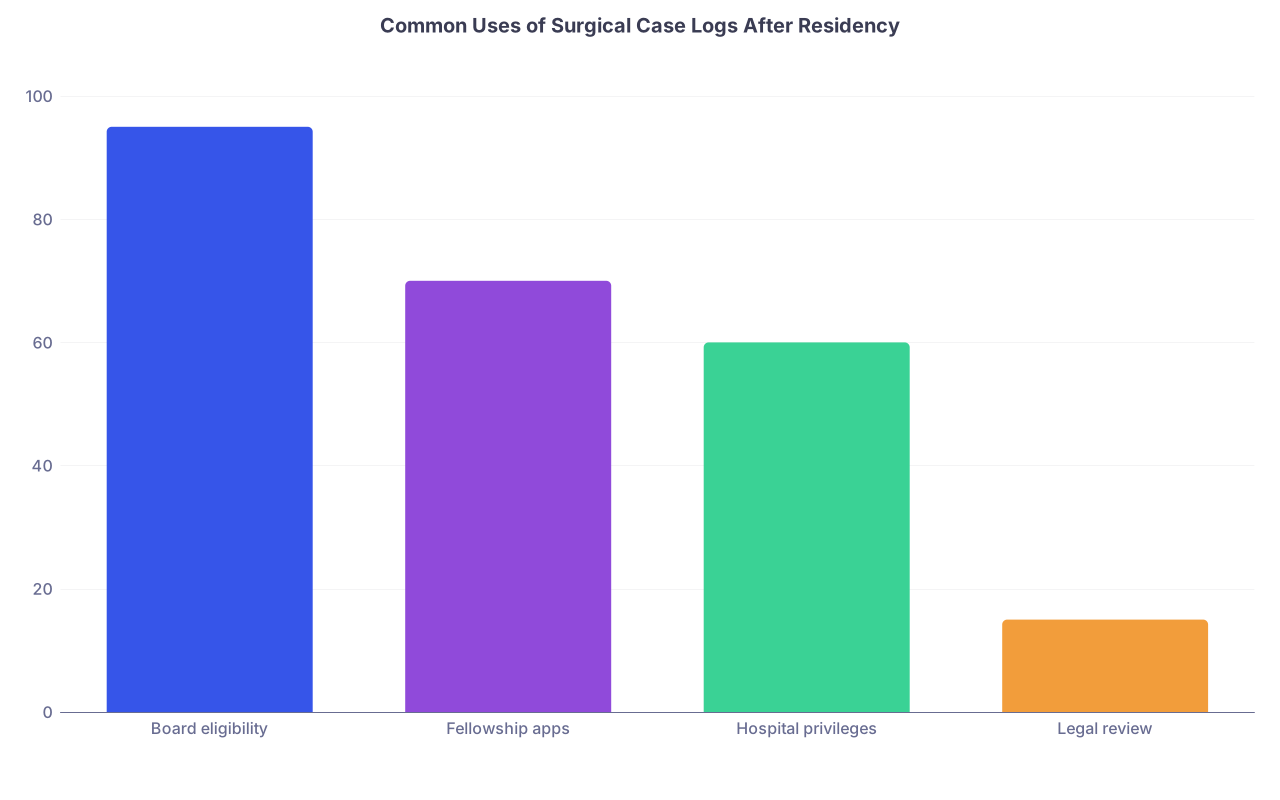
| Category | Value |
|---|---|
| Board eligibility | 95 |
| Fellowship apps | 70 |
| Hospital privileges | 60 |
| Legal review | 15 |
Numbers represent the approximate percentage of residents who will encounter each of these uses in some form. This is not rare.
Mistake #11: Treating Volume as the Only Metric That Matters
Everyone loves to flex numbers:
- “I’ve done 300 laparoscopic choles.”
- “I hit the endoscopy minimum in PGY-3.”
- “My total cases are way higher than the class ahead.”
Here’s the uncomfortable truth: excessive volume with poor judgment = liability, not strength.
If your evaluations mention:
- Poor intraoperative judgment
- Unsafe speed
- Struggling with basics despite high case counts
Then an inflated case log makes things worse. It suggests you’re either not learning or not honest.
How to avoid this trap:
- Focus your logging on accurate representation, not bragging rights.
- Pair case counts with operative feedback—what you learned, what you still struggle with.
- If you’re heavy in one area (e.g., bariatrics, trauma), acknowledge gaps and seek balance.
Smart faculty don’t ask, “How many did you do?” They ask, “What can you actually do independently?”
A Simple, Safe Case Logging Workflow
If you want a “no drama, no regret” system, keep it boring and consistent.
Here’s a reasonable workflow:

| Step | Description |
|---|---|
| Step 1 | Finish OR/Call Day |
| Step 2 | Write names and procedures in quick list |
| Step 3 | Check op note or schedule for accurate info |
| Step 4 | Enter cases in logging system same day |
| Step 5 | Verify role, category, attending, site |
| Step 6 | Weekly review for completeness |
Does it take time? Yes.
Is that better than explaining suspicious logs to your PD or a board? Absolutely.
FAQ (Exactly 5 Questions)
1. How many cases can I safely batch log at once without looking suspicious?
You’ll occasionally have a heavy call or OR day where you legitimately log 8–12 cases at once. That’s fine. What looks bad is weeks of inactivity followed by 80 cases in two days. As a rule of thumb, if you’re regularly logging more than 15–20 cases at a time, you’re waiting too long and increasing your error rate. Daily or every 2–3 days is ideal.
2. If a senior let me “run the case” but they did the hardest part, can I log as primary?
Usually no. “Primary” means you performed the critical steps, not just opened, closed, or handled easier portions while the attending or chief did the key parts. If you’re unsure, ask: “Would you be comfortable if I logged this as surgeon junior?” If they hesitate, log as assistant. Being slightly conservative protects your integrity.
3. What if my program’s auto-import case system is wrong or incomplete?
Then you fix it. Auto-import is a starting point, not a finished product. Review each imported case, correct the attending, role, procedure type, and category. If the system frequently misattributes cases, bring it up to your PD, but do not assume “the computer handled it.” You’re the one whose name is attached to the final log.
4. Can I log a case I scrubbed into but left halfway through for another emergency?
Yes, but be honest about your role. If you were there for a meaningful portion and actually participated in important steps, log as assistant with that understanding. If you only helped with set-up or a few minutes of retraction before leaving, it’s safer not to log it. Ask yourself whether you could credibly describe the case and your contribution if questioned.
5. How do I handle combined or staged procedures in my log?
For combined cases (e.g., hernia repair plus bowel resection), log the distinct major components if your system allows, following ACGME guidelines and your program’s conventions. For staged procedures done on different days, each stage usually counts as a separate case. When in doubt, ask your PD or a senior who knows how the CCC and boards expect them to be recorded. Don’t improvise categories just to squeeze out more numbers.
Bottom line:
Three things will keep you out of trouble: log early, log honestly, and log accurately.
If you would be uncomfortable defending a case entry in front of your PD or a board examiner, do not put it in your log that way.