The dirty secret about ACGME surgical case minimums is simple: almost nobody in leadership actually believes they define competence. We treat them as a floor for accreditation, not a finish line for training. And behind closed doors, the conversation is much blunter than anything you’ve heard in conferences or glossy program brochures.
You’re being sold a very sanitized story: “Meet the minimums, you’ll be fine.”
Inside the program director meetings, the talk sounds more like: “If our grads are leaving with only the minimums in X, we’ve failed.”
Let me walk you through how this really works in surgery programs.
What ACGME Minimums Actually Mean (When the Doors Are Closed)
On paper, ACGME case minimums look precise and reassuring. Numbers. Categories. Thresholds.
In PD meetings, we talk about them like this:
- “These are the numbers that keep us accredited.”
- “The Review Committee only cares if people are way under.”
- “No one believes 85 of anything makes you safe on day one as attending.”
Most residents think minimums are some sort of evidence-based standard for competence. They are not. They are political numbers. They’re compromise values built from old datasets, committee fights, and the lowest common denominator of what most programs can realistically provide.
I’ve heard this line multiple times from surgical program directors when the residents are not in the room:
“If someone finishes at or near the minimums in several key areas, we start asking how they were allowed to graduate.”
That’s the opposite of the message you hear as a trainee. To you, it’s: “Track your cases so you meet your minimums.”
To us, it’s: “If all they did was just barely hit the minimums, no fellowship wants them and we’re embarrassed to sign off.”
So, the first truth: ACGME minimums are a regulatory trigger, not a competence guarantee.
How Case Logs Are Actually Used Against You (And For You)
You think of your case log as an annoying checkbox. Faculty and PDs think of it as an x‑ray of your training — and sometimes of your work ethic.
Here’s the internal logic:
- Case log well above minimum in core areas, consistent over years → “This resident was active, assertive, and present.”
- Case log barely above minimum in several core areas → “Red flag. Was this a bad rotation structure, disinterest, or avoidance of hard cases?”
- Case log with bizarre gaps (no ICU procedures, almost no emergent cases, few complex index operations) → “This person’s experience is narrow. They’ll struggle in independent practice.”
The really uncomfortable part: we do talk about individuals by name in these reviews. Not just numbers, not just anonymized. In Clinical Competency Committee (CCC) and program leadership meetings, it’s direct:
- “Why is Smith at 130 for major cases when their peers are 220–250?”
- “Look at Lee’s index numbers in [core operation]. They’re at 1/3 of the class median.”
- “How did Patel do five years of general surgery and log this few emergencies?”
We compare you to your peers far more than we compare you to the ACGME minimums.
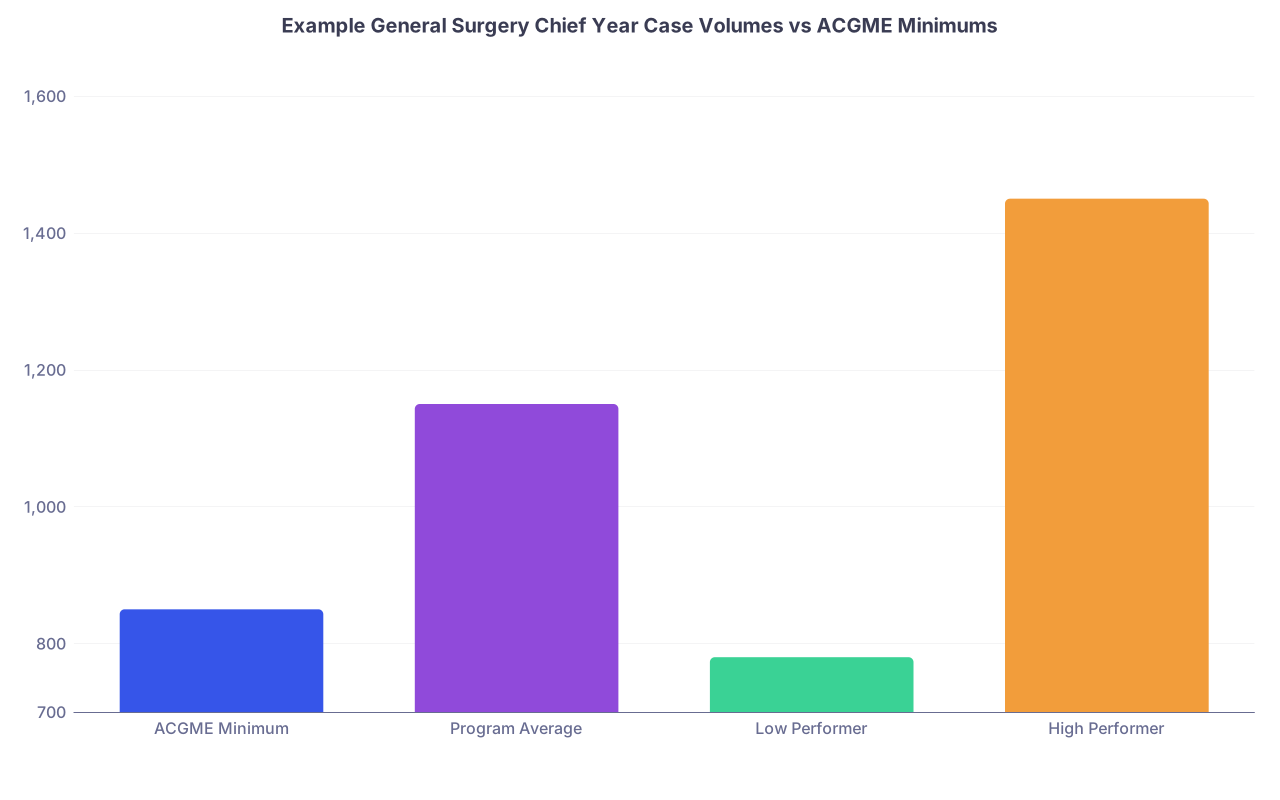
| Category | Value |
|---|---|
| ACGME Minimum | 850 |
| Program Average | 1150 |
| Low Performer | 780 |
| High Performer | 1450 |
This is what that internal discussion often looks like: everyone technically “meets” the requirement, but someone at 780 in a program where most are 1100–1200 stands out like a siren.
Do we fail someone purely based on numbers? Rarely. But do the numbers push us to look harder at performance, professionalism, readiness for independent practice? Absolutely.
The Quiet Reality: “Minimum” vs “Expected” vs “Competitive”
Programs almost never show you this explicitly, but here’s the three‑tiered framework we actually use in our heads:
ACGME Minimum
The formal number. The “you can’t graduate below this without serious justification” floor.Program Expected Range
The internal benchmark we care about. Usually not published.
Things like: “Our chiefs should be around 1000–1200 cases total, with at least X of Y categories.”Competitive / Strong Graduate
The kind of numbers that make faculty comfortable writing, “This trainee operates like a junior attending.”
This is what high‑quality fellowships and private groups quietly look for.
Let me put that into something more concrete.
| Category | ACGME Minimum | Program Quiet Expectation | “Strong Graduate” Signal |
|---|---|---|---|
| Total Major (Gen Surg example) | ~850 | 1000–1200 | 1200–1500+ |
| Bread-and-butter index cases | Minimum met | 1.5–2x minimum | 2–3x minimum |
| Emergency/trauma volume | Basic exposure | Robust, year-on-year | Clear, high-volume log |
| Laparoscopic/advanced lap | Minimum met | Above minimum | Substantially above |
| ICU/procedural exposure | Checked box | Consistent across years | Broad, high-volume |
No, this isn’t a single official document. But this is how the talk actually goes:
- “Yeah, she’s at the minimum for endoscopy, but everyone else is 2x. Why?”
- “His emergent laparotomy numbers are weak. Did he avoid nights? Bad luck? Or something deeper?”
- “I don’t care that he ‘meets’ ACGME. These numbers don’t look like someone ready for solo community practice.”
You’re playing a different game if you’re aiming to be safe, certified, and employable versus simply “not in trouble with ACGME.”
How Programs Really React When Residents Are Under the Minimums
Let’s talk about the nightmare scenario everyone pretends doesn’t happen: a chief hits PGY5 and is below ACGME minimums in a key category.
Here’s what rarely gets said publicly:
This isn’t just your problem. It’s a program‑threatening problem.
The internal panic usually unfolds like this:
- Someone in admin or the PD does a mid‑PGY5 audit and realizes: “We’ve got a problem. Jackson is under in [category].”
- Urgent email chain: “We need to get them cases. Now.”
- Overnight, you see your schedule warping.
I’ve seen it repeatedly:
- Residents mysteriously pulled off clinics and busy services to get stuck on endoscopy or a specific subspecialty block.
- Cases “gifted” by more senior residents or fellows.
Translation: the CT fellow backs off and lets the PGY5 do parts they normally wouldn’t, just so the log can hit the number. - Attending says in the OR: “We’re letting you do this whole case because your numbers are low, but you should’ve had this down a year ago.”
Nobody will write that in your graduation letter. But they will absolutely say it in faculty meetings.
And here’s the harsher part: persistent under‑minimum numbers make leadership nervous about graduating you and nervous about the program’s status.
You’ll hear phrases like:
- “If the RRC sees this pattern, they’re going to come after us.”
- “We have to prove this was an outlier, not a system failure.”
- “Document everything. Show the opportunities were there.”
This is why, behind closed doors, the mantra is:
“We cannot let someone get to the end under the minimums. We must catch this early.”
Which leads to the next point.
Why You Cannot Treat Case Minimums as a Last-Year Problem
Residents love to ignore their logs until late PGY4/early PGY5 and then suddenly panic‑log three months of cases. I’ve watched chiefs stay up after call “back entering” 50+ cases, trying to reconstruct what they did.
Program leadership sees this. And they hate it.
The internal conversation sounds like this:
- “We can’t meaningfully remediate a case deficit discovered at the end of PGY5.”
- “If they were under all along and we never intervened, that’s on us.”
- “We need mid-year audits starting PGY2 or PGY3, not when they’re finishing.”
Some programs formalize this with semiannual case reviews. Others just rely on one obsessive APD. But everywhere, the goal is the same: avoid an end‑of‑training crisis.
Let me hammer one ugly truth:
If you discover you’re significantly under in a key category in your chief year, you will get “padded.” That might help your log. It usually doesn’t fix your actual skill deficit.
Because you can’t compress three years of graded responsibility into three months of panic cases.
Not All Cases Are Equal (And We All Know It)
Another unsaid reality: we all know the game of “clicking roles” in the case log.
Behind closed doors, faculty say things like:
- “I don’t care that he has 50 of those logged as surgeon junior. I’ve watched him. He’s been first assist on half of them.”
- “Her chief numbers look great, but I know the fellow really ran those rooms.”
We look at:
- Role: Surgeon junior vs surgeon chief vs first assist. We know the patterns on our own service. We know who was actually doing the critical part of the case.
- Type: Bread‑and‑butter vs weird niche procedures. Twenty rare cases don’t replace a deficit in basic operations.
- Time: When in residency the cases occurred. A ton of complex cases logged early PGY2 but thin PGY4–5 experience? That’s not the same as steady progressive responsibility.
We also know which rotations behave like this:
- High‑volume but low autonomy subspecialty services, where you log a ton but learn less than your case count suggests.
- Slow services where the few cases you do are high-yield because the attending lets you truly run the show.
The ACGME log interface doesn’t capture this nuance.
Faculty and PDs do. Fellowship directors do. Senior partners hiring you do.
So if you’re gaming the case log — stretching “surgeon junior” when you barely dissected — just understand: your numbers might pass ACGME, but your reputation won’t.
The Future: Why Minimums Are Going to Look More and More Fake
Here’s the part almost no one tells you as a trainee: the gap between ACGME minimums and real-world readiness is going to widen, not shrink.
Why?
Robotics. Subspecialization. Safety culture. And the politics of accreditation.
Let me lay it out.
Robotics is hollowing out your classic index experience
In many general surgery programs now, the fellow or attending does the critical portions of robotic colectomies, foregut, hernias. You, the resident, might open, dock, do some camera work, and close. Then log “colectomy, laparoscopic/robotic, surgeon junior.”
In PD meetings, we talk about it bluntly:
- “Robotics is killing resident autonomy in complex cases.”
- “Their logs look great. Their hands do not.”
- “You cannot tell from ACGME numbers who can actually run a robot.”
The minimums aren’t adjusted for how much autonomy has evaporated in big academic centers. So the log looks strong, and yet the chief looks scared when they’re asked to do a straightforward robotic case alone.
Subspecialization is fragmenting surgical identity
Another closed‑door conversation:
- “This resident wants colorectal. They’re fine there, but their bread‑and‑butter general isn’t strong.”
- “Do we care if our graduates can do everything, or just what they’ll do in practice? ACGME doesn’t ask that question.”
Minimums treat you like a generalist. The real world is shoving you into narrower boxes.
Risk aversion is strangling “real” independence
We’ve tightened supervision, policies, EMR documentation, and QA reviews to the point that true “solo” experiences are rare in some hospitals. You’re always under an attending’s shadow, legally and practically.
So yes, the numbers may say 200+ laparoscopic cholecystectomies logged. But if you’ve never once been allowed to truly run a high‑risk one — from decision to proceed, to bail‑out maneuvers, to conversion — that 200 means less than it did twenty years ago.
Everyone in leadership knows this.
We’re just behind in how we measure it.
How Smart Residents Use This Knowledge
You can’t change the ACGME minimums. You can’t single‑handedly reverse robotics or subspecialization. But you can stop playing the “minimum game” and start playing the “real readiness” game.
Let’s be specific.
You start tracking not just totals, but spread and timing.
Ask: “Where am I clearly below my peers? What core areas have thin experience? Am I actually the primary surgeon in the cases I’m logging?”You approach your PD or APD early (PGY2–3, not 5) with concrete data:
“My emergent laparotomy numbers are low compared to the class. How can I fix this next year?”
That’s the kind of resident PDs go out of their way to help.You aggressively seek graded responsibility, not just exposure.
In the OR, you say things like, “I’d like to run as surgeon junior on this case if you’re comfortable — I’ve logged several as first assist already.”You stop thinking “meet the minimum” and start thinking “am I someone they’d trust with their family member at 2 a.m.?”
Because behind closed doors, that’s exactly how we frame it:
- “Would I let this person take my call?”
- “Would I be okay with them being the only surgeon in a small hospital in the middle of the night?”
Your case log is just evidence. The real verdict is much more personal.

| Step | Description |
|---|---|
| Step 1 | PGY1-2 Ignore Case Logs |
| Step 2 | Late PGY3 Realize Minimums Exist |
| Step 3 | PGY4 Panic Log and Compare to Peers |
| Step 4 | Scramble for Padding Rotations |
| Step 5 | Stable but Unexamined Experience |
| Step 6 | PD Questions True Autonomy and Readiness |
| Step 7 | Under or Near Minimums? |
The residents who break this pattern do something different: they analyze early, ask for help directly, and treat minimums as the floor, not the target.
FAQ: What You’re Afraid to Ask Out Loud
1. If I meet all ACGME minimums, can my program still hold me back from graduating?
Yes. Programs are obligated to attest to your competence, not just your numbers. If your faculty and CCC feel your technical skill, judgment, or professionalism isn’t sufficient for independent practice, they can extend training or withhold graduation, even if your case log is perfect. It’s uncommon, but it happens — and when it does, leadership cites global performance, not just logs.
2. Do fellowship directors actually look at specific case numbers or just assume residency trained me?
The good ones absolutely look. They know which programs overproduce in certain categories and which underproduce. Some fellowships will quietly request or review detailed logs when they’re on the fence about you. And they heavily weight letters where attendings explicitly comment on your operative independence more than your raw totals.
3. Is it ever okay to “up-code” my role on the case log if I did a decent portion of the case?
No. And everyone knows it happens. When logs look suspiciously inflated, word gets around. Attendings remember who constantly tries to bill themselves as surgeon junior when they barely handled the case. That reputation hurts you far more than a lower but honest case number. Integrity in logging is non-negotiable if you care about long-term credibility.
4. How do I know if my numbers are truly low or just different because of program structure?
Straight answer: you ask. Sit down with your PD or APD and say, “Can we look at my case log compared with class medians or recent graduates?” Most programs track this internally. If they hesitate, press politely. You want to see your standing by category and by PGY year. Then you can target what’s really missing — not guess based on vague minimums.
Remember these things.
ACGME minimums are a bureaucratic floor, not a competence guarantee. Programs judge you against your peers and their own internal expectations, not just the published numbers. And if you act early and think beyond “meeting the minimums,” you give yourself a shot at finishing residency as a surgeon your faculty genuinely trust — not just a log that passed inspection.