What do you actually do when you realize you might finish residency without enough real operative reps to feel safe taking call on your own?
If you’re in a low-volume surgery program, you already know the vague reassurances: “Quality over quantity,” “You’ll learn in fellowship,” “Everyone gets what they need in the end.” Some of that is true. Some of it is lazy.
You cannot conjure cases out of thin air. But you are not powerless.
Here’s how I want you to think: your program is your baseline, not your ceiling. Your job now is to build a parallel training track around it.
We’re going to walk through what to do this month, this year, and before you graduate to make sure you’re not the PGY-5 who’s great on paper and scared stiff in the OR.
Step 1: Get Brutally Honest About Your Numbers
Before you “fix” anything, you need to know exactly where you stand. Hand-waving like “we’re kind of low volume” is useless. Numbers and patterns are what matter.
Start here:
Download your current case log.
Sit down with your ACGME or equivalent log and export it to a spreadsheet.Sort by CPT / case category.
Look for:- Bread-and-butter cases (for your field)
- Index / milestone procedures
- Emergency vs elective
- Your actual role: skin closure vs first assist vs primary surgeon
Compare to expected benchmarks.
Use rough, realistic targets as “danger” thresholds, not perfection standards. For general surgery residents, for example:
| Level | Total Cases | Key Concern if Below* |
|---|---|---|
| PGY-2 | 150–200 | Very few appendectomies, cholecystectomies |
| PGY-3 | 350–450 | Limited laparoscopy, no basic foregut/hernia |
| PGY-4 | 600–750 | No major cases as surgeon (colectomy, major hernia) |
| PGY-5 | 850–1000+ | Thin across bread-and-butter categories |
*These are rough guideposts, not strict rules, but if you are significantly below these or missing core categories, you have a real gap.
- Focus on patterns more than totals.
Two residents with 900 cases can be very different:- One has 150 lap choles, 80 appys, 60 hernias, 40 colectomies
- The other has 600 scopes, 200 “assistant” on big cases, barely any bread-and-butter they actually drove
You are not trying to be impressive. You are trying to be safe.
Now actually name your gaps on paper:
“By PGY-3, I’ve only done 5 lap appys as primary, 4 lap choles, and almost no emergent cases.”
That sentence is what you’re going to solve for.
Step 2: Squeeze Every Drop Out of Your Home Program
People skip this and jump to fancy away rotations. Mistake. There is usually 20–30% more case volume you can extract inside your own system if you get aggressive and intentional.
2A. Fix your schedule before you fix your career
Sit down with your chief or coordinator with a specific ask, not a vague complaint.
Wrong:
“We’re just not getting enough cases.”
Better:
“I’m at 12 lap choles total as a PGY-3. I’d like to aim for at least 40 by end of 3rd year. How can we change my assignments so I’m in that room more often?”
Be the person with data and a plan, not the person whining in the workroom.
Tactically:
Ask to be assigned preferentially to:
- Bread-and-butter general rooms
- Emergency / trauma ORs
- High-volume surgeons who like to teach
Offer trades:
“I’ll cover floor/consults Monday afternoon if I can scrub the entire foregut room Wednesday.”If your program uses block scheduling, ask the PD:
“Can my next elective block prioritize high-volume services? Here’s my current case mix and what I’m missing.”
2B. Be the first one to the OR list—every day
Most low-volume residents aren’t actually maximizing what they have. Harsh but often true.
Daily habit:
- Print the OR schedule or open it first thing.
- Mark every case you could reasonably scrub.
- Talk to your chief/attending: “I’d like to scrub this hernia and this lap appy. Can we arrange coverage for floor/ED for those times?”
If you show consistent OR hunger, seniors usually start feeding you cases. If they don’t, that’s a different conversation with your PD.
2C. Move up from “assistant” to “driver”
You might be in the room a lot but barely touching the case. You fix that by:
Saying it clearly beforehand:
“Dr. X, I need to get more reps actually running the case. For this lap appy, can I do the port placement and most of the dissection while you talk me through?”Asking for defined steps:
“Can I be responsible for the critical view dissection on this lap chole, even if you do the cholangiogram and duct division?”
Concrete roles build competence. “I’ll help” does not.
Step 3: Build Strategic External Experiences (Not Random Away Rotations)
If your hospital’s volume is structurally low—rural setting, small catchment, too many residents for the cases—you’re not fixing that from the inside. You create a second training ecosystem.
3A. Targeted external rotations
You don’t need 6 away rotations. You need 1–3 surgical months designed to fill specific holes.
Examples:
- Low trauma? Arrange a month at a level 1 trauma center with a reputation for resident autonomy.
- Barely any bariatric or foregut? One high-volume community bariatric center can double your numbers.
- Weak peds exposure? Rotate at a regional children’s hospital that actually lets residents operate.
Structure your pitch to your PD like this:
“My current logs show 8 trauma laparotomies and very limited emergency operative exposure. I’d like to do a 4-week rotation at [X Trauma Center] between [months] with the goal of increasing emergent general surgery experience, particularly trauma laparotomy and bowel resection. I’ll cover my call responsibilities by swapping with [co-resident] and will ensure all service needs here are met.”
You are more likely to get “yes” if you bring a complete logistical plan, not just a wish.
3B. Private practice / community exposure
Some of the best case volume is not at the academic mothership. It’s that community surgeon 40 minutes away doing 8 cases every Tuesday and Thursday.
Ask your PD or chair:
- “Are there community surgeons who take residents occasionally? I’d like to be their go-to resident for a month, especially for bread-and-butter general cases and hernias.”
If they say yes, treat it like a prized away rotation:
- Show up early.
- Stay late.
- Do every single case offered.
- Find ways to be useful outside the OR (clinic, follow-ups).
Community surgeons will often let you do much more of the operation than an academic attending who’s juggling fellows and a packed list.
Step 4: Use Simulation and Lab Time Like a Professional, Not a Student
Simulation does not replace live cases. But if you’re in a low-volume setting, it’s your only way to multiply the teaching effect of each real case you do get.
Think about simulation as a force multiplier, not fluff.
4A. Technical reps: intentional, not random
If you have access to:
- Laparoscopic box trainers
- Virtual reality platforms (LapSim, Simbionix, etc.)
- Animal lab / cadaver lab
- Microsurgery lab (for certain subspecialties)
Then stop casually “playing on the sim” once a month and build a plan.
Example for a general surgery PGY-2 weak in laparoscopy:
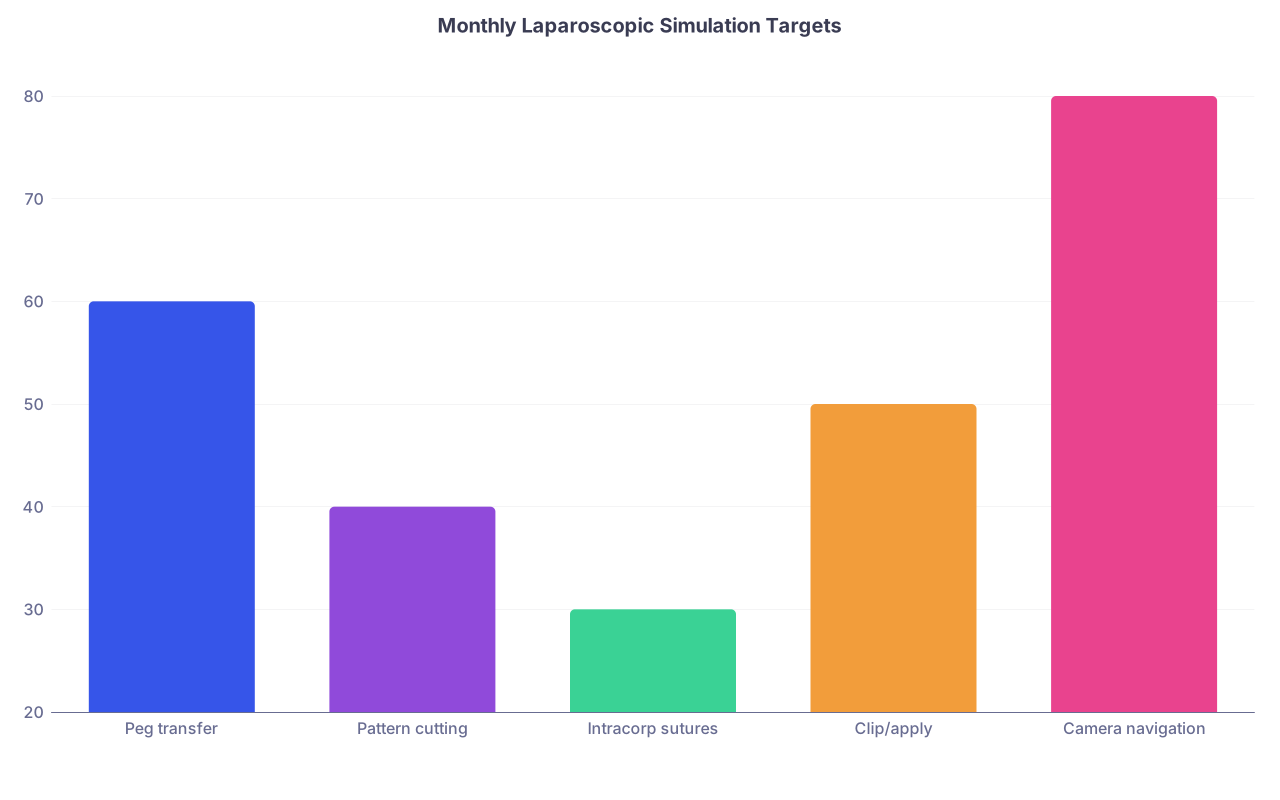
| Category | Value |
|---|---|
| Peg transfer | 60 |
| Pattern cutting | 40 |
| Intracorp sutures | 30 |
| Clip/apply | 50 |
| Camera navigation | 80 |
That’s reps per month, not per year.
Log it. Make it visible. Take screenshots of score improvements if the simulator tracks it. Use that in discussions with attendings: “I’ve done ~150 intracorporeal sutures on the sim this month. I’d like to close the enterotomy on this case.”
4B. Lab / cadaver courses: be greedy
Many residents treat lab days as a break. You can’t afford that.
If there’s:
- A vascular anastomosis lab
- A trauma cadaver course
- Arthroscopy skills course
- Anastomosis / bowel lab
You show up early, stay late, and repeat each step until the staff kicks you out.
Also: hunt for industry-sponsored courses (yes, the ones with logos and slightly cheesy brochures). They often include cadaver labs for fellows and residents. If your PD is okay with it, those can be gold.
Step 5: Leverage Faculty Relationships for Case Access and Real Autonomy
The single biggest difference I’ve seen between low-volume residents who do fine and those who struggle? The ones who did fine had 1–3 attendings who intentionally “adopted” them as operators.
You do not wait passively to be chosen. You engineer this.
5A. Identify your “operative mentors”
You want surgeons who:
- Operate a lot
- Actually like teaching in the OR
- Believe in graded autonomy, not hand-over-hand forever
Then you do three things:
- Consistently show up prepared for their cases—know their preference cards, steps, usual pitfalls.
- Tell them explicitly what you’re trying to build:
- “I want to be truly comfortable running straightforward lap choles by the end of this year.”
- After a stretch of working with them, ask:
- “Can we set a goal that for the next 5 lap choles, I run from incision to closure, and you step in only if I’m unsafe or too slow?”
Most decent surgeons will respect that and respond.
5B. Ask for hard, specific feedback
Not “How am I doing?” You will get fluff.
Instead:
- “What step of this operation do you not trust me with yet?”
- “What would I need to show you for you to let me run this case from start to finish?”
- “If I were taking call alone next month, what case type would make you nervous for me?”
Then you write those answers down and target them like a training program.
Step 6: Be Smart with Fellowships and the “I’ll Learn It Later” Trap
Here’s a hard truth: a weak technical base does not magically disappear in fellowship. It compounds.
But fellowship can absolutely rescue some deficiencies if you plan for it properly.
6A. Choose fellowship based on reality, not prestige
If your general surgery residency is light on:
- Complex cases
- Index procedures
- Any real independence
Then pursuing a high-volume, hands-on fellowship is more important than a brand-name field you barely touch.
Example:
You graduate gen surg comfortably doing bread-and-butter but limited complex foregut or hernia.
- A strong minimally invasive / foregut fellowship at a community powerhouse might be more valuable than a low-volume “elite” academic MIS program where a senior fellow or attending does everything.
You’re a neurosurgery resident who barely clipped an aneurysm:
- A busy cerebrovascular fellowship with true autonomy matters more than a famous name where you’re third in line.
Ask hard questions during fellowship interviews:
- “How many primary cases does the fellow log on average?”
- “What percentage of common cases does the fellow run skin to skin by midyear?”
- “What do your grads feel unprepared for?”
If they dodge, that’s your answer.
6B. Name what must be learned in residency vs can be deferred
Some things you must be solid on before you graduate residency:
- General surgical exposure: safe lap chole, appy, hernia, basic laparotomy
- Your specialty’s version of “bread-and-butter emergencies”
- Basic tissue handling, suturing, knot tying, hemostasis
More niche or complex stuff can realistically be pushed to fellowship:
- Super-complex reconstructions
- Rare oncologic cases
- Highly specialized procedures (e.g., skull base, advanced endovascular, complex hepatobiliary)
You are not trying to become a master of everything in residency. You are trying to avoid being dangerous or helpless.
Step 7: Document Your Story for Future Jobs and Privileging
There’s a second reason to build your case volume intelligently: you will eventually have to prove to a credentialing committee that you can do what you say you do.
If your primary residency program is obviously low-volume on paper, and you do a ton of work to supplement it, you need a story that ties it all together.
Create a training portfolio:
- Your official ACGME/board case logs
- A one-page summary of external rotations and what you gained:
- “Trauma month at [Hospital X]: 35 trauma laparotomies, 20 emergent bowel resections, 10 splenectomies as primary or first surgeon.”
- Simulation / lab milestones:
- “Completed X hours of laparoscopic simulation with documented metrics; cadaver labs in vascular anastomosis and trauma.”
For job interviews, be ready to say, calmly:
“My home program’s case volume in [area] was on the lower side, so I built additional experience through [rotations, sim, labs]. By graduation, I had done [numbers] of [key procedures], and I feel comfortable independently managing [list of bread-and-butter cases].”
If you sound clear and factual instead of defensive, people believe you.
A Quick Reality Check: When the Problem Is Actually the Program
Sometimes the fix is not “squeeze more out of your program.” Sometimes the program is simply too small for the number of residents, or poorly structured, or unwilling to let residents operate.
If:
- Multiple senior residents graduate with clearly inadequate logs
- Attendings routinely shut residents out of cases
- Efforts to address this with PD/chair go nowhere
You have two hard options:
- Accept that fellowship will be your main training, and behave accordingly (aggressively target a powerhouse fellowship and make sure they know exactly why you need it).
- Explore transferring (rare, painful, but sometimes the right move in severe cases).
What’s not an option: pretending it’s fine and then being the attending who can’t safely do the work they’re credentialed for.
FAQ (Exactly 5)
1. How do I know if my case volume is “dangerously low” versus just a bit lighter than average?
Look at both total numbers and distribution. You should be worried if by late PGY-4 (or equivalent senior year) you have:
- Very few bread-and-butter cases as primary (for general surgery: <30 lap choles, <20 appys, <20 hernias)
- Almost no emergent cases you’ve actually led
- Case logs heavily skewed to “assistant” with few cases logged as surgeon
If you’re slightly below peers but with balanced experience and progressive autonomy, you’re probably okay. If you’re missing whole categories or never run cases yourself, that’s a structural problem.
2. My attendings say I’m “too slow” to run full cases. Is that a volume issue or a skill issue?
Usually both. Low volume slows your technical growth, which then justifies attendings not giving you more autonomy. Vicious cycle.
You break it by:
- Doing focused sim work on critical steps
- Asking for specific, time-bound goals: “By the next 5 lap choles, can I do ports, dissection, and clip application, and we’ll track my time?”
- Asking for deliberate practice cases on simpler patients (not the 12th re-op abdomen)
If after a period of targeted work you’re still very slow, you may need honest discussion with your PD about fit and expectations.
3. Can simulation really compensate for low live case volume?
No. But it can multiply the effect of each real case you do. A resident with 60 lap choles + 300 high-quality sim reps on camera navigation, dissection, and suturing is far ahead of someone with 80 lap choles who never practiced outside the OR. Sim does not replace real patients, but it makes each real case count more.
4. How do I bring this up with my PD without sounding like I’m attacking the program?
Use data and “I” language instead of vague criticism. For example:
“I’ve reviewed my case logs and I’m concerned about my exposure to emergent operations—especially trauma laparotomies and bowel resections. I’d like your help creating a plan to strengthen this over the next year. I’ve brainstormed options like an away rotation at [X] or more time on [high-volume service]. Can we discuss what’s realistic?”
You’re presenting yourself as a motivated trainee solving your problem, not accusing them of running a bad shop.
5. I’m already a PGY-5 and my numbers are weak. Is it too late?
It’s not ideal, but it’s not automatically fatal. You need to:
- Maximize every remaining month—no coasting, no wasted OR days.
- Get a fellowship in a truly high-volume, high-autonomy program that directly addresses your deficits.
- Be honest with yourself and your mentors about what you cannot safely do alone yet and avoid taking early jobs that demand those skills on day one.
Residents have absolutely salvaged thin residencies with smart, intense fellowships. But you need urgency now, not next year.
Open your case log today and sort it by procedure type and surgeon role. Circle, in writing, the three procedures you’d be ashamed to admit you’re not comfortable with for your level. That list is your training plan for the next six months.