What do you do when you finally match into surgery… and then realize your main site barely sees a ruptured AAA, has never done a Whipple, and sends every complex trauma downtown?
You feel grateful you matched. And a little sick to your stomach.
Good. That means you understand the stakes.
Here’s how to handle it.
1. First: Is Your Training Actually in Trouble… Or Just Not “Sexy”?
Before you start planning to transfer or signing up for 6 fellowships to “make up for it,” you need to get specific about what’s actually lacking.
There’s “low volume in a few big cases” and there’s “I will not meet basic competence.”
They are not the same.
Start with this brutally honest checklist:
- Do you have a university or tertiary-care partner site in your program?
- Is your program ACGME-accredited with no major citations?
- Do your chiefs routinely pass the boards on first try?
- Are recent grads getting fellowships/jobs you’d be happy with?
- Is there any formal arrangement for rotating at high-volume centers (trauma, transplant, onc, vascular)?
If most of these answers are yes, your training is probably adequate on paper. The problem is likely exposure and confidence, not total incompetency.
If many answers are no, you have a structural problem, not just a vibes problem.
You’re not guessing here. Look at actual data:
| Area | Good Sign |
|---|---|
| Accreditation | ACGME accredited, no recent major citations |
| Boards | >90% first-time board pass rate |
| Case Logs | Graduates meet/beat ACGME minimums |
| Fellowships | Grads matching in credible programs |
| Partnerships | Affiliation with tertiary/academic center |
If you do not know these numbers, that’s step one: find out. Ask the PD directly or the chiefs off the record.
2. Accept the Reality, Then Exploit the Advantages
You’re at a community-heavy program. That ship has sailed.
You can waste energy fantasizing about a do-over. Or you can exploit what community sites often do better than big-name academic hospitals.
Because they do have advantages. I’ve watched residents come out of smaller, community-heavy programs and eat some “elite” grads for lunch in the OR.
Common upsides you’re probably ignoring:
- More autonomy earlier. Attending might scrub, then step back. Or not scrub at all.
- Less competition from fellows. You’re not fighting three HPB fellows for one Whipple.
- Better continuity with bread-and-butter general surgery: hernias, choles, colectomies, appendectomies, urgent overnight cases.
- Closer relationships with a smaller group of attendings. That matters for rec letters and phone calls later.
The trap: thinking you’re “behind” because you are not seeing a liver transplant every Thursday. You’re not supposed to be a transplant surgeon at graduation. You’re supposed to be a safe, efficient general surgeon with solid judgment and technical fundamentals.
Community settings can be very good for that—if you’re intentional.
3. Map the Gaps: Exactly What Are You Not Getting?
You can’t fix “low volume.” You can fix: “I’ve only assisted two open AAA repairs and never done one skin-to-skin.”
Break it down:
- Go look at ACGME case minimums for general surgery (or your specific specialty).
- Talk to chiefs who trained mostly at your community site. Ask them where they struggled or felt light.
- Ask:
- Which complex cases never happen here?
- Which do happen, but rarely?
- Which are “protected” for certain senior residents or attendings’ favorites?
Now write your own personal “risk list”:
- Example: “Risk areas for me at this program: complex HPB, advanced laparoscopic (foregut/bariatric), complex vascular, high-level trauma.”
This becomes your playbook. You’re not just vaguely anxious anymore; you have defined targets.
4. Make the Community Site Work Hard for You
Most residents in community hospitals coast. They get tons of bread-and-butter volume, become “pretty good” technically, and stop there.
You don’t have that luxury if you’re worried about complexity gaps.
Here’s how you turn your current site from “fine” into “weaponized”:
Own every case you do
If you’re not going to get 1000 different types of weird cases, the ones you do get need to count.
Pick cases where you will lead, not spectate. That means:
- Volunteer for add-ons and after-hours cases (the unscheduled stuff is usually more complex).
- When there’s a chance to be primary, state it clearly: “Dr. X, I’d really like to take this skin-to-skin if you’re comfortable with that.”
- Run the whole thing mentally the night before: steps, anatomy, failure points, bailout options.
Your goal: by PGY-3, community attendings are asking for you by name because “you move the case.”
Overprepare ruthlessly
You don’t have the luxury of tons of repetition on rare cases. So when one does appear, it has to stick.
For any semi-unusual operation coming up:
- Watch 2–3 good operative videos (not random YouTube hacks; real surgical education sources).
- Read the chapter and a couple of recent clinical articles.
- Write down a one-page “case map”: patient factors, approach, anatomy pitfalls, bailouts.
Then in the OR, you’re not just following. You’re co-piloting.
You want attendings to trust you enough that when a big case finally comes, they hand you more of it.
5. Go Get What Your Hospital Can’t Give You
Sometimes the site just doesn’t see the cases. Period. They’re shipped downtown or to the tertiary partner.
Fine. Go downtown.
Ask bluntly about outside rotations
This is where you stop being indirectly anxious and start being directly annoying (professionally).
Questions for your PD or APD:
- “Where do our residents get their high-volume trauma/HPB/vascular experience?”
- “Are there elective or required rotations at [nearby academic center]?”
- “Is there room to expand my time at that site if we identify a gap later on?”
If they say, “We send residents to [X Center] for trauma and complex onc,” ask for specifics:
- How long?
- Which year?
- How many OR days per week?
- Are you actually operating, or just holding retractors for fellows?
If that rotation is real and robust, you can breathe a bit. If it’s token (“yeah you go there for a month and mostly pre-round”), you need more.
Build targeted away time
You’re not a med student anymore. “Away rotations” are now called things like:
- Visiting resident rotations
- Short-term electives
- Research years with heavy clinical exposure
You can structure:
- A 1–2 month elective at a high-volume trauma center (PGY-3/4).
- A focused rotation at an HPB/bariatric/colorectal powerhouse.
- A research year at a big-name place where you also get OR time.
Yes, this takes asking. Yes, it’s work. But here’s the reality: high-volume centers like extra hands that know what they’re doing. If your PD and their PD are on board, it’s not impossible.

| Step | Description |
|---|---|
| Step 1 | Matched at community site |
| Step 2 | Maximize autonomy and fundamentals |
| Step 3 | Identify specific gaps |
| Step 4 | Request high volume rotations |
| Step 5 | Plan electives or research year |
| Step 6 | Build strong letters and rep |
| Step 7 | Graduate with competitive profile |
| Step 8 | Case volume adequate? |
6. If You Want Fellowship: Build a “Serious” Profile Anyway
You’re probably also worried about this: “Will anyone take me seriously for fellowship if I’m from a small community program?”
Short answer: yes, if your application looks like you didn’t sleepwalk through residency.
What program directors really look for:
- Strong letters from recognizable surgeons with specific praise, not generic mush
- Evidence you can work and learn: research, QI, or clinical productivity with some outputs
- Case logs showing you’re not a spectator
- Interview performance: can you talk intelligently about the field, current literature, and your actual operative experience?
Notice what’s not on that list: “Name-brand hospital only.” It helps, but it’s not everything.
Concrete moves:
- Attach yourself to 1–2 academically active attendings even at the community site. There’s almost always at least one surgeon writing papers, doing QI, or giving talks.
- Take on 1–2 projects per year. Not 10 you never finish.
- Present at local/regional meetings at minimum. National if possible.
- Use any elective/research time to network at the bigger center where you want to train.
Residents from community programs match good fellowships every year. The ones who do are never the ones who “just did the cases and went home.”
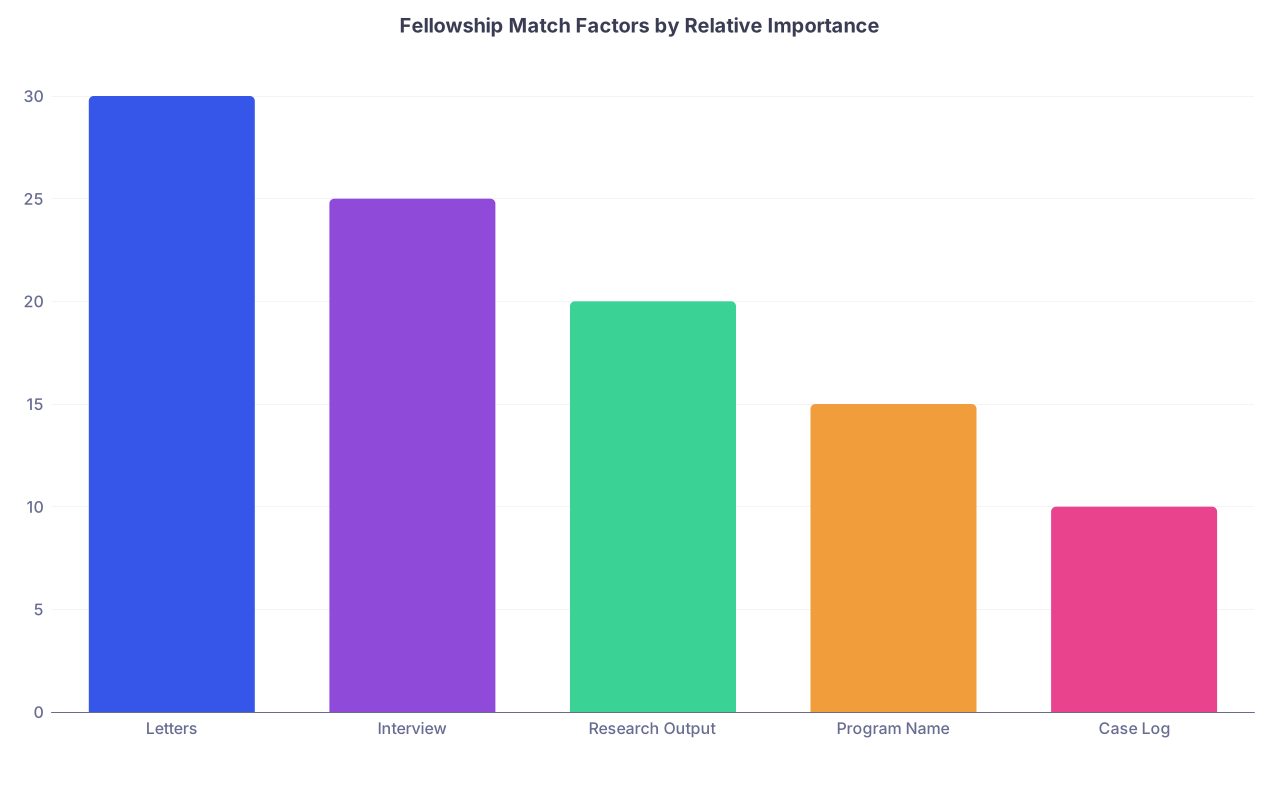
| Category | Value |
|---|---|
| Letters | 30 |
| Interview | 25 |
| Research Output | 20 |
| Program Name | 15 |
| Case Log | 10 |
7. Fix the Trauma/Complex Case Anxiety Specifically
The psychological part is real. Being at a place where all the mess goes somewhere else makes you feel soft.
Here’s how to push back against that.
Trauma
If your site ships major trauma:
- Get ATLS early and actually master it, not just pass it.
- Push to rotate at a Level I trauma center for at least 2–3 months total during residency.
- During that rotation, live in the trauma bay and ICU. Be the person always present, not the one scrolling in the call room.
- Ask the trauma faculty, near the end: “If I were graduating this year, what trauma skills would you worry about for me?”
That question stings. Good. The answers are your checklist.
Complex cancer / HPB / transplant
You’re not going to become an HPB master in a low-volume community job. But you do need:
- Comfort with biliary anatomy and major bleeding control
- Ability to handle unexpected findings in the abdomen
- Judgment about when to bail and transfer
Supplement with:
- Visiting observerships or short rotations at big onc centers.
- HPB and complex GI CME courses with cadaver labs as a senior resident (yes, these exist, and some programs will fund them).
- Aggressively reading/post-op debriefs for every slightly-complex case you do see.
8. Use Data, Not Insecurity, to Decide if You Should Try to Transfer
Everyone in your position at some point thinks, “Should I leave?”
Sometimes the answer is yes. But most of the time, residents underestimate what they can extract from their current setup if they stop being passive.
Here’s a rational framework.
You should actively explore transfer if:
- ACGME has placed your program on probation or serious notice.
- Chiefs are consistently under case minimums in major categories.
- Board pass rates are bad and nobody seems bothered.
- Multiple grads say, “I did not feel prepared,” and they’re not just complainers.
- You’ve had direct conversations with leadership and get vague reassurance, not concrete plans.
You should probably stay and optimize if:
- Case logs are solid, grads do fine, but the site simply isn’t “flashy.”
- You have at least some access to an academic partner or high-volume rotations.
- There are faculty who are willing to go to bat for you with letters and opportunities.
Transferring mid-residency is messy. New politics, lost seniority, sometimes even repeating a year.
So don’t do it because someone on Reddit said “community programs are trash.” Do it because the training is structurally unsafe or clearly inadequate, and you’ve confirmed that with actual data, not vibes.
9. Protect Your Future Self: Plan Your Senior Years Early
The later you wait to address gaps, the more desperate and less effective your fixes will be.
As a PGY-1/2:
- Identify your program’s elective structure for PGY-3/4/5 now.
- Figure out which rotations are negotiable. There’s almost always some flexibility: more time at trauma, less at private practice, etc.
- Start the conversations with leadership: “By senior year, I’d like to have had at least X months of high-acuity trauma / complex onc.”
As a PGY-3:
- Lock down any outside electives. These often take 6–12 months lead time for agreements, credentialing, housing, etc.
- Decide what you want to be speaking credibly about at graduation. For example: “I am very strong in open and laparoscopic bread-and-butter general surgery, comfortable with emergent laparotomy, and have meaningful exposure to complex onc through 3 months at [X Center].”
Make your senior year intentional, not whatever the scheduler throws at you.
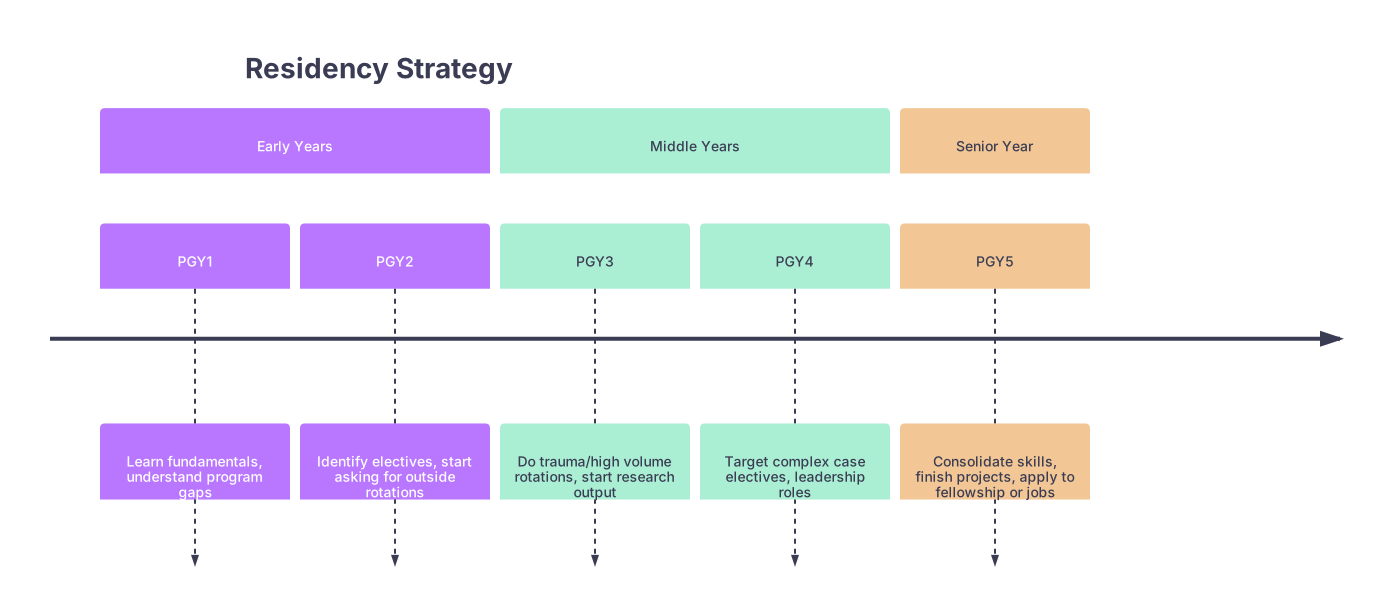
| Period | Event |
|---|---|
| Early Years - PGY1 | Learn fundamentals, understand program gaps |
| Early Years - PGY2 | Identify electives, start asking for outside rotations |
| Middle Years - PGY3 | Do trauma/high volume rotations, start research output |
| Middle Years - PGY4 | Target complex case electives, leadership roles |
| Senior Year - PGY5 | Consolidate skills, finish projects, apply to fellowship or jobs |
10. Mindset: Stop Apologizing for Where You Train
Last piece, and it matters more than people admit.
If you spend five years acting like your program is second-rate, it shows up in two places:
- Your confidence in the OR
- Your interviews for fellowship and jobs
People pick up on it. Quickly.
You can be realistic about limits without constantly trashing your training. The most convincing residents from “no-name” places sound like this:
“I’m at a community-heavy program, so I get a lot of autonomy and bread-and-butter volume. I knew I needed more high-acuity trauma and HPB exposure, so I built in rotations at [Big Center] and did a research year there. Between the two, I feel solid about my foundation and my experience with complex disease.”
That’s someone who understands the game and played it, instead of complaining about the rules.
FAQ (Exactly 4 Questions)
1. I’m an intern and already feel like my program is “weak.” Is it too early to worry about this?
It’s not too early to pay attention, but it is too early to panic. Intern year is supposed to feel like scut and chaos no matter where you are. Use PGY-1 to learn basics: workups, peri-op management, ICU care, how your attendings think. Start quietly collecting data: case numbers, how chiefs feel, where grads end up. Real structural decisions—like electives, outside rotations, research time—usually start to matter PGY-2 into PGY-3. That’s when you push hard.
2. My program leadership keeps saying, “You’ll get enough cases, don’t worry.” How do I push back without getting labeled difficult?
You do not argue opinions; you ask for specifics. “Can we look at recent graduate case logs, especially in complex GI, vascular, and trauma?” “Where are our residents getting their high-acuity exposure?” “Would it be possible to add a month at [X Center] in PGY-3?” Calm, data-focused questions are hard to dismiss as “difficult.” If they still hand-wave you away, that’s a red flag about the culture, not about you.
3. I want a very competitive fellowship (HPB, vascular, trauma), but my current site doesn’t do much of that. Am I already behind?
You’re not behind yet, but you’re on the clock. Competitive fellowships want: a smart, hardworking resident who has shown commitment to that field and sought out real exposure. For you, that probably means: research or QI in that area, at least one substantial rotation at a true high-volume center, and strong letters from people in that subspecialty. Your community base can actually help—if you show you can operate and manage patients well—then you add the “brand-name” subspecialty exposure via electives or a research year.
4. If I handle this well, will employers or fellowship PDs still judge me for being from a community program?
Some will. Many will not. What they really judge is the combination of where you trained, what you did with it, and how you present yourself. If your case logs are solid, your letters are strong and specific, you can discuss your cases and complications intelligently, and you’ve clearly sought out additional complexity where needed, you stop being “the community resident” and start being “the resident who made the most of their situation and looks ready.” That’s who gets hired and matched. Not the one with the fanciest logo on their badge.
Key points to remember:
- Diagnose the actual gaps in your training with data, not anxiety.
- Squeeze every drop of autonomy and bread-and-butter experience from your community site, then bolt on targeted high-volume exposure through electives, research, or outside rotations.
- Stop apologizing for where you matched; start building the training profile you want from where you are.