
The fellow is not your enemy—but if you do nothing, they will walk off with your cases.
If you’re a senior resident in a surgical program and you’re suddenly “competing” with new fellows for primary cases, you’re in one of the most common and most poorly handled situations in modern surgical training. Programs add fellowships to look prestigious. Residents then quietly panic when their case logs stall out.
Let me walk you through how to handle this like an adult surgeon in training, not a passive victim of the system.
First, Get Clear on What You Actually Need
Before you start fighting over cases, you need to know your target. “Enough cases” is not a feeling; it’s a number and a pattern.
Pull your actual requirements:
- ACGME minimums for your specialty (and any subcategories that matter)
- Any board expectations beyond the bare minimums
- Your program’s historical averages for graduating chiefs
You should know three things cold:
- Where you are now in each key category
- The projected pace if you keep getting current volume
- The gap you actually need to close during your senior year
Do this in writing, not in your head. Sit down with your case log and make a quick reality table.
| Case Type | ACGME Min | Program Avg Chief | You Now (PGY-4 end) | Needed by Graduation |
|---|---|---|---|---|
| Basic Laparoscopy | 85 | 140 | 65 | 75+ more |
| Major Vascular | 44 | 65 | 28 | 36+ more |
| Thoracic | 20 | 35 | 9 | 26+ more |
| Endoscopy | 50 | 90 | 42 | 48+ more |
Now you know what actually matters. You may not need to die on the hill of “every lap appy on the service.” You may absolutely need to defend your advanced lap, vascular, or thoracic cases.
You cannot advocate intelligently if you cannot quote your numbers.
Understand the Politics: Why Fellows Suddenly Get Everything
Here’s what’s really going on, stripped of the fluff:
- Fellows are often recruited with the promise of operative volume.
- Attendings like operating with fellows because it’s closer to junior faculty level help.
- Administration likes the prestige and productivity of fellowship-trained surgeons finishing cases faster.
- Resident education becomes “we’ll fit you in where we can.”
No one will admit it that bluntly. But you will see it in the room assignments.
The mistake many residents make is personalizing this: “The fellow is stealing my case.” Not accurate. The structure is set up to favor them unless you intervene.
Your job is to reinsert yourself into that structure—explicitly, consistently, and early.
Step 1: Have a Direct, Numbers-Based Talk with Your PD
Not a vague complaint. A targeted, data-backed conversation.
Go in with:
- Your case logs (printed or on a tablet)
- The specific categories where you’re short
- Examples of recent weeks where fellows took primary roles on cases you needed
You’re not whining. You’re showing a training risk.
Say something like:
“I’m concerned about meeting both ACGME and board expectations in [laparoscopic, vascular, thoracic, etc.] cases. I’m currently at X, our graduating chiefs average Y, and with the new fellows starting, I’ve already seen several cases where they’re primary and I’m either assistant or not in the room. I want to work with you on a clear plan to ensure I graduate with adequate primary exposure.”
Then ask very directly:
“How do you expect residents and fellows to share cases on this service? What’s the hierarchy? What is the default for who gets to be primary operator?”
Force clarity. Vague responses like “We’ll make sure you get enough” are useless. Push for something like:
- “Chief residents get first priority on bread-and-butter and index cases.”
- “Fellows get priority only on advanced or index cases specifically tied to their fellowship goals, and residents are second assist but still scrubbed.”
- “We’ll reserve certain days or rooms as resident-priority lists.”
If they won’t define it, you’re going to be negotiating case by case with attendings. If they do define it, you now have something you can quote politely in the moment: “Dr. X, Dr. PD mentioned chiefs will primary these cases—mind if I take the lead?”
Step 2: Talk to the Fellows Early—Before the First Fight
Do this in week one. Not after the first blow-up when you’ve already formed resentments.
You catch them in the lounge or after a case and say:
“Hey, I’m [Name], chief on this service. I know you need X, Y, Z for your fellowship, and I’m trying to finish my boards-qualifying numbers. Can we be explicit about how we split cases so we both get what we need and don’t step on each other constantly?”
Then have a straight conversation. Ask:
- “What cases are you under pressure to get? What are your board/fellowship targets?”
- “Where do you not care as much? Stuff I can reliably have as primary?”
- “How do you feel about alternating primary operator on similar cases?”
A lot of fellows are reasonable when you treat them like colleagues, not competitors. Many are also anxious—they’re starting a new role, want to impress, and often were explicitly told they’d be “running the room.”
You’re trying to build a working contract:
- They get priority on cases that are truly advanced or fellowship-specific.
- You get priority on bread-and-butter and key index chief-level cases.
- You both alternate or share appropriately in the gray zones.
If a fellow is stubborn and says some version of, “I was told I’d be running all the big cases,” file that away. That’s PD/business-office level talk that you should bring back upstairs.
Step 3: Use the Schedule Like a Weapon, Not a Calendar
Passive residents check the OR schedule the night before, shrug, and show up wherever they’re assigned.
Aggressive, smart residents treat the schedule like a chessboard.
Here’s what you do:
- Look at the OR schedule at least 24 hours in advance.
- Identify:
- Priority cases you absolutely need as primary
- Cases that are “nice to have but negotiable”
- Speak to attendings in advance, not at 7:15 am in front of the whole team.
You walk up the day before and say:
“Dr. Smith, tomorrow we have two laparoscopic colectomies. I’m trying to increase my primary advanced lap volume before graduation and I’m still short of our program’s usual chief numbers. Would you be comfortable with me leading one of those as primary, with [Fellow] assisting?”
Then you turn around and tell the fellow:
“I spoke with Dr. Smith—plan is I’ll primary the first colectomy while you assist, and you can take lead on the second while I assist. Sound good?”
By the time you’re in the OR, the negotiation is already settled.
If you wait until everyone is scrubbed and staring at each other, you’ve already lost.
Step 4: Negotiate Within the Case, Not Just “Who’s Primary”
Sometimes you will not win the “primary” label. That doesn’t mean you get nothing.
You can carve out specific, high-value portions of the case:
- “Can I do the port placement and critical dissection?”
- “Can I perform the proximal and distal anastomoses?”
- “Can I do the exposure and vessel control for this bypass?”
- “Can I drive the scope and do the intraoperative decision-making, even if you place the stapler?”
You say this out loud, calmly:
“Since [Fellow] is primary on this one, would you be okay with me doing the anastomosis and the critical parts of dissection so I can still count this as meaningful primary experience?”
A lot of attendings will say yes if you’re specific. They don’t want to referee vague “it’s my case” arguments. They will happily assign defined chunks: “Fellow does exposure, you do the resection, fellow does reconstruction,” etc.
Document it honestly in your case log. Do not play games. But do not undersell yourself either—if you did the entire dissection and technical work while the fellow assisted and made suggestions, you are not “assistant” in any meaningful educational sense.
Step 5: Build Alliances with the Right Attendings
Some attendings genuinely see themselves as educators. Others don’t. You probably already know who’s who.
Your goal is to intentionally attach yourself to the attendings who:
- Verbally ask, “Who needs this more?” before assigning primary
- Rotate primary status between resident and fellow
- Remember your name and where you are in your training
- Have a track record of sending out confident graduates
Make a list—literally—of who these people are in your program.
Then structure your life to maximize time on their services:
- Swap calls or elective rotations strategically to land on their blocks
- Ask chiefs/administration if you can be assigned to their rooms when there’s a choice
- Volunteer to come in early/late for their add-ons
And be explicit:
“Dr. Lee, I really benefit when I get to primary your laparoscopic and open cases. I know we have fellows around now, but if there are cases where you think the chief should primary, I’d really like those opportunities. I’m short in [X category] and trying to close the gap.”
The attendings who care will remember that and often protect your role.
Step 6: Fix Your Day-to-Day Behavior in the OR
If you want to win primary roles competing against a fellow, your behavior cannot be passive or sloppy. Fellows get picked because they act like junior faculty. Residents sometimes act like students.
You need to look and sound like the person who should be running the room.
That means:
- You’ve read the op notes from this attending on this operation before
- You know their preferred positioning, incision, instruments, and sequence
- You can present the case succinctly and correctly
- You anticipate steps and ask for instruments before you’re told
You literally say, before incision:
“Plan is midline incision from X to Y, enter abdomen with [technique], explore quadrants, then start with mobilizing the [structure] from lateral to medial using [instrument]. I’ll watch [critical structure] closely here because of [patient-specific issue].”
You talk like that, the attending naturally turns to you as the operator, even if the fellow is on the opposite side of the table. You sound like the surgeon. The fellow just sounds like extra help.
Sloppy behavior—showing up barely knowing the CT, fumbling with trocars, not knowing port placement—gives attendings a perfect excuse to say, “Let’s have the fellow run this.”
Do not give them that excuse.
Step 7: Use Data to Call Out Systemic Problems (Calmly)
If you notice a pattern—entire services where fellows are always primary and residents never get meaningful cases—you document it.
Not in a rant. In a clean, unemotional way.
For example:
- Track several weeks on vascular: note who was primary (fellow vs resident) on major cases
- Note how many cases you were scrubbed in but functionally just retracting
- Match that to your case log deficits
Then, in a meeting with your PD or department leadership, you say:
“On the vascular service this block, there were 18 major cases: 12 major bypasses or endovascular repairs, 6 carotids. Fellows were primary on 15 of the 18, with residents either assisting or retracting. I’m at X carotids and Y major vascular operations total, below both ACGME minimums and our usual chief averages. At this pace, I’m at risk of graduating underprepared. Can we define a policy where chiefs get primary on at least some proportion of these cases?”
Sensible leadership will see the problem. Spineless leadership will give you platitudes.
If you get platitudes, you escalate—not emotionally, but formally. That may mean bringing up concerns in CCC meetings, involving the GME office, or requesting that case distribution be reviewed by your Clinical Competency Committee.
This is your career. You cannot quietly accept “you’ll be fine” when your numbers say otherwise.
Step 8: Think Beyond Raw Volume—Target the Right Cases
Residents sometimes panic about raw case numbers and miss the quality side.
You do not just need “more cases.” You need:
- Defined index operations for your specialty
- Cases where you’re truly making decisions and running the flow
- Enough repetition in core procedures to build muscle memory
If you’re weak in lap chole, lap appy, colectomy, hernia repairs, etc., do not waste your political capital fighting for the rare super-complex redo case the fellow actually needs.
Strategize:
- Trade: Give the fellow the complex redo, take two standard cases and own them start to finish.
- Own the “boring” but essential cases and do them flawlessly.
- Use night and weekend add-ons as volume multipliers—fellows go home, you stay and operate.
I’ve seen residents dramatically shift their logs just by:
- Owning every emergency lap appy and chole for a month
- Staying for after-hours cases when fellows leave
- Taking every straightforward hernia they can find
Unsexy, but that’s how you get to board-ready.
Step 9: Know When to Stop Being Polite
Most situations can be handled with early, calm, explicit communication. But occasionally you get:
- An attending who insists the fellow is always primary
- A fellow who blocks you from meaningful participation
- A PD who won’t enforce any structure
Then you stop playing nice and start documenting and escalating.
That might look like:
- Email summaries after PD meetings: “As discussed, I remain below target in [X] and am still frequently in an assistant-only role on cases you identified as chief-level. I would like to revisit specific solutions.”
- Anonymous or named input on program surveys pointing out residents are not getting index cases due to fellow dominance.
- Requesting formal review in your semi-annual evaluation—a document that can’t be easily ignored.
You do not scream or throw instruments or fight in the OR. You build a paper trail showing that the system is not meeting its own educational obligation.
Is it uncomfortable? Yes. But graduating undertrained is worse.
A Quick Visual: How Your Case Mix Might Shift With Fellows
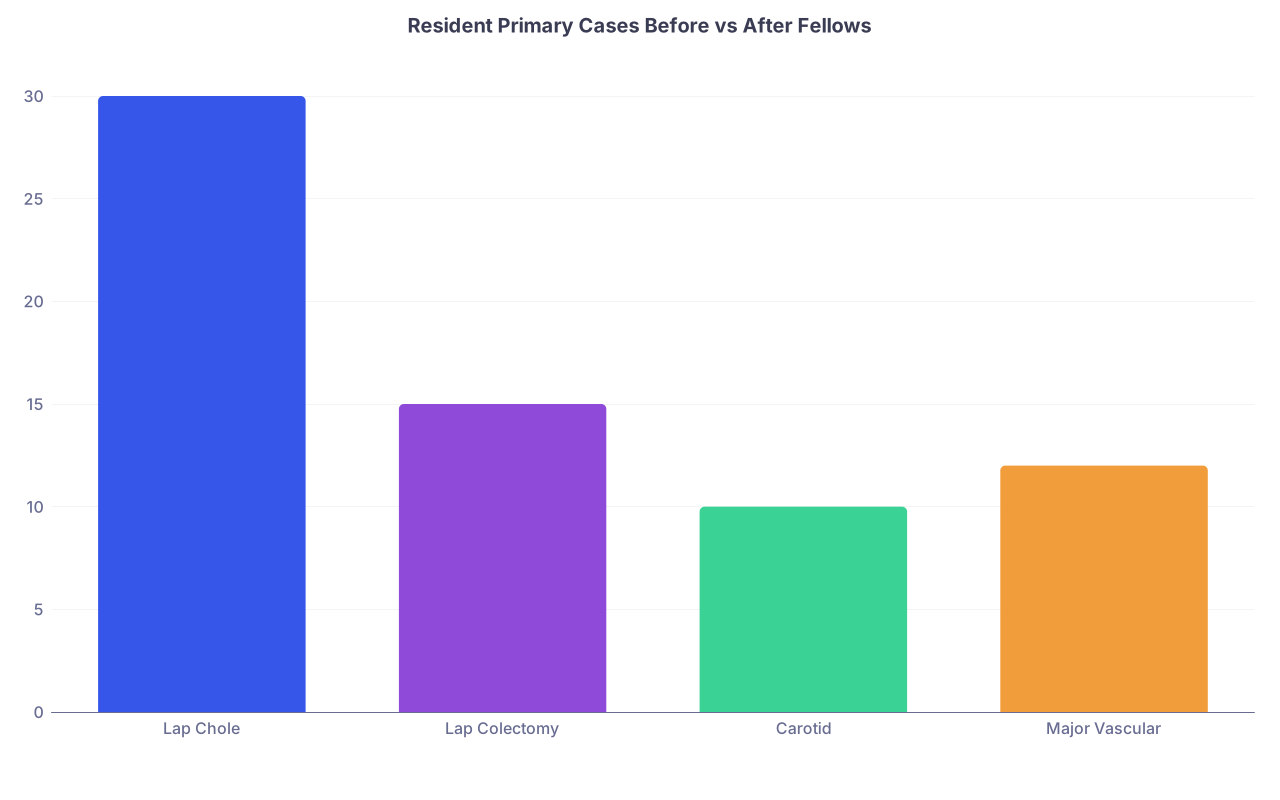
| Category | Value |
|---|---|
| Lap Chole | 30 |
| Lap Colectomy | 15 |
| Carotid | 10 |
| Major Vascular | 12 |
Imagine your numbers look like that pre-fellowship, then you watch each category drop 30–50%. You cannot ignore that. You act at the first sign of a sustained downward trend, not at the end of the year when it’s too late.
Step 10: Protect the Next Class Once You’re Safe
Once you’ve clawed and negotiated your way to a safe graduation case log, do something that too many people skip: make it better for the class behind you.
Share with your juniors:
- Which attendings advocate for residents vs fellows
- Phrases that worked when asking for primary roles
- How you structured conversations with PD and fellows
- What data you tracked and how you presented it
Even better—push for formal, written expectations in your program:
- “Chief residents will primary X% of index cases on services with fellows.”
- “Fellows will act as assistants or second surgeons for defined categories.”
- “Case distribution will be reviewed quarterly by CCC.”
Leave a footprint. Otherwise the same fight repeats every year with every new chief.
Key Takeaways
- Do not fight blindly. Know your exact case deficits and use numbers—paired with calm, explicit conversations—to argue for primary roles against fellows.
- Solve problems upstream. Talk early to your PD, your fellows, and key attendings; pre-negotiate cases off the schedule instead of arguing at the table.
- Act like the surgeon you want to be. Show up prepared, speak like the operator, claim defined portions of cases when you can’t be primary, and escalate formally (with data) when the system is failing your training.