
The case numbers you see on websites and recruitment slides are not the real story.
Programs quietly game surgical volume all the time, and most applicants never figure it out until they are already trapped in a contract.
Let me walk you through how it actually works behind the scenes — because faculty talk about this when you’re not in the room, and I’ve heard those conversations.
The Illusion of “High Volume” Programs
Every surgical program wants to be “high volume.” It sells well to applicants, it makes faculty feel important, and it looks good on ACGME reports. But here’s the trick: when you hear “our chiefs graduate with 1,200+ cases,” you almost never get the qualifiers that matter.
I’ve sat in meetings where the program director says, in almost these exact words:
“We just need the totals to look strong. The residents don’t need to know how the sausage gets made.”
What you see on the website:
- “Our residents exceed ACGME minimums by 30–50%.”
- “Unparalleled operative experience.”
- “Chief residents perform complex cases independently.”
What’s usually buried:
- How many of those cases are actually primary surgeon vs assistant.
- How much double- or triple-scrubbing is happening.
- Whether junior residents are blocked from cases so seniors can pad numbers.
- Whether clinics, endoscopy, and low-value add-ons are inflating totals.
The game is to hit ACGME minimums and still look sexy to applicants — without necessarily giving each resident the depth and independence they think they’re signing up for.
The Specific Ways Programs Quietly Inflate Case Numbers
This is where the manipulation actually happens. These are the tricks residents complain about privately and program directors will never put in writing.
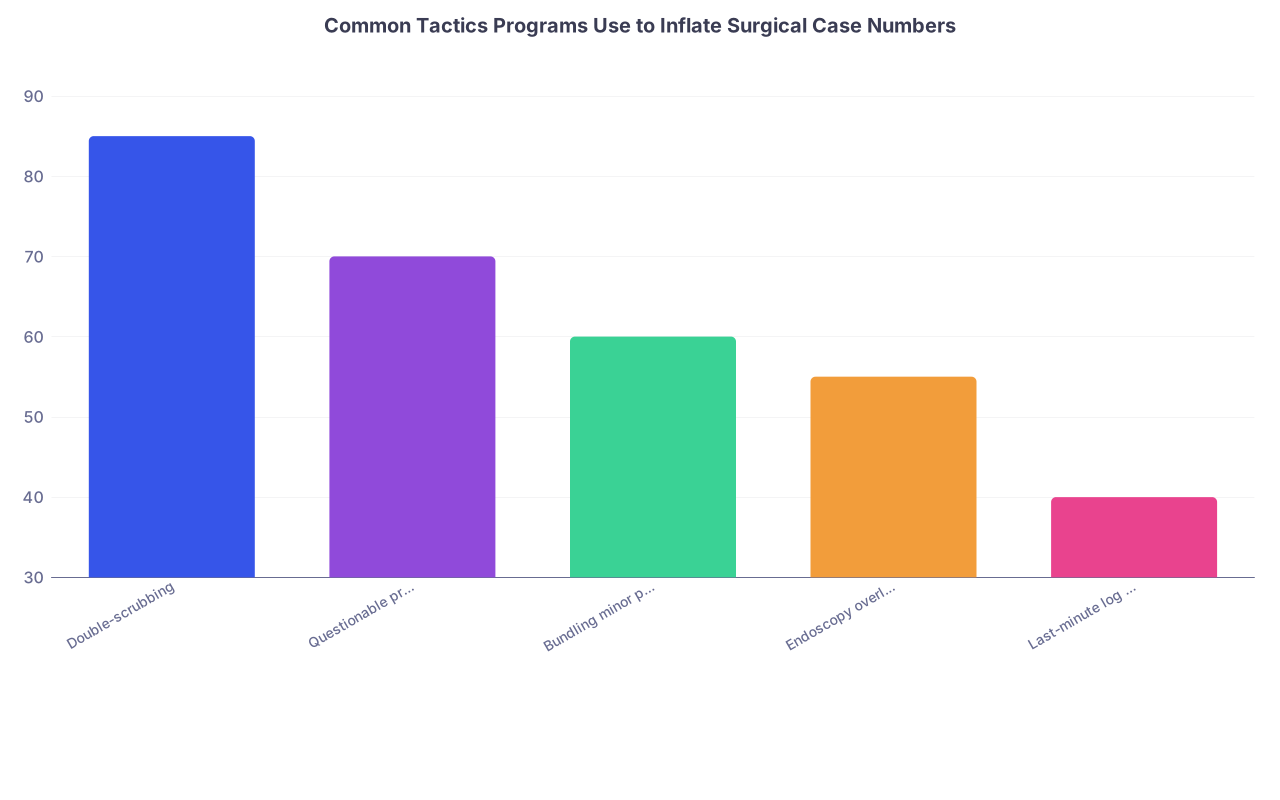
| Category | Value |
|---|---|
| Double-scrubbing | 85 |
| Questionable primary designation | 70 |
| Bundling minor procedures | 60 |
| Endoscopy overload | 55 |
| Last-minute log changes | 40 |
1. The “Primary Surgeon” Shell Game
The most abused field in any case log: role.
Programs know ACGME cares about primary surgeon numbers. So what happens in a lot of places? The word “primary” gets… flexible.
Typical scenario:
Senior resident stands on the right side. Junior stands on the left, holds retractors, maybe throws a few stitches. Attending does the key parts.
End of the case, the attending turns and says, “You can both log as primary.”
On paper: 2 “primary surgeon” cases.
Reality: 1.5 assistants, 0 true independent primary.
Worse, you’ll see:
- Residents who barely touched the laparoscope marking “primary.”
- Short-stay procedures (port removals, simple I&Ds) logged as primary surgeon to pad numbers.
- A culture where questioning your role designation is implicitly discouraged because “you’re hurting your own numbers.”
I’ve literally heard an attending tell a resident: “Don’t be strict about that, ACGME isn’t in the room.”
2. Double- and Triple-Scrubbing Everything
Some double-scrubbing is normal and beneficial, especially early on. But some programs crank this to 11 just to make their case logs look massive.
Red flags you’ll hear from residents (if they trust you):
- “There were three of us scrubbed on a straightforward lap chole.”
- “We had four people scrubbed on a single colectomy — PGY1, PGY3, PGY5, and fellow.”
- “We rotated through the room mid-case so everyone could log it.”
Why this matters: if half your major cases are shared between multiple residents, nobody gets enough reps to feel truly independent by graduation. Everyone’s log looks big. Skill level doesn’t match the paper.
Some PDs explicitly push this. I’ve seen an email that said:
“Make sure senior residents are scrubbed into junior cases where possible so they can boost complex numbers.”
It sounds educational. It’s really just numerical theater.
3. Padding With Low-Value, Low-Complexity Procedures
You’ll see programs brag about “our residents do huge numbers.” Then when you dig into it, a shocking proportion is minor, repetitive, or low-yield.
Common padding moves:
- Tons of port removals, wound VAC changes, PEGs, trachs, I&Ds.
- A massive number of bedside procedures counted the same way as actual OR cases in the culture of the program.
- Overweighting endoscopy or lines in specialties where that’s marginal for your goals.
Nothing wrong with learning those skills. But when your “1,200 cases” includes 300 endoscopies, 150 central lines, 100 drain placements, and 80 abscess I&Ds, your “big number” doesn’t equal big experience.
I’ve watched programs deliberately shift juniors toward procedure-heavy, complexity-light services just before ACGME reporting cycles to boost global numbers.
4. Manufacturing “Experience” in Clinic and Endoscopy
Some specialties lean on this more: general surgery, colorectal, GI-heavy services. But the tactic is the same.
You’ll see:
- Clinics where every “procedure” is logged — small biopsies, punch procedures, minimal interventions.
- Endoscopy sessions where residents stand in for the attending briefly, then log the full case as primary.
- Cases where the fellow “lets the resident drive” for part of the scope, and suddenly everyone logs it as primary.
Endo and clinic are important. But they become a blunt weapon in case log inflation if they’re used to make up for weak open or major cases.
Programs don’t advertise:
“Our open abdominal exposure numbers are mediocre, but your colonoscopy numbers will look great.”
They just say: “Outstanding endoscopy experience!”
5. Quiet “Log Optimization” Near Graduation
There’s a dirty little secret many residents have seen: case log clean-up sessions.
Typical pattern in the spring before graduation:
- Program director or coordinator runs a report.
- A few residents are light in key ACGME categories.
- Suddenly emails go out: “Make sure your cases are fully logged. Some categories may be undercounted.”
Then the fun starts:
- Residents “remember” cases from months ago and enter them with generous roles.
- Ambiguous cases get reclassified into categories they’re short on (e.g., “was that really a complex foregut or just a straightforward one?”).
- Some attending “verifications” become rubber stamps — nobody’s cross-checking details anymore.
Has ACGME cracked down on this in some places? Yes.
Does it still happen? Absolutely.
Nobody wants a graduating chief who doesn’t meet minimums. And some programs quietly fix that on the back end.
How to Spot Inflation Before You Match There
You can’t rely on what’s printed. You have to listen between the lines and read the culture. Here’s how people who know the system actually evaluate programs.
| Signal Type | Healthy Program | Inflated/Questionable Program |
|---|---|---|
| How they talk about numbers | Balanced, specific, nuanced | Big totals, vague detail |
| Resident language | “I feel confident doing X alone” | “Our numbers are huge” |
| Distribution | Steady autonomy increase by PGY | Sudden spike only late |
| Fellow presence | Clear role boundaries | Fellows everywhere in 'big' cases |
| Attending attitude | Honest about who does what | “Just log it as primary” culture |
Ask Residents About Specific Cases, Not Just Counts
Residents will often unconsciously parrot the party line if you ask, “Is the volume good?” That question is useless.
Ask things like:
- “By what point did you feel comfortable doing a lap appy alone?”
- “Who usually does the key parts of a Whipple / colectomy / major case? Attending, fellow, senior?”
- “When you log a case as primary, how much of the operation are you actually doing?”
- “What percentage of your cases are actually done without a fellow in the room?”
Listen for:
- Hesitation.
- Residents glancing at each other before answering.
- Answers that sound too polished, too aligned with website claims.
I’ve watched a chief say “we have great autonomy” while his co-resident, sitting three feet away, rolled her eyes so hard it was almost audible.
Dig Into Distribution, Not Just Totals
Program websites love to quote chief-level totals. They almost never show PGY-by-PGY breakdowns. Ask directly:
- “What were your case numbers at the end of PGY-2 and PGY-3?”
- “At what level did you start being true primary on major cases?”
- “Do interns get any primary cases beyond lines, I&Ds, and port removals?”
Red flags:
- Intern and PGY-2 years full of nothing but scutty procedures and assist roles.
- Autonomy only kicking in late PGY-4 or PGY-5.
- Seniors hogging cases “because they need numbers,” leaving juniors undercooked.
If you hear a lot of, “Yeah, junior years are rough but your chief year is amazing,” that’s code for: we backload your experience to make sure our graduates don’t fail ACGME thresholds, and you might feel underprepared for the boards or real practice until very late.
Watch for the Fellow Factor
Fellows aren’t the enemy. Bad structure is.
Programs with heavy fellowship presence in bread-and-butter or complex cases can quietly starve residents of meaningful primary experience while still inflating logs.
Questions to ask:
- “On a typical complex case, is it attending + fellow + resident, or just attending + resident?”
- “How is case allocation handled when both a fellow and resident want the same case?”
- “Do you ever feel like you’re there just to retract while the fellow operates?”
Look at the body language when you ask. The real answer is usually on their faces before they open their mouths.
Ask How Case Logs Are Reviewed
This is the one question almost nobody asks, and it’s where you catch the games.
Try this:
- “How often are your individual logs reviewed with you?”
- “Does anyone ever question your role designations (assistant vs primary)?”
- “Has the program ever had residents scrambling at the end to make minimums?”
A healthy program:
- Reviews logs at least yearly with honest discussion.
- Sometimes tells residents, “You listed this as primary, but you were really assisting — change it.”
- Is transparent if a resident is trending low in a category and actually fixes it with real cases, not paperwork magic.
An inflation-heavy program:
- Vaguely mentions “we monitor logs” with no specifics.
- Has no culture of critical review of primary vs assist roles.
- Only pays attention when the ACGME report is coming due, then suddenly everybody’s “making sure everything is logged.”
The Culture Test: What Attending Behavior Tells You
Data can be massaged. Culture is harder to hide.
On interview days, watch and listen to the attendings carefully. Their casual comments tell you more about case inflation than any brochure.

| Step | Description |
|---|---|
| Step 1 | Interview Day |
| Step 2 | Listen to Residents |
| Step 3 | Observe Attendings |
| Step 4 | Likely healthy volume |
| Step 5 | Possible inflation |
| Step 6 | Honest about autonomy |
| Step 7 | Respect resident role |
How They Talk About Autonomy
Programs that truly prioritize real primary experience say things like:
- “By mid-PGY-3 we’re pushing you to run a room.”
- “Fellows do not take residents’ index cases.”
- “We’ll slow down to let you struggle through the hard parts. That’s the point.”
Inflation-heavy programs lean on vague slogans:
- “Lots of exposure.”
- “You’ll see everything.”
- “Our graduates are very comfortable.”
- “You’ll log huge numbers.”
Notice the difference? One talks about what you actually do. The other talks about how big the numbers look.
How They Treat Residents in Front of You
Here’s the quiet part most applicants miss.
Watch:
- Does the attending defer to the resident to answer clinical questions? Or talk over them?
- When discussing a case, does the attending say “we had a great case and Dr. X (resident) did most of it”? Or is the resident never mentioned as an operator?
- Do residents seem relaxed speaking about operative experience? Or guarded?
I’ve been in pre-interview conferences where attendings say, “Don’t scare them with talk about ACGME minimums — just say we do tons of cases.” That’s not a training culture; that’s marketing.
How You Can Protect Yourself (And Your Future Practice)
You’re not going to fully decode a program in one interview day. But you can avoid the glaring traps.
Here’s how you protect yourself against inflated case volume propaganda.
Ignore the Website Totals
Take whatever number they boast (900, 1,100, 1,400) and put it on mute. Your questions should be:
- “How many real primary major cases will I have done by the end of PGY-3?”
- “What kinds of cases are you short on, honestly?”
- “Where do graduates usually feel weakest when they leave?”
A director who says, “Our trauma exposure is a little light, but we make up for it with strong colorectal and HPB” is actually more trustworthy than the one who claims everything is amazing.
Hunt for Discrepancies
Talk to:
- A junior resident.
- A mid-level resident.
- A chief.
If they all tell the exact same polished story in the exact same way, they’ve been trained. That’s not authenticity; that’s messaging.
Watch for:
- Chiefs who quietly admit: “I’m fine, but I wish I’d had X earlier.”
- Juniors saying: “We don’t really get on the main cases yet, but they say it gets better.”
- Anybody saying: “We always hit our numbers, don’t worry.” That’s not the flex they think it is.
Ask Where Graduates Go — And How Prepared They Felt
One of the most honest barometers of real training: what graduates say after they’ve left.
Questions that get better answers:
- “Have any recent grads come back and said they felt underprepared in any area?”
- “Do any graduates from the last 3–5 years struggle passing boards or early in fellowship?”
- “Any alumni who had to scramble late to meet certain case requirements?”
If the answer is always, “No, never, everyone is thrilled,” they’re lying or not listening.
Some of the best programs I know will openly say:
- “Our vascular exposure is lighter than ideal; people who want that do a fellowship.”
- “We’re strong in laparoscopy, weaker in complex open HPB — we try to supplement with certain rotations.”
That’s what honesty sounds like.
FAQ: Surgical Case Numbers and Program Games
1. If both residents log “primary” on a case, does ACGME care?
A little, but not as much as you think. ACGME mostly sees totals and category distributions. They don’t have a camera in the room. They can audit and question outliers, but day-to-day, programs have a lot of leeway. That’s why the culture of honest logging matters more than the technical rules.
2. Are community programs better or worse about inflation than big academics?
Different games, same problem. Community programs sometimes inflate with sheer volume of bread-and-butter minor procedures and very loose “primary” roles. Academic programs often have the fellow factor and double-scrubbing. The only way to judge is to ask residents specifically what they actually do, not what the stats show.
3. Can I trust ACGME case log public data when comparing programs?
You can use it as a rough directional guide, but not as a precise measure. If a program’s chiefs average 350 major cases and another’s average 1,000, that difference is real. But if it’s 1,050 vs 1,200, the spread might be mostly inflation, logging habits, and category games. Use the data to spot extremes, not to split hairs.
4. What’s a realistic goal for “good” operative experience by graduation?
For most surgical fields, you want: strong independent competence in bread-and-butter cases, repeated exposure (not just one or two) to the major index procedures, and early enough autonomy that you’re not first doing everything alone as a new attending. The exact number changes by specialty, but if you don’t feel comfortable running a room solo by late PGY-4, something’s off regardless of the raw count.
5. How early should I start asking about case numbers as a med student?
Earlier than you think. On sub-I’s, you should quietly ask residents about their logs, how they’re built, and whether they feel matched to reality. Don’t obsess over totals as an MS3, but pay attention to patterns. If multiple residents from different years all hint that “the numbers look good, but…” — believe them.
Key points you should walk away with:
Most programs massage case numbers, and some outright inflate them — the question is how far, and whether anyone is honest about it.
You cannot judge operative experience by website totals; you have to interrogate who actually does what in the OR and when autonomy really starts.
If you listen to how residents and attendings talk — not just what they say — you can usually tell within a day whether the case volume is real or just clever accounting.