
The worst rotation schedule is the one that ignores the calendar.
If you treat all months as equal, you’ll miss peak OR seasons, get stuck on “dead” weeks with no cases, and walk into away rotations when the department is half-empty and the chief is on vacation. I’ve watched smart students do everything right academically and still have weak letters—because they showed up in February to a service that’s slammed in August.
Let’s fix that, step by step, across an entire year.
Big Picture: How Surgical Case Volume Actually Cycles
First, you need a mental map. Case volume does not stay flat. It shifts with:
- School calendars (resident vacations, graduation, new intern start)
- Patient behavior (holidays, deductible resets, school breaks)
- Weather (trauma, ortho, vascular, burn)
- Flu/COVID/RSV waves (elective case delays)
Here’s the rough pattern most US hospitals follow. Not perfect, but close enough that you should plan around it.
| Month | Elective Volume | Trauma/Acute Volume | Teaching Environment |
|---|---|---|---|
| Jan–Feb | High | Moderate | Stable |
| Mar–Apr | High | High | Busy, pre-graduation |
| May–Jun | Moderate | Moderate | Senior residents checked out |
| Jul–Aug | Variable | High | New residents, chaotic |
| Sep–Oct | High | Moderate | Strong teaching |
| Nov | Moderate | High around holidays | Short weeks |
| Dec | Low–Moderate | High trauma/ED | Heavy vacations |
Now let’s turn this into an actual timeline you can follow.
12–18 Months Before: Choose Your Target Seasons First, Not Rotations
At this point you should not be thinking “Which hospital?” yet. You should be thinking “Which months for which services?”
Step 1: Decide what you want out of each rotation
You can’t optimize for everything. Pick the main goal for each type of rotation:
- Core home rotation (MS3/early MS4):
- Goal: Learn the basics, see a broad mix of cases, figure out if you even like this field.
- “Letter of recommendation” rotation:
- Goal: Show consistency, work with letter writers, be present for conferences and clinics, not just cool cases.
- Procedural/technical rotation:
- Goal: Volume and repetition—lap choles, hernias, scopes, fractures, C-sections.
- Trauma/acute care month:
- Goal: Resuscitation, ICU exposure, night work, quick decision-making.
- Away/audition rotation:
- Goal: Be visible to the PD and key faculty during a normal (not skeleton-crew) month.
Write this on paper. Literally label each upcoming rotation by its primary purpose. Because peak case volume is not always the best time for a letter, and slow months are not always bad if your priority is face time or conferences.
Step 2: Map your school’s calendar against peak OR seasons
At this point you should:
- Pull your medical school academic calendar (start/end of clerkships, exam blocks).
- Highlight:
- June–July (new resident transition)
- November and late December (holidays)
- Match week and graduation
- Overlay the typical case cycles from the table above.
You’re looking for:
- Months with:
- Normal staffing
- Full clinic and OR schedules
- Minimal holidays
- Months to avoid for critical rotations:
- July at a new teaching hospital
- Late December at almost any site
- Thanksgiving week if it’s only a 4-week rotation
You aren’t booking anything yet. You’re choosing 3–4 “prime windows” (e.g., September, October, January, March) where you want your highest-impact rotations to live.
9–12 Months Before: Lock In Core Rotations Around High-Volume Seasons
Now the calendar starts to matter. At this point you should be placing:
- Core surgery clerkship (if flexible)
- Subspecialty surgical rotations (orthopedics, ENT, urology, OB/GYN, neurosurgery, plastics, etc.)
- Any early exposure electives
Core surgery rotation: when to do it
If you can choose, aim for:
- Not the first month of the year (you’re clueless, they’re figuring out new workflows)
- Not the dead of summer at a residency-heavy shop if July is pure chaos
- Avoid December if you want a lot of elective cases
Strong options:
- September–November: Cases are steady, residents are comfortable, teaching is decent.
- January–April: Very good for elective volume and consistent schedules.
If surgery is your likely specialty:
- Put core surgery in the first half of the year where you still have time to:
- Do a sub-I later
- Apply for away rotations with actual experience
Subspecialty rotations: match seasonal case peaks
At this point you should identify which subspecialties are seasonal beasts:
- Orthopedics:
- Peaks: Winter (slips, falls), sports seasons (late summer/fall), ski/snowboard areas in winter.
- Plan: If you want trauma-heavy ortho, aim for Dec–Feb (but avoid the two holiday weeks) or peak sports-injury seasons locally.
- Trauma/Acute Care Surgery:
- Peaks: Summer (more MVCs, violence, outdoor accidents) and holidays.
- Plan: If you want raw experience and don’t care as much about attending continuity, June–August can be wild—in a good way.
- OB/GYN (L&D):
- Births are relatively steady but some hospitals see local bumps based on school calendars and elective inductions near holidays.
- Plan: Avoid major holidays when staffing gets thin; aim for “normal” months.
- ENT, plastics, derm surgery, some uro:
- Heavier elective volume in early year and after summer vacations.
- Plan: Jan–May or Sep–Oct for cosmetic-heavy or clinic-to-OR continuity.
You want at least one high-volume rotation in a field you’re considering as a career, placed in one of your earlier “prime windows.”
6–9 Months Before: Design Your Away Rotation Calendar Around Volume, Not Just Reputation
This is where people screw up. They get an away at “top program X” and accept whatever month they’re offered—even if it’s the deadest OR month of the year.
At this point you should:
- Shortlist 3–6 away sites.
- For each, email or check with:
- The student coordinator
- Chief residents you can find via program websites
- Recent alumni from your school who rotated there
Ask very specific questions:
- “For general surgery rotations, which months have the most consistent OR days for students?”
- “Are there months when a lot of attendings are away at conferences?”
- “Are students pulled to cover wards more when interns are new in July?”
- “Are there blocks where trauma volume is high but elective cases drop off?”
Then you match:
- Goal: Letter + evaluation by PD
- Pick: A month where:
- The PD is actually in town.
- Teaching conferences are fully running.
- OR schedule is not decimated by holidays.
- Good bets: August–October at most programs.
- Pick: A month where:
- Goal: Raw case volume / trauma exposure
- Pick: A month with high acute volume even if electives dip.
- Good bets: June–August or December in many urban centers.
Avoid:
- Last two weeks of December for an away. Half the staff is gone. OR lists collapse.
- The exact first month new interns start, if students get used as extra floor coverage.
3–6 Months Before: Week-by-Week Fine-Tuning and Call Patterns
By now, your rotation slots are mostly assigned. You’re not moving entire months easily, but you can still optimize within months.
At this point you should:
- Get the call schedule template for the service (from prior students or chiefs).
- Ask how the OR schedule changes by week for:
- Major conferences (ACS, AAOS, ACOG, etc.) when attendings disappear.
- Holiday weeks.
- Exam weeks for residents (ABSITE, in-service exams).
You’re trying to avoid:
- Being on your only “golden OR week” but stuck on nights that never see a case.
- Landing your crucial evaluation week when your primary attending is at a national meeting.
How to stack high-yield weeks
Within a 4-week rotation, aim to arrange:
- Week 1:
- Lighter call if possible; learn systems, show up on time, learn names.
- Week 2–3:
- Heavier OR exposure, more call, more nights if trauma-heavy.
- Week 4:
- Protect one or two key OR days with your main attending for final impressions and cases you can lead.
Do this by:
- Swapping call days early with willing residents.
- Asking chiefs directly: “If there’s a week with more big cases, I’d like to be around for that—where should I aim my call days?”
People who ask this bluntly often get exactly what they want. Because it shows you care about the work.
In-Rotation: Day-by-Day Tactics to Maximize Cases in Any Season
Even in “slow” months, you can still see more cases than the average student. That’s not optimism; it’s logistics.
At this point, each day, you should:
- Check the OR board before you leave (for tomorrow’s cases).
- Identify:
- The rooms with high-yield cases for your level (lap chole > rare Whipple you’ll just watch).
- Surgeons who like students vs. those who clearly do not.
- Text or tell your resident:
- “These are tomorrow’s cases I think I can be useful on—can I scrub with Dr. X at 10:00 if we’re free?”
Also:
- On “dead” days:
- Ask to float to:
- Endoscopy
- Minor room
- Other teams with full lists
- Go to clinic and follow patients pre-op → OR → post-op. That continuity matters to letter writers.
- Ask to float to:
Peak season or not, the student who checks the board, shows up early, and politely requests high-yield cases gets more reps. Every time.
Specialty-Specific Peak Season Plays
Let’s get more concrete for a few common surgical tracks. These are general tendencies; always double-check locally.
General Surgery
- Elective heavy months: Jan–April, Sep–Oct.
- Trauma heavy: June–Aug, holiday weeks.
Optimal pattern if you want gen surg:
- Core gen surg: Jan–April or Sep–Oct (good volume + teaching).
- Sub-I at home: Aug–Oct of your MS4 year (right before ERAS submission / interview season).
- Away rotations:
- 1 trauma-heavy month (June–Aug).
- 1 balanced service month (Aug–Oct) when PD is around.
Orthopedic Surgery
- High trauma: Winter (falls, snow/ice), summer (recreational injuries), evenings/weekends.
- Elective joints/backs: Early year before deductibles reset, also fall.
Optimal pattern:
- Core or early ortho elective: Winter for trauma experience.
- Away rotations:
- Late summer/early fall (Aug–Oct) at programs you want, when they’re in full swing.
- Protect:
- ABSITE weeks and AAOS if that drains attendings.
OB/GYN
- L&D constant, but:
- Some places have more scheduled inductions before holidays.
- GYN onc, MIGS, urogynecology may have more steady elective volumes Jan–May and Sep–Nov.
Optimal pattern:
- Core OB/GYN: Any “normal” month (avoid major holiday clusters).
- Sub-I and away:
- Late summer/fall when residents are comfortable, attendings not all away.
How Conferences and Exams Quiet the OR
You’ll see visible OR drops around:
- Major specialty conferences:
- ACS Clinical Congress (general surgery)
- AAOS, AANS, ASTRO, SGO, ACOG, etc.
- Board/in-service exams:
- ABSITE (late Jan for surgery)
- Specialty in-service exams across fields
At this point in your planning, you should:
- Look up the major conferences for your target specialty.
- Check their typical dates.
- Do not schedule your one critical away rotation squarely on top of those if you can avoid it.
If you’re already locked in:
- Plan to:
- Be ultra-useful to the attendings who stay.
- Work with PA/NP/solo surgeons who might appreciate an engaged student more when others are gone.
Quick Visual: Yearly Case Volume Focus
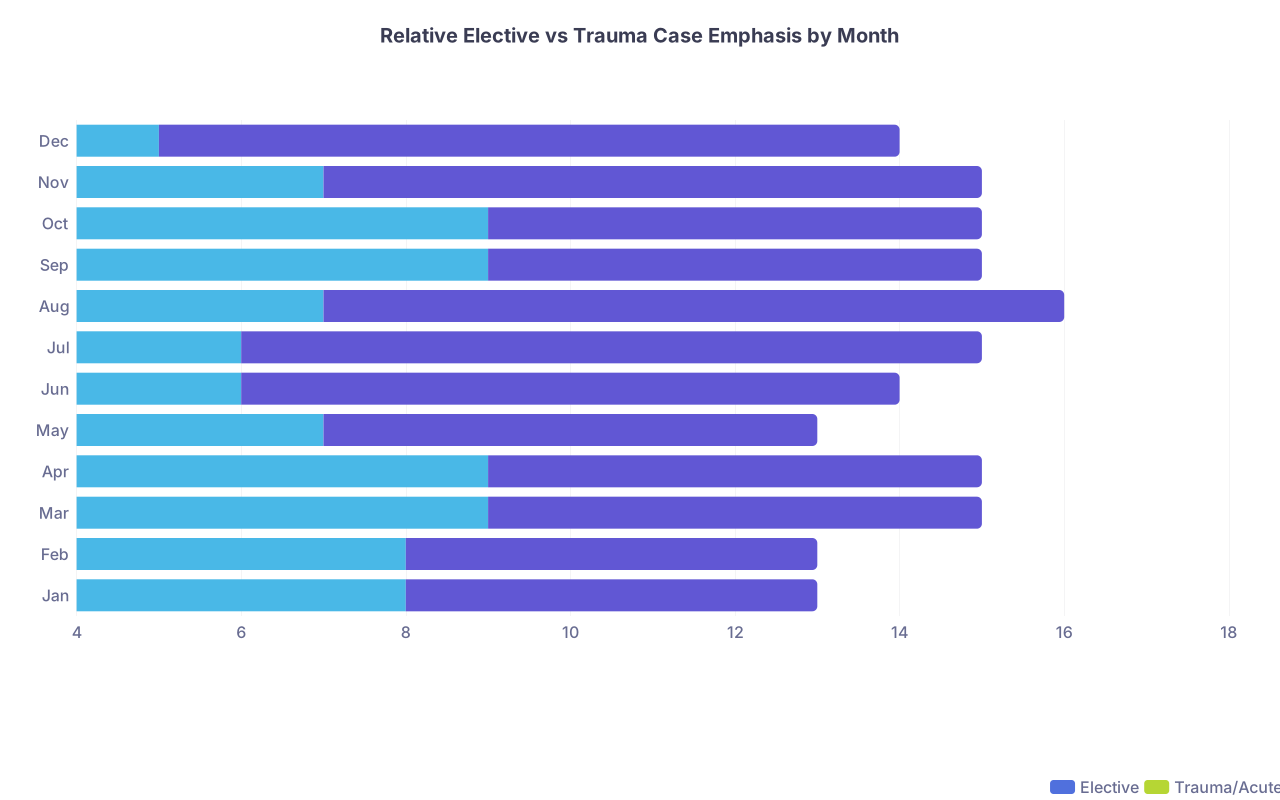
| Category | Elective | Trauma/Acute |
|---|---|---|
| Jan | 8 | 5 |
| Feb | 8 | 5 |
| Mar | 9 | 6 |
| Apr | 9 | 6 |
| May | 7 | 6 |
| Jun | 6 | 8 |
| Jul | 6 | 9 |
| Aug | 7 | 9 |
| Sep | 9 | 6 |
| Oct | 9 | 6 |
| Nov | 7 | 8 |
| Dec | 5 | 9 |
Use this as a rough mental model, not gospel. The key is that you think about what you’re walking into.
The Real Future Shift: Data-Driven, Not Gut-Driven Scheduling
Hospitals are already tracking:
- Hourly OR utilization
- Case types by day of week and month
- Cancellation patterns around holidays and flu season
- Surgeon block-time usage
It’s only a matter of time before students can see a dashboard that says:
- “Average student case exposure in August trauma: X”
- “Average elective cases per student in March breast surgery: Y”
You are early. But you can act like that data already exists.
At this point you should behave like your future self with full analytics would:
- Choose rotations not by convenience, but by:
- When attendings are present.
- When ORs are actually running.
- When residents are skilled enough to teach but not so busy they ignore you.
Put It All Together: A Sample MS4 Surgical Year
Here’s one example for a student aiming at general surgery:
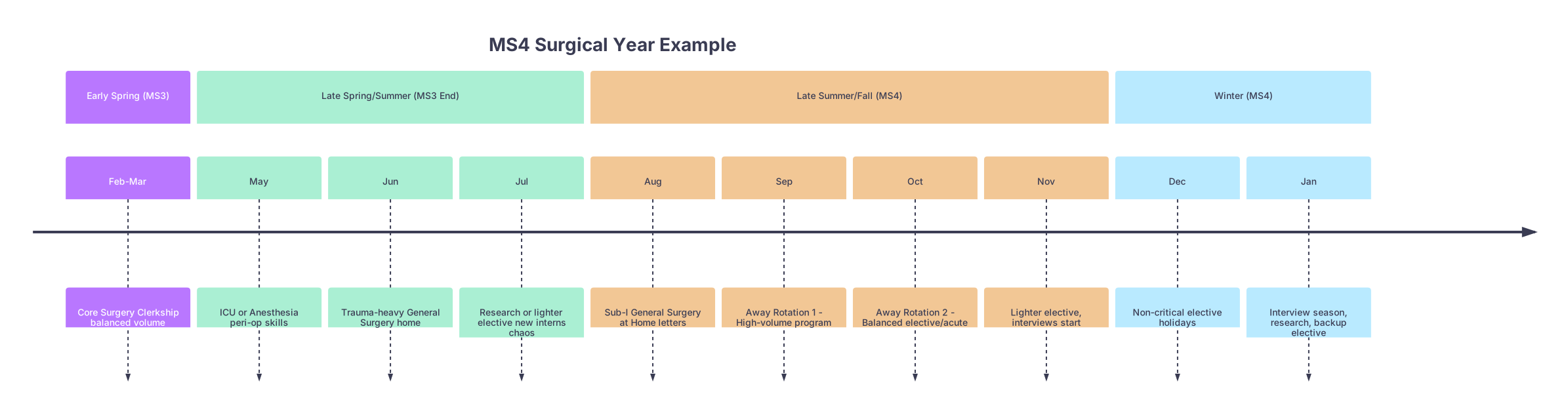
| Period | Event |
|---|---|
| Early Spring (MS3) - Feb-Mar | Core Surgery Clerkship balanced volume |
| Late Spring/Summer (MS3 End) - May | ICU or Anesthesia peri-op skills |
| Late Spring/Summer (MS3 End) - Jun | Trauma-heavy General Surgery home |
| Late Spring/Summer (MS3 End) - Jul | Research or lighter elective new interns chaos |
| Late Summer/Fall (MS4) - Aug | Sub-I General Surgery at Home letters |
| Late Summer/Fall (MS4) - Sep | Away Rotation 1 - High-volume program |
| Late Summer/Fall (MS4) - Oct | Away Rotation 2 - Balanced elective/acute |
| Late Summer/Fall (MS4) - Nov | Lighter elective, interviews start |
| Winter (MS4) - Dec | Non-critical elective holidays |
| Winter (MS4) - Jan | Interview season, research, backup elective |
You’d adjust for your specialty, but the logic stays:
- Peak volume months for skills and exposure.
- Stable, fully staffed months for letters and away rotations.
- Holiday and chaos months reserved for electives where continuity and volume matter less.
What You Should Do Today
Do one concrete thing right now: pull up your school calendar and write down three “prime rotation windows” (e.g., Sept–Oct, Jan–Mar) and three “avoid if possible” windows (e.g., late Dec, early Jul).
Then open your rotation request form or VSLO dashboard and move at least one major rotation—core, sub-I, or away—into a better month based on case volume, not just what was left open.