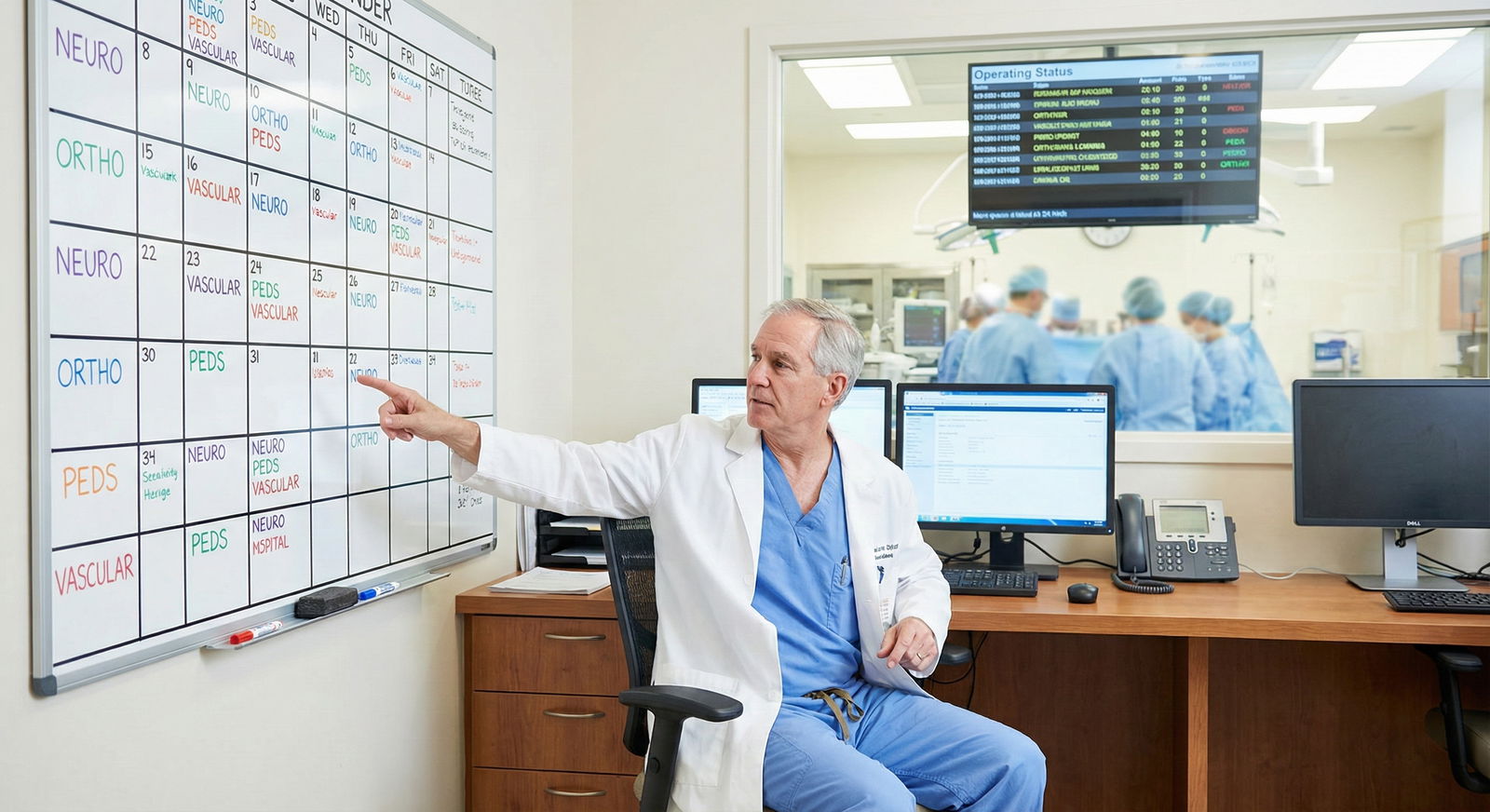
The way most residents “plan” electives is backward. They chase hype rotations and big-name surgeons instead of building a deliberate, year‑by‑year case exposure strategy.
You are not collecting badges. You are building a surgical portfolio over time. That means you plan electives like a long campaign, not a series of last‑minute grabs.
Below is a concrete, chronological timeline for planning electives across your residency (and late med school if you’re not there yet) so you end up with:
- Balanced case exposure
- Protected time for boards and research
- Enough depth in a niche to be competitive for fellowship
- Actual bandwidth to sleep and not burn out by PGY‑5
Use this like a playbook. Year by year, quarter by quarter.
Big-Picture Map: What Your Electives Need to Cover
Before we zoom into months and weeks, you need the blueprint. Over a full general surgery residency, a balanced elective plan should deliberately allocate time into four buckets:
| Bucket | Total Target Time | Primary Goal |
|---|---|---|
| Bread and butter | 2–3 blocks | Core case competence |
| Subspecialty depth | 2–4 blocks | Fellowship competitiveness |
| Adjacent skills | 1–2 blocks | ICU, endoscopy, imaging |
| Future-focused areas | 1–2 blocks | Robotics, AI, global surg |
If you finish residency and you have not touched at least three of those four buckets, something went wrong.
MS3–MS4 (Or PGY‑0): Setting the Foundation
This applies if you’re a med student eyeing surgery, a prelim year, or a “PGY‑0” research year.
At this point you should…define your direction, not your final plan.
Months 0–6 (mid‑MS3 to early MS4):
Audit your exposure so far.
Grab a piece of paper (yes, physical):- List every rotation you’ve done.
- Under each, write: “clinic / ward / OR” and rough case types you saw.
- Circle any area where your OR exposure is basically zero.
Choose 1–2 exploratory electives. Focus on:
- A high-volume acute care / trauma or general surgery service
- One subspecialty that might be your future (e.g. colorectal, MIS, vascular)
Don’t over-specialize yet.
Doing three plastics sub‑I’s as an MS4 because you “love plastics” is how people end up unable to manage a sick abdomen at 3 a.m. later.
Months 6–12 (late MS4):
At this point you should be:
- Locking in sub‑internships that show you can function like an intern.
- Prioritizing services with real case volume, not just prestige.
Ask bluntly: “How many cases will a sub‑I typically scrub in a 4‑week block here?” If they dodge, that’s your answer.
PGY‑1: Stop Thinking “Elective,” Start Thinking “Gaps Log”
Intern year is mostly non-elective, but planning starts now.
Q1 (July–September): Track, don’t tweak
You probably have minimal control over schedule yet. Fine. Your job now is data collection.
At this point you should:
Create a simple case exposure spreadsheet:
- Columns: Date, Service, Case type (e.g. lap appy, open hernia, CABG assist), Role (primary, first assist, observer)
- Add a “Bucket” column: Bread & Butter / Subspecialty / Adjacent / Future
After each week, do a 5‑minute review:
- Are you seeing mostly bread & butter gen surg?
- Are you completely missing ICU/critical care? Endoscopy? Trauma?
This sounds pedantic. It isn’t. The chief who “suddenly” realizes in PGY‑4 they have barely any endoscopy? They didn’t track.
Q2–Q3 (October–March): Start mapping PGY‑2 electives
Around mid‑PGY‑1, the chief/residency admin will ask about elective preferences. Most interns shrug and say, “Oh, colorectal sounds cool.” That is lazy.
At this point you should:
Pull up your gaps log. What’s thin?
- No trauma?
- No vascular?
- Weak ICU exposure?
Design PGY‑2 electives with three goals:
- Patch obvious gaps (especially ICU/trauma).
- Secure at least one bread and butter‑heavy elective where you operate a lot.
- Start tasting subspecialties you might pursue.
Time electives around life and boards.
- Avoid brutal electives right before ABSITE.
- Place heavier operative electives when you’re not covering nights if possible.
Q4 (April–June): Lock scheduling constraints
By late PGY‑1 you should:
- Have requested electives in writing (email) with:
- Top 3 preferences
- When you prefer to take them
- Why (educational rationale, not “because it’s chill”)
Residents who do this early almost always get better slots.
PGY‑2: Foundation Electives – Build your Core
PGY‑2 is where elective planning actually starts affecting your case log.
At this point you should…prioritize breadth + critical care.
Aim for 2–3 elective blocks this year. Sequence matters.
Block 1 elective (early PGY‑2: July–October)
Best uses:
- Surgical ICU / Trauma ICU elective
- Acute Care Surgery on a team that actually takes you to the OR
Why now?
- You need strong ICU and resuscitation skills to be safe as you gain autonomy.
- Trauma/ACS gives you bread and butter emergent cases: appys, choles, bowel, washouts.
During this block:
- Keep tracking your case log by bucket.
- Note complication management and decision-making, not just procedures.
Block 2 elective (mid‑year: November–February)
Here you start to tilt toward likely interests, but still broad.
Options:
- Endoscopy elective (if your program offers a focused block)
- Vascular general (for lines, amputations, bypass exposure)
- Colorectal (colons, anastomoses, ostomies)
At this point you should:
- Ask yourself, “Could I see myself doing a fellowship in this?”
- Watch the fellows. Do you like their day-to-day or just the idea of the specialty?
Block 3 elective (late PGY‑2: March–June)
This is flexible. Good uses:
- A second ICU/Trauma stint if you’re still weak there
- A future-focused elective: robotics, MIS, or a structured imaging rotation
- A global surgery elective if your program allows and you’re actually serious about global work
PGY‑3: Targeted Depth + Strategic Volume
PGY‑3 is the inflection point. You’re competent enough to benefit from higher-level electives and close enough to fellowship decisions that choices matter.
At this point you should…commit to a direction, not a single program.
Decide on a track, even if you’re not 100% on the fellowship:
- Track A: General surgery practice
- Track B: Fellowship-heavy (MIS/colorectal/HPB/plastics)
- Track C: Acute care / trauma / critical care focus
Q1–Q2 (July–December): High-yield subspecialty electives
Plan 2 subspecialty-heavy electives here.
Examples:
If considering colorectal/MIS:
- 1 block colorectal (lots of lap cases, pelvic anatomy)
- 1 block advanced MIS/foregut with robotics exposure
If leaning vascular:
- 1 block open vascular
- 1 block endovascular / hybrid OR focused
If pursuing trauma/critical care:
- Additional trauma ICU block
- Acute care surgery with heavy OR call
At this point you should:
- Start building mentorship: choose electives on services with attendings who write strong, detailed letters later.
- Be clear with them: “I’m thinking of MIS fellowship; I want my elective here to build a solid case base and work closely with you.”
Q3 (January–March): Board prep + balanced exposure
ABSITE hits. Do not stack a crushing elective here if you can help it.
Ideas:
- An elective with manageable hours but consistent OR time (bread and butter gen surg).
- A structured simulation / robotics curriculum block if your program has one.
Q4 (April–June): Early fellowship positioning
By spring PGY‑3 you’re only months away from submitting fellowship apps (for some fields).
At this point you should:
Review your case log with your PD or advisor:
- Are you overweighted in one subspecialty and light everywhere else?
- Do you need a general surgery heavy block to avoid being “too niche and too green” at graduation?
Adjust PGY‑4 electives now, while there’s still room to move.
PGY‑4: Fellowship Prep and Autonomy Electives
PGY‑4 is where elective planning gets political. Everyone’s angling for the “good” rotations. You’re going to be smarter about it.
At this point you should…align electives tightly with your post-residency goal.
Q1 (July–September): Anchor elective in your intended field
If you’re applying (or about to apply) for fellowship:
- Take an elective in your target subspecialty on:
- The highest-volume service
- With faculty who are known in that field
- Where you can be primary surgeon on a meaningful number of cases
During this block:
- Track key fellowship-relevant cases:
- MIS: laparoscopic colectomies, Nissens, bariatrics
- Colorectal: low anterior resections, pelvic dissections
- Trauma: laparotomies, vascular injuries, thoracotomies
You’re not just counting cases. You’re curating the ones that will show up on your CV and in interviews.
Q2 (October–December): Adjacent skills and leadership
This is prime time for adjacent skill electives:
- Advanced endoscopy (if future practice will need it)
- Imaging/radiology rotation (CT/MRI/US reads with radiologists)
- Administrative/quality improvement elective where you lead a project
Why now?
- Fellowship apps often expect some mature QI/research experience.
- You can combine a lighter elective with interview travel if timing aligns.
At this point you should:
- Ensure you’re not neglecting global competencies:
- Managing complications
- ICU-level decision-making
- Systems-level thinking (discharge, readmissions, LOS)
Q3–Q4 (January–June): Patch holes before chief year
Late PGY‑4 is your last real chance to correct major exposure gaps.
Pull your ACGME (or equivalent) case log and mark anything that’s:
- Dangerously low compared to program averages
- Personally weak (you’ve “done” 20 but don’t feel comfortable)
Good late-PGY‑4 elective uses:
- Another general surgery or ACS block to reinforce bread and butter.
- Extra ICU time if you still feel shaky running a sick unit overnight.
- A forward-looking elective in robotics/AI integration/innovation lab if you’re at a center that actually uses them meaningfully.
PGY‑5 (Chief Year): Finish the Portfolio, Don’t Chase Novelty
By chief year, if you’re still chasing “cool” electives, you’ve missed the point.
At this point you should…protect your competence, not your ego.
Q1–Q2 (July–December):
- Chief responsibilities already act like a full-time elective in leadership and autonomy.
- If you have any elective control, use it for:
- Maximizing bread and butter cases you’ll see in independent practice
- Mentoring juniors on services where you’re strong
Future-focused stuff (AI, VR, innovation labs) is nice, but not if you’re undercooked on basic laparotomies.
Q3–Q4 (January–June):
- No heroics. No brand-new niche elective in the last 4 months.
- Focus on:
- Repeating high-yield, high-volume services
- Cleaning up your case log for credentialing
- Ensuring you meet hospital/practice requirements for privileges in common procedures
Integrating Future of Medicine: Robotics, AI, and New Tech
The trap with “future of medicine” electives is simple: people treat them like shiny objects and forget they still need to close an anastomosis under pressure.
You integrate them with intention.
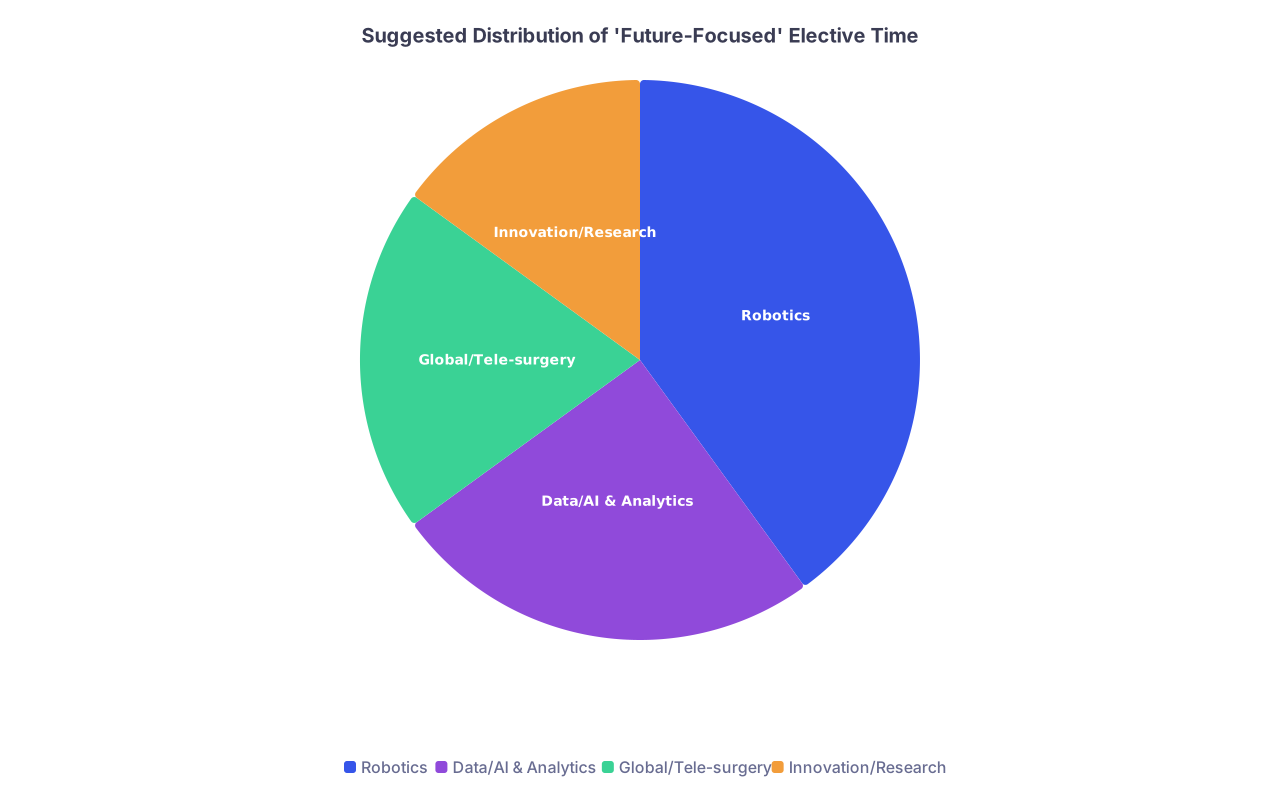
| Category | Value |
|---|---|
| Robotics | 40 |
| Data/AI & Analytics | 25 |
| Global/Tele-surgery | 20 |
| Innovation/Research | 15 |
When to add these:
- PGY‑2–3: Robotics simulation / exposure block (console time + bedside)
- PGY‑3–4: Data/AI elective working with quality or analytics team (readmission prediction, length-of-stay modeling, etc.)
- Any year with structured support: Global surgery or tele-surgery initiative with proper supervision and ethical structure
At this point you should…treat future-focused electives like seasoning, not the main dish.
- 1–2 blocks total across residency, not 6.
- You should come out more competent with new tools, not less competent at basic surgery.
Putting It All Together: Sample 5-Year Elective Timeline
Not every program will allow this exact layout, but it gives you a concrete model.
| Year | Block 1 | Block 2 | Block 3 | Block 4 |
|---|---|---|---|---|
| PGY-1 | Mostly assigned | Mostly assigned | Plan PGY-2 with PD | Lock preferences |
| PGY-2 | Trauma/ SICU | Vascular or Colorectal | Robotics / Global / ACS | — |
| PGY-3 | MIS/Colorectal | Endoscopy / Vascular | Gen Surg (high volume) | Adjust PGY-4 plan |
| PGY-4 | Target subspecialty | Imaging / QI / Endoscopy | Trauma / ICU (if needed) | Robotics / Innovation |
| PGY-5 | High-volume gen surg | ACS / Chief-heavy | Repeat key service | No new electives |
This is not perfect. But it’s balanced. You graduate:
- With bread and butter competence
- With fellowship-relevant depth
- With a taste of future tools and systems
Week-by-Week: How to Actually Plan an Elective Block
Let’s zoom into a single 4‑week elective. Most residents waste half of it “figuring it out.” You’re not doing that.
4 weeks before the elective
At this point you should:
Email the service chief or elective director:
- Confirm start date, expectations, OR days, clinic days.
- Ask for a pre-reading list and typical case mix.
Review your case log:
- Identify 3–5 procedures you really want to solidify on this block.
Week 1
Days 1–3:
- Learn the workflow fast: boards, rounds, how cases are assigned.
- Make it known (once, clearly) what you’re hoping to gain:
- “I’m aiming to get more comfortable with laparoscopic colectomies and stapled anastomoses; I’d really appreciate opportunities to do those when appropriate.”
End of Week 1:
- Quick self-audit:
- How many cases did you actually scrub?
- Were you primary or just retracting?
If it’s low or weak, speak up early, not in Week 4.
Week 2–3
At this point you should double down:
- Target specific attendings who teach and let you do more.
- Ask to pre-op complex cases: imaging review, plan, consent discussion.
- Log not just the case but what part you did (ports, dissection, anastomosis).
Week 4
- Ask for specific feedback:
- “What would you want me to improve before I’m a chief doing these independently?”
- Update your gaps log:
- Did this elective actually move the needle in the bucket you intended?
If the answer is no, that’s a planning problem. Fix it for the next block.
Common Planning Mistakes (And When They Creep In)
You’ll see these all the time:
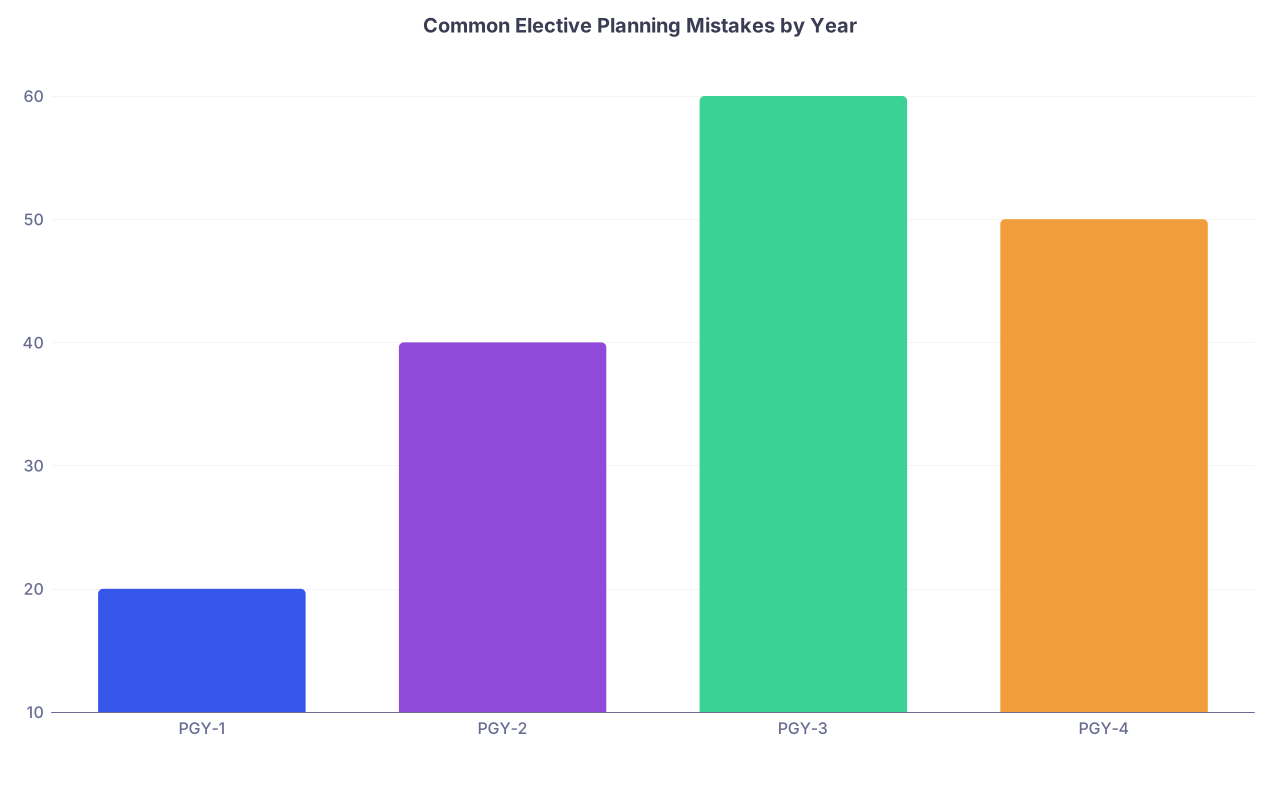
| Category | Value |
|---|---|
| PGY-1 | 20 |
| PGY-2 | 40 |
| PGY-3 | 60 |
| PGY-4 | 50 |
Over-specializing too early (PGY‑2).
Three plastics electives before you can run a bowel obstruction overnight is malpractice on yourself.Ignoring ICU/trauma until it’s too late (PGY‑3–4).
Then you’re chief on nights, overwhelmed, and it shows.Choosing electives for lifestyle, not learning (any year).
Everyone wants a chill block sometimes. But if every elective is “easy,” you pay for it later in fellowship or practice.No longitudinal plan.
Taking each year as it comes without a 5‑year arc is how you end up lopsided.
A Visual: How Your Focus Should Shift Over Time
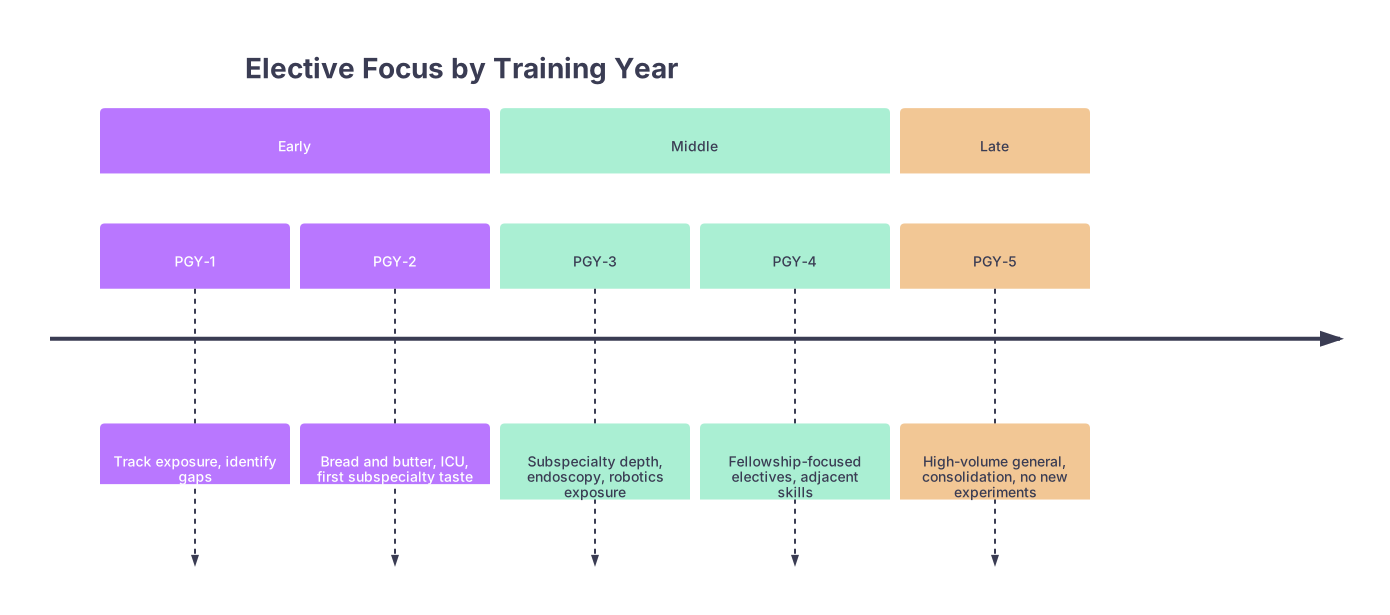
| Period | Event |
|---|---|
| Early - PGY-1 | Track exposure, identify gaps |
| Early - PGY-2 | Bread and butter, ICU, first subspecialty taste |
| Middle - PGY-3 | Subspecialty depth, endoscopy, robotics exposure |
| Middle - PGY-4 | Fellowship-focused electives, adjacent skills |
| Late - PGY-5 | High-volume general, consolidation, no new experiments |
What You Should Do Today
Open your case log (or start one if you somehow still do not have one) and:
- Mark each case with one of four labels: Bread & Butter / Subspecialty / Adjacent / Future.
- Count how many you have in each bucket by year.
- Write down the next two electives where you can intentionally shift those numbers.
If you cannot name those next two electives and what they’re supposed to fix, your plan isn’t a plan yet. It is momentum. Fix that now.