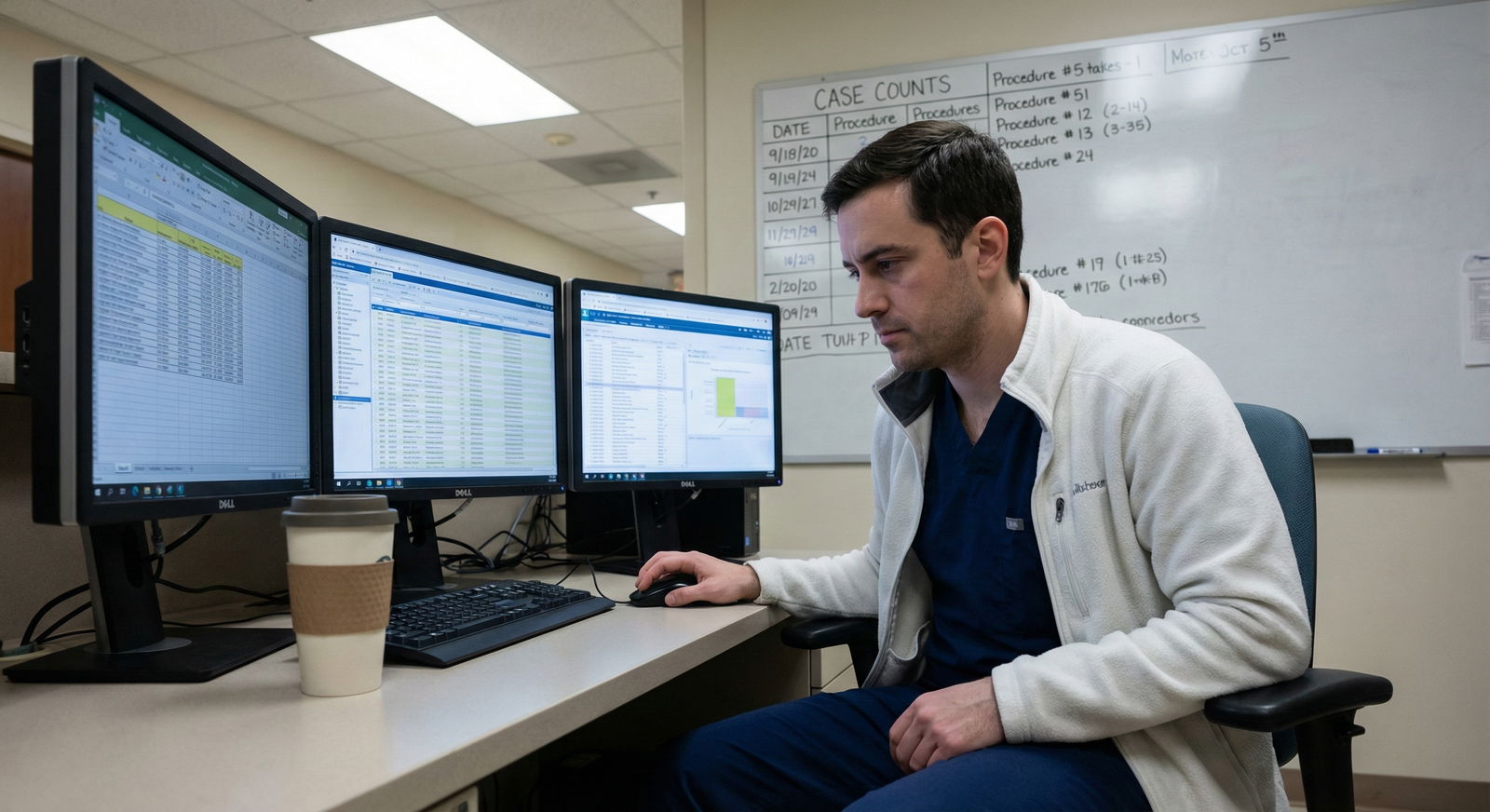
It’s January 1st. Your fellowship applications open in June. You think your case volume is fine. You also have a bad feeling you’re about to find out your “I do a lot of cases” story doesn’t match the actual logs.
This six‑month window is when serious applicants quietly separate themselves. Not by magic letters or glowing PD emails. By cold, boring, unsexy case audits and targeted fixes.
Here’s your timeline.
Six Months Out: Hard Audit, No Denial
At this point you should stop guessing and start counting.
Week 1: Pull everything
Sit down for 60–90 minutes, no interruptions. You’re going to collect every data source that even pretends to track your operative experience.
Pull:
- Official ACGME/ACGME-like logs (New Innovations, MedHub, Typhon, whatever your program uses)
- EMR case history (Epic/OR Manager/Optime reports; ask your OR analyst if needed)
- Any personal/op log spreadsheets or Notion/OneNote lists
- Clinic procedural lists (endoscopy suite, minor procedure room, cath lab equivalents)
- Call logs for high-yield procedures done off-hours (e.g., trauma OR, emergent scopes, bedside procedures)
Then immediately export your “official” log to a static file (CSV or Excel). That’s your baseline.
Now, create one master Excel or Google Sheet. Four tabs:
- Raw export – untouched from your official system
- Cleaned log – you’ll standardize names and remove duplicates here
- Missing/Discrepant – cases found elsewhere but not in official log
- Summary – procedure counts vs targets
Do not skip this. Mental tracking is garbage.
Week 2: Clean and reconcile
Now you align reality with what the fellowship committee is going to see.
Stepwise:
Standardize procedure names
- Map “Lap chole” = “Laparoscopic cholecystectomy” = “Cholecystectomy, lap”
- Same for scopes, flaps, segments, etc.
Kill duplicates
- Same date, same patient initials/MRN, same procedure – keep the primary entry
- Watch for “resident, assistant, observer” triple-logging errors
Reconcile with EMR
- Run an OR case report for your name as primary/assistant over residency
- Cross-check 3–6 recent months line by line to see how “off” your logging habits are
- If you’re missing more than ~10–15% of your recent cases, assume earlier years are worse
Feed your Missing/Discrepant tab
- Any case in the EMR or your personal list that is not in the official log gets recorded
- Include date, MRN (or partial), procedure, your role, and source
Then talk to your coordinator or PD: “I’ve identified X cases that didn’t make it to my log; what’s the correct process to add them?” Some systems let you back‑enter; some want documentation. Follow the annoying rules. This is worth the pain.
Week 3: Benchmark against reality
At this point you should know your actual volume. Now you need to know what “enough” looks like for your specialty.
Build a very basic target table based on ACGME minimums and what your senior co‑fellows matched with.
| Fellowship Type | Key Case Type | Typical Competitive Range |
|---|---|---|
| MIS/Bariatric | Lap foregut cases | 150–250+ |
| Colorectal | Colon/rectal resections | 120–180+ |
| Surgical Oncology | Complex onc resections | 100–150+ |
| Vascular | Endovascular interventions | 200–300+ |
| Trauma/CC | Trauma laparotomies | 70–120+ |
Sources:
- Last year’s successful applicants from your program (ask them: “What were your rough numbers for X, Y, Z?”)
- Fellowship program websites (some list minimum expectations)
- PD or APD (“If you see a borderline volume for X, what number makes you nervous?”)
Now, in your Summary tab, track:
- Total major cases
- Key index cases for your intended fellowship
- Trend by PGY year (are you actually growing, or did you peak as PGY‑2?)
- Bread-and-butter vs specialized (e.g., foregut vs misc lap gen surgery)
Use conditional formatting to flag weak spots (e.g., below minimum, barely at minimum, strong). You want your eyes to hurt a little when you see the gaps.
Five Months Out: Identify Gaps, Make a Plan
Now that the data is clean, you admit where you’re short.
Week 4–5: Categorize your volume
Ask yourself four blunt questions:
- Do I meet ACGME minimums comfortably, or just scrape by?
- Do I have fellowship-relevant depth, or just a random pile of bread-and-butter?
- Are there glaring holes? (e.g., almost no revisional bariatrics, no rectal cancers, barely any open aortic work)
- Is my senior-year trajectory showing leadership, or am I still the assistant on everything cool?
Make a focused gap list, not a vague wish list.
Example for MIS applicant:
- Solid: Lap chole, lap appy, primary hernias
- Borderline: Lap foregut (fundoplication, hiatal hernia repairs)
- Weak: Revisional bariatric, complex abdominal wall recon
Example for colorectal:
- Solid: Right/left colectomies; colonoscopies
- Borderline: Low anterior resections
- Weak: IPAA, redo pelvis, complex fistula work
Write down 3–5 specific categories, not 20.
Week 6: Match gaps to opportunities
Now you look at your schedule and ask: where in the next 5 months can I realistically fix this?
Pull your rotation schedule from now to June. Overlay your gaps on it.
You’re looking for:
- High-yield rotations (HPB, MIS, colorectal, vascular, trauma, transplant)
- Steady-volume weeks (endoscopy, bread-and-butter general surgery in a high-volume community site)
- Low-yield or “check the box” time (administrative, research elective, consult‑heavy rotations) you might be able to tweak
This is where people either take control or drift.
Have a 15–20 minute conversation with:
- Your PD or APD
- The fellowship‑aligned attending who knows you best
Say something like:
“I’ve audited my case log and I’m solid on X and Y, but light on Z and Q. Over the next 5 months, where would you plug me in to realistically shore that up?”
You’re not begging for special treatment. You’re showing up with data and a time box.
Four Months Out: Tactical Reassignment and OR Positioning
At this point you should be actively shaping where you stand and what you do in the room.
Week 7–10: Micro‑targeted tweaks
You’re not getting a whole extra year of MIS or colorectal. You’re getting:
- A week shifted from a low-yield elective to a high-yield service
- A habit of positioning yourself for the right cases every day
- The reputation as “the resident who shows up early and owns X type of case”
Concrete moves:
Ask for specific weeks, not vague favors
- “Could I be on MIS the week of March 11? I saw they have three hiatal hernia cases booked.”
- “If there’s flexibility, could I swap one clinic half‑day for more OR on colorectal in April to work on low anterior resections?”
Call the board the afternoon before
- Identify cases aligned with your gaps
- Email or text the chief: “I saw there’s a redo ventral hernia with component separation tomorrow; any chance I can be assigned to that room?”
This is what strong applicants do quietly. Daily.
Be clear about your role in the OR
When you’re in the case you need, make your intention obvious:- “Dr. Smith, I’m trying to build my experience with complex abdominal wall; would it be OK if I lead from port placement through mesh fixation, with your guidance?”
Attendings remember that. And usually say yes if you’ve shown up prepared.
- “Dr. Smith, I’m trying to build my experience with complex abdominal wall; would it be OK if I lead from port placement through mesh fixation, with your guidance?”
Three Months Out: Tracking Trajectory, Not Just Totals
Now you’ve been “on it” for a few weeks. Time to see if it’s actually working.
Week 11–12: Mid‑course check
Update your Summary tab with new cases. Compare:
- Two months before you started this process
- Now
Look for:
- Increase in key fellowship‑relevant cases
- Increase in primary operator vs assistant roles
- Any category still flat despite your efforts
Now is the time to escalate if something isn’t moving.
Examples:
- You’re still not getting trauma laps despite being on trauma all month → talk to the trauma director specifically about taking more primary roles.
- You’re on vascular but stuck on minor cases while the other senior gets the open aortas → have a direct, polite conversation: “I’m applying in vascular, and I’d like to be considered primary on at least X more open cases this month where feasible.”
Week 13: Lock in letters tied to case volume
By this point, there should be 2–3 attendings who’ve seen your operative growth in the last 2–3 months.
Ask them for letters now, while your cases with them are recent:
“I’ve been focusing on building my case volume in X and Y before fellowship applications in June. I’d really value a letter that can speak to my progression as primary surgeon on these cases.”
This links their narrative to your numbers. Programs love that. “I’ve seen this resident perform 25+ complex foregut cases as primary” hits differently when your log backs it up.
Two Months Out: Fine‑Tuning and Presentation
At this point you should stop trying to fix deep structural gaps. That ship has mostly sailed. Now you refine how your case volume reads on paper.
Week 14–16: Clarify and categorize
You’re preparing for ERAS or equivalent. You want your case volume to:
- Look clean
- Tell a story
- Align with your stated interests
Do three things:
Clean up weird outliers
- If you logged procedures with bizarre names or misclassified them, correct them now
- Make sure high‑value cases are appropriately labeled under the right category (e.g., not “Other: MIS” when they’re clearly “Lap colectomy”)
Create a one‑page “Operative Highlights” doc for yourself
Not for upload. For interviews and your own clarity. Include:- Total major cases
- Key procedure counts (3–5 types)
- Any leadership/teaching in the OR (“primary on X cases where I taught juniors”)
- 2–3 “representative cases” you can discuss in depth (complex, complications, decision‑making)
Check for internal consistency
- Does your claimed interest in HPB make sense if you have 6 hepatectomies and 0 Whipples? Maybe you reposition as “complex GI/foregut with strong HPB exposure.”
- If you’re branding as advanced endoscopy but you have mostly diagnostic scopes, be honest and emphasize trajectory, not expertise.
One Month Out: Dry Run and Final Patch Jobs
Now you should be out of denial and into rehearsals.
Week 17–18: Mock fellowship application + interview alignment
Fill out a mock ERAS (or your match platform) entry set, focusing on how your case volume shows up indirectly:
- Experiences section: are your “most meaningful” experiences tied to actual operative numbers?
- Research: does it line up with what your logs say you’ve seen?
- Personal statement: if you claim “extensive experience” with something, verify your logs would back that word up.
Then, do a 30‑minute mock interview with someone who will be blunt:
- PD, APD, recent fellow, or that senior attending who never sugarcoats anything
- Tell them: “Drill my operative volume. Ask what would make you nervous as a PD.”
Common questions you should rehearse with numbers handy:
- “How many lap foregut cases have you done as primary?”
- “What’s your experience with revisional bariatric?”
- “How comfortable are you performing a low anterior resection independently?”
- “What types of complications have you personally managed in the OR?”
You’re not reciting a spreadsheet, but you should not be guessing.
Final Two Weeks Before Apps Open: Lock, Don’t Panic
At this point you should stop tinkering and commit.
Week 19–20: Freeze the log and sync your story
Export your final pre‑application case log
- Save as PDF and Excel
- This is what you’ll reference if a program asks for logs later
Align your letters, statement, and CV with your actual numbers
- If a letter writer is emphasizing your trauma experience, make sure your trauma log isn’t an embarrassment
- Personal statement stories should be traceable to real cases with real volume behind them
Stop comparing raw numbers to your co‑residents daily
Look at your trajectory and your fit. Your goal was never to “win” volume. It was to prove you’ve had enough reps that fellowship won’t be starting from zero with you.
Visual Summary: Case Volume Over the Six Months
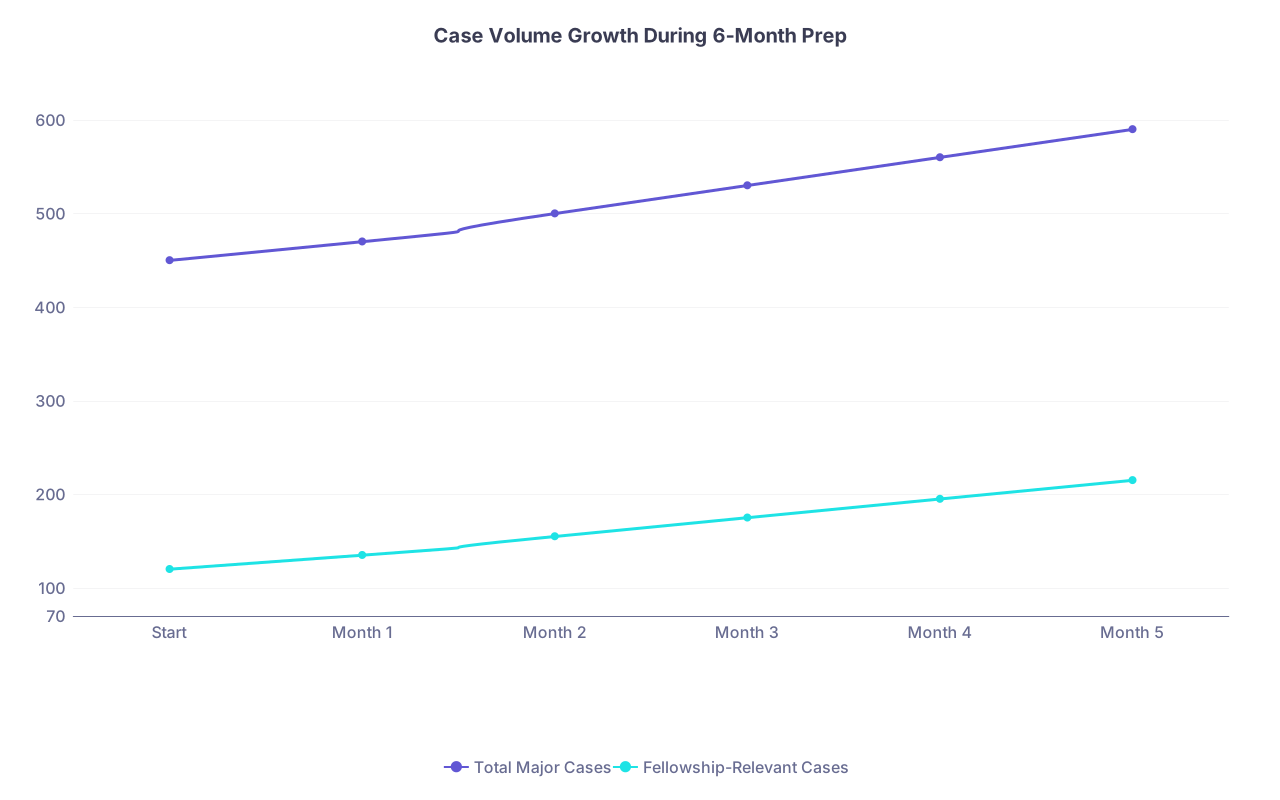
| Category | Total Major Cases | Fellowship-Relevant Cases |
|---|---|---|
| Start | 450 | 120 |
| Month 1 | 470 | 135 |
| Month 2 | 500 | 155 |
| Month 3 | 530 | 175 |
| Month 4 | 560 | 195 |
| Month 5 | 590 | 215 |
You’re not trying to double your numbers. You’re trying to show a clear upward slope in the cases that actually matter.
Quick Process Map: From Panic to Plan
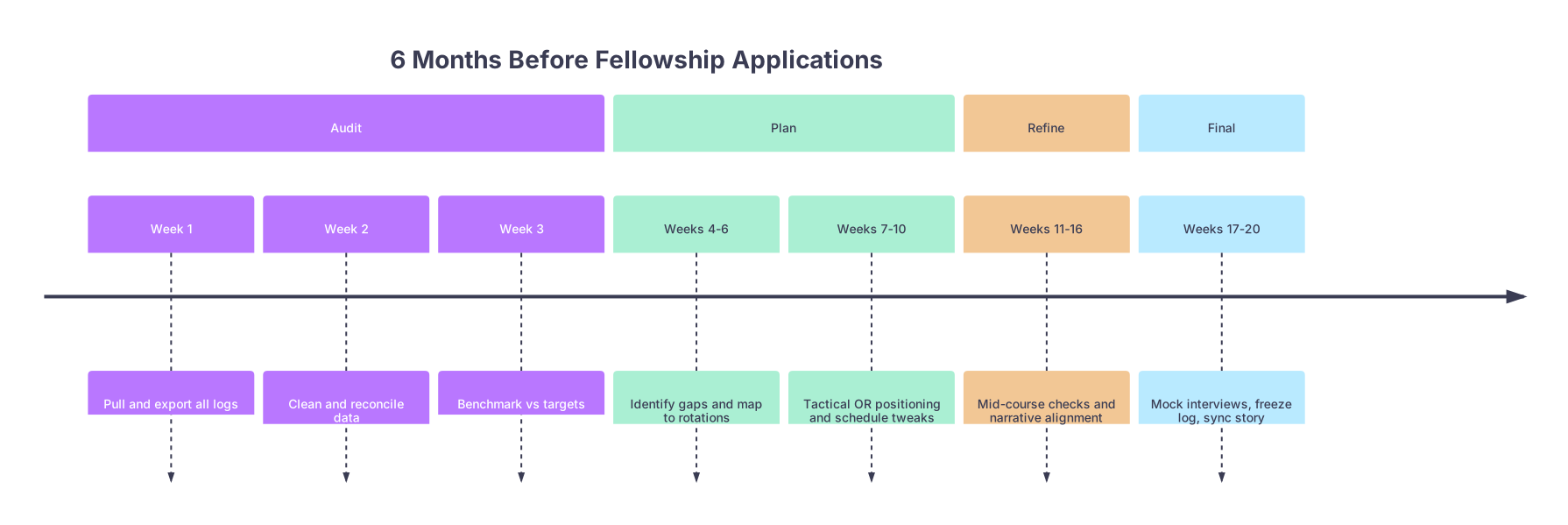
| Period | Event |
|---|---|
| Audit - Week 1 | Pull and export all logs |
| Audit - Week 2 | Clean and reconcile data |
| Audit - Week 3 | Benchmark vs targets |
| Plan - Weeks 4-6 | Identify gaps and map to rotations |
| Plan - Weeks 7-10 | Tactical OR positioning and schedule tweaks |
| Refine - Weeks 11-16 | Mid-course checks and narrative alignment |
| Final - Weeks 17-20 | Mock interviews, freeze log, sync story |
What This Looks Like in Real Life
To make this less abstract, here’s the pattern I’ve seen work for strong applicants:
- The PGY‑4 going for MIS who realized in January he only had ~30 real foregut cases; by June he was at 85, because he aggressively placed himself in the right rooms and made his intention clear.
- The future colorectal fellow who was clinically busy but scattered; she did a 2‑week focused push on pelvic cases, tracked them obsessively, and could quote her numbers cold in interviews.
- The vascular applicant who was great clinically but had borderline open volume; he couldn’t fix the entire gap, but he got enough extra primary open cases to convince programs he wouldn’t melt in an open aneurysm repair.
None of them waited for their PD to “make it happen.” They audited, then acted.

FAQ (Exactly 2 Questions)
1. My case volume in my target area is honestly weak. Should I still apply this cycle or wait a year?
If your overall surgical foundation is strong but niche volume is light, you usually still apply. Programs care far more about fundamentals, judgment, and trajectory than whether you have 15 or 40 of a rare case. You might:
- Be transparent in your personal statement about seeking more depth in that area
- Emphasize how quickly your case numbers have grown in the last 6 months
- Use letters that speak to your technical growth curve, not just your totals
The scenario where I’d seriously consider waiting a year: you’re barely meeting ACGME minimums and your PD is hesitant to call you technically ready. That’s not a case volume problem anymore; that’s a training problem, and an extra year or focused chief year can change everything.
2. How much do fellowship programs actually care about the exact numbers in my log?
They care more about patterns than raw numbers. A colorectal PD isn’t counting whether you did 132 vs 147 colon resections. They’re asking:
- Do you have enough reps to function as a safe, semi‑independent senior on day one?
- Does your log match your story and your letters, or does it look inflated or random?
- Are you primary on an increasing share of complex cases in your last 12–18 months?
I’ve seen applicants with “average” numbers match at excellent programs because they were clearly the person everyone trusted in the OR. I’ve also seen case logs that looked huge but screamed “chronic assistant.” Volume is necessary. Ownership and trajectory are what actually sell.
Key points:
- Six months out, you stop guessing and do a ruthless, data‑driven case audit.
- You cannot fix everything, but you can meaningfully shift your fellowship‑relevant volume and your trajectory.
- Your log, your letters, and your interview story must tell the same, consistent operative story—built on real numbers, not vibes.