

You are not getting enough cases because you are being too passive, not because you are “protecting relationships.”
Let me be blunt. The residents and students with the best surgical case volume are not always the smartest or the most technically gifted. They are the ones who quietly, consistently, and strategically negotiate OR access with attendings and staff without triggering the “entitled learner” alarm.
You can learn exactly how to do that. It is a skill. And like any skill, there is a structure to it.
This is that structure.
Step 1: Fix Your Mindset About “Asking for Cases”
Most trainees start from the wrong premise: “If I ask for more cases, I will look entitled.”
Wrong premise.
Here is the correct frame:
- Attendings are responsible for patient safety and education.
- The OR is for the patient, not for you, not for the attending’s ego, and not for your logbook.
- Your goal is to align your educational needs with patient care and workflow, not to “get what you want.”
When you approach OR access as:
“How can I help you take great care of this patient and grow my skills appropriately?”
You stop sounding entitled. You start sounding like a future colleague.
Bad mindset phrases that instantly sound wrong in an attending’s head:
- “I really need this case for my numbers.”
- “Can I scrub this instead of the intern?”
- “I have not had a lap appy yet this week; I should get this one.”
Better mindset phrases:
- “This is a case I am trying to get more reps on. Is there a part of the case I can focus on today?”
- “If there is flexibility on who is primary, I would appreciate the chance to do more of the case, as long as it fits your plan.”
- “Where do you see my role in this case? I want to make sure I am useful and learning appropriately for my level.”
That shift—from entitlement to alignment—is the core of the whole game.
Step 2: Know What Actually Controls Your OR Access
You are not negotiating in a vacuum. There are real levers and constraints.
| Factor | Why It Matters |
|---|---|
| Patient complexity | Higher risk → more attending control |
| Case type | High-stakes cases → less learner freedom |
| Your PGY level | Sets expectations for role |
| Service/rotation norms | Some services are territorial |
| Attending personality | Some love teaching, some tolerate it |
| OR staff culture | Charge nurses/anesthesia can block/help |
If you pretend these do not exist, you will sound tone-deaf. Attendings smell that from across the scrub sink.
Basic rules:
- The more complex or high-risk the case, the less you should push for primary operator status. Ask for defined portions, not the whole thing.
- The more junior you are, the more you should anchor on learning objectives, not “I want to do the whole case.”
- The more chaotic the list (late starts, add-ons, staff issues), the more you must dial down “ask mode” and dial up “help mode.”
If you are a student: you are negotiating exposure and participation, not being primary operator. Big difference.
If you are a senior resident: you are negotiating graduated responsibility, ideally with some advance planning, not the day-of only.
Step 3: Prepare Before You Ever Open Your Mouth
Most people “negotiate” OR access as they are walking into the room. That is already too late for anything meaningful.
You prepare in three ways:
- Know the cases
- Know what you want
- Know what you are offering
1. Know the cases
Before you talk to anybody:
- Check the OR schedule the day before (or two days before if your hospital posts early).
- Flag:
- Cases appropriate for your level (lap appy, lap chole, hernia, scopes, etc.).
- Cases where you have already done several (to show progression).
- Complex or first-time cases where your goal is exposure, not “doing.”
If you show up saying, “What cases are we doing today?” you have already marked yourself as passive and unprepared. That kills your leverage.
2. Know what you want
You do not walk up and say, “I want to do more cases.” That is vague and self-centered.
Be specific, short, and realistic:
- “I am trying to get more comfortable with:
- trocar placement,
- safe dissection in Calot’s triangle,
- closing laparoscopic port sites.”
Or:
- “I have done skin-to-skin for basic lap appy a few times. I would like to solidify that with a few more supervised reps.”
Translate “I want more cases” into 3–4 specific, skill-based goals.
3. Know what you are offering
You are not a customer. You are staff.
You offer:
- Reliability: you show up prepared, on time, know the patient and imaging.
- Efficiency: you help cases move, not slow them down.
- Situational awareness: you read the room; you do not push when everything is on fire.
That means, before negotiating for access, you:
- Know the key labs and imaging on your patients.
- Know indications for the operation and any major comorbidities.
- Have read at least one solid, practical description of the procedure (not just the abstract from a paper).
This way, when you ask for a bigger role, the attending has seen actual evidence you can handle it.
Step 4: Use the Right Script at the Right Time
You need actual language. Not vague ideas.
There are 3 critical windows to negotiate OR access:
- Pre-rotation or early in the rotation
- The afternoon before surgery
- Morning of / pre-op area
You do not need complex speeches. You need short, clear, respectful phrases.
1. Early in the rotation: set the frame
This is where most trainees fail. They do not set expectations early, so each day becomes a new one-off negotiation. Exhausting for everyone.
You fix that with a single, 60-second conversation.
Example (resident, first or second day):
“Dr. Lee, can I ask you briefly how you like to involve residents in the OR?
I am a PGY-3, and my main goals this month are:
– improving efficiency and flow in basic laparoscopic cases,
– getting more reps with safe dissection, and
– learning how you decide what parts of the case to give to the resident.If you are comfortable with it, I would appreciate feedback during the month on how much of the case you want me to handle and how I can earn more responsibility.”
Student version:
“Dr. Lee, I am a third-year on this rotation. I want to be useful in the OR and not just another person in the way.
My focus this month is:
– understanding the basic steps of common cases,
– learning safe instrument handling and camera work, and
– seeing how surgeons think about anatomy and decision-making.How do you usually like to involve students? And what would you want to see from me to get more hands-on opportunities?”
Why this works:
- You show self-awareness (your level).
- You show specific goals.
- You ask how to earn more access; you do not assume it.
Attendings like trainees who are goal-oriented but not demanding.
2. Afternoon before: negotiate your role
This is your best leverage point. The OR schedule is set, the day has shape, but emotions are not high yet.
Find the attending in person or send a short message, depending on culture.
Example (in person, preop clinic or wards):
“Dr. Patel, I saw we have two lap choles and a hernia tomorrow.
I have done a few lap choles as first assist and parts of the dissection.
For tomorrow, if it fits your plan, I would like to focus on
– doing the initial port placement under supervision, and
– taking the lead on the dissection in Calot’s triangle.Are you comfortable with that, or is there a different part of the case you would prefer I focus on?”
Short message version:
“Dr. Patel, for tomorrow’s lap choles, my goal is to gain more experience with trocar placement and early dissection, if appropriate.
If you prefer a different role for me, I am happy to follow your plan and support however is most helpful.”
Student version:
“Dr. Patel, I am on your cases tomorrow and have reviewed the procedures and anatomy.
If you are comfortable, I would like to:
– hold the camera for part of the case, and
– close some of the skin incisions.If that is too much for tomorrow’s list, I am happy just observing and assisting as you see fit.”
Notice: you are asking for defined responsibilities, not vague “I want to be primary.”
3. Morning of: confirm without being annoying
Do not corner an attending as they are fighting with anesthesia over delays.
Pick your moment—often in the pre-op holding area or just after the timeout.
Clean version:
“Dr. Nguyen, just to confirm my role for this case: am I focusing on ports and early dissection, then you will take over when it gets more complex?”
Or:
“For this case, where would you like me to start, and when would you like me to step back?”
You are not asking for more here. You are clarifying and showing that you take your role seriously.
Step 5: Read the Room and Adjust in Real Time
Even if you negotiated a role, your ability to adapt is what keeps you from seeming entitled.
There are three main cues you must monitor:
- The patient’s condition
- The attending’s stress level
- The OR team’s bandwidth (anesthesia, nursing, techs)
When any of these spike, you downshift.
Examples:
Bleeding unexpectedly?
You say:“Do you want me to pause here?”
And you actually pause. Hands still. No arguing.Attending getting short or directive?
You say:“I will step back for a moment; let me know if you want me back in.”
Nursing or anesthesia clearly behind or overwhelmed?
You avoid additional “Can I do more?” requests. Instead:“How else can I help?” (positioning, line placement, charting, etc.)
Looking for chances to step back when things escalate is how you build trust. Next time, your attending will be much more inclined to give you longer, less interrupted stretches.
Step 6: Earn Future Access with How You Behave in the Case
What you do once you are scrubbed in determines whether you get invited back or quietly frozen out.
Here is what attendings pay attention to far more than you think:
- Do you know the steps of the operation?
- Do you understand the why, not just the “how”?
- Do you keep your composure when corrected?
- Do you ask targeted questions, or constant chatter?
The anti-entitlement checklist while scrubbed:
- You do not argue about retraction or positions. You adjust and say “Okay.”
- You do not keep talking after the attending has given you clear, technical feedback. You implement first.
- You call out landmarks as you go: “I see cystic duct, cystic artery, critical view area here.”
- You ask one or two high-yield questions per case, not thirty.
- Good: “What are your criteria for converting this to open?”
- Bad: “What made you choose surgery as a specialty?” during a tricky dissection.
At the end of the case, you close the loop—this is where you plant seeds for future access.
Post-case script:
“Thank you for letting me do that portion.
What is one thing you would like me to do differently next time?
And for future similar cases, do you see me eventually doing this skin-to-skin with you, or are there specific skills I should focus on first?”
This does three things at once:
- Shows gratitude without groveling.
- Asks for focused, actionable feedback.
- Signals that you are thinking about progression, not just this one case.
Attendings remember that.
Step 7: Work the Non-Attending Side of OR Access
You are not just negotiating with the surgeon. The OR is an ecosystem.
Two groups can quietly help or quietly block you:
- Anesthesia
- Nursing/OR staff (especially charge nurses and scrub techs)
If anesthesia trusts you, they will not fight your presence. Sometimes they will even advocate for you to get a line, airway, block, or at least not delay the start because “the learner is too slow.”
If nursing trusts you, they will:
- Help you get your attending when needed.
- Not roll their eyes when you scrub in.
- Sometimes tell you which attendings are better to work with for certain cases.
Basic protocol:
- Introduce yourself every day to the charge nurse and OR staff.
- Ask:
“Anything I can do to help the room move faster today?”
- Say thank you. Out loud. To scrub techs, circulators, anesthesia.
You are building social capital. You can spend that later when you ask to be added to a case or swapped into a better learning opportunity.
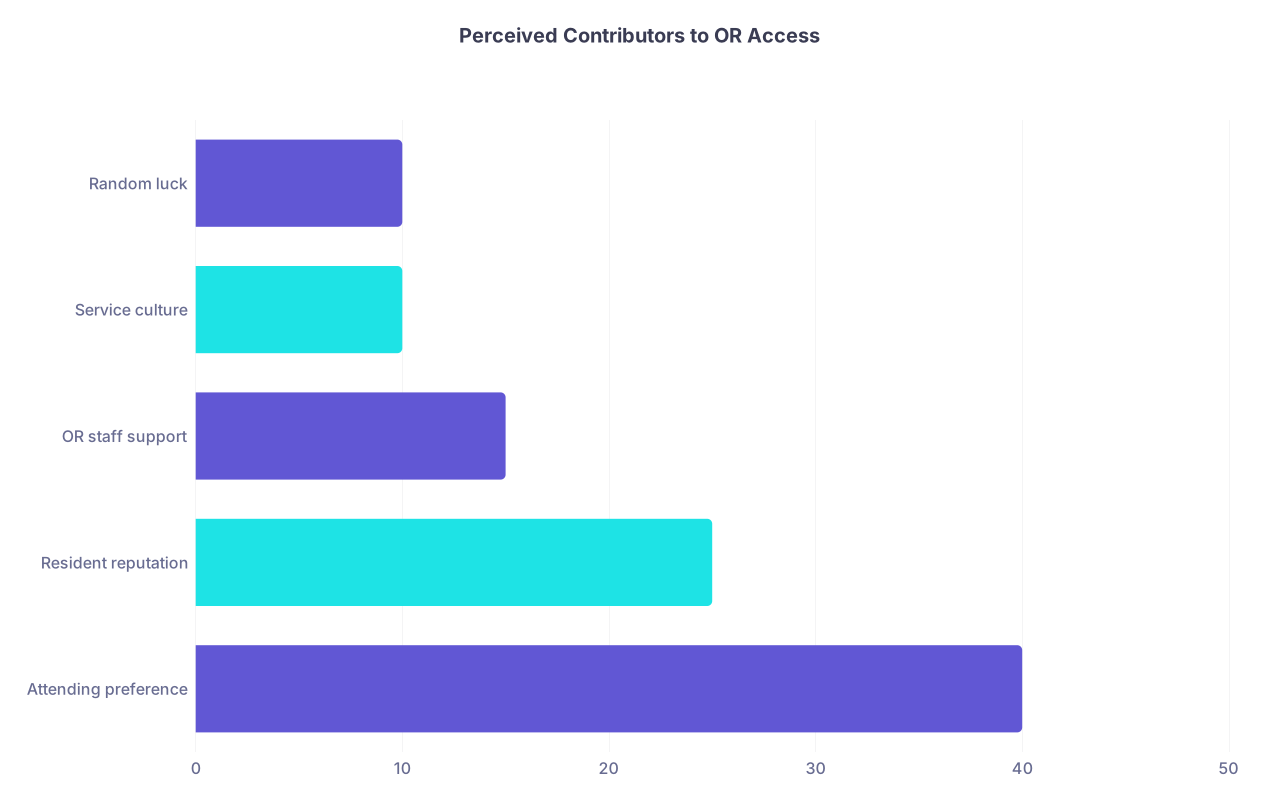
| Category | Value |
|---|---|
| Attending preference | 40 |
| Resident reputation | 25 |
| OR staff support | 15 |
| Service culture | 10 |
| Random luck | 10 |
Yes, attending preference still dominates. But the rest is not trivial.
Step 8: Handle “No” Without Burning Bridges
If you want more OR access, you will hear “no” often.
How you respond is the difference between:
- Someone who gets an upgraded role next week, and
- Someone who gets quietly written off as “entitled and inflexible.”
Common “no” scenarios:
- Attending: “I need the chief to do this one.”
- Attending: “This case is too complex for where you are right now.”
- Charge nurse: “We cannot add you to another room; staffing is tight.”
- Co-resident: “I am behind on my numbers and really need this case.”
Your job is to show that you can hear “no” and still be collaborative.
Polished responses that keep doors open:
Case 1 – Attending prefers chief:
“Understood. I will still scrub and watch.
Is there a specific part you would like me to pay particular attention to so I can be more ready next time?”
Case 2 – Too complex:
“That makes sense.
For similar cases, at what point would you be comfortable with me handling some part of it? I want to know what I should be working toward.”
Case 3 – No staffing:
“I get it. Let me know if anything opens up. In the meantime, I will stay available to help on the floor or with discharges.”
Case 4 – Co-resident needs case:
This is touchy. You do not win by trying to “out-argue” your colleague in front of the attending.
You can say privately:
“I also need more reps on this, but if you are behind on numbers, I am fine stepping back this time.
Can we look at the upcoming schedule together and trade so I get priority on a similar case next week?”
You protect the relationship. You show you are not selfish. And then you follow up.
Step 9: Track Your Volume and Have Data, Not Vibes
If you feel like you are not getting enough OR access, you need evidence.
Not “It feels like I never do cases.” That is useless.
Track:
- Number of cases you:
- scrub in
- are primary operator for (or major portions)
- assist only
- Types of procedures (categorize: lap appy, lap chole, open hernia, etc.).
- Which attendings you operate with and what you did.
Basic reality: some attendings will always be more generous and more comfortable teaching.
When you have 3–4 weeks of data, you can approach a program director, rotation director, or chief with something like:
“Over the last month, I have scrubbed 20 cases, but I have only been primary or done significant portions on 3 of them.
Most of my hands-on time has been with Drs. X and Y; with others, my role has mostly been observational.
My goal is to be more ready for independent practice by graduation, especially with basic general surgery cases.
Are there attendings or services where I should aim to be scheduled more often? And is there anything in my performance that is making attendings hesitant to give me more responsibility?”
This is calm, specific, and solution-oriented. Nobody can call that entitled.
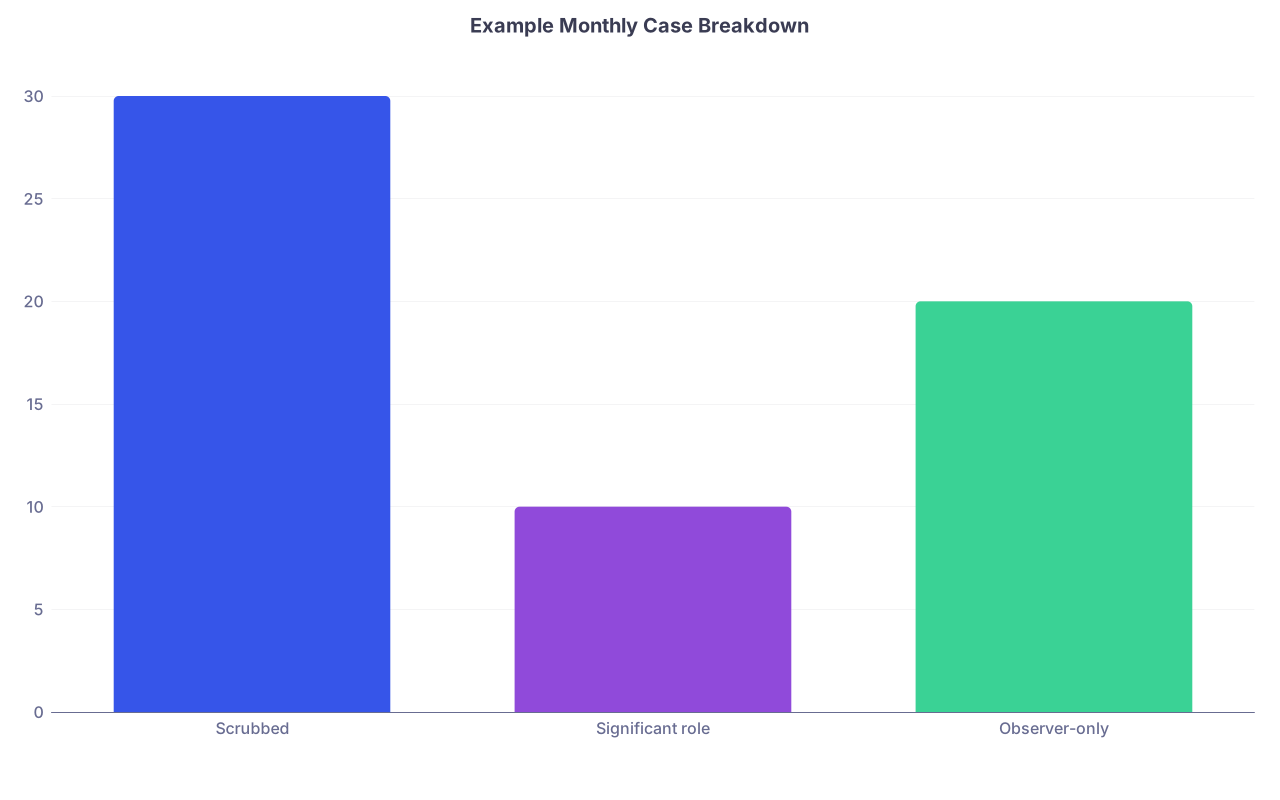
| Category | Value |
|---|---|
| Scrubbed | 30 |
| Significant role | 10 |
| Observer-only | 20 |
When you track this over several months, patterns appear. You negotiate from facts, not feelings.
Step 10: Play the Long Game – Building a Reputation That Attracts Cases
The future of surgical training is headed toward:
- More complex patients.
- Higher documentation burden.
- More pressure for efficiency and earlier end times.
- Simulators, AR, and digital tools for skills.
All of that shrinks the casual teaching time in the OR.
The residents and students who will still get robust case volume will be the ones attendings actively request.
That does not happen from one rotation. It happens from a pattern:
- You prepare.
- You help the service.
- You take feedback well.
- You do not whine.
- You step up when the team is drowning.
- You step back when the patient is at risk.
Occasionally, you will get a direct compliment:
“You are solid in the OR. I will pull you into my cases when I can.”
Often, you will not hear anything. You will just start noticing:
- You get texted when someone needs an extra set of hands.
- You get added to last-minute cases.
- You get named on group messages: “Have [your name] scrub with me on that lap appy.”
That is the real “negotiation” — it is front-loaded. Earned before you even ask.
The Core Moves to Remember
You do not need to be slick. You need to be structured.
The 3 takeaways:
Negotiate early and specifically.
Set expectations at the start of the rotation. Before cases, ask for defined roles, not vague access. Tie everything to skill-based goals and patient care, not your “numbers.”Behave in a way that earns trust, then protect that trust.
Prepare, read the room, downshift when things get tense, and close the loop with focused feedback questions. Handle “no” calmly so “yes” is easier next time.Use data and relationships, not complaints.
Track your case volume, partner with OR staff, and bring concrete patterns—plus a solution mindset—to chiefs and leadership if you are systematically underexposed.
Do these consistently and you will get more OR access than the loud, entitled person every single time.


