It is the middle of PGY-2. You are sitting in the call room, VSAS and ABSITE questions open on one screen, ACGME case log open on the other. You scroll. And realize your numbers are ugly.
Your co-resident casually mentioned they just hit 120 logged cases. You are at 63. Half their volume. You feel that drop in your stomach: “Did I already screw up my training? Am I going to be a weak chief? Will fellowship programs smell this a mile away?”
Let me be blunt: low volume at PGY-2 is a problem. But it is a fixable problem if you treat it like a complication and manage it with a clear plan and aggressive follow‑through.
This is your 6‑month recovery playbook.
Step 1: Diagnose the Problem Precisely (1 Week)
Before you start thrashing and signing up for every case in the OR board, you need a clean diagnostic workup. Vague “I feel behind” is useless. You need numbers.
1. Pull Your Case Log and Slice It
Open your ACGME/ACGME-equivalent case log and extract:
- Total cases
- Major vs minor
- by category:
- Basic laparoscopic (appy, chole)
- Hernia
- Bowel
- Vascular access
- Trauma/critical care
- Endoscopy (if applicable)
- by role:
- Surgeon junior
- First assistant
- Teaching assistant (if any)
Now benchmark yourself.
| Area | Reasonable Mid‑PGY2 Range | Your Number |
|---|---|---|
| Total cases | 80–130 | |
| Lap appy (primary) | 10–25 | |
| Lap chole (primary) | 10–20 | |
| Inguinal hernia (open) | 5–15 | |
| Central lines/ports | 15–40 | |
| Trauma laparotomy (any) | 3–10 |
These are ballparks, not gospel, but they keep you honest.
2. Identify the Pattern of Low Volume
You are not behind for “no reason.” It is almost always one or more of these:
- Rotation structure:
- Long block on non‑operative services (ICU, consults, floor)
- Busy clinic months with minimal OR access
- Personal behavior:
- Turning down add‑on cases
- Leaving early to “finish notes” instead of staying for cases
- Not checking next day’s OR schedule
- Political issues:
- Attending who never lets residents do cases
- Senior hoarding skin/prep/drain placement
- You are at the bottom of a big resident stack (chief + senior + mid + you)
- Documentation/logging:
- You did the work but never logged it
- Logging as assistant when you functioned as primary
Be honest. If you lie to yourself here, the rest of this is pointless.
3. Convert Anxiety into a Gap Number
You need a target. Example:
- Your total cases: 65
- Reasonable target by end of PGY‑2: 150
- Gap: 85 cases in 9 months → about 9–10 extra cases per month
For our playbook, we will focus on a 6‑month intensive recovery window: aim to gain at least 50–70 additional meaningful cases in 6 months.
Step 2: Build a 6‑Month Case Volume Plan
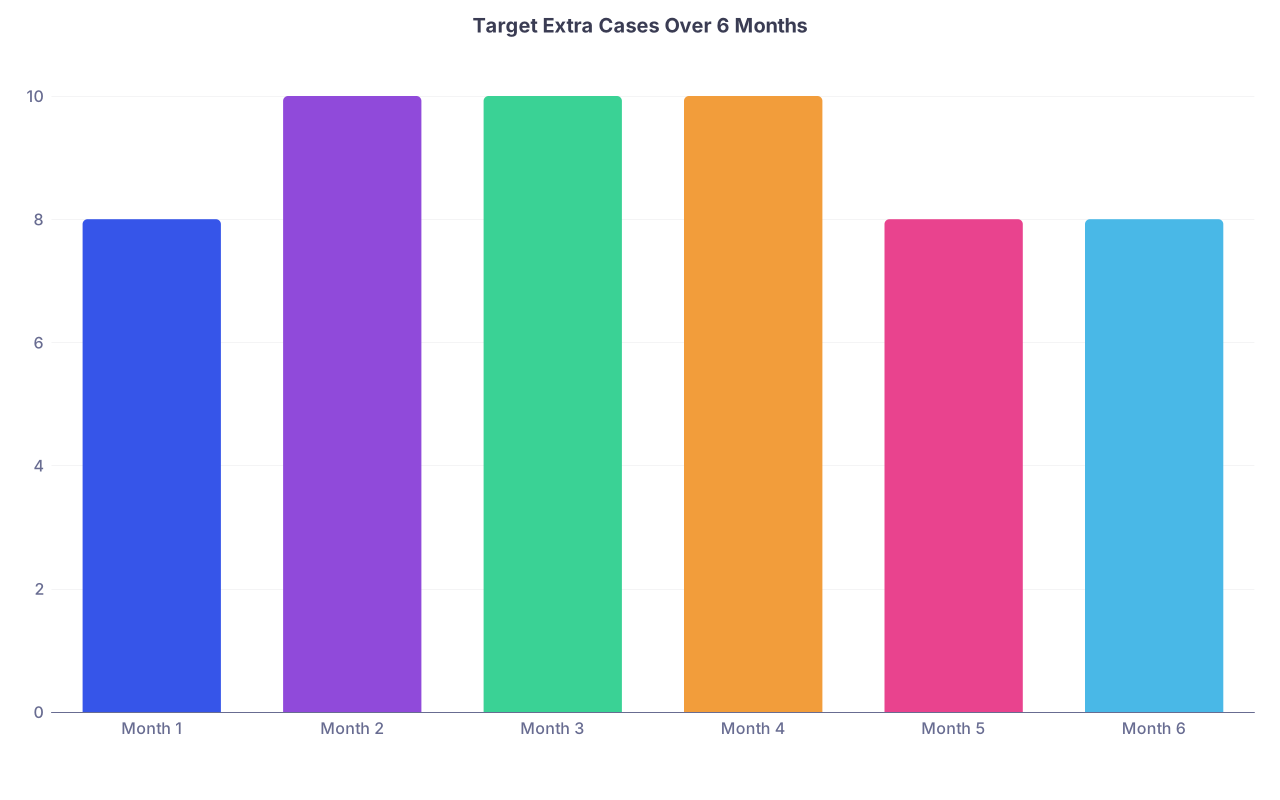
| Category | Value |
|---|---|
| Month 1 | 8 |
| Month 2 | 10 |
| Month 3 | 10 |
| Month 4 | 10 |
| Month 5 | 8 |
| Month 6 | 8 |
You are not going to magically triple your cases by just “trying harder.” You need structure.
1. Set Specific Volume and Skill Targets
Break it down into:
- Total case count
- Key operation count
- Technical skill goals
Example 6‑month targets:
- +60 total cases
- +15 laparoscopic appy/chole as primary
- +10 open hernias as primary
- +10 basic bowel cases (lysis of adhesions, small bowel resections) even as assistant with meaningful participation
- +10 central lines/ports
- +5 trauma laparotomies (any role)
- +10 miscellaneous (I&Ds, amputations, vascular access)
2. Map Targets to Rotations
Pull your schedule for the next 6 months.
Write it out:
- Month 1–2: Night float / Trauma
- Month 3–4: General surgery (bread and butter)
- Month 5: ICU
- Month 6: Vascular / Endoscopy
Now assign realistic goals per block:
- Trauma/night float:
- Goal: trauma laparotomies, emergent appy/chole, lines, chest tubes, washouts
- General surgery:
- Goal: bread‑and‑butter lap cases, hernias, elective bowel
- ICU:
- Goal: central lines, A‑lines, chest tubes (may count as minor, but they are skills)
- Vascular/Endo:
- Goal: ports, fistulas, basic endoscopy if allowed
You are engineering opportunities, not hoping for them.
3. Decide Your Weekly Volume Minimum
Pick a non‑negotiable floor, for example:
- Minimum 3 operative cases per week (any role)
- Aim for 1–2 primary cases per week
If you hit a week with no cases, that is an alarm bell. You fix the next week aggressively.
Step 3: Fix Your Day‑to‑Day Behaviors (This Changes Everything)
This is where most residents sabotage themselves. Not because they are lazy. Because they are passive.
1. Pre‑OR Board Routine (10 Minutes Daily)
Every afternoon:
- Open the OR schedule for the next day
- Scan all rooms, not just “your” attending
- Identify:
- Cases that match your goals (lap choles, appys, hernias)
- Attending known to teach
- Send targeted messages:
- To your chief:
“I saw Dr. X has two lap choles tomorrow at 10 and 12. If service allows, could I scrub one as primary? I am trying to increase my lap biliary numbers.” - To an attending you know:
“I have a lighter census tomorrow. I am working on my case volume and lap skills. If there is room, I would like to scrub your 11 a.m. chole and do key portions.”
- To your chief:
You will be surprised how often this works if you are specific, respectful, and consistent.
2. On‑Shift Rules
Adopt these hard rules for the next 6 months:
- Do not leave an OR‑heavy day early to type notes unless explicitly ordered
- Offer early to cover:
- “I can consent and see pre‑ops if that gets me into more cases.”
- When a case is “optional,” say:
- “I would like to scrub in, I am working on my volume and skills.” No apology. Just intent.
- If there is a conflict between floor scut and an available case:
- First, attempt to offload tasks:
- “I can sign out stable patients to the intern and handle the OR cases, if you are OK with that.”
- If chief says no and needs you on the floor, you do what they say. But you ask again next time.
- First, attempt to offload tasks:
You are not entitled to cases. You are advocating for them.
Step 4: Strategic Conversations with Chiefs and PDs (Within 2–3 Weeks)
You cannot fix a low‑volume problem in the shadows. You need leadership aligned with your plan.
1. Talk to Your Chief or Service Senior
This is not a whining session. It is a structured 10‑minute conversation.
Script it roughly like this:
“I pulled my case log and I am behind where I want to be for PGY‑2, especially in basic lap and hernia cases. I put together a 6‑month plan to add about 60 cases with a focus on bread‑and‑butter general surgery. On this rotation, I think the highest‑yield cases are X, Y, and Z. Can we make a plan so that when the service allows, I can scrub those more consistently or do key portions?”
Then back it up with behavior:
- Be early
- Hold pagers when others are in the OR
- Trade scut for cases (“I will do all the discharges if I can scrub that hernia this afternoon.”)

2. Meet with the Program Director (Within the Month)
You are not going to surprise a PD with the phrase “my volume is low.” They already half‑know. You earn respect by owning it early and showing a real plan.
Bring:
- Printout of your case log
- Your 6‑month target sheet by category
- Your upcoming rotation schedule
Talk like this:
“My current case numbers are lower than I am comfortable with, especially for laparoscopy and hernia. I have put together a 6‑month plan to increase my volume, with specific targets month by month. I wanted to get your input and see if there are structural changes—electives, specific attendings, trauma nights—that you recommend to accelerate this.”
What you want from this meeting:
- Honest feedback on whether your concern is valid
- Suggestions for:
- High‑yield attendings
- Rotations where you can front‑load cases
- Opportunities for outside rotations or electives focused on operative time
- Explicit support:
- “I will email the trauma faculty and let them know you are trying to increase your operative experience and are eager for emergent cases.”
If your PD is dismissive (“You are fine, do not worry about it”) but your numbers really are low, push gently:
“I hear you, but I want to be proactive. Here is the data compared to our mid‑PGY‑2 mean. Would you be OK if I worked with [APD/rotation director] to get targeted OR time over the next few blocks?”
You are not complaining. You are managing your career.
Step 5: Maximize Learning per Case (Not Just Count)
Low volume is bad. High volume with low engagement is also bad. You need dense learning from every single case you get.
1. Pre‑Op Micro‑Preparation Protocol
For each case you know you will scrub, spend 10–15 minutes doing:
- Review:
- Indication and patient-specific issues (BMI, prior surgeries, comorbidities)
- Watch:
- Single short YouTube or institutional video of that procedure (from a reliable surgeon, not random shaky GoPro nonsense)
- Write on index card (or your phone):
- 3–5 key steps in order
- 1–2 common pitfalls
- One question to ask in the OR if appropriate (“How do you decide between medial vs lateral approach here?”)
You show up already mentally in the case.
2. Intra‑Op: Demand Responsibility (Respectfully)
At your level, for bread‑and‑butter cases, you should say clear things like:
- “I would like to do Veress or open Hassan and dock the ports.”
- “Can I take the first attempt at the critical view?”
- “Can I close the fascia and skin?”
If you get shut down repeatedly without explanation, that is a separate issue (we will handle that later). But often, attendings are just used to passive residents. When you show intent, it flips a switch.

| Step | Description |
|---|---|
| Step 1 | Identify Case |
| Step 2 | Prepare Briefly |
| Step 3 | State Goals to Attending |
| Step 4 | Perform and Reflect |
| Step 5 | Ask Why and Adjust |
| Step 6 | Log Case Properly |
| Step 7 | Given Key Portions? |
3. Post‑Op: Log and Debrief the Same Day
You do this or you will lose cases on paper.
- Log the case that day:
- Correct CPT mapping
- Correct role (if you did critical portions, fight to log as surgeon junior, not assistant)
- Quick debrief:
- 2 minutes: “What should I focus on next time to improve?”
- Write down one take‑away for that procedure
You are compressing spiral learning—each case slightly better than the last.
Step 6: Attack the Common Structural Barriers
Now let us talk about the ugly realities that quietly kill your volume.
1. Senior or Fellow Case Hoarding
You have seen this:
- Senior always scrubs the straightforward choles and appys
- Fellow stands at the field for every simple case and uses you as retractor stand
Do not accept that pattern without pushback.
How to handle:
- First, talk to the senior one‑on‑one, not in front of attendings:
- “My numbers are low, and I am trying to build up basic lap experience. For the straightforward cases, can I take primary and you step in if I struggle or for the hard parts?”
- If they are reasonable, things improve. If not:
- Document patterns privately (dates, cases)
- Bring up to rotation director/PD framed as concern about your competency, not character assassination:
- “I am not getting access to primary roles on basic cases on this service, despite asking. I am worried about my development. Can we adjust expectations?”
You do not need to win every battle. You need to change enough of the pattern.
2. Non‑Operative Rotations
ICU, consult, off‑service. They are important. But they kill volume if you are not intentional.
Strategies:
- Ask explicitly before the rotation:
- “Are there any opportunities to scrub emergent cases from ICU—laparotomies, re‑operations, line placements, trachs?”
- Volunteer for procedures:
- If a chest tube or central line is needed, you say first: “I will do it.”
- Coordinate with OR when patients from your unit are going down:
- “Our patient is going for washout at 4 p.m. Can I scrub with the team if unit coverage is safe?”
You squeeze operative technical reps out of a non‑OR month.
3. Night Float / Trauma
This is secretly one of the best places to spike your volume. Or to get zero cases if you hide at the desk.
Rules for trauma nights:
- You physically go to the ED for every trauma activation, not just sit by the phone
- You state your intent early to the trauma attending:
- “I am focusing on increasing my case volume and comfort with emergent laparotomies. If there is any belly case tonight, I want to be there.”
- You accept chaos:
- These will be middle‑of‑the‑night, bloody, complex. You will not be “perfectly prepared.” That is fine. You show up anyway.
Step 7: Data‑Track Your Recovery Weekly
You treat this like an ongoing QI project on yourself.
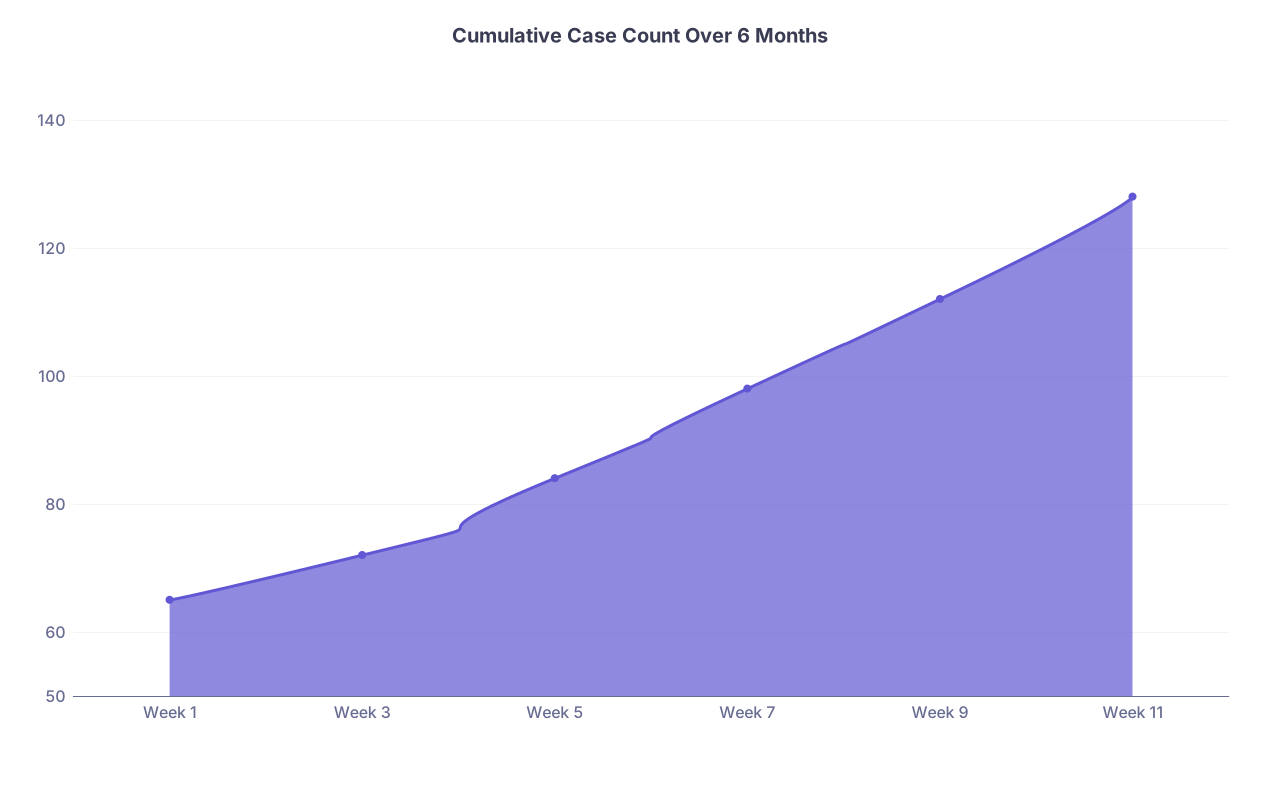
| Category | Value |
|---|---|
| Week 1 | 65 |
| Week 3 | 72 |
| Week 5 | 84 |
| Week 7 | 98 |
| Week 9 | 112 |
| Week 11 | 128 |
Every Sunday night, do a 10‑minute review:
- Log check:
- How many new cases this week?
- How many as primary vs assistant?
- Category check:
- Any progress on target areas (lap appy/chole, hernia, trauma, lines)?
- Behavior check:
- How many times did you proactively ask for a case?
- How many times did you skip a case for something that could have been delegated?
If the graph stays flat for 2 weeks in a row, you change something that week:
- Email chief/attending requesting more OR time
- Ask PD for help adjusting assignments
- Move your own schedule around tasks to free OR windows
You do not let 2–3 “bad weeks” quietly stack into another low‑volume year.
Step 8: Future‑Proof Yourself for Fellowship and Beyond
Let us talk about the nightmare in your head: fellowship applications and attending competence.
1. How Fellowship Committees Actually See Case Logs
They look for:
- Trajectory: Did your volume and responsibility increase over time?
- Bread‑and‑butter competence: Can you handle a basic general surgery case safely?
- Category exposure: For specialty fellowships (colorectal, MIS, surg onc), they check subspecialty volume in PGY‑4/5 more than early years
So your job:
- Turn the PGY‑2 low volume into a story of growth:
- “I started slow because of rotation mix and passive behavior, realized it by mid‑PGY‑2, then deliberately increased my exposure. By chief year, I was doing X number of cases as primary, including complex Y.”

2. Aligning PGY‑3 and PGY‑4 with Your Operative Identity
Once you fix the immediate volume problem, think longer arc:
- Identify your likely path:
- Community general, acute care, trauma, MIS, colorectal, surg onc, vascular etc.
- From PGY‑3 onward:
- Make sure your elective blocks and “easy” months are pushed toward your operative priorities
- Protect high‑yield rotations
- Do not trade away your best OR months for a random off‑service elective unless it pays off clearly
Low volume as a PGY‑2 does not doom you. Staying passive in PGY‑3 and PGY‑4 does.
Common Mistakes That Keep Residents Stuck
You might recognize yourself in some of these.
Waiting for permission to care about your numbers
You are not a passenger. Nobody will manage your case log for you.Over‑valuing “being helpful” at the expense of your own growth
Yes, be a team player. But if you are the permanent floor mule so others can operate, you are sacrificing your training.Letting shame keep you silent
Feeling behind is embarrassing. So residents hide it. Then 2 years pass and it is not salvageable. You are catching it now. Use that.Equating logging with bragging
Logging accurately is not flexing. It is your only proof that you are getting what you need.
A 1‑Week Micro‑Plan to Start Right Now
You do not fix a 6‑month problem in your head. You start with 7 days of controlled aggression.
For the next 7 days:
- Every afternoon, check tomorrow’s OR board and identify at least 2 cases that could be yours.
- Every morning, state your preferred case to your senior:
- “If service allows, I would like to scrub the 11 a.m. lap chole as primary.”
- Say yes to every reasonable OR opportunity, even if it means staying late once or twice.
- Log every single case the same day.
- Sunday night, look at:
- How many cases you gained
- How different it felt to actually chase them
Repeat that for a month. Then for six.
FAQs
1. What if my attendings or seniors say I am “too early” to be primary on basic cases?
Then you need clarity. Ask directly:
“What specific skills do you want to see from me before you are comfortable with me taking primary on a lap chole or hernia?”
Write down their answer. Use it as a checklist. Then circle back in 4–6 weeks and say:
“I have worked on X, Y, and Z. Can I take primary on the next straightforward case so you can assess me?”
If the goalposts keep moving without reason, escalate calmly to your PD with data, not emotion.
2. My case volume is low because of personal leave or illness. Am I just doomed?
No, but you lose the luxury of drifting. Bring this up transparently with your PD:
- Explain the time away
- Show exactly how it affected your numbers
- Ask for specific remedies:
- Extra elective OR time
- Redistribution of some rotations
- Focused high‑yield blocks in later years
Programs usually bend if you show up with honest data and a serious plan.
3. How do I balance studying for ABSITE with chasing more operative time?
You stop treating them as competing missions. Use this model:
- OR = primary learning lab for anatomy, indications, complications
- ABSITE prep = formalizing and expanding what you see in the OR
Plan:
- 30–60 minutes of questions or reading nightly, tethered to your recent and upcoming cases
- Example: If you have 3 gallbladders tomorrow, do a short session on biliary anatomy, indications, complications, and critical view tonight
You are not choosing “book vs knife.” You are building a loop where each makes the other stronger.
Open your case log today. Do not just stare at the total number. Break it down by category and level of responsibility. Then write, on one sheet of paper, your 3 highest‑priority case targets for the next month (for example: +4 lap choles, +3 hernias, +5 lines/chest tubes). Put that paper in your white coat. Tomorrow morning, pick one case from the OR board that moves one of those numbers and say out loud: “I want this one.”