
You are on week 2 of your surgery rotation.
Your scrub cap is still clean because it has barely seen the OR.
You are:
- Chasing vital signs
- Calling consults no one reads
- Putting in orders that get co-signed without a glance
- Being told “We’re full at the board today, maybe next case”
Meanwhile your classmates are posting selfies in lead, bragging about “second assist on a lap chole,” and you are timing vancomycin.
You are not crazy to be annoyed. Surgical case volume matters. For skills. For letters. For your sanity. For anyone even half-considering a surgical field, getting frozen out of the OR this block is a real problem.
So let us fix it.
Below is a stepwise, practical protocol to move yourself from “scut donkey” to “default extra set of scrubbed hands” this block. Not abstract “be proactive” fluff. A concrete sequence.
Step 1: Diagnose Why You Are Not Getting OR Time

You cannot fix this until you know why you are stuck outside.
Usually it is one (or a mix) of these:
You are invisible to the team running the OR list.
The chief or attending genuinely does not know you are:- Interested in being there
- Free at that time
- Capable of not slowing the room down
You are functionally needed on the floor.
Example:- 2 juniors on vacation, one resident cross-covering multiple services
- The person physically present to do pages and notes becomes “too valuable” to release
You look unprepared, so no one wants to risk you in a time-pressured case.
I have seen students:- Not know which side is being operated on
- Show up without having read the indication or anatomy
- Fumble tying a single instrument tie
Attending sees that once and does not call you again.
Rotation culture is bad and no one protects student OR time.
Some services are frankly lazy about involving students.
They will happily let you sit in the workroom or chase paper unless you force structure into the system.
For the next 2 days, do a quick reality check:
- How many cases did you ask to scrub vs just hope they would invite you?
- How often are you the only one answering floor pages?
- Has even one attending or chief said out loud they expect you in their room?
If you cannot answer these with specifics, assume problem #1 and #3 are active: you are invisible and considered unprepared.
Step 2: Build a Simple Weekly OR Plan With Your Chief
Trying to negotiate case-by-case is amateur hour. You want scheduled, predictable OR blocks where the team has already agreed you will be scrubbed.
Do this tomorrow, before pre-rounds if possible.
The 5‑Minute Conversation Script
Find the chief or senior resident who runs the list.
Say something like this:
“Dr [Name], I want to maximize my OR time this block while still being useful on the floor. Could we look at the schedule together and pick specific cases or half-days where I should plan to be scrubbed in, and I will protect that time?”
Then:
Open the OR schedule with them.
Even just for the next 3–5 days.Identify 2–3 priority windows per week.
Not 10. You are not getting every case. A realistic goal:- 1 big case (major)
- 1–2 smaller cases (minor/ambulatory)
Clarify expectations around the floor.
Ask directly:“On the mornings I am in the OR, what do you want done before I go down? And who will handle new pages so I am not pulled out mid-case?”
Repeat back the plan.
Example:“So Thursday morning I will round quickly on my two patients, update their notes, and be in OR 7 by 7:15 for the colectomy. Friday afternoon I will scrub the lap choles unless there is a new ICU admission. I will check with you before leaving the floor.”
Now you have explicit permission and a senior who has mentally slotted you into the OR.
To keep this organized:
| Day | Time Block | Case Type | Role Goal |
|---|---|---|---|
| Monday | PM | Lap Chole | First assist |
| Wednesday | AM | Open Hernia | Skin closure |
| Thursday | AM | Colectomy | Retract + tie |
| Friday | PM | Vascular lab | Observe + learn |
This is not fantasy. I have watched students go from zero to 3–4 cases a week by doing exactly this on trauma, vascular, and general surgery.
Step 3: Become the Least Risky Person to Bring Into the OR
Surgeons are not complicated. They will bring the person who:
- Knows what is happening
- Does not slow them down
- Makes their life easier in subtle ways
So you build that profile deliberately.
The Night Before: 20‑Minute Prep Per Case
Do not “skim UpToDate for 2 hours.” That is procrastination disguised as work. Use a focused template:
For each case you’re scheduled to scrub:
1‑sentence indication
“65-year-old male with symptomatic cholelithiasis, failed conservative management, scheduled for laparoscopic cholecystectomy.”Key anatomy and danger zones
For lap chole: Calot’s triangle, cystic duct/artery, common bile duct.Basic steps (5–7 bullets max)
Not a textbook. Just the skeleton:- Port placement
- Expose gallbladder
- Identify critical view
- Clip/cut cystic duct and artery
- Take gallbladder off liver bed
- Remove, check hemostasis, close
What could go wrong (1–2 points)
- Bleeding from cystic artery
- CBD injury
Write this on a single index card / small note. Glance at it in the locker room.
Day-of: Show Up Like You Belong
Non-negotiables:
- In OR by 15–20 minutes before incision
- Gown/glove technique not a disaster
- You know:
- Patient name
- Reason for surgery
- Side/level
- Any major comorbidities (on the sign-out or the pre-op note)
Very early on, ask the scrub or resident quietly:
“Where would you like me to stand and what is my main job in this case?”
That one sentence signals you understand hierarchy and workflow. I have seen attendings turn around at that moment and say “Good, you can close if there’s time.”
Step 4: Trade Scut for OR—Intelligently

| Category | Value |
|---|---|
| Floor work | 45 |
| OR time | 20 |
| Clinic | 15 |
| Idle/Workroom | 20 |
You are not going to escape floor work. Stop trying. The win is to convert low-yield scut into OR credit.
You do that by:
Owning specific scut tasks so the team releases you.
Example:- “I will update all post-op day numbers and vital sign ranges in the notes before 7:15.”
- “I will pre-round on rooms 1–4 and put in draft notes before going to the OR.”
Then you must actually deliver. Fast and accurate.
Trading tasks with co-students or interns.
- You take all 6 dressing changes this afternoon
- They take the two phone calls to families and the discharge summary
Then you claim the ready-to-start 3 pm case.
Doing high-visibility scut that makes attendings happy.
Small list:- Pulling up relevant imaging on the screens before they ask
- Having the consent visible and correct
- Making sure the correct side is marked and everyone has the correct patient info
The message: “When I’m here, things run smoother.”
People call that person into the OR more.
What You Stop Doing
If a task meets all three of these criteria:
- No one reads it carefully
- It does not change management
- It keeps you physically away from the OR
You either:
- Batch it for non-OR hours, or
- Ask directly if it can be skipped or streamlined
For example:
“Dr [Senior], I can either rewrite all vitals in each progress note line-by-line right now, or I can keep them summarized and get down to the OR on time. Which do you prefer?”
Nine out of ten reasonable seniors will say, “Summarize, go to the OR.”
If they say, “Rewrite them,” at least you forced them to explicitly choose paperwork over your case exposure. That matters later when you escalate.
Step 5: Ask Explicitly for Hands-on Portions of the Case
Being in the OR but never touching a needle driver is another type of being stuck.
You fix that by being unambiguous about your goals.
Say this to the chief/senior before the case, somewhere neutral like the workroom:
“I am trying to get better at basic skills this block. If it fits the flow of the case, could I close skin or place a few simple interrupted sutures?”
Clear. Modest. Specific.
Then you back it up:
- Practice instrument ties on a towel roll the night before
- Know which suture is typically used (ask scrub or resident)
- Do not be precious about perfection – you can ask for feedback as you go
If you do well once, you establish a new standard. Plenty of attendings will say things like:
- “Let the student close, they did a nice job last time.”
- “You can staple the port sites again today.”
You want to become the default closer on at least some cases. That is realistic for a motivated student by week 3–4.
Step 6: Use Feedback and Data to Course-Correct Mid-Block
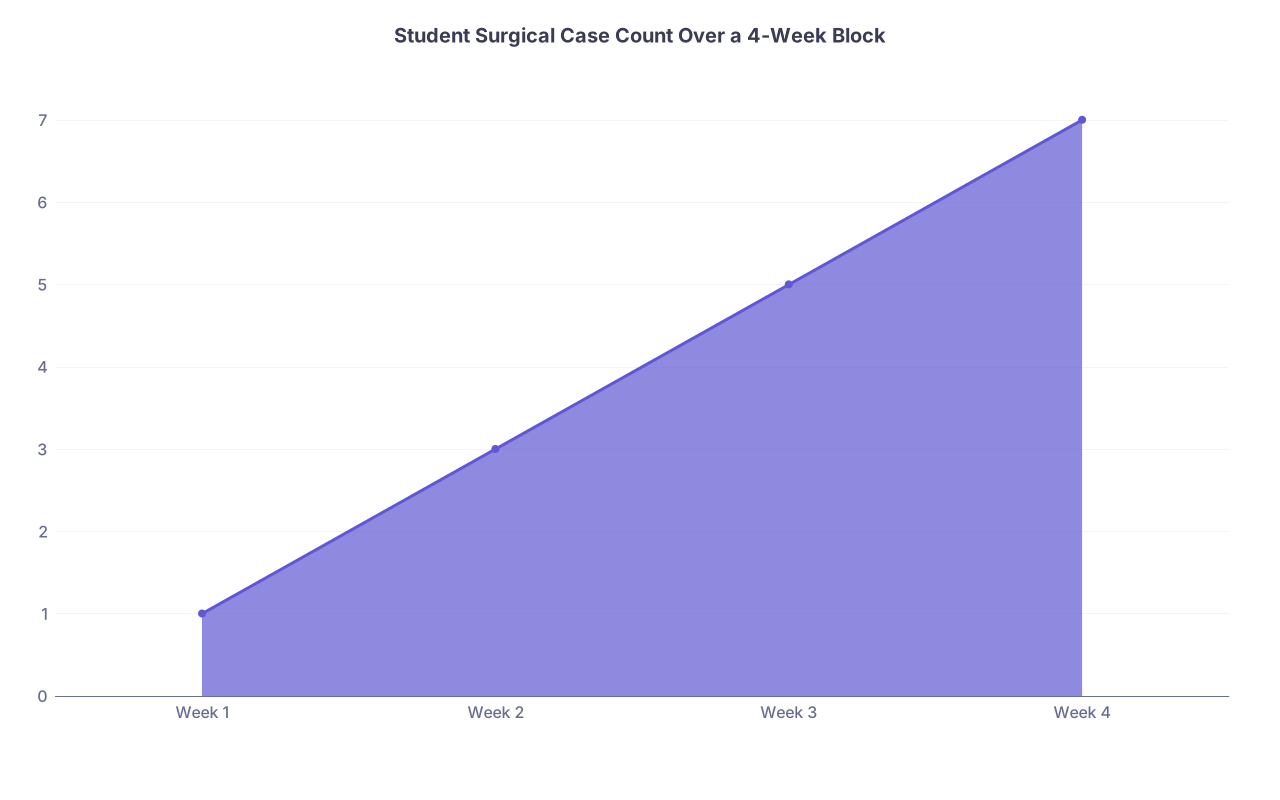
| Category | Value |
|---|---|
| Week 1 | 1 |
| Week 2 | 3 |
| Week 3 | 5 |
| Week 4 | 7 |
Stop treating this like magic. Track it.
Make a simple log in your notes app:
- Date
- Case
- Role (observe / retract / close / other)
- Attending
Every Sunday, look at it:
- Week 1: 1 case just observing?
- Week 2: 2–3 cases retracting?
- Week 3: 4–5 cases, closing in at least 1?
If it is not trending up by week 2, you need to actively reset expectations.
The Mid-Rotation Check-in
Find someone who writes your eval (often the chief or a key attending).
Script:
“Dr [Name], I want to check how I am doing and how I can improve. One of my goals this rotation is to get more OR experience and basic hands-on skills. Right now I have done [X] cases, mostly [observing/retracting]. What do I need to change to be trusted with more OR time or more active roles?”
Then stop talking.
You will get something:
- “Be faster with notes so you can come down on time.”
- “Read more about the cases; you seemed unprepared on that hernia repair.”
- “You are doing fine, sometimes the schedule is just weird.”
Whatever they say becomes your to-do list for this week. Knock those items out visibly.
If you get the “you’re fine, it’s just the schedule” answer and your log shows you are clearly below average (e.g., 1–2 cases total by week 3), that is when you escalate to the clerkship director with data, not feelings.
Step 7: Use the System When Culture Is the Real Problem
Some services truly do not care if students ever scrub. If that is your reality, pretending otherwise wastes time.
You are not powerless. You just have to be structured.
Know Your Rotation’s Written Expectations
Most clerkships have something like:
- “Students should scrub a minimum of X cases.”
- “Students should have meaningful OR exposure each week.”
If you cannot find it, ask the coordinator or check the syllabus.
Then, if by mid-rotation you are far below that, send a calm email to the clerkship director or site lead.
Something like:
Subject: OR Experience on [Service Name]
Dear Dr [Name],
I wanted to briefly update you on my experience on [Service]. I am very interested in maximizing my OR exposure this block. So far, in [X] weeks, I have scrubbed [Y] cases, primarily in an observational role. I have asked the team for additional OR opportunities and tried to be efficient with floor work, but the case volume available to students has been limited.I wanted to ask if there are specific days, services, or attendings you would recommend I work with in the remaining weeks to meet the rotation goals for surgical case exposure. I am happy to adapt my schedule if feasible.
Best,
[Name]
You did not complain. You asked for a solution. You aligned it with “rotation goals.” That is language clerkship directors respond to.
Often they will:
- Slot you into a different room
- Tell the service explicitly “get the student into the OR”
- Pair you with a more teaching-oriented attending
I have seen this email turn a dead rotation into a 10-case week.
Step 8: Position Yourself for Future Case Volume (Beyond This Block)

| Step | Description |
|---|---|
| Step 1 | Current Rotation |
| Step 2 | Good OR Habits |
| Step 3 | Strong Evaluations |
| Step 4 | Sub-I or Acting Internship |
| Step 5 | High Case Volume Months |
| Step 6 | Competitive Surgical Application |
You are not just chasing cases for this month. You are building a reputation.
Make Yourself the Student Residents Ask For
Residents talk. The next time a service hears, “We’re getting a new student,” someone will say:
- “I hope we get someone like [Your Name], they actually helped in the OR.”
Or:
- “Just keep them on the floor, last month’s student slowed down every case.”
You want the first one.
Behaviors that drive that reputation:
- Always on time to the OR, never the rate-limiting step
- Knows their patients and indications cold
- Learns from one correction; does not make the same mistake 3 times
- Does not whine about hours; channels frustration into constructive request (“How can I be more useful so I can get to the OR?”)
This pays off in:
- Better letters: “Actively sought and earned meaningful operative experience.”
- Sub-I preferences: seniors will request you back.
- More autonomy on future rotations: they will let you run parts of the case earlier.
Use Technology and “Future of Medicine” Trends to Your Advantage
You are in a weird transitional era where:
- Robotic cases are increasing
- Some attendings rely heavily on pre-op imaging and intra-op navigation
- Simulation is more available than ever
Students who lean into this look very prepared.
Practical moves:
Robotic cases:
- Learn the basic console workflow (port placement, docking).
- If your institution has a sim console, do the basic modules.
Then you can say: “I have done the intro sim modules—may I observe at the console side screen to understand the steps?”
Pre-op planning tools:
- Get in the habit of pulling up CT/MRI and actually walking through the anatomy with a resident.
- Ask: “Can you show me on the scan where you expect to dissect?”
-
- Use lap trainers after hours.
- Learn simple tasks: peg transfer, cutting on a line, intracorporeal knot.
When an attending asks if you have used a box trainer and you can say “Yes,” you immediately look like someone ready for more responsibility.
This is how you future-proof yourself. As surgery tech evolves, the core habit—preparation, ownership, efficiency—stays identical.
Step 9: Concrete 7‑Day Action Plan (Start Now)

If you have 1–3 weeks left in the block, do this:
Day 1–2
- Have the 5‑minute OR planning conversation with your chief.
- Identify at least 2 specific upcoming cases you will scrub.
- Start your case log (simple note in your phone).
Day 3–4
- For each assigned case, do the 20‑minute night-before prep.
- In the OR, ask explicitly: “Can I close if there is time?”
- Own one annoying but high-value task on the floor (all dressings, or all pre-round vitals).
Day 5
- Review your log. Count:
- Total cases
- How many you scrubbed
- How many you did something (retract, close)
- If still low, ask your chief:
“I would like to increase my hands-on OR experience next week. What do I need to improve to get more of that?”
Day 6–7
- If you are clearly below your rotation’s expected exposure and your chief is not adapting, send the polite, focused email to your clerkship director asking for advice on improving OR exposure.
- Spend 30–45 minutes in a sim lab or with a suture kit. Practice enough that the next time they hand you a needle driver, you are not shaking like it is your first time holding chopsticks.
This is the minimum effective dose. Students who do this see real change within one block.
Quick Reality Checks and Common Mistakes

A few hard truths that will save you time:
Waiting to be invited is the fastest way to never scrub.
The OR is busy, not evil. They will forget you exist if you do not put yourself on the schedule.Pretending to be interested in surgery to get more OR time usually backfires.
Just be honest: “I am not sure about surgery, but I want to get as much OR exposure as possible so I can make an informed decision.” Attendings respect that.If you are chronically late, you are done.
One no-show for a case can undo a week of goodwill. Protect OR times like an exam.Over-helping in the OR is a thing.
Do not rearrange instruments, correct the scrub nurse, or narrate anatomy for the attending. Do the job you were given, plus one small anticipatory helpful thing (like suction at the right time) – nothing more.
Final Thoughts: Your Levers This Block
You cannot change the call schedule. You cannot conjure extra cases out of thin air.
You can:
- Make OR time explicit and scheduled with your chief, not something you “hope” will happen.
- Be ruthlessly prepared and low-friction in the OR, so you are the safe bet to invite back.
- Trade and batch scut work intelligently, and escalate professionally when culture—not your behavior—is the real barrier.
Do those three consistently for the rest of this block, and you will not finish saying, “I never got to see anything.” You might still be tired. You might still hate floor scut. But you will have real cases, real skills, and a reputation as the student people want in their OR.