The way most residents collect laparoscopic versus open cases is backwards—and it quietly sabotages their future versatility.
You do not need “as many lap cases as possible.” You need the right laparoscopic–open balance for your level, your graduating skill set, and your career targets. Let me break this down specifically.
Why Laparoscopic vs Open Distribution Actually Matters
Program directors will tell you, “Just meet your ACGME minimums and you’ll be fine.” That is the bare minimum. Graduating with the wrong pattern of cases can leave you:
- Technically weak in conversions and bailouts
- Dangerous in complex laparoscopy because you have no open anchor
- Uncompetitive for MIS fellowships (yes, they look at distribution)
- Underprepared for community practice where open is still very real
Your case log is not just a number. It is a technical identity:
- High lap / very low open: “Camera jockey with no bailout plan.”
- High open / low lap: “Comfortable in the wound, slow and obsolete with the scope.”
- Balanced with intentional skew based on goals: “Deliberate, trainable, and safe.”
You are aiming for the third category.
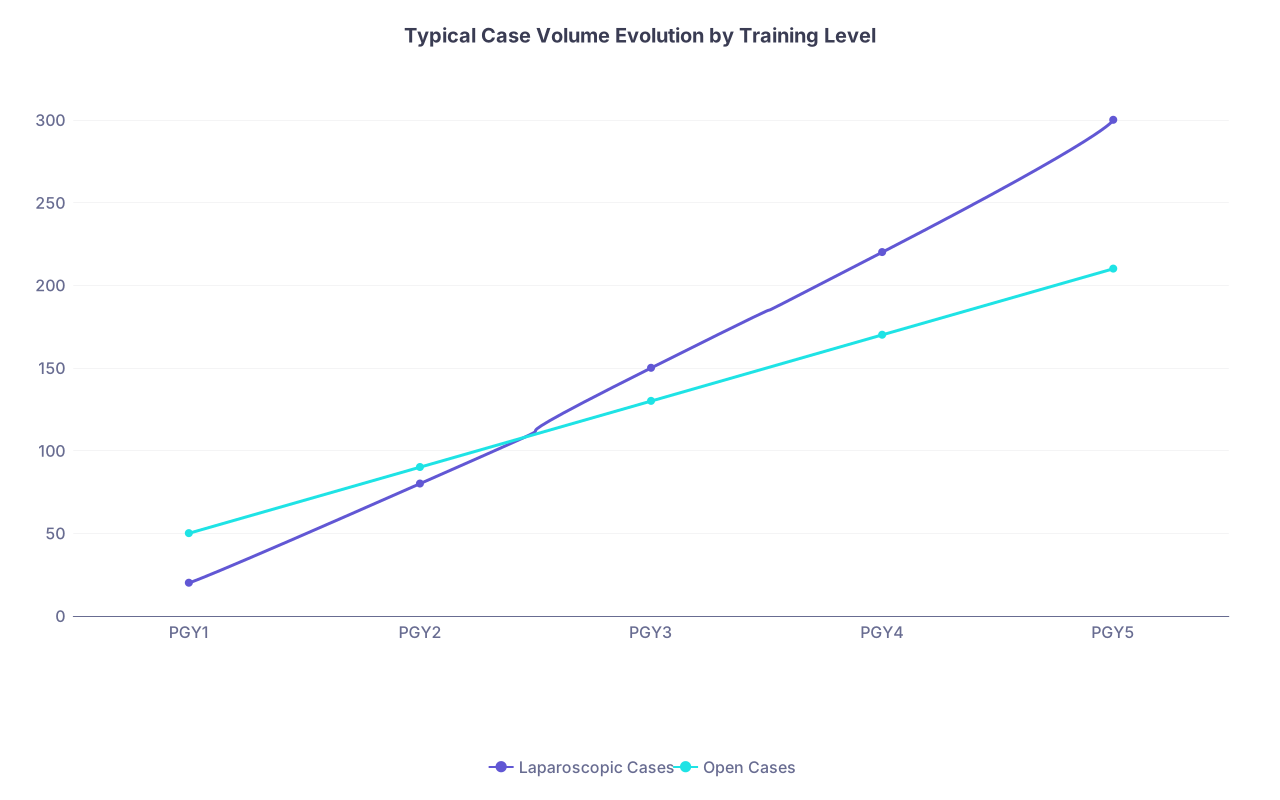
| Category | Laparoscopic Cases | Open Cases |
|---|---|---|
| PGY1 | 20 | 50 |
| PGY2 | 80 | 90 |
| PGY3 | 150 | 130 |
| PGY4 | 220 | 170 |
| PGY5 | 300 | 210 |
Notice: lap volume should rise fast, but open should never flatline.
The Technical Realities: What Laparoscopy Teaches vs What Open Teaches
If you do not understand what each modality actually trains, you will overvalue one and neglect the other.
What Laparoscopy Actually Builds
Laparoscopy is not just “smaller incisions” and fancy towers. Done properly, it trains:
- 2D–3D mapping: Interpreting two‑dimensional images into three‑dimensional maneuvers.
- Fine motor control at distance: Long instruments, fulcrum effect, small movements → large instrument excursions.
- Team choreography: Anesthesiologist, scrub, assistant, and camera tech all matter more.
- Energy discipline: Precise use of hook cautery, harmonic, LigaSure, etc., in tight spaces.
- Tissue respect under magnification: You see exactly how much you’re crushing or tearing.
Specific operations where laparoscopy builds core skills:
- Lap chole: angle of Calot dissection, safe critical view, misidentification risk recognition.
- Lap appy: intracorporeal knot vs stapler use, mesoappendix management, working in pelvis.
- Lap ventral hernia: mesh handling, preperitoneal vs IPOM understanding, large field navigation.
- Lap foregut (Nissen, Heller): hiatal work, esophageal dissection, mediastinal spatial awareness.
If your practice or fellowship will be MIS-heavy, these numbers matter a lot. But not at the expense of losing the open foundation.
What Open Surgery Teaches That Laparoscopy Cannot Replace
Here is where many residents are quietly undertrained now.
Open surgery gives you:
- Tactile feedback: Tissue planes, tumor consistency, pulsing vessels, friable cirrhotic livers.
- Force calibration: How hard can I pull before this mesentery tears. Laparoscopy hides this.
- Global anatomic orientation: Whole abdomen or field exposed; you see relationships at once.
- Decisive control of bleeding: Direct clamping, finger pressure, packing—life-saving when scopes fail.
- Damage control mindset: In trauma and sepsis you often start and end in open territory.
Key open operations that define your backbone:
- Open laparotomy for obstruction/ischemia
- Damage control laparotomy in trauma
- Open colectomy with primary anastomosis
- Open gastric/bowel resection with hand‑sewn anastomosis
- Open vascular exposure (femoral, popliteal, carotid) if your program does it
Residents obsessed with lap numbers commonly end up weak at two things that matter in real life: catastrophic bleeding control and hostile abdomen re-entry.
Typical Pitfalls in Case Distribution (By Level and Goal)
Here’s what I see repeatedly when I review senior residents’ case logs before graduation.
PGY1–2: The False Comfort Zone
Common pattern:
- Lots of assisting on lap cases—camera, trocar placement, occasional dissection.
- Limited primary operator time in either lap or open beyond basic cases.
- Weak exposure to tough open cases because they are “saved for the senior.”
This produces second-years who think they are “pretty good with the scope” but cannot do a safe midline laparotomy and bowel run alone at 3 a.m.
At this stage, you need:
- Explicit practice in opening and closing multilayer abdominal incisions
- Setting up for and starting a trauma laparotomy under supervision
- At least some hands-on, not just watching, in lap chole and appy
PGY3–4: The Laparoscopy Rush
This is where the case distribution often goes off the rails.
Residents realize MIS fellowships and jobs care about lap volume, so they:
- Hog the easy lap choles and appys
- Avoid complex open cases where they will be slower and more exposed
- Brag about “300+ lap choles” while barely comfortable with a difficult reoperative abdomen
I have literally seen a PGY4 panic during a lap chole bleeding from the cystic artery, convert late, and then freeze because they had never truly controlled bleeding in an open Calot triangle. That is a distribution problem, not just a judgment problem.
PGY5: Last-Minute Panic
By chief year, patterns emerge:
- Some have beautiful lap numbers but barely meet open complex case thresholds.
- Others were “the open workhorse” and now feel behind on foregut/hernia lap cases.
- Almost everyone has at least one obvious gap (trauma, HPB, colorectal, foregut).
Trying to “fix” this in the last six months is like trying to learn piano before your recital. Better than nothing, but not impressive.
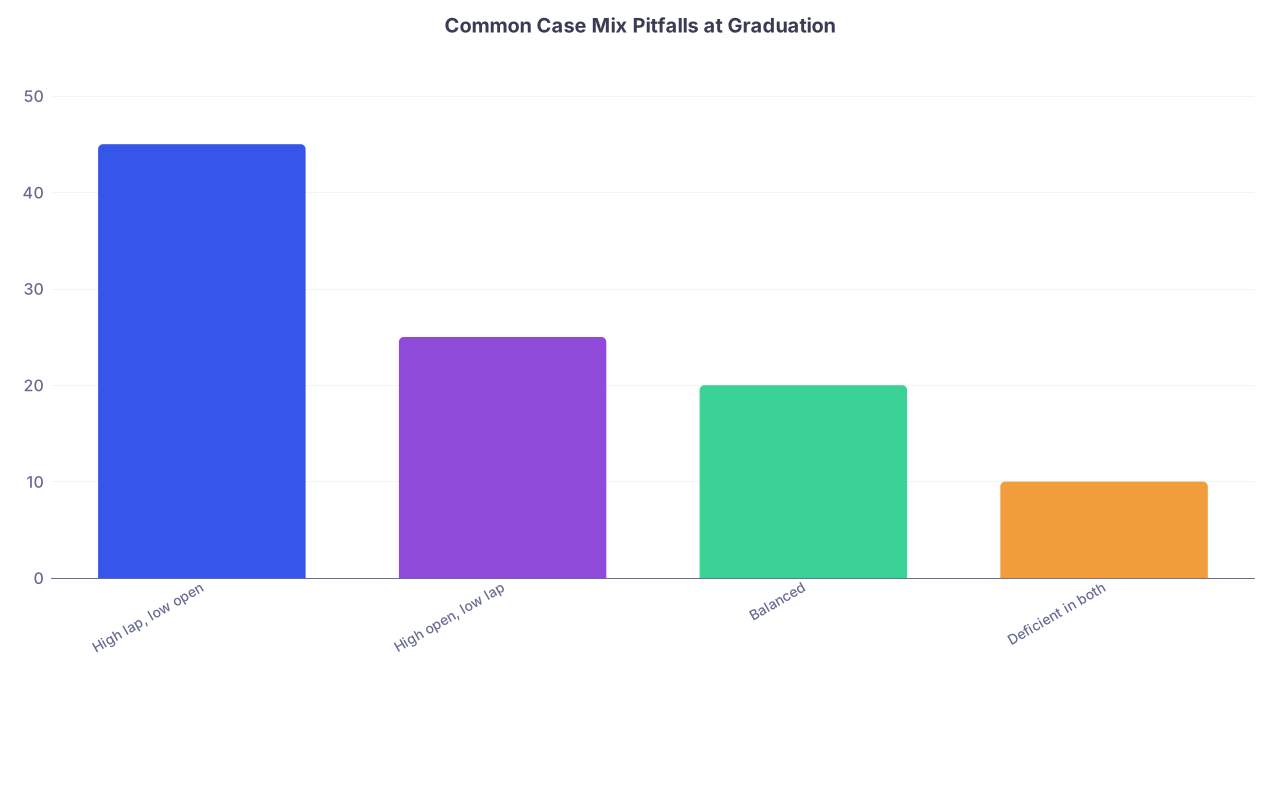
| Category | Value |
|---|---|
| High lap, low open | 45 |
| High open, low lap | 25 |
| Balanced | 20 |
| Deficient in both | 10 |
Balanced graduates are the minority. You are trying to be in that 20%.
How to Intentionally Shape Your Lap vs Open Portfolio
Now the part nobody explains: how to actually control this.
Step 1: Define Your Target Practice Pattern
You cannot optimize what you have not defined. Stating “I want to be a good surgeon” is useless.
Be specific:
- Future community general surgeon, mostly bread‑and‑butter, some endoscopy
- Academic colorectal / foregut / MIS fellowship track
- Trauma/ACS heavy practice
- Rural generalist with broad open exposure, limited high-tech support
Each pattern implies a different ideal lap/open balance.
| Career Goal | Laparoscopic % | Open % | Priority Areas |
|---|---|---|---|
| Community General | 55–65% | 35–45% | Lap bread-and-butter, strong open bailout |
| MIS / Foregut Fellowship | 70–80% | 20–30% | Advanced lap, solid open safety net |
| Trauma / ACS | 40–50% | 50–60% | Damage control, emergent conversions |
| Rural Generalist | 45–55% | 45–55% | Wide open skill set, selective lap |
Those percentages are not ACGME gospel. They are pragmatic targets.
Step 2: Audit Your Current Case Log—Properly
Do not just count total cases. Break them into buckets:
- Lap chole: elective vs acute, BMI, prior surgery history
- Lap appy: uncomplicated vs perforated/abscess
- Lap ventral and inguinal hernia: primary vs recurrent vs post‑op mesh complication
- Lap colectomy: right/left, BMI, immunosuppressed, prior radiation
- Open laparotomy: trauma vs non-trauma, bowel resection vs lysis of adhesions only
- Conversions: elective vs emergency, early vs late
You want to see patterns like:
- “I have 120 lap choles but only 4 were acute cholecystitis in high‑risk patients.”
- “I have done 40 laparotomies but fewer than 10 involved true hostile abdomens.”
- “I almost never do the anastomosis; I open and close and then step away.”
Those patterns are far more important than the raw number.

| Step | Description |
|---|---|
| Step 1 | Download Case Log |
| Step 2 | Categorize by Type |
| Step 3 | Request MIS heavy rotations |
| Step 4 | Target trauma/emergency blocks |
| Step 5 | Meet with PD and mentor |
| Step 6 | Track monthly progress |
| Step 7 | Identify Gaps |
Step 3: Use Rotations Strategically
You have more control than you think, if you start early enough.
- Second year: Fight to be on trauma/ACS and a solid MIS rotation. Not as an observer, as a doer.
- Third year: Make sure you are on service with the strongest laparoscopic attendings and also the most “old-school but technically superb” open surgeons.
- Fourth/Fifth year: Steer elective rotations based on your audit. If you are lap‑heavy, choose HPB, trauma, colorectal with significant open volume. If open‑heavy, pick MIS/foregut/hernia.
The worst mistake is passively accepting a schedule that amplifies your existing bias.
Step 4: On Each Case, Negotiate Your Role Intentionally
Here is the part residents mess up: they treat all cases equally. They should not.
For cases that build your deficit:
- Speak up clearly: “I’d like to be primary on this and I’m specifically trying to improve my open [or lap] skills for graduation.”
- Show you know the steps cold. Attendings are more generous when you clearly prepared.
- Ask for graduated responsibility: “Can I do the dissection and you take the anastomosis the first few times, then we switch?”
For cases in your strength zone:
- Do not hoard easy lap choles when your open numbers are weak.
- Instead, look for complex variants—acute, obese, post‑ERCP, prior RUQ surgery. Quality over sheer count.

Conversion: The Overlooked Bridge Skill
Your competence is not defined by how many pure laparoscopic cases you have. It is defined by how safely you convert when you must.
A safe conversion requires:
- Early recognition that progress or safety is compromised
- A mental and technical checklist for port removal, patient repositioning, and incision planning
- Comfort with opening quickly and cleanly in a field you have already partially violated
You should aim for a handful of deliberate conversions where you:
- Call the conversion yourself
- Plan the incision
- Open, explore, and complete the critical portion open
Residents terrified of conversions have usually not practiced them.
How MIS Fellowships Actually View Lap vs Open Distribution
Let me be blunt. If you want a solid MIS/foregut fellowship:
- You do need higher laparoscopic volume than a generic generalist.
- You do not get extra credit for 500 lap choles if 300 of them were cookie‑cutter and you never touched paraesophageal hernias, revisional bariatrics, or complex ventral hernias.
Fellowship directors look for:
- High lap volume across varied procedures: foregut, hernia, colon, bariatric (if available).
- Evidence of good open fundamentals: not necessarily high numbers, but not zero.
- Clear progression of responsibility in op notes—moving from assistant to surgeon.
Open incompetence is a red flag, even for MIS. They know those fellows will crack when their first revisional foregut case bleeds.
The Community Practice Reality: Open Is Not Dead
A lot of tertiary‑center residents graduate with a skewed worldview. They assume:
- Everyone has 3D scopes, all energy platforms, and robust ICU support.
- Every general surgeon in the wild does complex lap foregut and redo hernias.
Wrong.
In many community and rural settings:
- Open colectomy and open ventral hernia repair are still very common.
- Laparoscopic resources may be limited for nights/weekends or by staff skill.
- Complex reoperative cases get done in open fashion because conversion risk is acceptable and time is limited.
If you plan anything outside a narrow academic niche, an anemic open portfolio is a safety hazard.
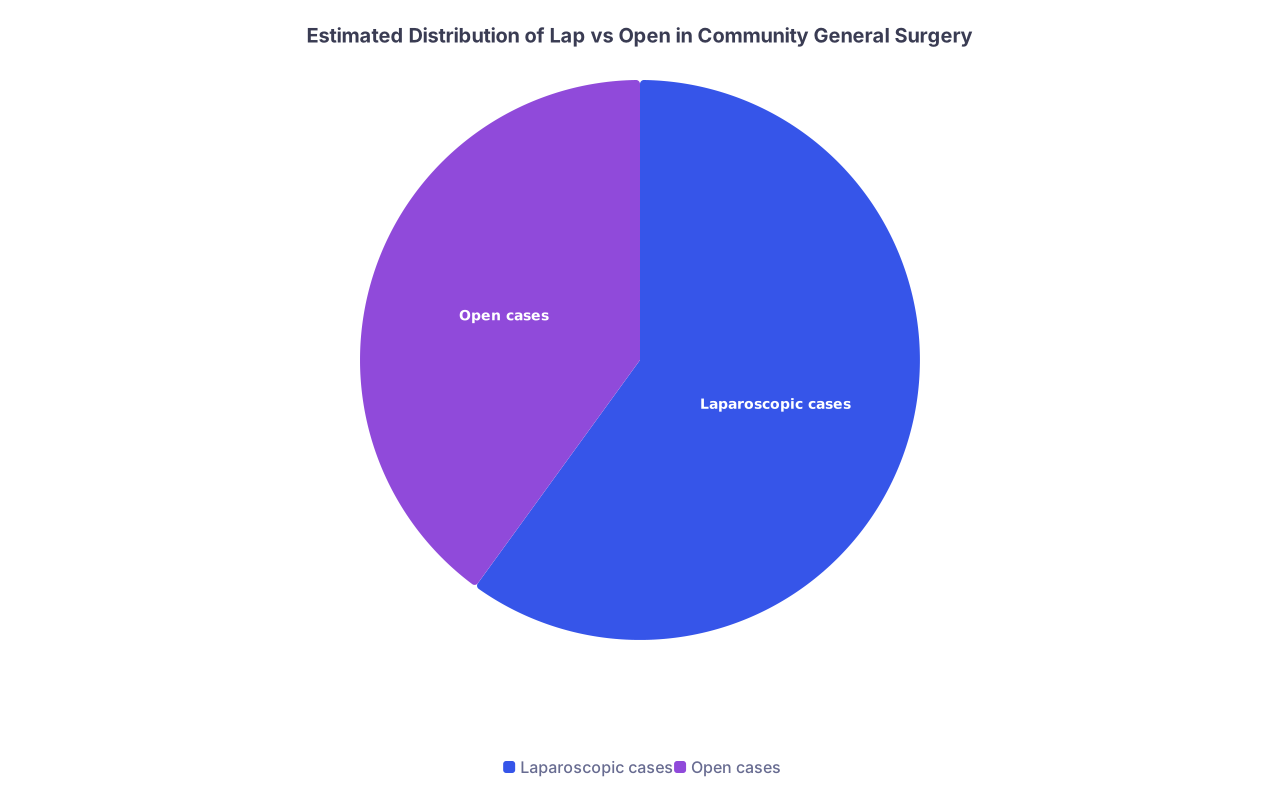
| Category | Value |
|---|---|
| Laparoscopic cases | 60 |
| Open cases | 40 |
You want to be comfortable on both sides of that pie chart.
Concrete Targets and Benchmarks (Not Just ACGME Minimums)
I am not going to list ACGME minimums—you can look those up. Let me give you functional targets instead. These are ballpark, not law, assuming general surgery training.
By graduation, a safe, versatile resident should roughly have:
- Lap chole: 150–250 total, at least 30–40 acute cases, several in obese/reoperative patients
- Lap appy: 60–100, with a good chunk perforated/complicated
- Lap ventral/inguinal hernia: 50–100 combined, including some recurrent and larger defects
- Lap colectomy / foregut: maintain enough exposure that you are not seeing your first Nissen as an attending
For open:
- Midline laparotomy as primary: 60–100, including at least 20–30 complex/hostile abdomens
- Open bowel resection with hand‑sewn or stapled anastomosis: 30–50 where you perform the main steps
- Trauma laparotomy: depends on institution, but you should feel comfortable leading the first 20–30 minutes of a damage control lap—packing, rapid control, temporary closure.
Are those perfect numbers? No. But they are a useful sanity check. If you are half those on either side, that is a red flag.
Protecting Your Future: Documentation and Narratives
Case volume is one piece. How you present your distribution matters in applications and job talks.
You should be ready to articulate:
- Your overall lap/open mix with real numbers.
- Specific complex scenarios: “Converted an acute chole in a cirrhotic patient; controlled bleeding open; performed critical portion.”
- Your self-identified gaps and how you addressed them late in residency. Fellowship directors like residents who see their own blind spots.
One practical tactic: keep a short, private log of “turning point” cases. The day you handled your first real conversion. The worst hostile abdomen you opened. That becomes interview material and proof that your numbers mean something.
Summary: How to Actually Optimize Your Skill Portfolio
Let me compress this.
- Do not chase raw laparoscopic numbers without an open safety net.
- Audit your case log early (PGY2–3), define your career target, and steer rotations and case roles accordingly.
- Practice conversions, hostile abdomens, and open bleeding control just as deliberately as you practice intracorporeal suturing.
If your case distribution supports that, you will not just “meet minimums.” You will graduate as someone people trust with a sick patient at 2 a.m.—scope or no scope.