
Only 3–7% of general surgery residents finish training with the recommended volume of true vascular exposure cases logged accurately.
Let me be blunt: vascular exposure is the quiet orphan of many operative logs. Everyone worries about lap choles, colectomies, and hernia numbers. Meanwhile, the cases where you control a bleeding common femoral artery at 2 a.m. or expose an iliac vessel for trauma or bypass? Those get mislabeled, under-logged, or never logged at all.
For most trainees, vascular exposure is rare. But when you need it, it is the difference between a salvageable limb and an exsanguinating patient on the table. So you cannot afford to treat these cases casually in your log.
Let me break this down specifically.
What Actually Counts as a “Vascular Exposure” Case?
Most people log “vascular” like it is a single bucket. That is wrong. There are at least three distinct concepts:
- Operations where the vessel is the primary target (endarterectomy, bypass, aneurysm).
- Operations where major vessels are exposed for another service (orthopedic, neurosurgical, oncologic) – the classic “vascular exposure” consult.
- Operations where you obtain proximal/distal control for trauma or hemorrhage control.
It is category 2 and 3 that are systematically under-tracked.
Concrete examples that should flag in your mind as “this belongs in a vascular exposure category”:
- Exposure of:
- Common femoral artery/vein for orthopedic tumor resection.
- External or internal iliac artery for pelvic oncologic work.
- Subclavian or axillary vessels for thoracic outlet or clavicle fixation.
- Popliteal artery for orthopedic knee reconstruction.
- Carotid artery for skull base or ENT oncologic resections.
- Trauma:
- Proximal control of iliac vessels via laparotomy.
- Popliteal artery exposure in the setting of knee dislocation with intimal injury.
- Axillary or brachial artery exposure for penetrating trauma.
- Specialized exposure:
- Retroperitoneal aortic exposure for open AAA or complicated EVAR conversion.
- Renal artery exposure for complex partial nephrectomy.
- Superior mesenteric artery (SMA) or celiac trunk exposure in complex oncologic resections (e.g., pancreaticoduodenectomy with vascular involvement).
Here is the usual mistake: a resident scrubs a limb-sparing sarcoma resection with ortho onc and the vascular team provides exposure and control of femoral vessels. In the log, the resident documents “Radical resection, lower extremity sarcoma – assistant.” No mention of “femoral artery exposure,” no vascular category selected, nothing that reflects one of the few complex vascular exposures they may see all year.
That is how your log lies to you. And to credentialing bodies.
Why Vascular Exposure Cases Are Rare but Crucial
You can go weeks without a meaningful vascular exposure, then get two in one call night. The volume is low, especially in community or non–high-volume trauma settings. But the skill is foundational.
The specific, high-yield skill set from proper vascular exposure:
- Understanding three-dimensional vessel anatomy beyond Netter:
- Relationship to nerve plexuses, veins, and fascia.
- How the vessel truly “sits” in the field, not how it looks on CT.
- Developing disciplined dissection habits:
- Sharp dissection on adventitia, not random tearing.
- Identifying artery vs vein vs nerve by feel and behavior in the field.
- Getting proximal and distal control:
- Where you can safely clamp.
- How much length you need for repair or bypass.
- How to plan your incision and retraction to actually achieve it.
- Hemorrhage control under pressure:
- Knowing the exposure approach cold when anesthesia is shouting about pressure and the cell saver is running non-stop.
I have seen senior residents freeze at the table when the attending says, “Get me proximal control of the external iliac.” They do not know where to start the incision. They do not know where to enter the retroperitoneum. That is not a “knowledge” problem. It is an exposure/log problem. They simply have not done it enough times, and their logs gave everyone the illusion they had plenty of vascular experience.
If you want to function as an independent surgeon in trauma, acute care, or even complex general surgery, you need a realistic record of which vascular exposures you have actually done. Not what the ACGME or an ABS form says you “should” have.
How Vascular Exposure Is (and Is Not) Captured in Current Case Logs
Different systems classify vascular work differently. But the pattern is the same: exposure tasks get buried.
| System / Context | Where Vascular Exposure Usually Ends Up |
|---|---|
| ACGME General Surgery | Vascular, Trauma, or “Other” Misc Procedures |
| Vascular Fellowship | Arterial Exposure, Open Vascular, Trauma |
| Ortho / Neurosurgery | Not separately tracked, buried in “approach” |
| Hospital Credentialing | Free-text op note, not structured data |
| Trauma Registries | Focus on injury type, not exposure details |
What this means for you:
- Your main case log (e.g., ACGME) will underestimate:
- How many unique vascular beds you have exposed.
- Your actual readiness for independent proximal control.
- Many exposure-heavy cases are coded by the “primary” procedure:
- The ICD/CPT codes reflect tumor resection or bone work.
- Vascular exposure feels like “part of” the bigger case, so it never gets logged as its own technical event.
The absurd part? Hospital credentialing committees or fellowship directors sometimes ask questions like:
- “How many femoral artery exposures have you done?”
- “What is your experience with popliteal artery repair and the exposure needed for it?”
Your ACGME report will not give that answer in any honest way. Unless you create your own vascular exposure tracking layer.
A Practical Framework: Building a Dedicated Vascular Exposure Log
You need a parallel system. Do not rely on the generic operative log alone.
I recommend a simple, structured, low-friction add-on, either:
- A spreadsheet (Google Sheets or Excel).
- Or a note-based system (Notion, OneNote) with a standard template.
Core principle: capture exposure and control information, not just “vascular yes/no”.
Here is a simple, realistic structure.
1. Fields You Should Track for Every Vascular Exposure
Keep it short enough that you will actually do it. I suggest these key fields:
- Date
- Institution
- Attending
- Role: Primary vs First Assist vs Secondary Assist
- Primary service: Vascular / Trauma / Ortho / Onc / ENT / Neurosurg / Other
- Approach:
- Midline laparotomy
- Retroperitoneal flank
- Groin (femoral)
- Supraclavicular / infraclavicular
- Medial knee / popliteal fossa
- Posterior approach, etc.
- Vessel(s) exposed (checklist style):
- Common carotid / internal carotid
- Subclavian / axillary
- Brachial / radial / ulnar
- Thoracic aorta / abdominal aorta
- Iliac vessels (common, external, internal)
- Common femoral / profunda / superficial femoral
- Popliteal
- Tibial / pedal
- Visceral (SMA, celiac, renal)
- Purpose:
- Exposure and control only (for another service)
- Exposure + repair
- Bypass / interposition graft
- Trauma hemorrhage control
- Complexity tags:
- Scarred field
- Obese patient
- Prior radiation
- Active hemorrhage
- Iatrogenic injury
This takes less than 1–2 minutes per case if your template is set up. Faster than the average ACGME logging session.
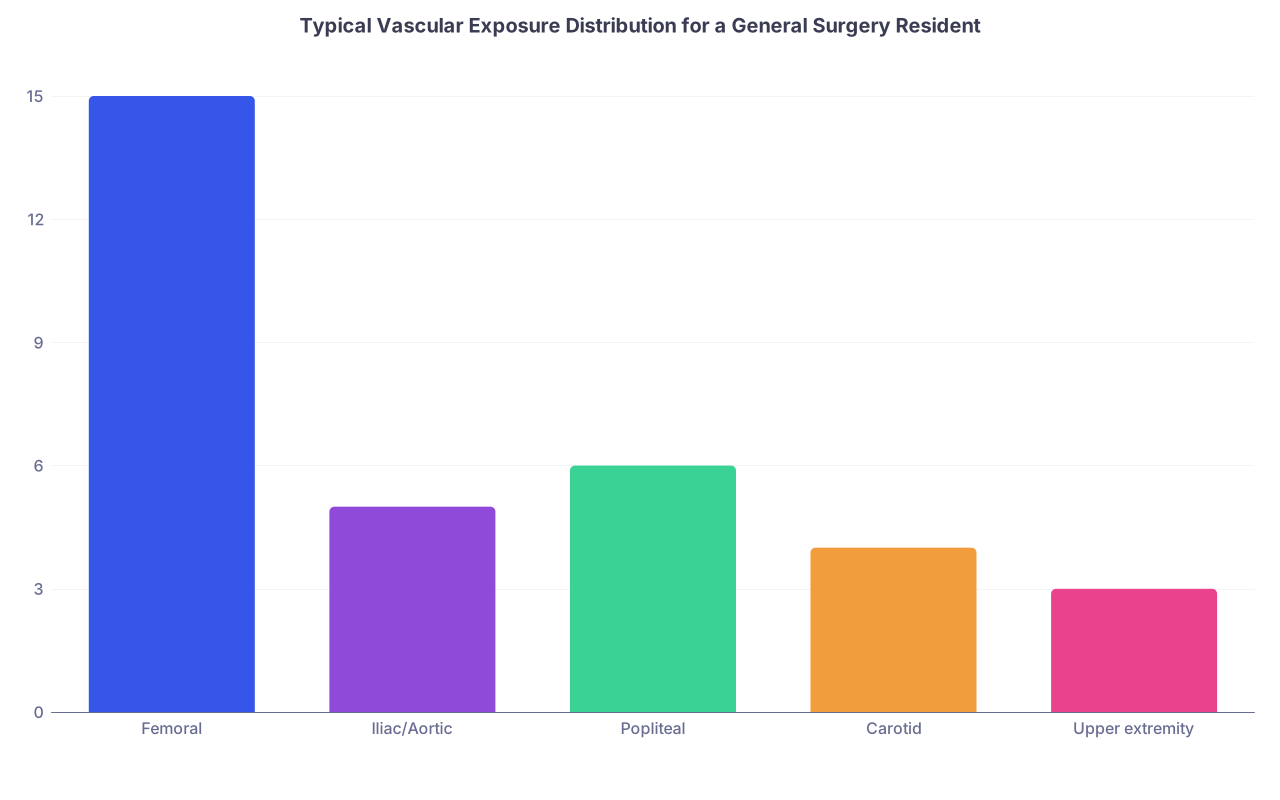
| Category | Value |
|---|---|
| Femoral | 15 |
| Iliac/Aortic | 5 |
| Popliteal | 6 |
| Carotid | 4 |
| Upper extremity | 3 |
What this chart represents: a pretty common pattern in a decent training program. Lots of groin exposures, much fewer meaningful iliac/aortic and upper extremity cases. If your numbers are far lower, you have hard data that there is a gap.
2. Encoding Levels of Independence
Your generic log has “PGY level” and role, but that is not the same as independence.
I strongly recommend you self-grade each case:
- Level 1 – Observed only; did not perform key steps.
- Level 2 – Performed part of the exposure (e.g., opening, some dissection) with heavy guidance.
- Level 3 – Performed the majority of exposure and obtained proximal/distal control under direct supervision.
- Level 4 – Performed full exposure and control with minimal prompting; attending scrubbed.
- Level 5 – Effectively independent exposure (fellow-type role), attending unscrubbed or scrubbed for critical moments only.
Many residents surprise themselves when they see the pattern:
- Lots of Level 3 femoral exposure.
- A handful of Level 2 iliac/aortic exposures.
- Maybe one or two Level 3 popliteal exposures.
- Almost no Level 4–5 outside the groin.
That is not failure. That is reality. But at least it is accurate reality.
Integrating Vascular Exposure Tracking With Your Daily Workflow
The only tracking system that works is the one you will actually use post-call when you would rather be unconscious.
A few tactics that I have seen work.
1. Use a Daily “Vascular Flag”
After each OR day or call shift, quickly ask yourself:
“Did I touch or see major vessels today in a way that changed my technical understanding?”
If the answer is yes, that case gets a vascular exposure entry. It might be:
- Opening the retroperitoneum and seeing iliac bifurcation clearly for the first time.
- Controlling popliteal artery during trauma ex-fix.
- Doing both proximal and distal control of the femoral artery for a redo endarterectomy.
If it meaningfully involved large vessel control or exposure, it is eligible.
2. Don’t Wait More Than 24 Hours
Past that, details blur. You will remember “big onc case” but forget that you dissected the SMA for 45 minutes.
Make it part of your sign-out or pre-sleep routine. Five minutes.
3. Sync With Your Official Log Weekly
Once a week:
- Pull up your vascular exposure log.
- Cross-check against your ACGME (or institutional) operative log.
- Ensure those major exposures are at least represented under the correct category codes, even if they cannot capture the full nuance.
That weekly check is how you avoid the classic “Oh, I never logged that popliteal repair” problem six months later.

| Step | Description |
|---|---|
| Step 1 | OR Day or Call Shift |
| Step 2 | No vascular log entry |
| Step 3 | Open vascular exposure log |
| Step 4 | Enter key fields in 1-2 minutes |
| Step 5 | Tag vessel and level of independence |
| Step 6 | Weekly - sync with official log |
| Step 7 | Any major vessel exposure? |
The idea is not perfection. It is repeatable behavior.
Why This Matters for Future Credentialing, Fellowships, and Real Life
You are not doing this just to admire your spreadsheet.
Vascular exposure tracking has very concrete downstream value.
1. Honest Readiness for Independent Practice
If you plan to:
- Take trauma call in a Level 1 or 2 center.
- Do acute care surgery with no onsite vascular surgeon overnight.
- Work in a community setting without 24/7 vascular coverage.
You need to answer questions like:
- “Have I actually exposed the supraceliac aorta myself?”
- “Can I confidently get control of the popliteal artery in a mangled knee trauma without turning the leg into mush?”
- “What is my pattern recognition around variant anatomy in the groin or retroperitoneum?”
A good vascular exposure log shows your real experience instead of wishful thinking.
2. Stronger Fellowship Applications (Vascular or Trauma)
Fellowship directors are saturated with vague statements like:
- “I have robust vascular exposure.”
- “I am comfortable with major vessel control in trauma.”
You can be precise instead:
- “Across training, I have performed 22 femoral exposures (14 Level 3, 8 Level 4), 7 popliteal artery exposures (all Level 3), and participated in 6 iliac/aortic exposures (Levels 2–3). I have independently obtained proximal and distal control for extremity vascular trauma in 5 cases.”
That is the language of someone who knows exactly what they have done.
3. Negotiating Privileges in Early Practice
Hospitals sometimes take a conservative stance with new graduates:
- “You can do basic general surgery but not vascular.”
- Or they limit you to minor vascular procedures.
Having a concrete self-documented vascular exposure log—especially if co-signed or at least informally endorsed by attendings—gives you some leverage:
- Evidence that you have performed specific exposures and vascular repairs.
- A way to define graduated privileges (e.g., “femoral exposure and control for access procedures,” “popliteal exposure with vascular backup available”).
No, your personal log is not magic. But it is more persuasive than “I think I have done plenty.”
Common Mistakes Trainees Make With Vascular Exposure Cases
I have seen the same patterns repeatedly.
Lumping all vascular work into a single bucket.
Reality: femoral exposure ≠ iliac ≠ popliteal ≠ subclavian. The anatomy, danger points, and technical requirements are totally different.Not recording the role and independence honestly.
Being present is not the same as doing the hard part. Watching an attending dissect down on the axillary artery while you hold a retractor is not “axillary artery exposure – primary.”Ignoring dirty, messy trauma exposures.
These are often the most technically educational. Contaminated fields, distorted anatomy, friable tissue. Many residents forget to log them because they feel chaotic and “non-elective” so they fall through the cracks.Trusting that “vascular rotation” automatically equals competency.
I have seen residents “do a month on vascular” and log mostly fistulas and simple access work. Meanwhile, their exposure log shows a near-absence of proximal control on major vessels. Vascular block on your schedule does not guarantee major exposure experience.Not differentiating exposure vs reconstruction.
For your own development, split those concepts. You can be very good at exposure and control before you ever lead a complex bypass. That baseline skill makes you far easier to credential and far safer in emergencies.
Building a Vascular Exposure “Curriculum” Out of Your Log
Once you collect a few dozen entries, you can do something more sophisticated: use your own log as a personalized curriculum.
Look at it every 3–6 months and ask:
- Which vessels have I never exposed?
- Maybe no subclavian/axillary? No SMA? No carotid outside standard CEA?
- Which exposures are stuck at Level 1–2?
- Have you ever actually led a retroperitoneal iliac exposure, or always been the assistant?
- Am I clustered in one anatomical area?
- All groin and popliteal, no neck or upper extremity, for instance.
Then you can target:
- Request cases deliberately:
- Ask vascular attendings to call you for specific exposures (e.g., “If you have a retroperitoneal iliac exposure or difficult popliteal, please page me if I am not scrubbed.”)
- Shape electives:
- If you are already solid in femoral, but weak in upper extremity and neck, prioritize rotations or electives that offer those.
- Prep anatomically in advance:
- If a case tomorrow involves axillary exposure and you have never done one, you should be reviewing that approach the night before like it is an exam.
Your log stops being a bureaucratic requirement and starts becoming a training tool.
What This Looks Like in Real Numbers
Here is a rough, realistic “good but not super-vascular-heavy” general surgery residency vascular exposure profile by graduation, based on trainees who actually tracked this:
| Vessel / Region | Total Exposures | Level 3–5 Cases |
|---|---|---|
| Common femoral | 20–30 | 12–18 |
| Popliteal | 6–10 | 4–6 |
| Iliac / aortoiliac | 5–8 | 2–4 |
| Carotid / neck vessels | 4–8 | 3–5 |
| Upper extremity arteries | 4–6 | 2–3 |
Now compare that to what most generic case logs show when you do not track exposures carefully:
- “Vascular cases”: 60–80.
- Zero breakdown by location, purpose, or independence.
Which one would you trust in a crisis?
Implementation: Do This in the Next 48 Hours
If you want something concrete, do the following this week:
Create the log.
Make a simple spreadsheet with the columns listed earlier.Backfill the last 20–30 major cases where you think you did vascular work.
You will remember more than you expect, especially big trauma or tumor cases.Commit going forward that any case with meaningful vessel exposure gets an entry.
Even if you are exhausted. Even if it was “only” part of a bigger case.At the end of this month, look at your pattern.
If it is all femoral and zero iliac/pop, you know what to chase.
This is not busywork. When you are the only surgeon in the building at 3 a.m. and the ED is rolling up a hemodynamically unstable pelvic trauma, you do not want your first honest experience with iliac exposure to be right then.
FAQs
1. Should I create a separate “case” in my official log for pure vascular exposure when I was assisting another service?
If your system allows multiple CPTs or “other procedures,” yes, you should represent that vascular work explicitly. At minimum, document it clearly in the narrative and in your personal vascular exposure log. I do not recommend gaming codes, but I do recommend being explicit that vascular exposure and control were performed, especially when you were primarily responsible for that portion.
2. How many vascular exposure cases are “enough” for a general surgery graduate who will take trauma call?
There is no magic cutoff, but patterns matter. I would be uncomfortable if someone had fewer than:
- 10–15 femoral exposures with proximal/distal control, and
- 4–6 popliteal exposures, and
- 4–6 iliac/aortic exposures (even if shared with an attending), before being the only surgeon managing major vascular trauma. Those are rough benchmarks, not laws. Your independence level in those cases matters as much as the count.
3. Do endovascular or hybrid procedures count toward “vascular exposure” experience?
They count as vascular experience, but not as open exposure in the sense we are discussing here. Understanding wire/catheter work and imaging is invaluable, but it does not teach you how to find and control a bleeding vessel through scarred tissue. Track them in a separate endovascular section if you do a lot of hybrid work, but do not fool yourself into thinking they replace open exposure.
4. I am in a low-volume center and will not hit the numbers you describe. What should I do?
You have three realistic options:
- Maximize every possible vascular exposure in your current program using deliberate tracking and pre-case planning.
- Seek visiting rotations, electives, or away experiences at higher-volume vascular or trauma centers.
- After residency, pursue fellowship (trauma/critical care with high-volume trauma, or vascular) before taking a job that expects you to manage complex vascular injuries alone. The worst option is pretending you are prepared when your log and experience clearly say otherwise.
Key points: First, vascular exposure cases are rare but disproportionately important, and standard logs systematically undercount them. Second, a simple parallel vascular exposure log—focused on vessel, approach, purpose, and independence—gives you a brutally honest picture of your readiness for real-world emergencies and future credentials.