You are a PGY-4 general surgery resident. It is 10:30 p.m., you are post-call, and your program director just asked you a deceptively simple question during your semiannual review:
“So. You say you want surgical oncology. By the time you finish chief year, how many major cancer resections do you think you actually need under your belt for fellowship to be realistic? And how many to not be dangerous?”
You mumble something about “whatever ACGME requires” and “we are pretty busy with HPB cases,” but you know that is not really the question. The real question is whether your case volume will make you competitive on paper and competent in the OR when you walk into day one of an onc fellowship.
Let me break this down specifically.
1. The Three Different Questions You Are Actually Asking
When people ask “how many major resections before oncology fellowship,” they are really asking three separate things:
- What do programs expect on your application to not look weak?
- What is truly needed to be safe and functional on day one of fellowship?
- What kind of volume gets you on track to be an independent cancer surgeon after fellowship?
These are not identical. The first is about optics and competitiveness. The second is about basic operative competence. The third is about long‑term professional trajectory.
I am going to talk about all three, but I will anchor numbers to the first two, because that is what actually determines whether you:
- Get interviews.
- Do not embarrass yourself in the fellowship OR.
- Do not harm patients while “learning” basic principles you should already know.
2. Baseline Reality: What General Surgery Residency Actually Gives You
Start with the floor: ACGME minimum case numbers for general surgery. They change slightly over time, but the spirit does not.
You are not being trained as a fully-fledged oncologic surgeon in residency. You are being trained as a safe generalist with exposure to cancer surgery. That difference matters.
Common patterns in a solid but not insanely busy program by end of PGY-5:
- Total major cases: 850–1,100.
- Complex abdominal (Whipple, total gastrectomy, multivisceral resections, etc.): often 40–80.
- Liver resections: 15–40.
- Pancreatic resections (Whipple/distal): 10–30.
- Esophagectomy: 0–10 in many places (yes, really).
- Major colorectal cancer resections (lap or open): 60–150.
- Breast oncologic operations (lumpectomy + mastectomy): 40–150, depending on program structure.
The median graduate is competent at bread‑and‑butter: colectomies, standard cholecystectomy, basic foregut. They are not “oncologic” surgeons for pancreas, liver, esophagus. That is what fellowship is for.
So the question becomes: how far above that baseline should you be if you are serious about surgical oncology?
3. Oncology Fellowship: What Program Directors Actually Care About
Let me be blunt. Fellowship directors are not counting every Whipple you have done. They care about three categories:
- Evidence that you can safely handle a big abdominal case as the primary surgeon.
- Evidence that you have chosen oncology intentionally (case mix + research).
- Evidence that you can survive a high-volume academic environment.
They use operative logs in a fairly practical way:
- Are you operating enough, period?
- Are you doing enough complex cases where anatomy is distorted and decision‑making matters?
- Is your mix obviously skewed to trauma and appendixes, with a near-total absence of meaningful cancer resections?
Here is the dirty secret: you do not need enormous pre-fellowship case numbers in pancreas/liver to match into onc. What you cannot get away with is looking like a low‑volume, low‑acuity, non-specialty‑oriented resident.
4. Concrete Targets: Case Volumes That Actually Mean Something
Now the numbers you probably came for. I am going to break it down into:
- “Do not look weak” numbers.
- “Good, solid candidate” numbers.
- “You came from a heavy onc/HPB program” numbers.
These are ballparks, not absolute thresholds. Programs differ. But this is realistic.
4.1 Big-Case Competence: General Complex Abdominal
Think: any laparotomy where you are not just taking the appendix. Multivisceral resections, major adhesiolysis, big colectomies, gastrectomy, retroperitoneal dissections.
By end of PGY-5:
- Bare minimum not to look weak for onc: ~120–150 truly major open abdominal cases as surgeon Jr or Sr (not just first assist).
- Solid onc candidate: 180–250.
- Heavy onc/HPB background: 250–350+.
If your total open major abdominal exposure is anemic, but you have a ton of minimally invasive colectomies and foregut, that is not fatal—but it does raise an eyebrow for HPB‑leaning onc fellowships.
4.2 HPB and Upper GI
Programs know that HPB exposure in residency is all over the map. They are not expecting you to be a mini-HPB surgeon. But they want to see that you have at least been around the block.
By the end of residency, rough targets:
Whipple / Pancreaticoduodenectomy (performed as primary surgeon, not just retracting):
- Do not look weak: 3–5.
- Solid: 8–15.
- Heavy HPB exposure: 20+.
Distal / central pancreatectomy:
- Do not look weak: 2–4.
- Solid: 5–10.
- Heavy: 10–20.
Major hepatectomy (formal right/left, extended) where you were doing more than skin and closure:
- Do not look weak: 3–5.
- Solid: 8–15.
- Heavy: 15–30.
Total/near-total gastrectomy for cancer:
- Do not look weak: 2–4.
- Solid: 5–10.
- Heavy: 10–20.
Esophagectomy:
- Many US programs: 0–5 and that is accepted.
- If you have: 3–5+ as a real operator, that reads as strong upper GI exposure.
Major takeaway: If you have 0 Whipples as primary surgeon and only scrubbed a couple, you are not doomed. But if your entire HPB section is essentially empty, it is harder to argue you are serious about complex abdominal cancer.
4.3 Colorectal Oncology
Many onc fellows will see a ton of colorectal malignancy. Programs often look at this domain to gauge both volume and quality of training, even if you are not going into colorectal fellowship.
Target ranges:
Colon / rectal cancer resections (lap or open, primarily for malignancy):
- Do not look weak: 40–60.
- Solid: 70–120.
- Heavy: 120–180+.
Complex rectal cancer (low anterior resections, APRs, pelvic exenterations) specifically:
- Do not look weak: 8–10.
- Solid: 15–25.
- Heavy: 25–40+.
If all your colectomies are for diverticulitis and benign polyps, it changes the tone. Not catastrophic, but less ideal. You want a clearly documented subset for malignancy.
4.4 Breast Surgery
For surgical oncology (non-HPB-specific), breast volume actually matters. Many general surg onc programs expect you to manage a substantial breast practice post-fellowship.
Breast lumpectomy + partial mastectomy:
- Do not look weak: 20–30.
- Solid: 40–70.
- Heavy: 80–120+.
Mastectomy (simple, modified radical):
- Do not look weak: 15–20.
- Solid: 25–40.
- Heavy: 40–70+.
If you come from a program where plastics owns all reconstruction and breast volume is low, that is fine, but you still should not be hitting fellowship with fewer than maybe 25–30 meaningful breast cancer cases total.
4.5 Sarcoma / Retroperitoneal
These are rare everywhere. No one expects big numbers. But even a small set of serious cases sends a strong signal.
Soft tissue sarcoma resections (trunk/extremity):
- Typical: 3–10.
- If 0: not a red flag, but less ideal if you are claiming “strong sarcoma interest.”
Retroperitoneal sarcoma / large retroperitoneal tumors:
- Typical in residency: 0–3.
- If you have been primary surgeon on even 1–2 big retroperitoneal cases, that stands out.
| Domain | Do Not Look Weak | Solid Candidate | Heavy Exposure |
|---|---|---|---|
| Major open abdomen | 120–150 | 180–250 | 250–350+ |
| Whipple | 3–5 | 8–15 | 20+ |
| Major hepatectomy | 3–5 | 8–15 | 15–30 |
| Colon/rectal CA | 40–60 | 70–120 | 120–180+ |
| Breast CA (total) | 35–50 | 65–110 | 120–190+ |
None of these are “requirements.” They are reality‑checked ballparks.
5. Competitiveness vs Competence: Where the Curves Cross
There is a point where additional pre-fellowship volume adds very little for getting in the door, but a lot for how you function once you are there.
On the competitiveness side:
- Once your total major case volume is >900 and you have a clearly non-anemic subset in onc-relevant fields, you are usually past the “is this person undertrained?” threshold.
- Programs then shift their focus to research output, letters, and fit. Not whether you did 9 or 19 Whipples.
On the competence side:
- The resident who has done 12–15 meaningful Whipples as primary surgeon operates differently from the one who has done 3, even if both match.
- Same story with 150+ complex colorectal cases vs 50. And 40+ major hepatobiliary vs 10.
Fellowship is short. Typically 2 years. If you spend the first 6–9 months just getting comfortable retracting around the SMV or doing basic hilar dissection because you never saw it in residency, you are leaving skill on the table.
I have seen fellows who are technically fine by the end, but always a step slower, less decisive, less able to improvise, because they were still building a foundation during time that should have been refinement.
6. What Fellowship Directors Actually Say (When They Are Honest)
If you sit in a selection conference long enough, you hear patterns:
- “Good total volume, but very soft in complex HPB. Strong research. We can teach the technical stuff.”
- “Numbers are okay, but look at the distribution—tons of trauma and hernias, almost no onc exposure. Are we basically re-training them from scratch?”
- “Great onc case mix, but the letters are lukewarm and they have weak academic output. Pass.”
Notice: case volume is necessary but not sufficient. They like to see:
- You can handle the entire life cycle of a cancer case in the OR: approach, exposure, vascular control, decision to resect vs abort.
- You are not a one‑trick pony. Too skewed a log (all trauma, all bariatric, etc.) makes them nervous.
- Your volume fits your story. If you claim “HPB is my passion” and you have 1 Whipple and 3 liver resections, the story is not coherent.
7. Year‑by‑Year: What Volume Progression Should Look Like
You cannot fix everything in PGY-5. If you are early, you can be intentional.
PGY-1–2: Foundation and Exposure
You will not log many “major resections” as surgeon, but you still shape your trajectory:
- Get into complex cases as a second assist or retractor. You learn the anatomy and sequence by watching, not just holding the camera for lap appys.
- Attach yourself to an onc/HPB faculty early. Show up to clinic. Volunteer for late add‑on complex cases.
If by end of PGY-2 you have never scrubbed a Whipple, hepatectomy, or big cancer colectomy, that is a red flag about your environment or your initiative.
PGY-3: Transition From Observer to Operator
This is where you begin to matter in major resections:
- Start taking real steps in big cases: Kocherization, vessel loops on SMV/portal vein, hilar dissection, full medial‑to‑lateral mobilization of colon.
- Aim to be primary surgeon on simpler onc resections (e.g., straightforward right colectomy for cancer, lumpectomy with SLNB).
If by the end of PGY-3 you have zero operative experience in onc cases beyond skin closure, you are behind.
PGY-4–5: Proving You Can Run the Room
These are the key years for case logs that actually move the needle for fellowship:
- You should be able to run at least parts of a Whipple or major hepatectomy almost end‑to‑end, under supervision.
- You should be operating independently on many colon cancer resections, basic breast resections, and less complex HPB.
By mid‑PGY-5, if you have never been allowed to lead a big cancer case, it will show in your confidence and your numbers. That may not be your fault, but you cannot hide it on a log.

| Step | Description |
|---|---|
| Step 1 | PGY 1-2 Exposure |
| Step 2 | PGY 3 Early Operator |
| Step 3 | PGY 4 Senior Onc Service |
| Step 4 | PGY 5 Chief With Major Resections |
| Step 5 | Attach to Onc Faculty |
| Step 6 | Primary Surgeon on Simple Onc |
| Step 7 | Lead Portions of HPB Cases |
| Step 8 | Fellowship Ready Case Mix |
8. Laparoscopic vs Open: What Actually Matters for Oncology
Another subtle but important point. Modern onc surgery uses both open and minimally invasive approaches. Fellowship directors are not anti-lap. But they pay attention to how “real” your experience is.
- 100 lap cholecystectomies do not substitute for 10 open hepatobiliary cases.
- 60 lap colectomies where you clip and divide the IMA and mobilize colon are meaningful. But if you never had to manage hostile abdomens or big open resections, you are missing muscle memory you will need.
For onc-bound residents, an ideal mix by graduation:
- At least 40–60 open colectomies / small bowel / complex abdominal resections.
- Another 60–100 laparoscopic colorectal / foregut cases with you doing the critical steps.
- Enough open upper GI and HPB that you are comfortable with big incisions, big bleeding, and postoperative wreckage.
The fellow who cannot handle a midline laparotomy without getting lost in adhesions is going to have a rough start.
9. “I Am at a Low-Onc-Volume Program. Am I Screwed?”
Not automatically. But you cannot be passive.
You have a few levers:
Elective rotations
Push for away or in‑house electives with HPB/surgical oncology. Even 1–2 dedicated months at a high-volume center can give you 10–20 big cases that change your log profile.Research alignment
If you lack volume, your application needs to scream “onc focus” in other ways: HPB/onc publications, abstracts, presentations, strong letters from recognized onc surgeons.Ownership of what you do have
Even in low-onc places, there are colon cancers, gastric cancers, breast cancers. Do not let them all be done by the same faculty with you “scrubbing in.” You should be the primary resident on as many of these as possible.
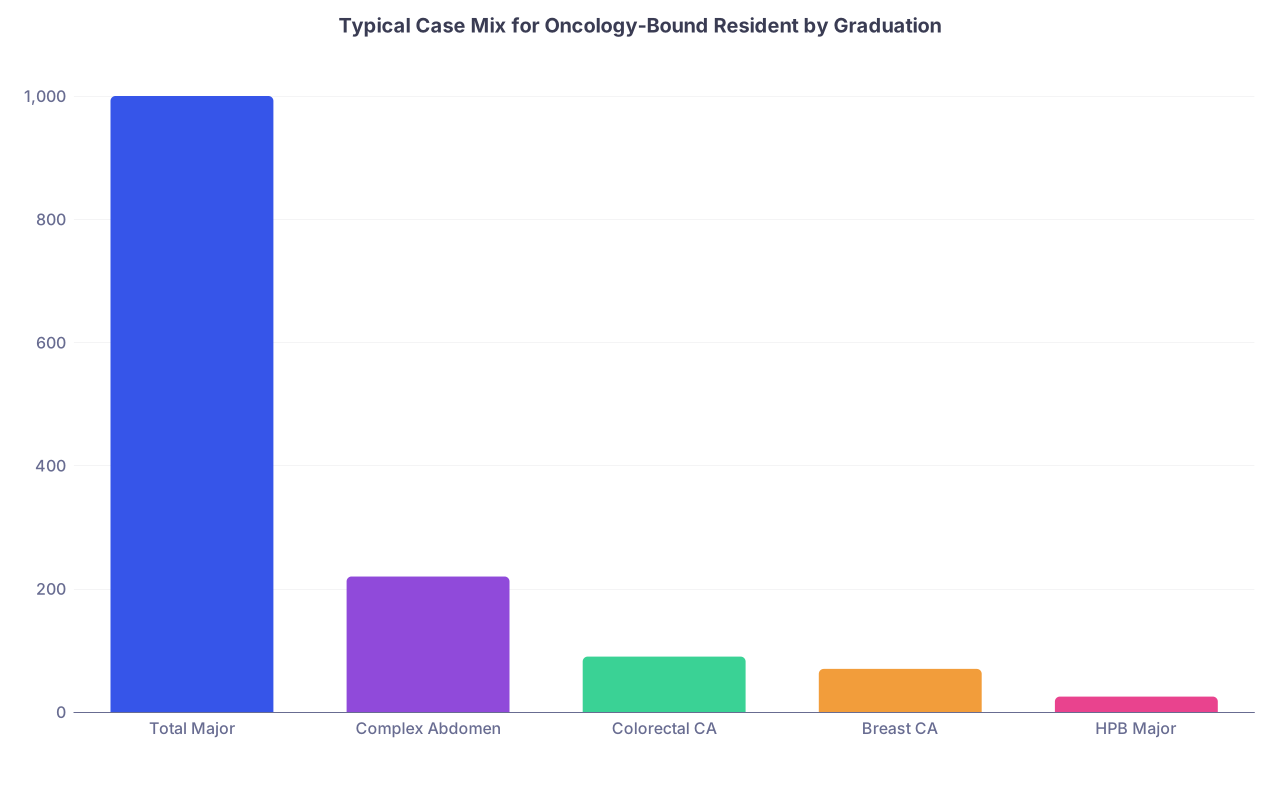
If, by graduation, you have:
- 900+ total cases.
- 60–80 colon/rectal cancer resections.
- 20–30 breast cancer operations.
- A handful (even just 3–5 each) of HPB major cases.
- Evidence of real onc research.
You can absolutely be a credible onc fellowship candidate, even coming from a “generic” community or mixed program.
| Category | Value |
|---|---|
| Total Major | 1000 |
| Complex Abdomen | 220 |
| Colorectal CA | 90 |
| Breast CA | 70 |
| HPB Major | 25 |
10. How Many Major Resections Do You Actually Need? A Straight Answer
Let me put a clear number on this, the way you probably wanted from the start.
If you are asking: “How many major cancer resections do I need before fellowship to be adequately prepared, not just barely acceptable?”:
I would aim for something like this by the time you graduate:
- Roughly 150–250 clearly major onc-related resections across domains
(big colorectal, major HPB, gastrectomies, sarcoma, major breast, etc.—not counting lap choles and appys).
Plus:
- Another ~100–200 complex but not strictly “onc-only” major cases (complex benign foregut, big diverticular resections, complex reoperative abdomen, etc.) that build the same skill set.
In other words:
- If your log shows 40–60 onc-major cases total, you will match only if the rest of your application is exceptional and your total volume is high. You will be underbaked technically.
- If you are in the 120–150 range of honest-to-god major onc resections, you are workable but will need to accelerate early in fellowship.
- Once you cross 180–200+ solid major onc and onc-like resections, you are in a very good technical position. Programs will worry much less about your ability to handle case load and more about everything else.
The absolute number is less important than the pattern:
- Are these cases spread across colon, HPB, breast, and retroperitoneum?
- Were you actually operating, not just retracting?
- Do your letters confirm that you perform at the level your logs suggest?
Programs know logs can be gamed. They trust logs that match the narrative from your letters and your interview.
11. How to Audit Yourself Right Now
If you are within 2 years of graduation and thinking oncology, do this tonight:
- Pull your ACGME case log.
- Filter for:
- Pancreatic resections.
- Liver resections.
- Gastrectomy / esophagectomy.
- Colon / rectal resections for cancer.
- Breast cancer operations.
- Sarcoma/retroperitoneal tumor resections.
- Count:
- How many are you listed as surgeon Jr/Sr vs assistant?
- How many are obviously oncologic resections versus benign disease?
Then ask three questions:
Do I have at least a visible “core” in colorectal and breast?
(Say, >50 colorectal CA and >30 breast CA by the trajectory of my current year.)Do I have any meaningful HPB/upper GI volume at all?
Even if modest (e.g., 10–15 major cases where I did something real).Does the trend suggest I will reach ~150+ serious major onc/onc-like cases by graduation if I keep hustling?
If the answer to all three is “yes,” you are probably fine. If one or more is “no,” you need to be more aggressive with your rotations and case assignments.
12. Where This Is All Going: The Future of Onc Case Volume
A few future-looking realities:
- Minimum case numbers will not get looser. As cancer surgery becomes more complex, fellowship programs are expecting better prepared residents, not less.
- Centralization is real. More big cases are being concentrated at high‑volume centers. This is good for patients, but bad for residents at low‑volume hospitals who do not seek out away experience.
- Robotics is not going away. But a robotic console log without strong open experience will not impress anyone in serious HPB/onc fellowships. You need both.
- Data transparency is creeping in. Over the next decade, ACGME and boards will almost certainly tighten the relationship between logs, outcomes, and certification. Being barely at the minimums will be increasingly uncomfortable.
If you want a career in onc surgery that does not feel like permanent imposter syndrome, you should aim to hit fellowship already comfortable in a hostile abdomen, not still trying to remember the steps of a Whipple.
Key Takeaways
- You do not need massive pre-fellowship HPB numbers to match oncology, but you do need a visible foundation: at least a handful of major pancreas/liver/gastrectomy cases plus robust colorectal and breast oncology volume.
- A realistic target for being genuinely ready, not just barely acceptable, is on the order of 150–250 major onc or onc-like resections by graduation, within a total log typically >900 cases.
- If your current numbers are soft, you are not doomed—but you must intentionally seek high-onc rotations, own every cancer case you can, and align your research and mentorship so that your application story and your log actually match.