
The mantra “quality over quantity” is being misused to justify dangerously low resident case volumes.
You are not training to be a philosopher of surgery. You are training to cut on live humans without hurting them. That requires reps. More than your program director’s PowerPoint will admit.
Let me be blunt: the biggest quiet threat to future surgeons is the comforting story that “a few excellent cases” can replace hundreds of routine ones. That is not education. That is wishful thinking dressed up as pedagogy.
Let’s pull this apart before it quietly caps your competence.
The Seductive Lie Hiding Behind “Quality”
Here is the mistake I see over and over: residents with clearly inadequate case numbers are told (or tell themselves):
- “It is fine; our cases are high complexity.”
- “We get more one-on-one with attendings, so fewer cases is actually better.”
- “Cases are centralized to subspecialists now; you do not need volume.”
- “Simulation and video review make up for low numbers.”
No. They do not. Not even close.
The core problem:
- Quality and quantity are not opposing forces in surgical training.
- You need both, and the relationship is not symmetrical.
- Without baseline volume, “quality” becomes meaningless hand-waving.
There is a minimum number of repetitions your nervous system needs before technical skills move from fragile to durable. Below that threshold, the “complexity” of each case is irrelevant. You are still clumsy. Just clumsy on harder patients.
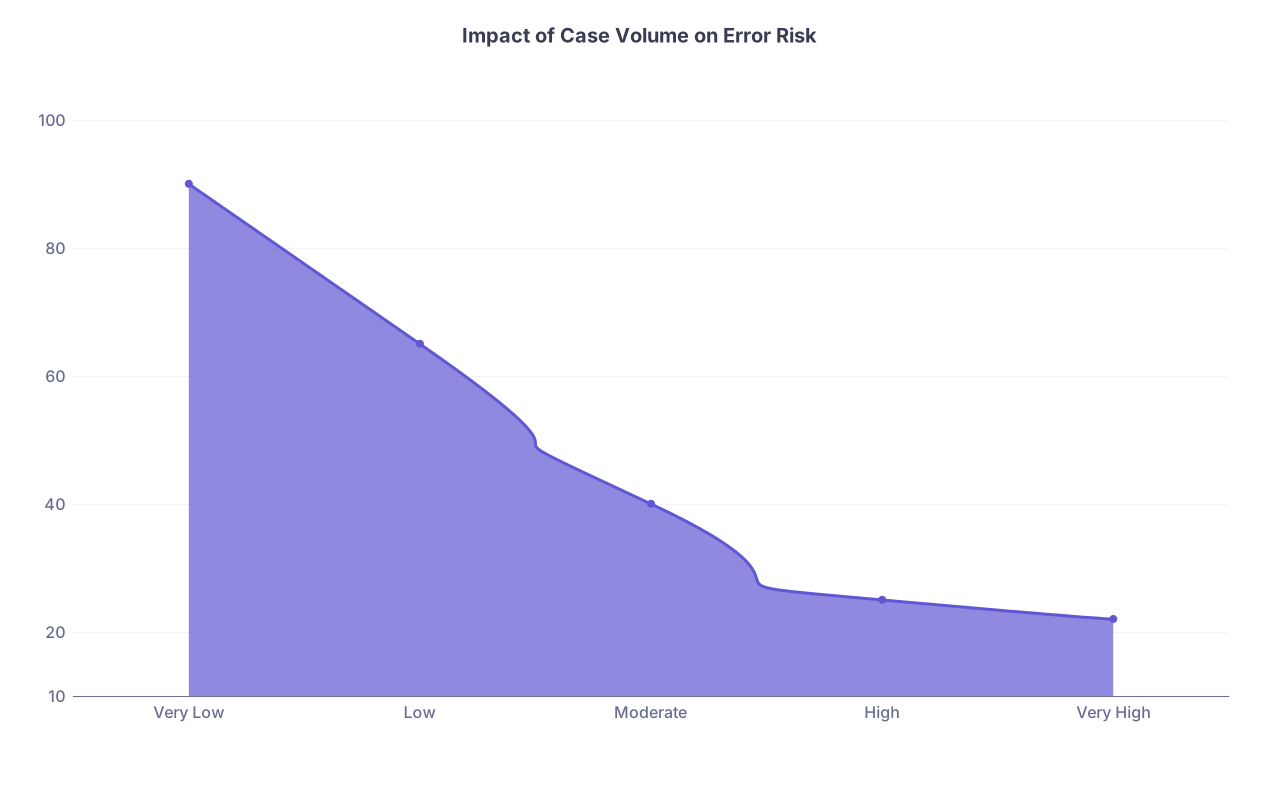
| Category | Value |
|---|---|
| Very Low | 90 |
| Low | 65 |
| Moderate | 40 |
| High | 25 |
| Very High | 22 |
That curve is real in spirit, even if the numbers are illustrative. Very low volume is not just “a bit worse.” It is catastrophically unsafe.
How Programs Misuse “Quality Over Quantity” To Cover Gaps
Programs rarely say, “We do not give you enough cases.” They use softer language:
- “We focus on deliberate practice.”
- “We prioritize graded responsibility over raw numbers.”
- “Our rotations are more subspecialty-based; the old volume models do not apply.”
Some of that is true. Some of it is cover.
Here is how the myth shows up in practice.
1. Hiding Staffing or Volume Problems
I have heard this speech almost word for word:
“Our case numbers are lower than average, but the teaching is better. So it balances out.”
Translation: we lost faculty, our catchment changed, or we are losing cases to private groups, and we have no solution. So we will reframe it.
Signs your program is using “quality” as camouflage:
- You routinely have 1–2 operative days per week with no assigned room.
- Junior residents are routinely bumped by fellows and told, “You will get your numbers later.”
- Your senior residents are barely above ACGME minimums in common cases.
- Off-service rotations swallow months of your PGY years with minimal OR exposure, labeled as “holistic training.”
None of that is “quality.” That is undertraining with better messaging.
2. Over-idolizing “Big Cases” While Ignoring Bread-and-Butter
Another bad pattern: programs brag about rare, massive, or glamorous cases.
- Whipple counts, ECMO cannulations, multi-visceral resections, complex spine reconstructions.
Yet their grads struggle with:
- Laparoscopic cholecystectomy
- Incisional hernia repair
- Basic lap appendectomy
- Simple fracture fixation or arthroscopy steps
You do not become safe on high-wire cases while shaky on the basics.
I have seen PGY-5s who can talk impressively through a pancreaticoduodenectomy but fumble trocar placement or struggle to close fascia efficiently. That is not sophistication. That is malpractice waiting to happen.
What The Numbers Really Mean (And Where Residents Fool Themselves)
Let me show you where many residents make a dangerous assumption: that meeting bare accreditation numbers equals “enough.”
| Case Type | Typical Minimum | Safer Target |
|---|---|---|
| Lap Cholecystectomy | 50 | 100–120 |
| Lap Appendectomy | 40 | 80–100 |
| Inguinal Hernia | 30 | 60–80 |
| Basic ORIF (long bone) | 25 | 50–70 |
| C-sections (OB/GYN) | 50 | 100+ |
Those are ballpark numbers, but the pattern is clear:
- Minimums are political compromises, not magic safety lines.
- They represent “we cannot defend anything lower” more than “this is ideal for competence.”
The myth: “If I hit the ACGME minimum, I am fine.”
The reality:
For most core procedures, you want to be at 1.5–2x the minimum to feel truly independent when the attending is not standing three feet from your shoulder.
Here is where you get burned:
- You think: “I did 45 lap choles; I am basically there.”
- You forget:
- How many of those were as primary surgeon versus camera-holder?
- How many had you managing complications rather than watching someone else bail you out?
- How many were straightforward BMI 28 elective versus inflamed, obese, or post-op abdomen?
Raw case count overestimates your true skill. Low case count plus overinterpretation? That is the trap.
The Skill Domains You Cannot Shortcut With “Quality”
Some parts of surgery simply do not bend to clever curriculum design. They require brute-force repetition.
1. Psychomotor Patterning
You cannot talk your hands into being faster.
Things that only repetition builds:
- Efficient, automatic instrument handling
- True ambidexterity with laparoscopic tools
- Consistent depth judgment on a 2D screen
- Intuitive tension control on sutures and knots
Sim can help, yes. But simulation is like batting practice on a machine. You still need real games. Under pressure. With time constraints, bleeding, and uncooperative anatomy.

Residents who over-believe the “quality over quantity” myth often:
- Do mostly sim and rare real cases
- Get praised for theoretical knowledge
- Then fall apart in subtle ways when confronted with a messy, real patient
You cannot see this decay on a checklist. But every experienced attending can feel it in the room.
2. Situational Awareness and OR Judgment
Good judgment in the OR is not just “book knowledge applied calmly.”
It comes from:
- Recognizing patterns of how cases evolve
- Having seen enough anatomical and pathological variation
- Having personally lived through:
- The one that bled more than expected
- The one where the view was never perfect
- The one where the anesthesiologist was fighting a problem at the same time
All the “high-yield” complex cases in the world are not a substitute for the dozens and hundreds of normal-but-slightly-off cases that teach you margin of safety.
You cannot develop that pattern recognition on 5 “amazing” cases a month.
3. Handling Complications — Your True Stress Test
Residents who drink the quality myth often have a warped sample of experience:
- A few glamorous primary cases
- Very few self-managed complications
- Most real disasters handled by attendings or fellows while they stand back “to observe and learn”
That sounds like safety. It is actually dangerous.
You must accumulate:
- Cases where you make the call to convert to open
- Cases where you decide to abort rather than push ahead unsafely
- Cases where you lead the bailout steps, not just scrub and watch
You will not get that if your total volume is low. The base rate of complications is not high enough. Fewer total cases = fewer reps in crisis decision-making = higher future risk.
The Structural Forces Quietly Crushing Resident Volume
You are not paranoid. There are systemic forces working against your case numbers.
1. Fellowship and Attending Case Hoarding
Let us stop pretending this is rare.
Common patterns:
- Fellows taking the main portion of cases while residents close skin
- Attendings keeping “easy, quick” cases to maximize RVUs and block time efficiency
- Resident being called in only for “hard parts,” which sounds educational but is actually less repetition on fundamentals
The sales pitch: “You get to do the critical steps.”
The truth: You miss the full-flow repetition that builds timing, setup, and troubleshooting.
2. Centralization of Care
As more complex cases move to high-volume centers:
- Some residents at small or mid-sized programs lose exposure entirely
- Others see such cases only as observers on visiting rotations
- Bread-and-butter shifts to ambulatory surgery centers that do not staff residents
Programs will tell you, “We partner with X center for exposure.”
Ask: “How many cases per resident? As primary surgeon? Logged?”
Vague answers are a red flag.
3. Duty Hour and Staffing Constraints
No, you do not fix this by going back to 120-hour weeks. That era created its own disasters.
But understand the math:
- Same or more service load
- Fewer hours in house
- More documentation and non-operative tasks
- Same or higher expectations for operative skill
Something has to give. Spoiler: it is the OR time, unless your program fights for it consciously.

| Step | Description |
|---|---|
| Step 1 | Resident Week |
| Step 2 | OR Time |
| Step 3 | Clinics |
| Step 4 | Floor Tasks |
| Step 5 | Documentation |
| Step 6 | EMR Inbox |
| Step 7 | Discharges and Notes |
If you are not actively defending OR time, the system will passively steal it.
How To Protect Yourself Against the “Quality Over Quantity” Trap
You cannot fix national trends alone. But you can avoid being the undertrained graduate who realizes too late that the story you were sold does not match your skills.
Here is what not to do, and what to do instead.
Mistake 1: Not Knowing Your Own Numbers in Detail
Wrong move:
- Trusting “you are fine, you are on track” from your PD or chief without specifics.
Better:
- Track your numbers monthly, not once a year.
- Break down by:
- Case type
- Primary vs assist
- Open vs minimally invasive
- Elective vs emergent
You want to see trends. Early warning signs:
- Your core cases (lap chole, appy, hernia, scopes, fracture fixations) are growing slowly compared with your peers.
- You have many cases logged as “assistant” where you actually barely did any critical steps.
- A large fraction of your volume is skin-to-skin with attending doing most technical parts.
If you are below your class average by a meaningful margin and your program waves it away with “but your teaching is high quality,” do not accept that at face value.
Mistake 2: Assuming “Watching Great Surgery” Translates to Doing It
Wrong move:
- Counting big cases you observed or lightly assisted as equivalent to ones you drove.
You need to separate in your mind:
- “Cases I really did, start to finish, including the boring setup and safe closure.”
- “Cases I touched for a few steps while someone else carried the cognitive load.”
Those are not the same. Not in your brain. Not in your hands.
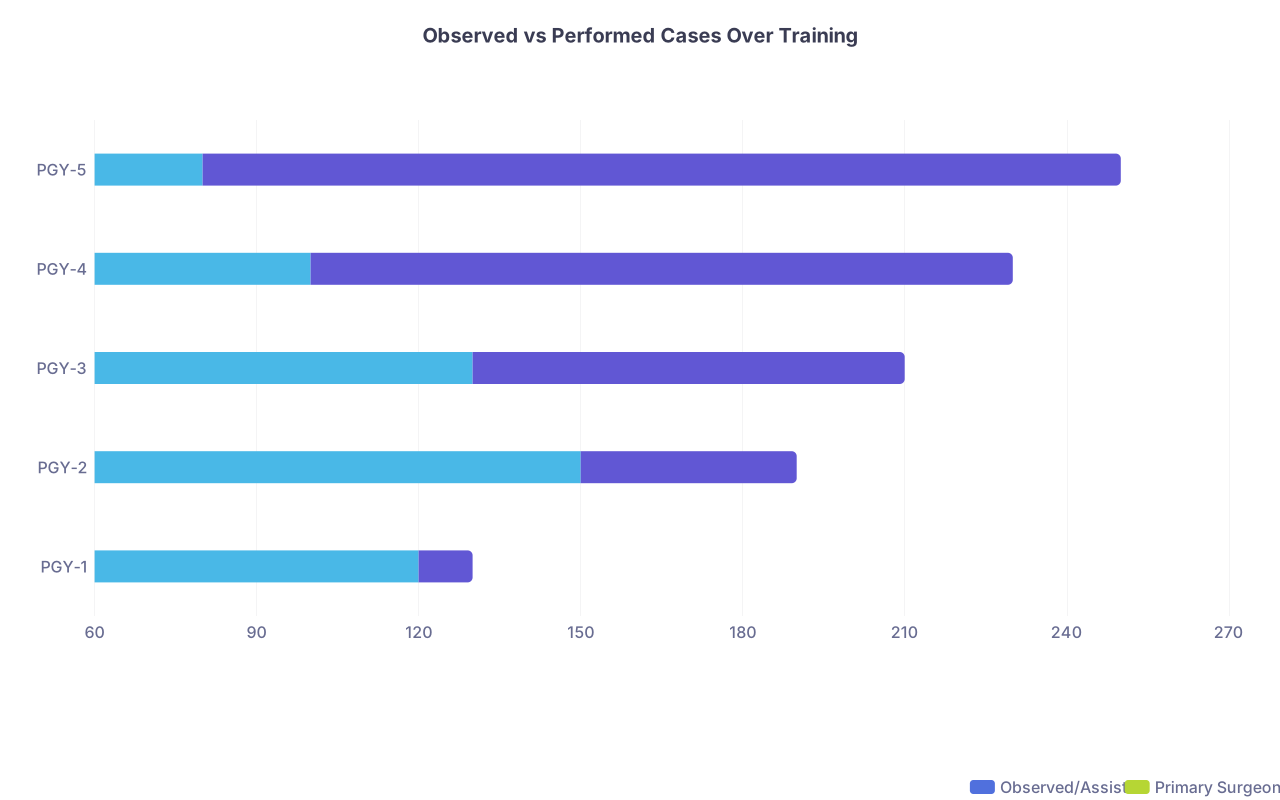
| Category | Observed/Assist | Primary Surgeon |
|---|---|---|
| PGY-1 | 120 | 10 |
| PGY-2 | 150 | 40 |
| PGY-3 | 130 | 80 |
| PGY-4 | 100 | 130 |
| PGY-5 | 80 | 170 |
If your stack skews heavily toward “observed/assist” even late in training, that is not sophistication. That is delayed independence.
Mistake 3: Not Pushing Early Enough for Bread-and-Butter Volume
Residents often chase prestige over utility:
- “I want to be on transplant again.”
- “Put me on complex spine; that is where the action is.”
Meanwhile they have:
- Weak numbers in common general procedures
- Minimal autonomous experience in stuff they will do weekly in practice
Do not make that trade.
You want boredom before graduation on core procedures. The feeling of “I have seen this a hundred times; I know every way it can go wrong.” Chase that, not only the rare and heroic.
Concrete steps:
- Request rotations specifically for core case exposure.
- Trade occasional “cool” cases for runs of bread-and-butter when your numbers are low.
- When given choice in the OR, volunteer for the basics until your counts are clearly safe.
Red Flags Your Program Is Leaning Too Hard on the Myth
Watch for these phrases; I have heard every one used to justify low numbers:
- “The ACGME minimum is just a number; we look at overall maturity.”
- “Our graduates feel confident, and that is what matters.”
- “We are more selective about which resident goes to which case; that is higher quality.”
- “Yes, your volume is less, but your cases are more complex than average.”
Ask simple follow-up questions:
- “What is our median case volume for lap choles by graduation?”
- “How does that compare to national averages?”
- “Can I see de-identified case logs for the last 3 graduating classes?”
- “How many cases do our grads typically do as the true primary surgeon in bread-and-butter procedures?”
Vague answers. Dodging. Shifting to talk about research, prestige, or fellowship matches. Those are not good signs.
The Future: Cases Will Keep Shrinking. Denial Will Not Help You.
You are training at a strange time:
- More non-operative management
- More interventional radiology and endoscopy replacing surgery
- Artificial intelligence assisting imaging, diagnosis, even intraoperative guidance
- Centralization of complex care
- Ambulatory centers siphoning off low-acuity, high-volume work
All of that pushes resident case numbers down unless somebody fights hard to protect them.
And here is the mistake I want you to avoid above all:
Believing that future tech, or fancy simulation labs, or perfect “competency-based assessments” will let you graduate with half the historical case volume and be just as safe.
They will not. Not for a long time. Possibly not ever.

Tech will help. It will not remove the need for your brain and hands to have failed, recovered, and adapted across hundreds of real patients.
If anything, the more complex the environment gets, the more dangerous a low-experience operator becomes.
Bottom Line: How To Stay Safe When Everyone Else Is Lowering the Bar
Let me narrow this down so you remember it.
You should be suspicious the moment you hear “quality over quantity” applied to:
- Your total logged cases across residency
- Bread-and-butter core procedures
- Your autonomy level on routine operations
Quality absolutely matters. Sloppy volume is not the answer. But do not let anyone sell you on the idea that:
- 40 “great” lap choles = 100 mixed complexity cases
- 30 “excellent” fracture fixations = 70 decent ones
- 50 C-sections with lots of discussion = 120 straightforward ones with you driving
They do not.
Protect yourself by:
- Knowing your numbers in painful detail
- Chasing safe boredom on core cases
- Challenging any vague reassurance that “complexity makes up for low volume”
- Seeking extra rotations, electives, or away experiences if your logs lag
You get one shot at training. You will not get a redo when you are alone in a community OR at 2 a.m. with no attending to bail you out.
Do not graduate undercooked just because someone slapped the word “quality” on your low volume.