
The reason some residents get all the big cases is not “luck” or “seniority.” It’s politics, pattern recognition, and a set of unwritten rules nobody puts in the handbook.
Let me tell you what really happens.
The Myth of Fair Case Distribution
Every program sells the same story on interview day: “We’re very mindful of case distribution; everyone graduates with excellent operative experience.” That’s technically true and functionally misleading.
Yes, almost everyone will hit the ACGME minimums. But those minimums are the floor. The difference between a resident who did 40 laparoscopic colectomies as primary and one who did 5 while holding the camera is massive. Same graduation certificate, totally different surgeon.
Here’s the ugly truth: the big cases follow patterns. Attendings are creatures of habit. Chiefs are protective of “their” numbers. Coordinators quietly steer certain residents toward or away from key rotations. And PDs only intervene when the imbalance becomes impossible to ignore.
You want the big cases? You have to understand how these decisions are actually made.
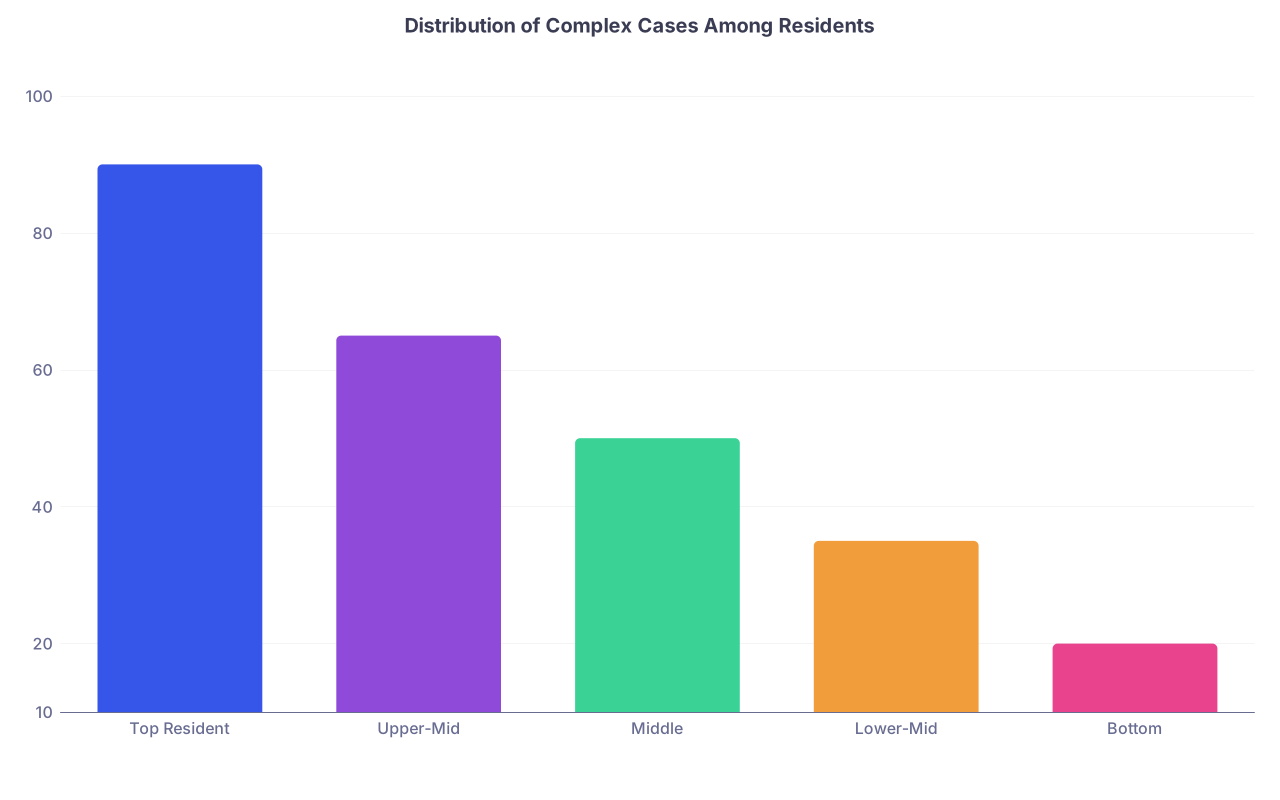
| Category | Value |
|---|---|
| Top Resident | 90 |
| Upper-Mid | 65 |
| Middle | 50 |
| Lower-Mid | 35 |
| Bottom | 20 |
That kind of skew is more common than anyone will admit at noon conference.
How Cases Really Get Assigned
On the surface, case assignments look simple: a schedule, a chief, and whoever’s on that service. In reality, several layers of unwritten logic sit underneath.
The Board and the “Go-To” Resident
In most surgical programs, there’s a whiteboard or an electronic case list for the next day. Here’s what usually happens at a mid-to-large academic program:
The night before:
Chief and/or fellow goes through the list. They’re thinking:
- Which cases are “mine” for fellowship applications or personal numbers?
- Which cases are political (referring doc, VIP, new technique, visiting surgeon)?
- Who can do this case without making me leave the OR at 8 pm?
That last question is where “go-to” residents emerge. Every service ends up with one or two people the attendings trust to not implode when things get messy. Those people get fed.
I’ve sat in rooms where attendings literally said:
“Give that redo colectomy to Alex. I don’t have three extra hours to teach.”
Or:
“Not putting an intern on that Whipple. I want to go home today.”
Nobody writes it down. But the message is clear: competence + reliability = more complex cases.
The Senior Tax
Here’s another unspoken rule: chiefs and seniors get first dibs on anything that “counts” for their logs, even if they’re half-asleep and uninterested.
Some chiefs blatantly call cases like they’re choosing teams at recess.
“I’m taking the liver. You can have the lap chole list.”
If you’re a junior and you happen to be on a service with a numbers-obsessed chief, you will see cases you’re perfectly capable of doing handed over with barely a glance in your direction. Not because you’re not ready. But because the senior year panic about “fellowship-competitive numbers” is real.
We all know the chief who somehow did 40+ pancreatoduodenectomies because they were attached to a high-volume HPB attending like a barnacle. That did not happen by accident.
Attendings Have Favorites (And Anti-Favorites)
You already suspect this. I’m just confirming it.
Some attendings gravitate toward certain residents. Usually because:
- They’ve worked together a lot and have rhythm
- The resident preps obsessively and makes the attending’s life easy
- Personalities match (or don’t)
- The resident is going into that attending’s specialty or fellowship
I’ve heard attendings say:
- “I’ll let Maya run this entire case; she’s going into colorectal with us.”
- “Not putting him on that case again. Last time was a disaster.”
You don’t have to be the smartest. But if an attending gets burned by your lack of preparation, your name will quietly slide down their mental list. And yes, that shows up on the board in subtle ways: your name next to hernia and port removals while someone else is on the rectal cancer resections.
The Quiet Gatekeepers: Coordinators, Fellows, and Chiefs
Residents obsess over what PDs think. Wrong target. The day-to-day gatekeepers of your operative life are not the PDs. It’s the people you probably underestimate.
The OR Coordinator and Charge Nurse
The OR coordinator knows who shows up on time, who disappears, who constantly delays starts because they “need 10 more minutes to consent,” and who’s always scrambling for equipment because they didn’t check the card the day before.
They cannot officially choose who gets which case. But guess whose names they “suggest” when someone asks:
- “Who’s good to run this room if we add a late case?”
- “Who’s usually with Dr. X on these big days?”
- “Who can flip fast between cases and not slow us down?”
What do they want? Efficiency and predictability. If you’re perpetually late, unprepared, or create drama with anesthesia or nurses, they will steer people away from you. Which often means you get parked in simpler, lower-risk rooms.
Fellows: The Invisible Ceiling
Fellows are often black holes for big cases. HPB, vascular, CT, MIS, colorectal—if there’s a fellow, your primary role can shift quickly from operator to assistant if you’re not intentional.
But here’s the part most juniors don’t realize: fellows are often the ones whispering who should get what.
I’ve seen:
- Fellows tell chiefs: “Let Sam do the first half and I’ll guide him; he’s reading and trying.”
- Or the opposite: “I’m not comfortable with her taking this; she’s still struggling with basic steps.”
Fellows also have their own numbers to hit. If they feel insecure about their operative volume, they will hoard. Period. Programs with weak oversight let this run wild.
The savvy residents:
- Early in the rotation, ask: “What cases do you need for your numbers? What can I own without stepping on your toes?”
- Show up for the fellow’s cases, even if they’re not “cool,” so there’s goodwill when something big is coming.
Chiefs as Gatekeepers… or Black Holes
Some chiefs are remarkably generous. They’ll say: “I’ve done 50 of these. You do it; I’ll bail you out if needed.” Those chiefs create beasts out of their juniors.
Others cling to every complex case like it’s gold because they’ve tied their self-worth to their logs. You can spot them: every big case is “their last one before fellowship,” all year long.
Your strategy changes based on which type you have. But pretending both types are “equally fair” is naïve. You need to recognize patterns early in the rotation and adjust.
The Hidden Scoring System Attendings Use
Attendings will never show you the scoreboard, but they absolutely keep one. It’s not a spreadsheet. It’s a gut-level ranking of who’s “investable.”
Here’s what really moves the needle.
1. Pre-Op Preparation (This Is the First Filter)
Attendings notice who:
- Reads on the exact operation the day before
- Knows the patient’s anatomy, comorbidities, and imaging cold
- Has a mental and verbal stepwise plan
If you walk in and can:
- Present a tight, relevant summary
- Pull up the CT and point out critical anatomy
- Answer “What’s your plan if this plane is obliterated?”
You move up the invisible list. If you fumble through basic anatomy or can’t articulate what happens if step 3 fails, your case ownership shrinks. You hold retractors; someone else does the anastomosis.
2. Intraoperative Behavior
The resident who:
- Anticipates the next step
- Doesn’t argue or get flustered when redirected
- Asks one or two high-yield questions, not a nonstop barrage
- Controls tissue gently and efficiently
Gets more responsibility. Simple as that.
The resident who:
- Blames instruments for their lack of control
- Argues about technique mid-dissection
- Clearly hasn’t practiced basic skills (knot tying, laparoscopic ergonomics)
Gets cut off early. And then, next time, they aren’t the one assigned to the big case.
3. Reliability Outside the OR
This part annoys people, but it’s real: case allocation is not divorced from your behavior on the floor and in clinic.
If you:
- Constantly disappear during rounds
- Leave notes undone
- Dump scut on co-residents
- Complain loudly about hours and “unfairness”
You get a reputation. And that reputation walks into the OR before you do.
Attendings ask chiefs, “Who’s good?” Chiefs don’t just evaluate your skills with a knife. They evaluate whether putting you on a major case means:
- The floor explodes while you’re scrubbed
- Call gets dumped on someone else
- Discharge planning and documentation go to hell
That’s how the “workhorse but gets big cases” resident is born. They handle the grind and still show up hungry in the OR. People trust them. So they get fed.
Why Some Average Residents Still Get Great Cases
You’ve seen it: a resident who is not the smartest, not the fastest, not the most technically gifted, but somehow is always on the best cases.
Here’s why that happens.
They:
- Show up early. Not 5 minutes. Early enough to see pre-op patients, review imaging, talk to anesthesia, and check equipment.
- Ask for cases explicitly but respectfully: “Tomorrow’s pancreatic case—if there’s room, I’d like to take the lead on exposure and maybe the reconstruction. What do I need to know cold for you to be comfortable with that?”
- Never burn people publicly. If they’re frustrated by case distribution, they take it to one person quietly, not as a full-on resident group complaint in front of staff.
- Make the attending’s day easier. They manage the floor, handle family updates, smooth nurse–resident friction, and don’t create drama.
Competence matters. But in the real world, consistency plus low-drama reliability often beats raw IQ and flashy technical talent.

The Dark Side: Bias, Cliques, and “Golden Children”
Let’s not pretend this is all about merit. It’s not.
Bias shows up in:
- Who gets the benefit of the doubt after a bad case
- Whose one mistake becomes their reputation vs. “a learning moment”
- Who gets informally mentored by powerful attendings
I’ve seen:
- The attending who always “clicks” more with residents who trained at their med school or share their background.
- Residents sidelined after one bad rotation evaluation while another resident with the same performance gets salvaged because “they remind me of myself.”
There are also cliques:
- Residents who socialize heavily with a small cluster of attendings and magically appear on all their best cases.
- Residents who wind up off the social map and steadily drift toward low-visibility cases, night float, and floor-heavy rotations.
Is it fair? No. Is it real? Absolutely.
You can’t fix systemic bias alone, but you can recognize where the gravity wells are and decide:
- Who is worth investing rapport with
- Which attendings are dead ends for your growth
- When to escalate a truly toxic, pattern-level exclusion to leadership with data, not just emotion
What Actually Works If You Want More Big Cases
You cannot control everything. Case volume distribution will never be perfectly fair. But you’re not powerless.
Here’s what consistently shifts things in your favor.
Make It Impossible to Ignore Your Preparation
If an attending repeatedly walks into the room and thinks, “They are more prepared than anyone else on this service,” they will fight to keep you on their cases.
That means:
- Night-before review of op notes from that attending’s prior cases
- Studying their preferred technique, not just the textbook version
- Coming in with a written or mental checklist: exposure, critical steps, bailout strategies
You’ll hear them say things like, “Let’s have you run this one,” to the chief. That sentence is gold.
Pick Your Battles and Your Allies
Fighting every perceived slight is a great way to be labeled “difficult.”
Instead:
- Identify 2–3 attendings who do the cases you want and who are actually capable of investing in residents.
- Show up relentlessly on their services—clinic, OR, cases that are not sexy but matter to them.
- Have one or two honest conversations: “I want to be independent in X and Y cases by graduation. When you see gaps, I want you to tell me bluntly.”
That’s how “golden children” are created. Not just coffee with an attending. Sustained, targeted investment.
Use Data if You Need to Escalate
Sometimes the distribution is not just unfair but dangerous to your training. PDs do not respond well to vague feelings. They respond to hard numbers and patterns.
Something like: “I’m concerned my operative experience in vascular is significantly below my peers. Over the last two rotations, I was primary on 3 major cases while co-residents averaged about 12–15. I’ve attached my log and the case lists for those months.”
That’s a different conversation than, “I never get the big cases; it’s not fair.”
| Resident | Major Cases (3 months) | Key Index Cases |
|---|---|---|
| You | 18 | 3 |
| Co-Res A | 32 | 11 |
| Co-Res B | 28 | 9 |
| Co-Res C | 30 | 10 |
Once you put numbers like that in front of a PD, they’re forced to at least pretend to fix it. Some actually will.
Understand Timing: When the Big Cases Cluster
Certain rotations, seasons, and services are kingmakers.
- High-volume cancer months: you’ll see repeat complex cases with the same attendings. Massive opportunity if you’re ready.
- Pre-fellowship months for seniors and fellows: case hoarding spikes.
- Post-graduation summer: juniors get unexpectedly big swings because seniors are gone and new ones are still ramping up.
If you’re going to go all-in on impressing people, aim for those windows. That’s when reputations and operative confidence skyrocket—or stagnate.
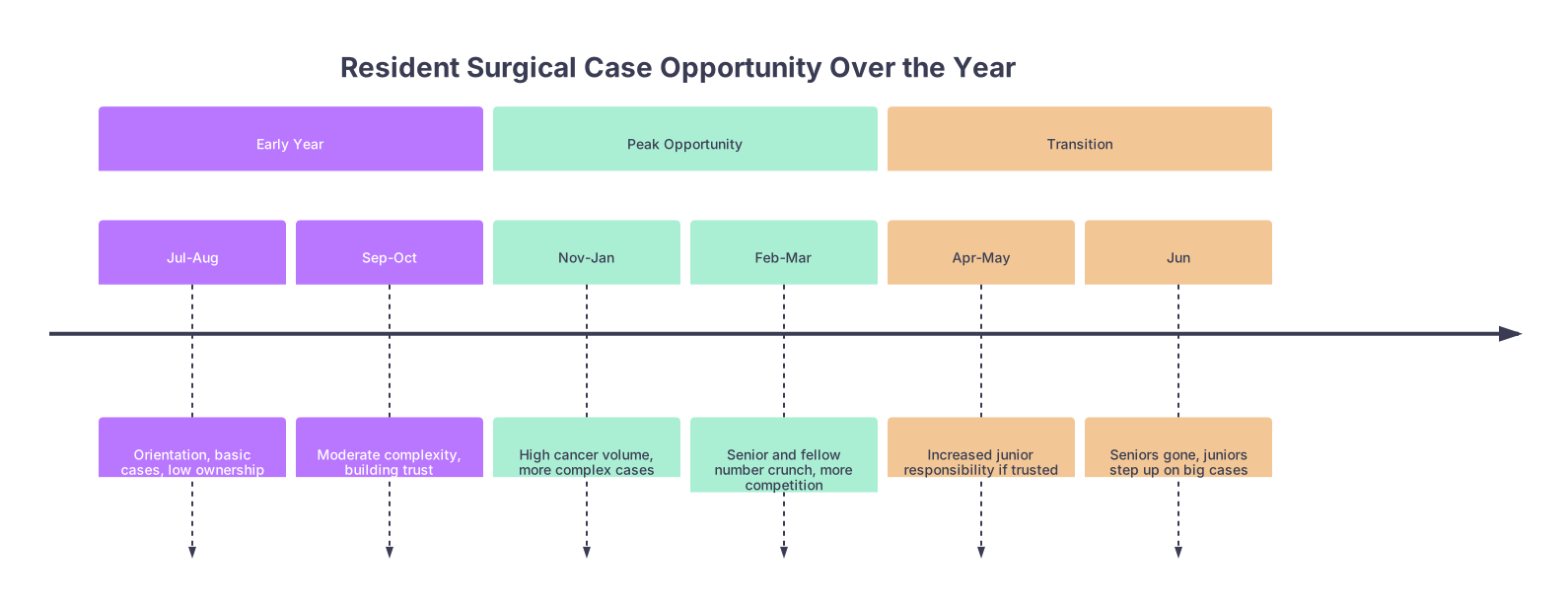
| Period | Event |
|---|---|
| Early Year - Jul-Aug | Orientation, basic cases, low ownership |
| Early Year - Sep-Oct | Moderate complexity, building trust |
| Peak Opportunity - Nov-Jan | High cancer volume, more complex cases |
| Peak Opportunity - Feb-Mar | Senior and fellow number crunch, more competition |
| Transition - Apr-May | Increased junior responsibility if trusted |
| Transition - Jun | Seniors gone, juniors step up on big cases |
The Future: Will AI and Robotics Make This Worse or Better?
You’re in the “Future of Medicine” phase, so let’s talk about the elephant in the OR: robotics, AI, and so-called “smart” case assignment.
Everyone claims new tech will democratize training. I’m not convinced—yet.
Here’s where we’re likely headed:
- Robotic platforms: Some programs already have residents locked out of early console time because the attending or fellow needs their numbers for credentialing. That can strangle resident operative autonomy if leadership is weak.
- AI case assignment: There will be tools that suggest “equitable” allocation of cases based on logs, milestones, and previous exposure. Sounds great. Until a chief or attending overrides the algorithm with one click because “today is not a teaching day.”
- Simulation and VR: This is where you can actually win. The resident who crushes complex tasks in sim and can prove it with metrics will have a much stronger argument to be primary on real-world analog cases.
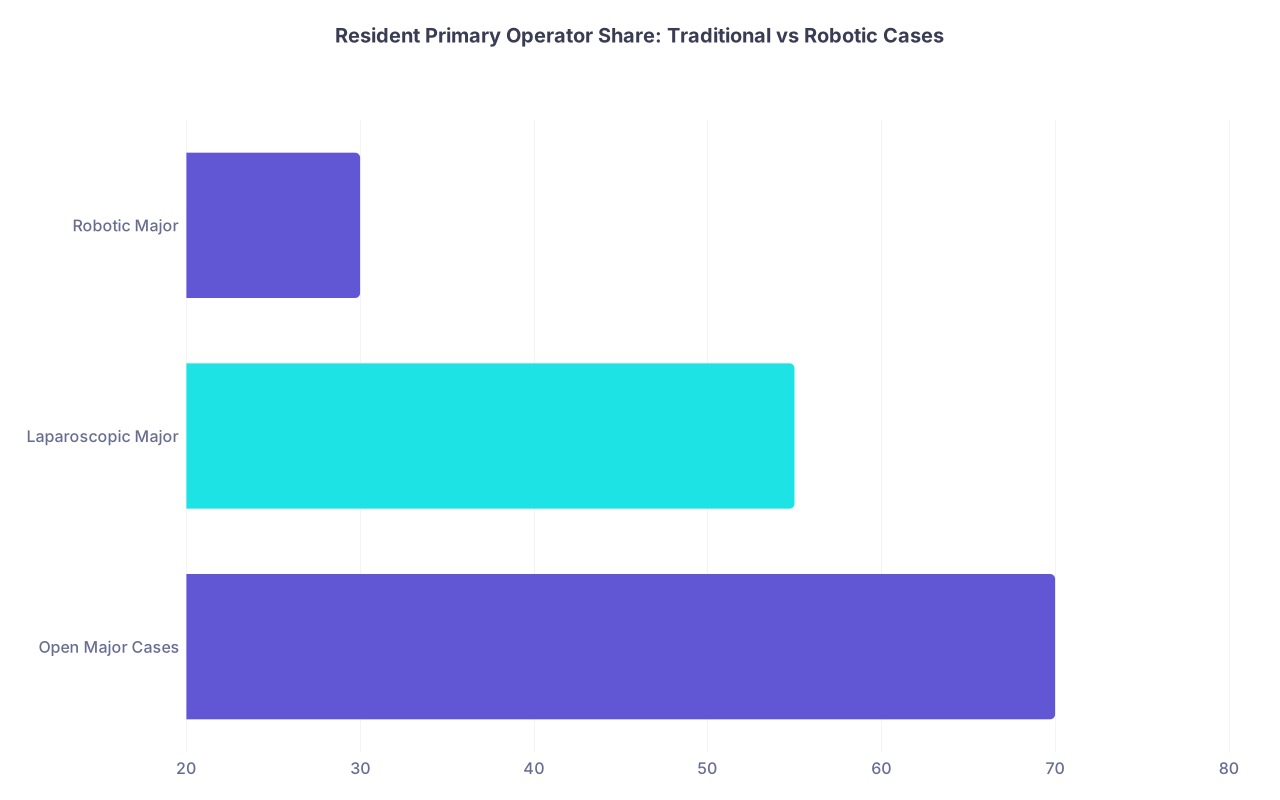
| Category | Value |
|---|---|
| Open Major Cases | 70 |
| Laparoscopic Major | 55 |
| Robotic Major | 30 |
If you’re smart, you’ll lean into:
- High-fidelity simulation to build trust faster
- Learning platform-specific tricks before you’re scrubbed
- Being the person who can troubleshoot tech issues calmly when the robot or tower glitches
Because here’s one thing that will never change: the resident who makes the attending feel safe—about patient outcomes, OR efficiency, and their own reputation—will always be the one invited back to the big cases.
FAQs
How early in residency can you realistically start getting “big” cases?
Earlier than most people think, but only if you act like you belong there and prepare like a maniac. I’ve seen motivated PGY-2s running major portions of colectomies and carotids because they built trust on the basics and didn’t act entitled. You probably won’t own the entire case, but meaningful chunks are absolutely on the table by mid-PGY-2 at a functional program.
What if my program is truly terrible at distributing cases—should I transfer?
Transfer is a nuclear option and rarely as clean as people imagine. Before you even consider it, you should: max out every opportunity on your high-yield rotations, direct your energy toward the attendings who actually teach, use your logs to push for better assignments, and exploit away rotations or electives at higher-volume centers. Only when you’ve done all that and can prove your numbers are dangerously low should you even whisper the word “transfer.”
How do I avoid being labeled “complain-y” while still advocating for more cases?
You separate emotion from data. You don’t whine in the workroom; you schedule a 1:1, bring your logs, show specific gaps, and pair every complaint with a proposed solution: “Here’s where I’m short. Here are three services or months where I could realistically increase exposure. How do we make that happen?” That’s how grown surgeons talk—and that’s who people are willing to fight for.
With these behind-the-scenes rules in your head, you’re no longer just hoping the big cases land in your lap. You’re playing the actual game that determines who leaves residency ready to operate. The next move is yours—how you show up on your very next rotation will decide whether you’re holding the camera or holding the knife.