
Your surgical log is lying about you—and bad documentation is the reason.
If your case numbers look weak, do not assume it’s because you are not operating enough. Very often, the real problem is that your documentation is sabotaging you quietly, every single day.
I’ve watched residents panic before fellowship applications. “I swear I’ve done more lap choles than this.” Or a junior attending in M&M getting grilled: “How many of these have you done in the last year?” Long pause. Weak answer. Not because they did not do the cases—but because the documentation was a mess.
This is how careers get limited without you even noticing.
The Silent Ways Poor Documentation Bleeds Your Case Volume
Let’s start with the ugly truth: poor documentation does not just make your log look sloppy. It changes how your program, your specialty, and future employers see you.
1. Under-counted cases from lazy logging
The classic mistake: “I’ll enter the log later.”
Later = never.
Common ways you quietly lose cases:
- You forget to log add-on or late-night cases
- You log them but skip key details (role, approach, complexity)
- You rely on memory at the end of the month and wildly under-report
Here’s the problem: surgical case logs are not designed to be reconstructed from memory. They assume real-time or near–real-time documentation. When you delay, you:
- Miss emergency cases where you were primary but never log them
- Mislabel assistant vs primary, because you barely remember the case
- Forget critical modifiers (open vs laparoscopic, revision vs primary, trauma vs elective)
Those “small” errors add up to dozens or even hundreds of lost cases over a residency or early career.
2. Bad role documentation: the “assistant forever” trap
Another major self-inflicted wound: you’re doing more than you’re documenting.
If your log is full of “assistant” when you were actually primary or surgeon junior, you’re tanking your numbers for no reason.
I’ve seen this pattern repeatedly:
- Early PGY years: appropriately documented as assistant
- Mid PGY: you start doing big portions of the operation, but still click “assistant” by habit
- Late PGY: you’re effectively running the case, but your log doesn’t show the progression at all
Fellowship directors and credentialing committees do not interview your scrub tech to verify that you “actually did a lot.” They look at the log.
If your log shows:
- 300 “assistant” lap choles
- 40 “surgeon junior”
- 10 “surgeon chief”
They will believe that. Even if, in real life, you were doing much more.
3. Procedure misclassification: the invisible complexity problem
Another quiet killer: choosing the wrong procedure code or oversimplifying what was actually done.
You lose credit when you:
- Log a complex redo operation as a basic primary procedure
- Fail to include multiple relevant procedures done in the same case (e.g., hernia + adhesiolysis + small bowel resection)
- Choose the vague “other” bucket instead of the precise code
So on paper, it looks like you’ve only done:
- “Inguinal hernia repair”
instead of - “Recurrent inguinal hernia repair with mesh, prior posterior approach”
That nuance matters—especially for:
- Fellowship applications
- Privileging decisions at new hospitals
- Program and ACGME case minimum reporting
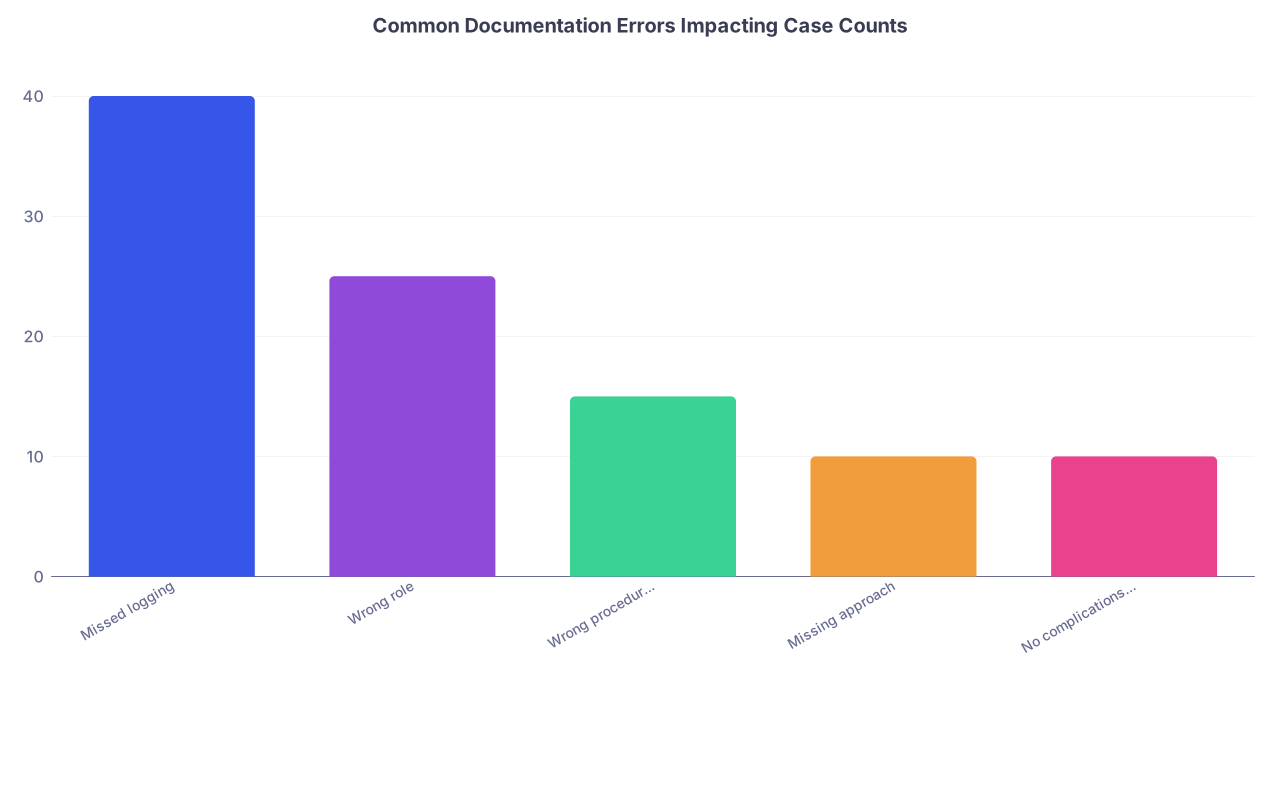
| Category | Value |
|---|---|
| Missed logging | 40 |
| Wrong role | 25 |
| Wrong procedure code | 15 |
| Missing approach | 10 |
| No complications logged | 10 |
How Poor Documentation Wrecks Your Present AND Your Future
This is not just about looking neat on paper. Poor surgical documentation has concrete consequences that can follow you for years.
1. You risk missing ACGME case minimums
Do not assume your program “will catch it.” They might not.
If your documentation is sloppy, you can end up:
- Below ACGME minimums in key categories
- Scrambling in your chief year to “pad” numbers
- Stuck with remediation plans or extra rotations
The most painful part? Sometimes you actually did enough cases. You just never documented them correctly.
| Category | Required | Poorly Logged |
|---|---|---|
| Laparoscopic cholecystectomy | 85 | 62 |
| Inguinal hernia repair | 60 | 41 |
| Appendectomy | 50 | 38 |
| Major bowel resection | 40 | 27 |
| Endoscopy (EGD/Colonoscopy) | 100 | 73 |
Notice: those “poorly logged” numbers are not always from lack of cases. Often they’re from:
- Night float cases never logged
- Multi-procedure cases partially documented
- Incorrect role designation
2. You look less competitive for fellowship
Fellowship directors review your case log. They know what a real high-volume trainee looks like.
If your documentation is weak, you’ll look:
- Light on index cases in that specialty
- Underexposed to complex or revision operations
- Like you never progressed beyond “assistant”
No one is comforted by, “I swear, I did way more.” They’ve heard that before.
You do not want to be the applicant whose letter says “excellent technical ability,” but whose case log shows low volume and minimal primary surgeon experience. That mismatch is a red flag.
3. Privileging and credentialing headaches as an attending
This one blindsides people.
Hospitals grant privileges based on:
- Your training
- Your case volume in specific procedures
- Documented experience—not vibes
If your case log does not show enough numbers or enough recent experience, you can:
- Get restricted privileges initially
- Face long back-and-forth with the credentials committee
- Need proctoring or “conditional” privileges for procedures you actually know well
Try explaining to a committee: “I did more bariatric cases than this; our logging system just wasn’t great.” They won’t be impressed.
The Most Dangerous Documentation Habits (And How To Kill Them)
Let’s get very specific. Here are the bad habits that wreck your surgical case numbers—and what you should do instead.
Habit #1: Logging “sometime this week”
This is the slow leak that sinks your numbers.
What happens when you log once a week, from memory:
- You forget which cases you actually scrubbed vs just saw in pre-op
- You underestimate your primary role cases
- You compress multiple similar cases into “I think I did two of those…”
- Night float and weekend add-ons go missing
Better habit: 24-hour rule.
- Log the case the same day or within 24 hours—no exceptions
- Use downtime: post-op, between cases, or before you leave the hospital
- Keep a simple backup list (notes app, small notebook) if systems are down
Habit #2: Defaulting to “assistant”
This is pure self-sabotage.
Often it stems from:
- Imposter syndrome (“I don’t deserve to call myself primary”)
- Confusion about role definitions
- Fatigue and clicking the first option on the list
Better habit: Be brutally honest, not modest.
Ask yourself:
- Were you the one primarily performing the critical steps?
- Was the attending scrubbed but hands-off except for supervision and rescue?
- Did you lead the case while junior learners assisted you?
If yes, you are not “just the assistant.” Document appropriately: surgeon junior, surgeon chief, primary—whatever your system uses.
Habit #3: Vague or wrong procedures selected
People rush through this part and pay for it later.
Common errors:
- Selecting only the “headline” procedure, ignoring additional work
- Choosing generic codes when a more accurate, complex code exists
- Failing to record conversions (lap to open)
- Missing important qualifiers: redo, emergency, trauma, contaminated field
Better habit: Build 30–50 go-to procedures you always document correctly.
You should know, cold, how you log:
- Lap chole (simple, acute cholecystitis, choledocholithiasis, with IOC)
- Appendectomy (lap vs open, perforated vs non)
- Hernias (inguinal, ventral, recurrent, with mesh, open vs lap)
- Major bowel cases (right hemicolectomy, sigmoid resection, LAR)
Save favorites or templates in your system if it allows. That’s not being obsessive—that’s being smart.

| Step | Description |
|---|---|
| Step 1 | Finish Case |
| Step 2 | Quick note of case details |
| Step 3 | Open case log system |
| Step 4 | Select correct procedure and role |
| Step 5 | Add approach and key modifiers |
| Step 6 | Save and verify count |
| Step 7 | Flag for urgent catch up |
| Step 8 | Review OR schedule and notes |
| Step 9 | Within 24 hours |
Tech, Systems, and the Future: New Tools Won’t Save Bad Habits
You might think: “Once everything’s integrated—EMR, OR schedule, case log—this will fix itself.”
Wrong. Sloppy documentation just migrates into nicer software.
The illusion of automatic capture
Some systems already:
- Pull your name from the OR schedule
- Generate automatic case lists for you
- Suggest procedure codes from the operative note
Sounds great… until:
- You are listed on the schedule but never scrubbed → falsely inflated assistant counts
- The system pulls only the primary CPT, ignoring secondary procedures
- Role defaults to “assistant” unless manually changed
- It cannot know if you converted lap to open unless you log it
Automation may fix missing-case problems but magnifies role and complexity mistakes if you are not vigilant.
AI-assisted documentation: a double-edged sword
We’re heading toward:
- AI drafting op notes from structured inputs
- Auto-tagging procedures, approach, devices used
- Linking your op note to case logs directly
This can help—but only if you:
- Review auto-generated content carefully
- Correct misclassification every time
- Do not trust “default” choices blindly
AI will happily make you look like an “assistant-heavy, low-complexity” surgeon if that’s what the defaults say. The system doesn’t care. You should.
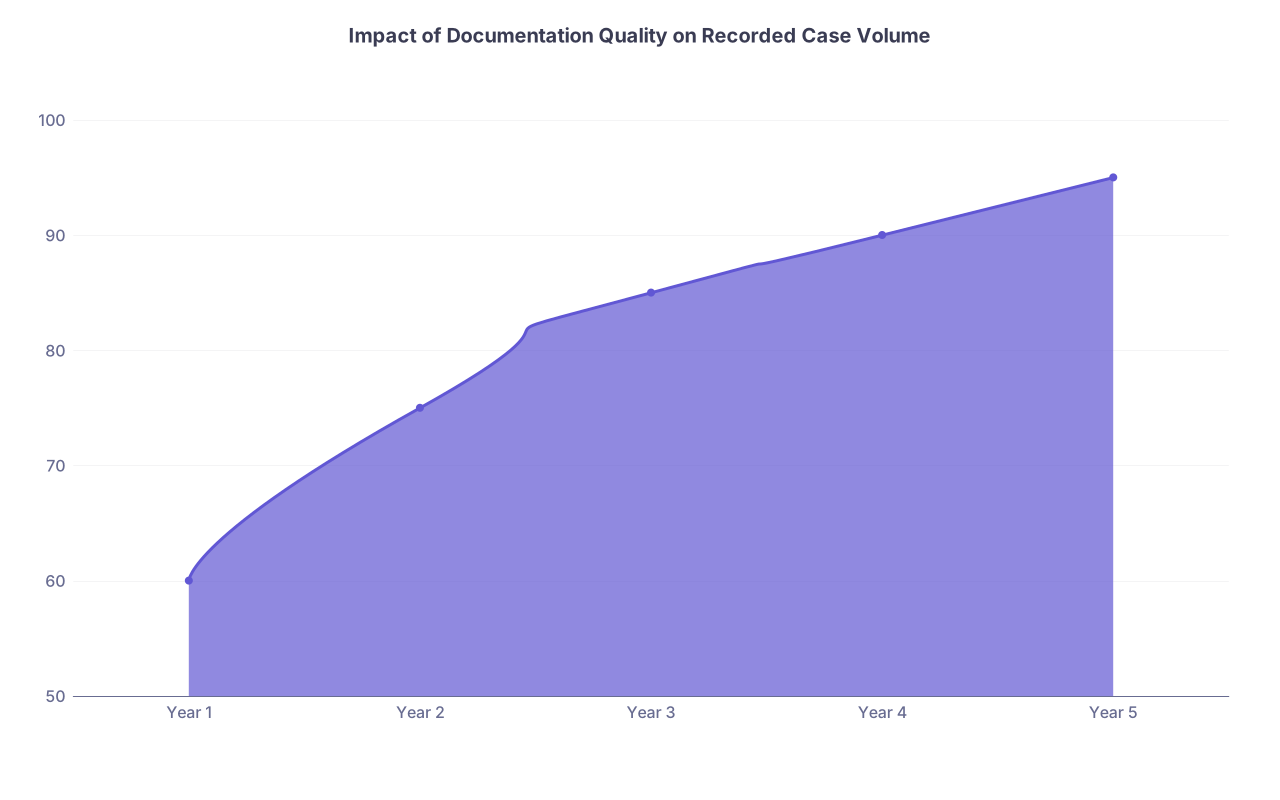
| Category | Value |
|---|---|
| Year 1 | 60 |
| Year 2 | 75 |
| Year 3 | 85 |
| Year 4 | 90 |
| Year 5 | 95 |
(Example: percentage of actual cases that end up documented when documentation practices improve over time.)
A Simple, Ruthless System To Protect Your Case Numbers
You do not need a complicated productivity scheme. You need a few non-negotiables.
1. Daily micro-routine (5–10 minutes)
End-of-day checklist before you leave:
- Open your case log system.
- Compare today’s OR schedule with what you’ve logged.
- For each case:
- Did you scrub? If no → don’t log it.
- What was your real role? Choose the accurate one, not the modest one.
- What exactly was done? Add secondary procedures and modifiers.
- Scan your total case count and key categories once a week.
If you are too tired “today,” you are building a massive problem for “future you.”
2. Monthly reality check against your numbers
Once a month, look at:
- Total case volume
- Key ACGME or specialty-specific categories
- Primary vs assistant distribution
- Trend in complexity (are you doing more advanced stuff, or flatlining?)
If something looks off—fix your documentation habits now, not in PGY-5 or year 3 of attending life.
3. Use your attendings and program as calibration tools
Ask directly:
- “For this type of case, when are you comfortable with me logging as primary vs assistant?”
- “Can we review a few of my logs to make sure I’m categorizing correctly?”
- “Does this operative description justify me as surgeon junior/chief?”
Most faculty will respect the question. It signals you care about accuracy, not gaming the system.

Future of Medicine: Documentation Will Define Your Competence More Than You Think
As surgery moves deeper into:
- Outcomes tracking
- Value-based care
- Public reporting
- Credentialing tied tightly to data
Your case log and documentation trail become your professional fingerprint.
You will be judged by:
- What you write
- What your systems record
- What your numbers show over time
Not by your stories in the surgeon’s lounge about “how many of these I’ve really done.”
We’re heading toward a world where:
- Hospitals cross-check op notes, billing codes, and case logs automatically
- Fellowship and job applications pull structured summaries of your case mix
- Outcomes by procedure and surgeon are easier to compare objectively
In that world, poor documentation is not just an annoyance. It’s professional self-harm.

FAQs
1. How often should I realistically be logging surgical cases?
Daily. If you push it beyond 24 hours, your accuracy starts dropping. Weekly bulk logging from memory is a guaranteed way to undercount, mislabel roles, and forget add-on or emergency cases. Build it into your end-of-day routine just like signing notes.
2. What if my attending disagrees with the role I chose in the log?
Have the conversation. Ask them directly how they define primary vs assistant vs junior surgeon for different cases. If they want you to list yourself as assistant for a case you thought you led, clarify expectations going forward. But do not preemptively downgrade yourself out of fear or habit—seek alignment, not automatic deference.
3. Is it dishonest to log multiple procedures from a single operation?
No, it’s dishonest not to—if you actually did them. If you performed a hernia repair plus small bowel resection plus lysis of adhesions, all materially and technically significant, they should be documented. The key is accuracy, not inflation. Don’t create work that was not done; don’t erase work that was.
4. Can better documentation really affect my job prospects years later?
Yes. Job applications and credentialing committees increasingly want objective evidence of your operative experience: numbers by procedure, trends over time, complexity. Weak or inconsistent case logs can delay privileges, restrict what you’re allowed to do initially, or make you look under-trained compared with peers—no matter how skilled you actually are.
5. What’s one concrete step I can take this week to fix my documentation?
Pick a single high-volume procedure you do often (lap chole, appendectomy, inguinal hernia). Create a simple “documentation template” for yourself: correct procedure code, typical modifiers, common variations (acute vs elective, open vs lap, converted), and clear role definition. For the next 20 cases of that type, document them perfectly and immediately. You’ll feel the difference in your numbers—and in your awareness of how much you were losing before.
Open your case log today and look at the last 10 cases you entered. For each one, ask yourself: “Does this reflect what I actually did in that OR?” If the answer is anything short of “yes” for all ten, fix them—and then fix the habits that created the gap.