The most dangerous threat to your senior-year case volume is not your competence. It is your calendar.
You can be clinically sharp, technically gifted, and still walk out of residency with a weaker case log than you should have—because you let scheduling errors quietly bleed away your operative exposure. I have watched excellent PGY-4s and PGY-5s sabotage their own numbers, not with big dramatic failures, but with small, repeated mistakes around rotations, vacations, clinics, and call.
You are not going to get these senior cases back. Once they are gone, they are gone.
Let me walk you through the scheduling traps that quietly shrink your senior-year surgical case volume, and how to avoid them before you are the one explaining to your program director why your logs are thin.
1. Treating the Master Schedule Like a Suggestion
The fastest way to lose cases is to assume “the chiefs will handle the board” and you just show up where you are told.
Here is what I have seen repeatedly:
- Senior resident never learns how block time is assigned.
- Does not know which attendings consistently run full rooms.
- Never looks more than 24–48 hours ahead at the schedule.
- Finds out too late that their “big day” was quietly reassigned or canceled.
You cannot afford that level of passivity.
Concrete mistakes here
Not checking the OR schedule early enough
If you are seeing tomorrow’s schedule for the first time at 5 p.m., you are already losing.
- Cases get canceled.
- Room assignments shift.
- New add-ons appear.
- Certain attendings will happily choose the eager junior who called them last night over the senior who never checked in.
Defer to the board, and the board will defer to someone else.
Not understanding “high-yield” blocks
Some blocks are workhorses: routine bread-and-butter that you need for numbers and competence (hernia day, chole day, vascular fistula block, OB C-section marathons). Others are black holes: long single cases with complex attendings who barely let you do skin.
If you do not know which is which on your service, you will waste precious senior time in the wrong room.
Assuming you will be protected as senior
You will hear this lie: “Once you are chief, you will get the big cases automatically.”
No. You will get:
- Service fires.
- Floor disasters.
- Clinic overflows.
- Admin tasks.
- Call coverage.
The OR board will not “auto-assign” you to high-value cases unless you push for it—with data, with seniority, and with professionalism.
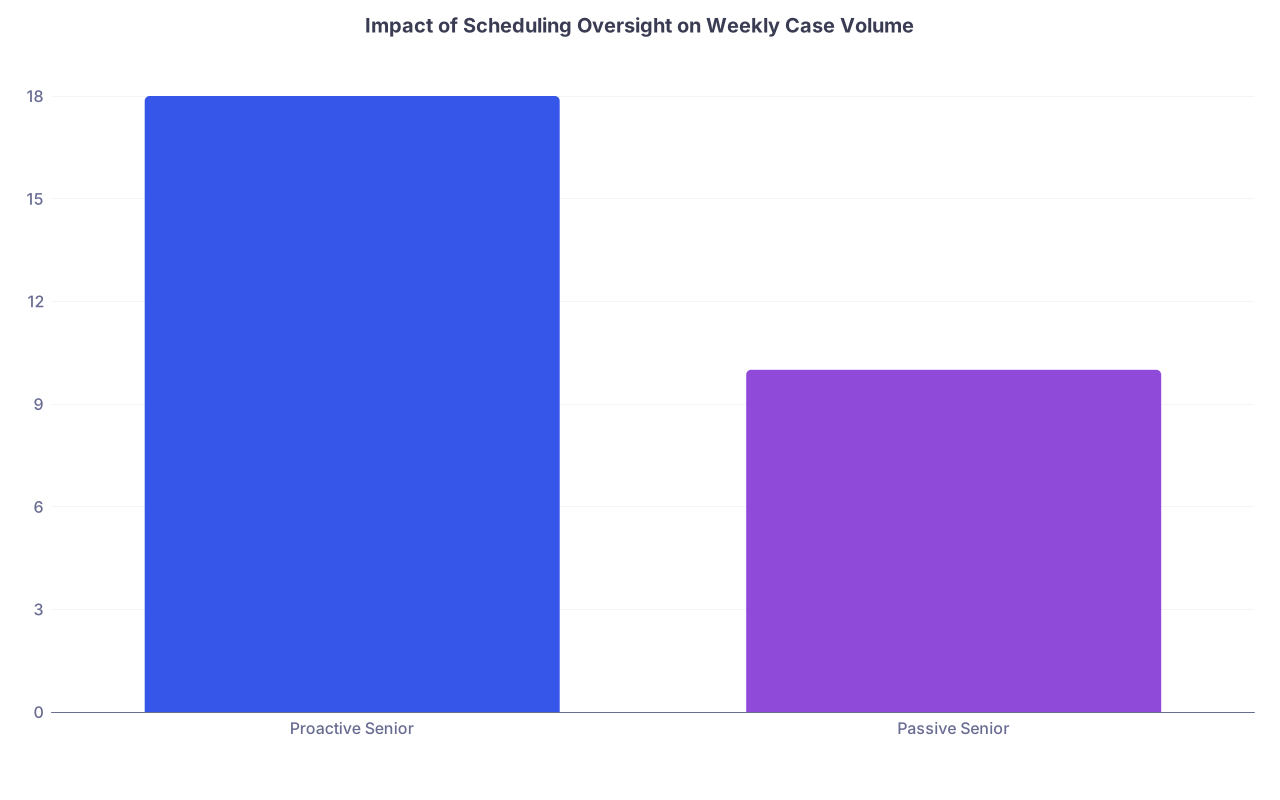
| Category | Value |
|---|---|
| Proactive Senior | 18 |
| Passive Senior | 10 |
How to avoid this mistake
- Look at the OR schedule 2–3 days ahead consistently.
- Identify:
- Which rooms historically yield the most resident participation.
- Which attendings routinely allow senior-level portions.
- Which blocks are predictable “numbers days” vs “watch-and-learn days.”
- Discuss with your chief/attending: “For Thursday’s vascular block, I would like to be primary on the fistulas. I can make sure consults and discharges are fully handled the evening before.”
You are not begging for cases. You are planning for them.
2. Letting Vacation and Electives Cannibalize Peak Case Time
Poorly timed vacation is one of the most avoidable ways to kill your case volume. Yet every year, seniors do exactly that.
Classic errors I see:
- Vacation during the highest-yield service of the entire year.
- Elective research block during the season when that subspecialty explodes (e.g., trauma summer).
- Away rotations that conflict with key home service chief months.
You cannot ignore the seasonal nature of surgical case volume.
Know the cycles of your program
Every program has predictable rhythms:
- Trauma-heavy seasons.
- Quiet academic months with endless conferences.
- Times when elective cases spike (e.g., January–March after insurance resets).
- Times when transplant, vascular, or onc cases cluster.
If you pick vacation blindly, you are choosing to miss the harvest.
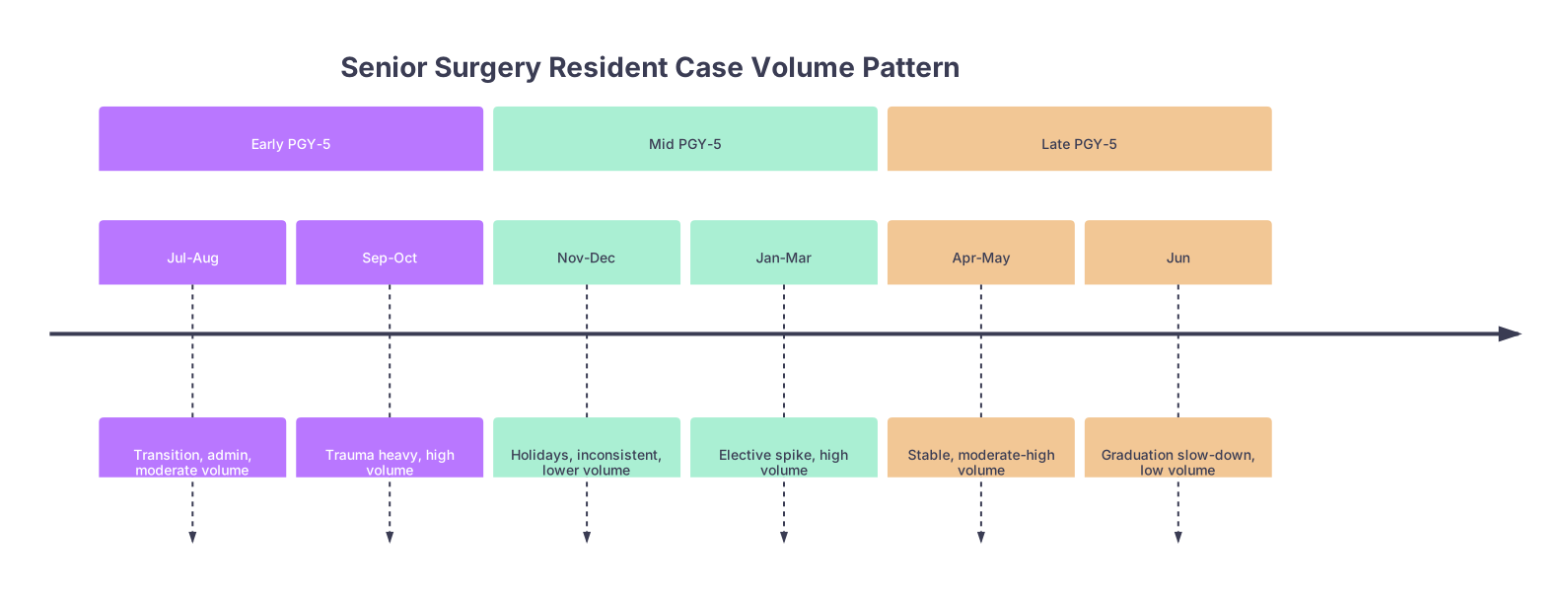
| Period | Event |
|---|---|
| Early PGY-5 - Jul-Aug | Transition, admin, moderate volume |
| Early PGY-5 - Sep-Oct | Trauma heavy, high volume |
| Mid PGY-5 - Nov-Dec | Holidays, inconsistent, lower volume |
| Mid PGY-5 - Jan-Mar | Elective spike, high volume |
| Late PGY-5 - Apr-May | Stable, moderate-high volume |
| Late PGY-5 - Jun | Graduation slow-down, low volume |
Red-flag mistakes
- Taking two weeks off during the exact month everyone says: “You must be on X service as senior.”
- Putting research or “light electives” into your final 6 months when you should be consolidating your case volume and independence.
- Failing to coordinate vacations with co-residents, leading to you getting pulled from the OR to cover service because someone else is gone.
Safer strategy
- Map your entire PGY-4 and PGY-5 year with:
- Rotation schedule.
- Known high-volume months.
- Required chief services.
- Place vacation during:
- Low-yield rotations.
- Known conference-heavy/admin-heavy months.
- Protect at least:
- Your key chief rotations.
- The months where you need numbers for a specific fellowship (e.g., vascular, colorectal, HPB).
Do the calendar work early, or do the regret work later.
3. Ignoring Clinic, Call, and Floor Coverage Politics
Another subtle way your case numbers shrink: you keep getting pulled out of the OR to solve problems someone else should have anticipated.
I watch seniors bleed OR time because of:
- Poor handoffs.
- Sloppy pre-op planning.
- Incomplete notes.
- Unclear expectations for who covers what during the day.
Result: you are scrubbed in, then scrub out because “there is no one else” to handle:
- A crashing patient on the floor.
- A difficult family meeting.
- A half-finished discharge summary blocking a bed.
- A clinic running behind.
Specific behavior that costs you cases
- Leaving loose ends the day before
You know what happens when:
- Labs not ordered.
- Consents not done.
- Imaging not reviewed.
- Discharge plans not written in advance.
Morning chaos. Attending frustration. And the easiest solution? Pull the senior out of the room to fix it because “they know the patient best.”
- Not negotiating clinic vs OR expectations
Some attendings will absolutely let you skip or reduce clinic to operate more—if:
- They trust you.
- You communicate in advance.
- You offer concrete value in return (e.g., “I will pre-chart all your new patients” or “I will handle all post-op calls tonight”).
The mistake: assuming clinic is immovable destiny and never having that conversation at all.
- Being the hero for every floor fire
If you let yourself become the default firefighter for:
- Non-urgent pages.
- Routine order clarifications.
- Minor post-op issues interns can handle.
You will be paged out repeatedly. And those “quick” interruptions add up to missed portions of cases and lost opportunities for primary surgeon roles.

How to avoid this
- The evening before:
- Finish notes.
- Anticipate labs, imaging, consultations.
- Clarify discharge plans.
- At the start of the day:
- Explicitly confirm with team: “Who is primary on handling pages while I am scrubbed for the Whipple?”
- Set norms with interns: what they handle vs when to break scrub.
- With attendings:
- Ask early: “On this service, when clinic and OR conflict, how do you prefer I prioritize as a senior?”
If you do not script this ahead of time, you will be the one dragged out of the OR—every time.
4. Failing to Track Case Logs in Real Time
You cannot fix what you do not measure. Yet many seniors do not look seriously at their case logs until 3–6 months before graduation.
That is a mistake.
Common pattern:
- PGY-3 and PGY-4 are busy, they assume volume is “fine.”
- Senior year starts, they coast, feeling “experienced.”
- Accreditation or fellowship requirements hit their inbox.
- Suddenly they realize they are under on key categories: e.g., laparoscopic colectomies, vascular access, thoracic cases, endoscopy.
Now it is too late to reconstruct an entire missing experience.
| Tracking Frequency | Typical Outcome | Risk of Missing Targets |
|---|---|---|
| Monthly | Early course corrections | Low |
| Quarterly | Tight but manageable | Moderate |
| Once in PGY-5 | Panic and patchwork fixes | High |
| At graduation | No recourse | Catastrophic |
Hidden problems from poor logging
- Cases are misclassified by OR staff or software.
- Your role (assistant vs primary) is misentered.
- Key cases never make it into the system at all.
- You falsely believe you have done “plenty” when the numbers say otherwise.
If you do not audit this, you will overestimate your experience.
Protective habits
- Review your case log monthly starting PGY-3.
- Break it down by:
- Required categories for your specialty board.
- Fellowship-relevant categories (e.g., for vascular, colorectal, MIS).
- Sit down with a trusted faculty member or PD yearly:
- “Here are my current numbers. Where am I light? What rotations in the next year can realistically fill those gaps?”
Do not wait until you are already chief to realize you are short on major cases that require months to accumulate.
5. Wasting Transition Time on New Rotations
Every new service comes with a learning curve for:
- Where cases get posted.
- Who controls assignments.
- How call impacts your OR days.
- Which clinic days are mandatory vs negotiable.
The mistake: spending the first 2–3 weeks just “getting oriented” without aggressively learning the local rules of case access.
By the time you figure out:
- Which attending to email the night before.
- Which scheduler controls block allocation.
- Which advanced practitioners can help cover floor/clinic.
Half the rotation is gone.

Specific errors seniors make
- Not introducing themselves to the OR charge nurse and scheduler on day 1.
- Not asking other residents: “Which days are the money days here?”
- Not clarifying with fellows: “What is my role vs your role? How can I maximize my hands-on time?”
You lose cases during that “polite silence” period when you are trying not to step on toes.
Better approach
On day 1–2 of any rotation, explicitly ask:
- “Which OR days are usually the heaviest?”
- “Who decides resident assignments to each room?”
- “Which attendings are most invested in senior autonomy?”
- “Are there routine add-on times that I should plan to be around for?”
This is not being pushy. This is protecting your training.
6. Letting Fellows and Advanced Learners Unintentionally Crowd You Out
You will not always be alone. Some services are fellow-heavy. Others have advanced practice providers or senior midlevels who function almost like fellows. If you pretend that does not affect your case access, you are kidding yourself.
I have seen residents lose out because they:
- Assume “the fellow will include me” without ever discussing expectations.
- Stand quietly in the back of the room and accept retractor duty.
- Never clarify with attendings what their senior-year goals are.
Where this becomes a scheduling problem
- The fellow often controls who is in which case.
- They frequently know the attending’s preferences better than you.
- They may naturally gravitate toward the most complex, high-yield operations—exactly the cases you need as a senior.
If you do not coordinate with them in advance, you will be scheduled into lower-yield rooms or minor cases while they take lead on the big ones.
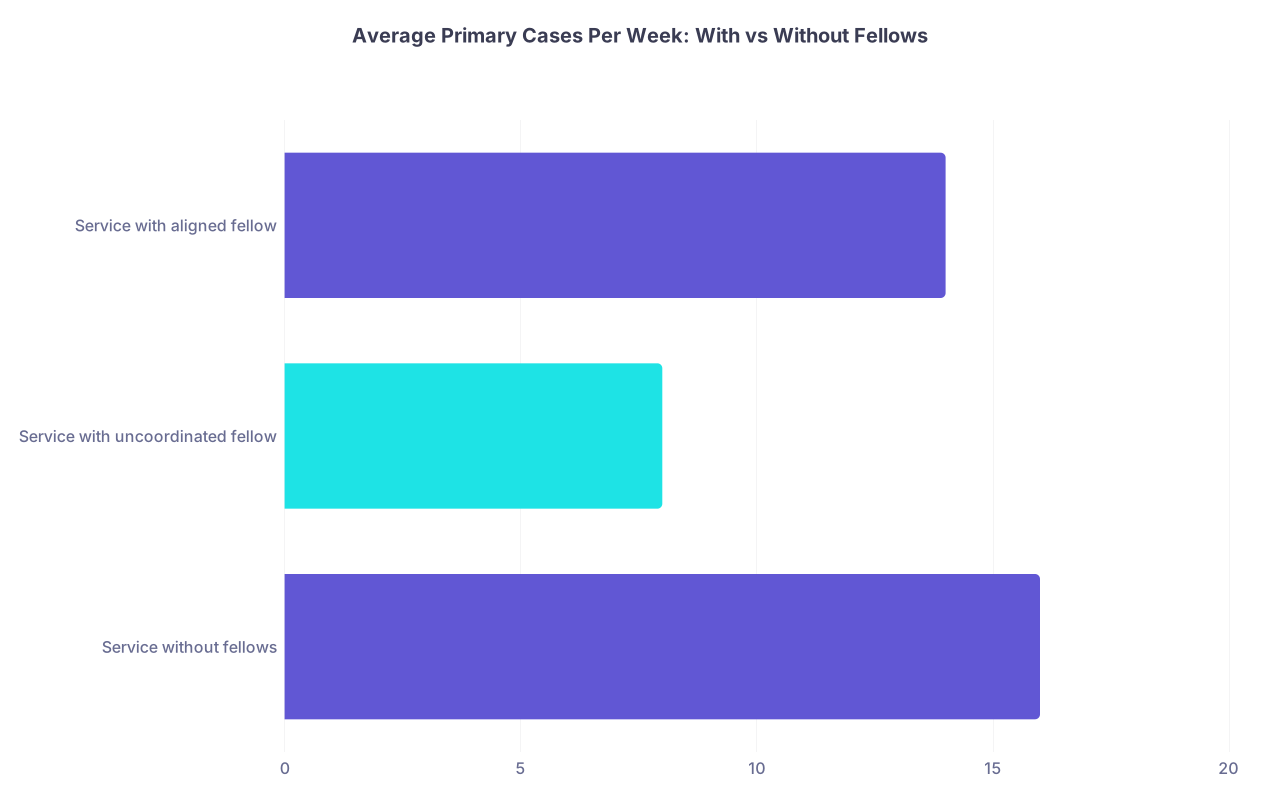
| Category | Value |
|---|---|
| Service without fellows | 16 |
| Service with uncoordinated fellow | 8 |
| Service with aligned fellow | 14 |
How to protect your volume without burning relationships
- Early on, say to the fellow:
- “I am a PGY-5 aiming to build independence on X, Y, Z operations. How do you see us dividing cases so we both get what we need?”
- With attendings:
- “For these key cases this month, I would like to be primary on at least some of them. I am happy to let the fellow take lead on the more complex versions.”
Do not wait until the last week of the rotation to realize you have essentially observed a fellowship instead of operating as a senior.
7. Underestimating How AI and Digital Systems Will Expose Your Gaps
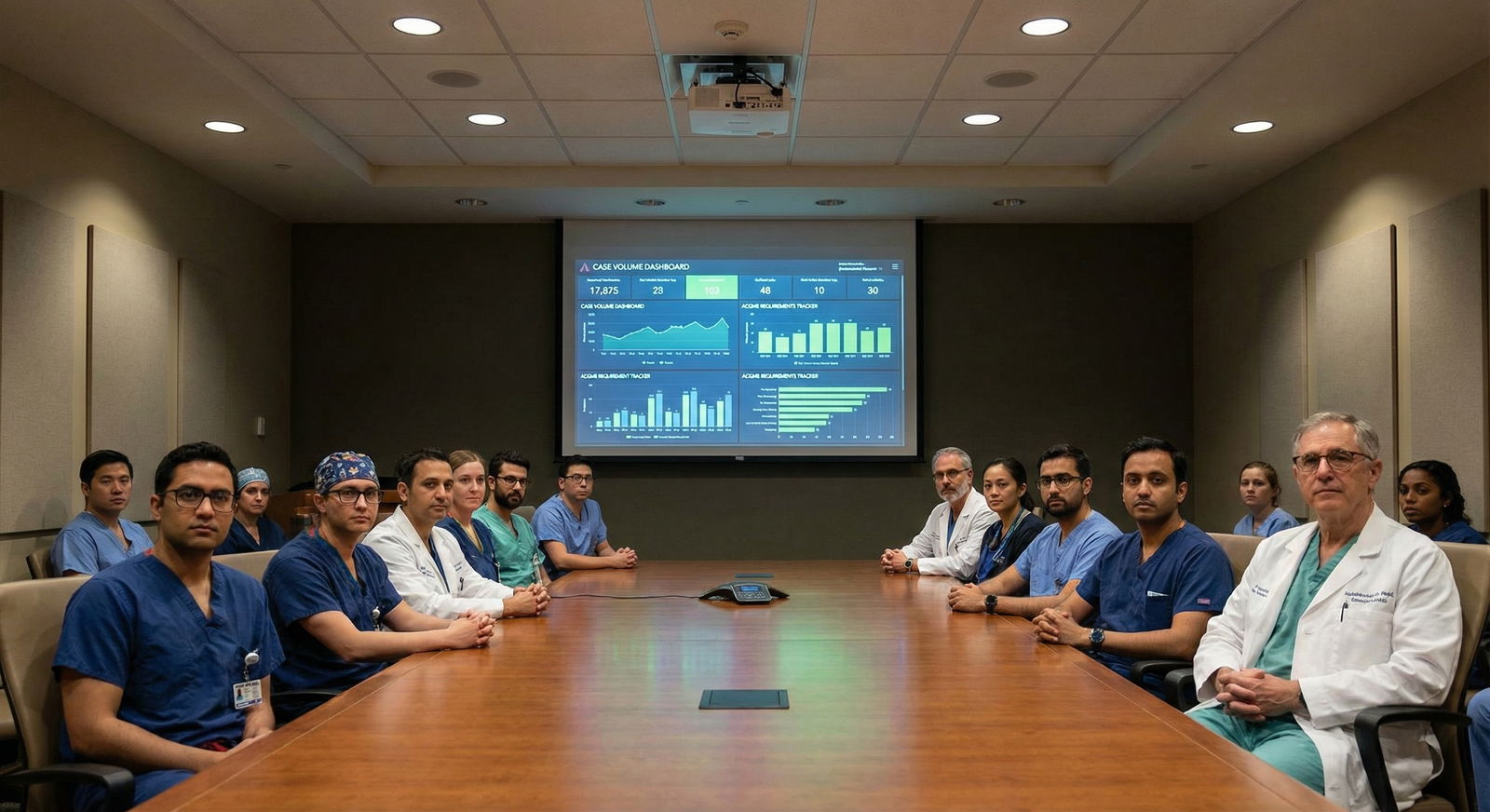
Here is the future-of-medicine piece no one is warning you about clearly enough: digital surgical training dashboards, AI analytics, and pattern recognition tools are coming for your case log.
Soon (in some places, already):
- Your case mix will be automatically compared to historical graduates.
- Your role in each procedure will be tracked at granular levels.
- Your progression from assistant to primary surgeon over time will be visible on a graph.
If you have scheduling patterns that consistently keep you away from high-value cases—vacation timing, elective choices, service swaps—that will not just hurt your skills. It will be obvious in your data trail.
New scheduling traps in the digital era
- AI-driven OR scheduling that optimizes for “efficiency” and assigns you to lower-risk, easier cases if your prior logs do not show experience.
- Automated constraints that prioritize fellows or subspecialty-track residents on certain cases when volume is limited.
- Dashboards that program leadership uses to justify reduced autonomy if you are behind benchmark.
If you let your early years be random and reactive, those algorithms will assume you are the resident who belongs in the minor room.
You need to:
- Proactively curate your case exposure.
- Make deliberate scheduling choices.
- Document your interest and competence in higher-level procedures with attendings who will back you up.
Future systems will not be kind to residents who float through their training without a visible pattern of progression.
FAQ (Exactly 4 Questions)
1. How early in residency should I start worrying about my senior-year case volume?
By PGY-3, you should already be looking at your case log trends. That does not mean obsessing over every number, but you should know where you are light. Waiting until PGY-5 is how people end up scrambling to “patch” whole categories of experience. Planning earlier lets you time rotations, vacations, and electives so your senior year is about refinement, not desperate accumulation.
2. What is the single biggest scheduling mistake that hurts senior residents?
Taking vacation or low-yield electives during their highest-value rotations or months. Especially when they were warned and ignored it. I have seen residents give away their prime trauma chief month, or step out during the only block with a high-volume complex onc surgeon, and then spend the rest of the year chasing those cases. Once that window closes, it almost never reopens.
3. How do I advocate for better case assignments without sounding entitled?
Come with specifics and solutions, not complaints. For example: “Next Tuesday we have three major cases. I would like to be primary on the laparoscopic colectomy; I will make sure all pre-op work and discharges are complete the night before so I can be fully available.” Attending surgeons respond well when you tie your request to service reliability, preparation, and a clear educational goal.
4. What if my program is small and overall case volume is limited—does scheduling really matter that much?
It matters more. In high-volume programs, you can sometimes survive sloppy scheduling because there are simply so many cases. In smaller or resource-limited settings, every case is precious. A few badly timed vacations, uncoordinated clinics, or passive weeks on a key service can create permanent holes in your experience. The tighter the environment, the less slack you have for avoidable mistakes.
Key points to remember:
- Case volume loss is rarely dramatic; it is the cumulative effect of small, avoidable scheduling decisions.
- Vacations, clinics, fellows, call, and digital systems will all shape your operative exposure—if you do not control them, they will control you.
- Start planning early, track your numbers, and treat your calendar as seriously as you treat your technical skills. Your future competence depends on both.