
The raw number on your case log is a lie—and every program director knows it.
You’ve been told to “get your numbers up,” to hit the minimums, to chase volume. Let me tell you what actually happens when PDs, chiefs, and fellowship directors look at your logs behind closed doors: they do not care that you did your 75th lap chole. They care which 75 cases you did, what your role was, and whether your log looks like a surgeon’s log or a warm-body-in-the-room log.
The unspoken truth? There is a hierarchy of cases that quietly separates “solid resident” from “future surgeon I trust with my family.” And that ranking has almost nothing to do with how your ACGME minimum report looks on paper.
Let’s walk through how people with actual decision power judge your case list—and what kinds of logs actually impress them.
How PDs Really Look at Case Logs
First myth to kill: nobody sits there reading every line of your case log like it’s a novel. They skim. Fast. But they’re trained to see patterns.
Inside a PD’s head, the process is more like this:
- Are the basics covered? (Minimums and obvious red flags)
- Does this log look real or manufactured?
- Where did this resident grow—bread and butter, complex, emergency, or subspecialty?
- Do the cases match the story this resident is selling in their application?
You think they see “1800 cases, great!”. Here’s what they actually see:
- “1800 cases, but 1400 are as assistant on low-level bread and butter? Something’s off.”
- “1100 cases, but tons of majors as surgeon chief, complex reoperations, real autonomy? This person is ready.”
One PD literally said in a selection meeting: “I don’t care if they did 200 hernias. Show me what they did as a chief on a bad belly at 2 am.”
They don’t just judge how many. They judge how you got those numbers and what kind of surgeon that implies.
The Quiet Hierarchy: What Cases Actually Impress
There’s an unspoken ranking of cases that PDs and senior faculty mentally apply. Nobody puts this into a PowerPoint for you. But everyone talks about it in the workroom after you leave.
Here’s the rough hierarchy they use when they think about “impressive” vs “filler” cases.
| Tier | Case Type Category | Typical Faculty Reaction |
|---|---|---|
| 1 | Complex, high-stakes, open | Strongly impressive |
| 2 | Advanced lap / endoscopic | Impressive if balanced |
| 3 | Bread-and-butter core | Expected, baseline |
| 4 | Minor / skin / scopes only | Filler unless early training |
| 5 | Questionable inflation | Actively suspicious |
Let me spell out what sits in each tier in the minds of attendings who actually operate.
Tier 1: Complex, High-Stakes, Open Operations
This is the stuff that makes senior surgeons nod quietly as they scroll.
Think:
- Open colectomies and low anterior resections
- Gastrectomies and esophagectomies
- Open AAA repairs, open bypasses (for vascular)
- Pancreatic resections, liver resections
- Complex trauma laparotomies, damage control, reoperations
- Big thoracic cases: lobectomies, pneumonectomies
- Complex oncologic resections with reconstruction
What impresses isn’t just their presence in your log. It’s your role and timing.
A third-year with a handful of these as “surgeon junior” under supervision? Solid.
A fifth-year with a strong cluster of major open cases where they were “surgeon chief,” especially on call or in urgent settings? Very impressive.
I’ve heard this exact line more than once:
“If they have no big open belly work as a chief, I don’t care how many laparoscopic widgets they clicked.”
Programs know the future is minimally invasive, robotics, endovascular. They also know when things go bad, someone has to open and fix it. That someone should not be holding a blade for the first time post-residency.
Tier 2: Advanced Laparoscopic and Endoscopic Work
Now we’re in the modern currency of surgery.
Advanced lap impresses—if it’s not the only thing you can do.
Cases that turn heads in this tier:
- Laparoscopic colectomies, gastrectomies, Heller myotomy
- Advanced foregut (fundoplications, paraesophageal hernias)
- Laparoscopic/robotic pancreatic or hepatic work
- Lap donor nephrectomies, advanced urologic lap/robot cases
- Endoscopic therapies beyond basic diagnostic scopes: EMR, ESD, complex ERCP (as GI fellow/applicant), interventional bronch procedures
You want a pattern that says: “I can handle advanced technology because I first learned the foundational open anatomy and principles.”
What worries PDs is a log that looks like:
- Tons of robotics, zero open rescue cases
- Dozens of advanced lap cases, all as assistant, very few logged as primary surgeon
- A lopsided log that’s 80–90% minimally invasive with barely any open equivalents
One surgical oncology fellowship director put it bluntly:
“Robotics doesn’t impress me if they can’t open a hostile abdomen without panicking.”
So advanced lap and robotics are tier 2. Powerful, but only if backed by tier 1 experience.
Tier 3: Bread-and-Butter Core General Surgery
You know this tier. But you probably underestimate how PDs see it.
Things like:
- Laparoscopic cholecystectomies
- Inguinal hernia repairs (open and lap)
- Ventral/umbilical hernia repairs
- Appendectomies
- Basic breast cases (lumpectomy, mastectomy without complex recon)
- Standard vascular access cases
- Routine colorectal benign resections
These are expected. They are not impressive by themselves. They only become impressive when either:
- You have a high level of autonomy on them as a junior (early trust), or
- You’re performing complex variations (incarcerated hernias at 3 am, reoperative ventral hernias with mesh, hostile gallbladders as the primary operator)
A PD will absolutely notice if your log is weak in this tier. A resident who doesn’t even have solid bread-and-butter numbers by PGY4 is a problem.
But nobody awards extra points because you did 200 instead of 120 lap choles. That’s like bragging you did 500 chest X-ray reads in intern year. Volume there is reassurance, not a flex.
The Cases That Do Not Impress (But You Keep Chasing Them)
You know what fills a ton of logs and barely moves the needle in anyone’s mind?
- Port removals and placements when it’s 90% “skin and sew,” little critical thinking
- Simple debridements and I&Ds in stable elective settings
- Endless scope-heavy logs where you were mostly “holding the scope and watching”
- Minor anorectal procedures done in clinic with almost no complexity
- Following an attending to the same 2–3 low-complexity cases over and over
Does that mean these cases do not matter? No. They build early skills, comfort with instruments, and basic OR flow.
But PDs do not look at 60 port removals and think: “Wow, this person’s a surgeon.” They think: “Okay, they spent a lot of time on vascular access.”
Intern and PGY2 years? Minor cases are fine. Expected.
PGY4–5 dominated by minor work? Red flag. It suggests you were not the first pick for big cases.
The Hidden Multiplier: Your Role in the Room
This is where residents routinely fool themselves and almost never fool a PD.
Three words: surgeon, assistant, teaching assistant.
Everyone knows how easy it is to… inflate. You stand at the table, hold a retractor, maybe cut a stitch, and the attending says, “You can log it as surgeon if you want.” Then it shows up in your log like you drove the entire case.
Behind the scenes, PDs do this:
- Look at the ratio of “surgeon” to “assistant”
- Look at when the shift to more “surgeon” happens (PGY3? PGY5? Never?)
- Check if high-stakes cases are consistently “assistant” even as chief
You want your trajectory to look like:
More assistant early → steady rise in surgeon junior → heavy surgeon chief in PGY4–5 on big cases.
What raises eyebrows:
- PGY5 with tons of “assistant” entries on core cases like lap chole, hernia, colectomy
- An applicant bragging in their personal statement about “running the room” with a log that shows almost everything as assistant
- A weird cluster of “surgeon” entries in 1–2 months that looks… manufactured
I’ve sat in a room where a PD scrolled, stopped, and said:
“They logged this as surgeon, but I was there. No way they did this case. This log is generous.”
You do not want that reputation.
The Patterns That Quietly Impress Fellowship Directors
Remember: fellowship directors review you at a different zoom level. They’re looking for a spine of experience relevant to their field.
They mentally ask:
- Did this resident actually see the range of pathology they say they’re passionate about?
- Do they have enough complex experience that I can safely polish them into subspecialty-level?
- Does their case log match the story in their personal statement and letters?
Here’s what different subspecialties privately like to see:
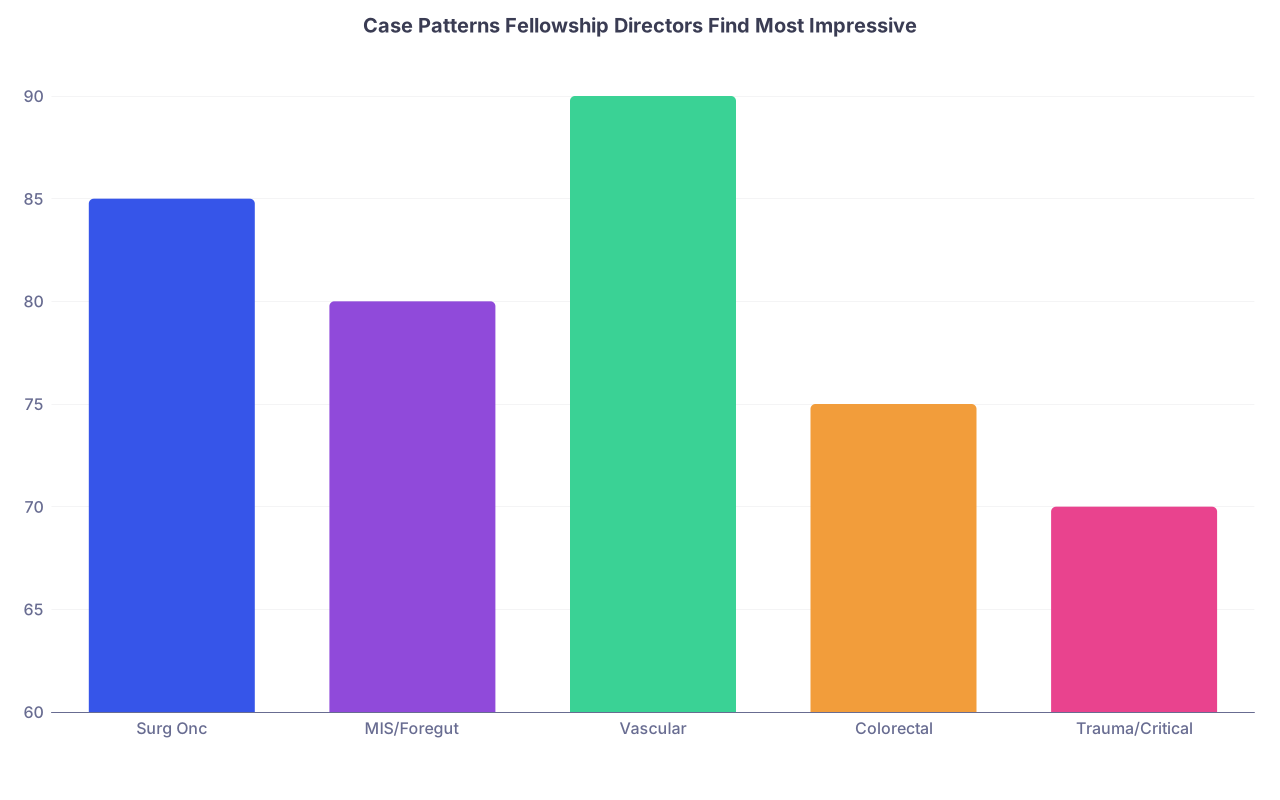
| Category | Value |
|---|---|
| Surg Onc | 85 |
| MIS/Foregut | 80 |
| Vascular | 90 |
| Colorectal | 75 |
| Trauma/Critical | 70 |
That chart is conceptual, but directionally accurate: vascular and surg onc directors care intensely about case pattern; trauma a bit less on sheer diversity, more on acuity plus volume.
Surgical Oncology / HPB
They want to see:
- Pancreatic resections, hepatic resections, complex GI cancer cases
- Some reoperative abdominal surgery, not just first-time elective cases
- Real autonomy on major cases by late PGY4–5
A log with a handful of pancreatic and liver resections only as assistant, no progression to surgeon chief? It tells them you watched, you didn’t truly do.
MIS / Foregut
They want:
- Advanced lap work: foregut, bariatric, complex hernias
- Open equivalents (Nissen conversions, revisional work, open bariatric)
- Not just 200 lap choles and sleeves with no real complexity
The MIS folks love lap numbers, sure. But privately they talk about who could troubleshoot a leak, not who racked up the most “case started” clicks.
Vascular
Vascular directors are blunt. They look at:
- Open carotids, open bypasses, open AAA, not just stents and EVARs
- A mix of endovascular plus real clamp-and-sew work
- Whether you did anything more than hold the wire on half those endovascular cases
An applicant who’s basically an endovascular tech with almost no open experience? They know that’s a salvage job at the fellowship level.
Red Flags PDs See in Case Logs (And Talk About Without You)
You won’t hear this feedback directly. You’ll just… not get the interview, or get quietly dropped down the list.
Major red flags:
Late or absent progression of autonomy
Still assistant-heavy on bread-and-butter in PGY5? Tells them you never got trusted.Hyperinflated surgeon counts on complex cases
The PD knows which attendings spoon-feed and label everyone “surgeon” for logging. They mentally down-weight those numbers.Lopsided specialty overexposure
Resident with 400 vascular cases and barely minimum general surgery? Fine for vascular fellowship, suspicious for general practice readiness.Missing core experiences
No real open colectomies. No emergent laparotomies. No reoperative abdomen. PDs ask: was it the program, or was it this resident?Chronologic weirdness
Huge spike of cases in one month that looks like a data-entry dump rather than real work. It suggests you weren’t logging honestly as you went.
How to Shape a Log That Actually Impresses (Without Gaming It)
You can’t conjure cases you never did. But you can influence how your log grows—and how it’s perceived.
Here’s what actually moves the needle:
1. Chase Autonomy, Not Just Volume
When you’re choosing between two ORs:
- OR 1: you’ll retract on a big onc case with senior fellows
- OR 2: you’ll be primary on a bread-and-butter general surgery case with a faculty who lets you run
Long-term, OR 2 usually helps you more.
A PD would rather see you as surgeon on a straightforward but complete operation than watch you assistant on a glamorous one for years.
2. Protect Some Open Experience
Do not let anyone convince you that open is “dead” and not worth your time. Every serious PD and fellowship director I know quietly values open skill.
If your hospital is lap/robot heavy, you should seek out:
- Trauma rotations where big open laparotomies happen
- VA or county rotations with more traditional open work
- Extra call where reoperations and hostile abdomens show up
Later, you’ll be shocked how often senior surgeons ask: “Can they open this safely?” not “Can they dock the robot?”
3. Be Honest With Your Role
One harsh truth: people who wildly inflate their logs get talked about.
You might think you’re playing the same game as everyone else. You’re not. Attendings remember who was actually leading that case.
If you’re early PGY and cut the skin, place some trocars, close the fascia—but didn’t actually drive the main part of the case—log it as assistant or surgeon junior honestly. PDs care far more about a believable trajectory than a pumped-up spreadsheet.
4. Match Your Story to Your Log
If you claim in interviews that you “love trauma” and “live in the trauma bay,” but your log shows minimal emergent laparotomies and you barely met trauma minimums, you lose credibility.
Common mismatch errors:
- Stating a passion for colorectal but with almost no colorectal majors
- Talking about how “vascular is my life” with 30 vascular cases total
- Claiming you “run big HPB cases often” with 2–3 as assistant and none as surgeon chief
Directors type your name, open your log, and check that story. Quietly.
The Future: Case Logs Are About to Get Scrutinized Even More
You’re entering an era with:
- Step 1 pass/fail
- More residents competing for the same fellowships
- Programs under the microscope for “outcomes,” autonomy, and “training quality”
When standardized test filters weaken, what do PDs lean on more?
- Narrative (letters and personal statements)
- Evidence of real operative experience and independence
Some programs are already experimenting with visual dashboards of resident case experience over time. They track:
- Number of cases per month
- Role trajectory (assistant → surgeon)
- Exposure to complex/emergent vs elective
- Balance of open vs minimally invasive
Do not be surprised when ACGME or specialty boards start asking hard questions about pattern, not just minimums. I’ve heard those conversations in closed committee rooms.
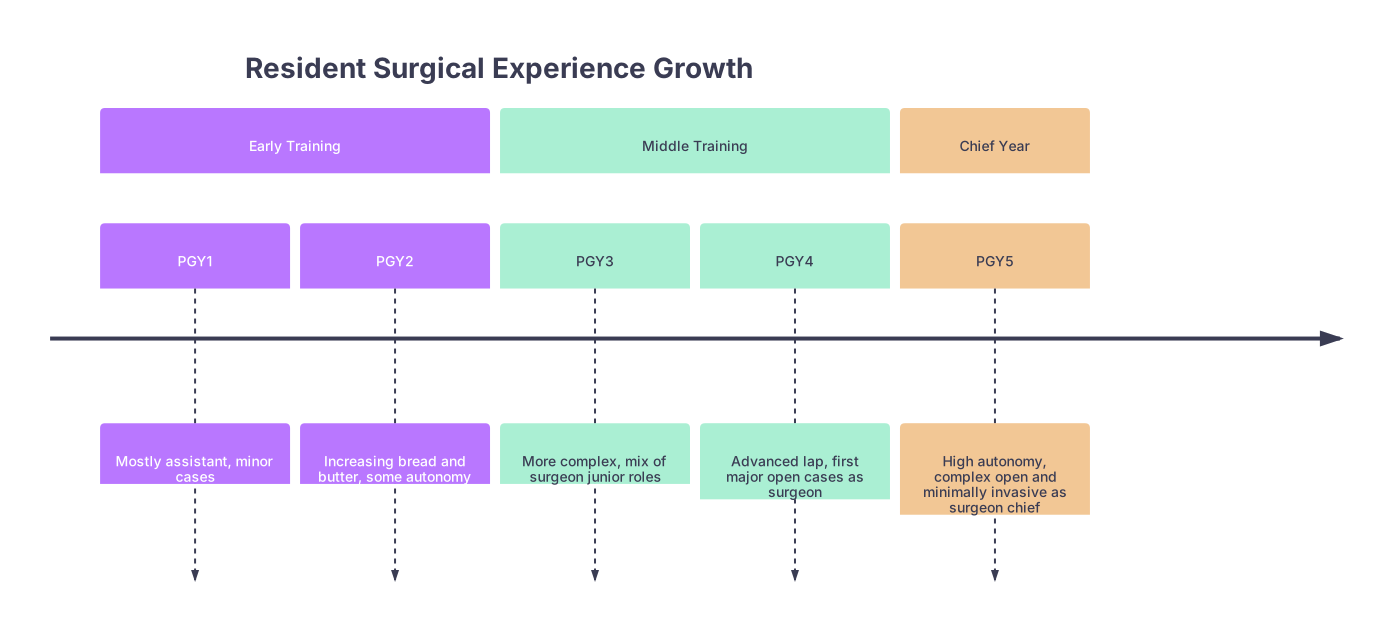
| Period | Event |
|---|---|
| Early Training - PGY1 | Mostly assistant, minor cases |
| Early Training - PGY2 | Increasing bread and butter, some autonomy |
| Middle Training - PGY3 | More complex, mix of surgeon junior roles |
| Middle Training - PGY4 | Advanced lap, first major open cases as surgeon |
| Chief Year - PGY5 | High autonomy, complex open and minimally invasive as surgeon chief |
Residents who think logs are just checkboxes are going to get blindsided when someone finally says out loud: “Minimums aren’t enough. Show me what kind of surgeon you became.”