
The way most students scrub just to “watch” a case is a waste of everyone’s time—including yours.
Let me tell you what actually runs through attendings’ heads when you tie yourself in, glue your eyes to the field, and never say a word.
What Attendings Really See When You “Just Watch”
Here’s the truth no one tells you in clerkship orientation: a scrubbed person who doesn’t contribute is either furniture or a future investment. Which one you become is 100% on you.
Most attendings mentally sort scrubbed learners into a few buckets the moment they walk in:
| Type | Initial Reaction |
|---|---|
| Passive Watcher | Ignored |
| Helpful Extra Pair of Hands | Used, then tested |
| Keen Future Surgeon | Mentored, evaluated |
| OR Tourist | Tolerated, remembered |
| Liability Waiting to Happen | Watched closely |
When you scrub but never touch an instrument, never retract, barely answer questions, and clearly have no plan other than “be present,” here’s the inner monologue I’ve literally heard in workrooms:
- “Why is this person scrubbed?”
- “They could’ve learned more just standing at the foot of the bed.”
- “If they’re not planning on surgery, why are they in my sterile field?”
And the harsh one:
- “If they ever ask me for a letter, I’ve got nothing to say.”
Scrubbing is not neutral. It sends a signal: “I want to be part of this operation.” If you then behave like you’re at a movie, it creates cognitive dissonance. Attendings notice that mismatch even if they never call you out.
Here’s the part you do not see: after you leave, attendings and residents talk about you. Not in a gossip way. In an evaluative way.
- “Did that student help at all?”
- “Would you want them as an intern?”
- “They scrubbed the whole day and just stood there.”
Those conversations decide who gets strong comments on MSPEs, who gets good rotations, and who gets pulled into the “come back for this cool case” circle.
When Scrubbing to Watch Is Actually Smart (and When It’s Just Annoying)
There are rare times when “just scrubbing to watch” makes sense. But students misunderstand the ratio: maybe 10–20% of the cases you scrub for should be primarily observational. Not 80–90%.
There are a few scenarios where attendings are actually fine with you mostly observing:
- First big case in a specialty you’re truly exploring
- Highly subspecialized or high-risk case (complex redo cardiac, transplant, advanced oncologic recon)
- You told them clearly: “I’m here to learn anatomy and flow; I know I’ll mostly observe”
The key difference: they know your intent ahead of time, and your behavior fits that story.
Where it backfires badly is when you do any of this:
- Scrub every minor, straightforward case, then never ask to retract or suture
- Take up space at the field that a PA, fellow, or junior could use
- Ask to scrub “just to see what it’s like,” then clearly check out mentally by the 40-minute mark
Attendings don’t say it out loud, but they think it: “If you’re going to scrub, be useful. Or at least be strategically curious.”
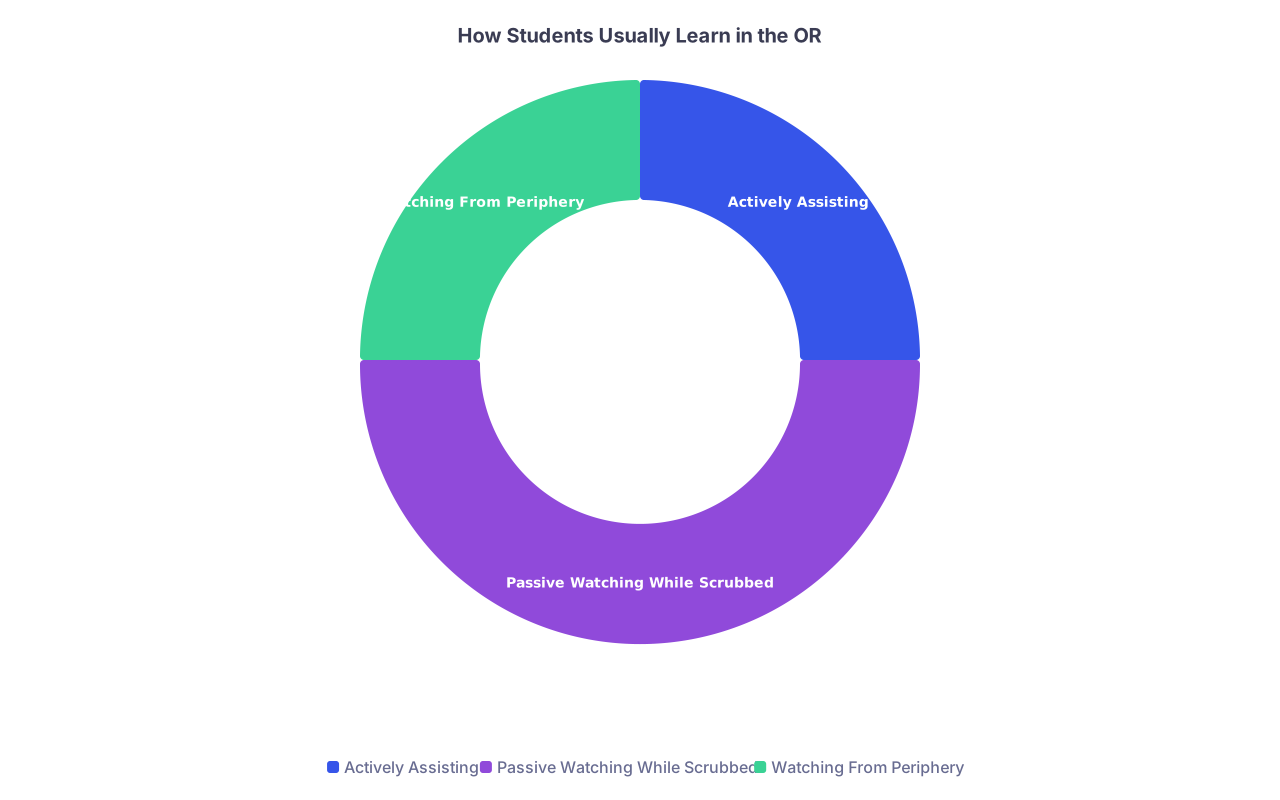
| Category | Value |
|---|---|
| Actively Assisting | 25 |
| Passive Watching While Scrubbed | 50 |
| Watching From Periphery | 25 |
Half of you live in that middle slice—passive, scrubbed, silent. That group gets forgotten.
You’d actually learn more—and irritate fewer people—by watching from the foot of the bed, staring at the monitor, and asking residents questions between critical steps. No sterile field. No expectations. No pretense.
So if you’re going to scrub, own that choice. Because once you’re in, attendings start grading you differently.
What Good Attendings Expect From a Scrubbed Learner
I’ve watched this play out in rooms at large academic centers and small community programs. Same patterns.
When an attending sees a student scrub in, they expect some version of the following, scaled to your level:
- You know, at minimum, what operation you’re doing and why.
- You have a basic mental map of the anatomy involved.
- You can follow the steps, even if you can’t perform them.
- You’re trying to be physically useful: retracting, suctioning, cutting sutures, helping with positioning, holding the scope.
Notice I didn’t say “You can tie perfect instrument knots” or “You’ve memorized the entire textbook chapter.” They expect engagement and effort, not perfection.
What they absolutely notice and dislike:
- The statue: You stand there, never adjust retraction, never anticipate, never ask, never offer.
- The tourist: You lean in for the “cool part,” then mentally drift when it’s tedious.
- The liability: You contaminate yourself or the field because you’re daydreaming.
- The ghost: You keep scrubbing into cases but fail every chance to step up or help.
Here’s what an attending actually sees as high-yield, even if you’re brand new:
- You ask the scrub tech quietly, “How do you like me to pass this?” instead of fumbling.
- You say: “Can I hold the camera?” or “Would it help if I retract here?” instead of waiting to be commanded.
- You keep track of counts, specimens, and big steps, showing you’re following the case flow.
Most attendings will meet your level of energy. If you scrub like a ghost, they’ll treat you like air. If you scrub like a future colleague, they’ll teach you like one.
The Hidden Economics of OR Time: Why Your Presence Has a Cost
You need to understand something faculty will never phrase this bluntly on the record: every extra person around the field has a cost.
Time, risk, and attention.
The OR is expensive real estate. At major academic centers, an OR minute can literally cost dozens of dollars. When an attending lets you scrub, they’re implicitly accepting:
- Slightly longer operative time (especially if you handle instruments or camera)
- Increased cognitive load (monitoring you, watching sterility, giving instructions)
- Slightly higher theoretical infection/contamination risk with another moving body
So when you scrub but contribute nothing, they feel that as pure cost.
Not always consciously. But it’s there.
Now, attendings differ. Some are deeply committed to education and will let you do “negative-ROI” participation because they believe in the long game. Others are already squeezed by RVU pressure, admin metrics, and OR efficiency benchmarks. They’re counting minutes.
You want to be the learner where the attending says, “Yeah, I lose 10 minutes, but they’re worth it.”
Not the one where they mutter afterwards, “No more random students in my cases.”

Here’s the behind-the-scenes part you don’t see: nurse managers and OR staff complain about inefficient rooms. If you’re the extra body that slows turnover or bumps into the Mayo stand, you aren’t just annoying the surgeon—you’re annoying the entire system.
That’s how students get quietly uninvited.
How to Scrub Like Someone Worth Teaching
If you’re going to scrub, you need a plan before you even walk to the sink. The students who get taken seriously do a few things differently. None of them are complicated, but almost no one does them consistently.
Before the Case
You show up with three things clear in your head:
- What operation is being done, and for what pathology.
- The rough steps and key anatomy.
- One or two focused questions you want answered.
Not “Tell me about hernias.” That’s lazy. More like: “For inguinal hernias, when do you choose open vs lap here?” or “Why do you prefer this mesh placement method?”
If you’re brand new to the rotation, you can still do this at a very basic level. Read the two-page operative description the night before, glance at a Netter plate or an online video, and walk in with some structure.
Then you quietly ask the resident before scrubbing:
- “Where do you want me?”
- “Anything specific I should know for this attending?”
- “Is this a good case for me to scrub, or would I learn more watching from the side?”
You’d be shocked how far that last question gets you. It shows you’re thinking about value, not just checking a box.
During the Case
Once you’re in, you have one simple rule: be either useful or clearly learning.
Useful looks like:
- Adjusting your retraction when the resident changes angle—without being told every time.
- Keeping the camera steady, horizon level, target centered. This alone can earn you a reputation.
- Helping with small logistics: holding suction in a blood pool, cutting sutures to appropriate length, helping with dressings at the end.
Clearly learning looks like:
- Following the steps out loud in your head and occasionally summarizing when asked: “We’re dissecting down to the fascia now.”
- Asking short, well-timed questions during noncritical moments.
- Not flinching away mentally when it gets tedious. Staying in it.
What kills you is pretending to be engaged while obviously zoning out. Attendings see that. You drop your eyes from the field, shift your weight, stop following the monitor. They know.

| Step | Description |
|---|---|
| Step 1 | Decide to Scrub |
| Step 2 | Ask Resident Where to Stand |
| Step 3 | Passive Watching |
| Step 4 | Retract or Hold Camera |
| Step 5 | Attending Engages |
| Step 6 | Resident Teaches Lightly |
| Step 7 | Forgotten by Team |
| Step 8 | Prepared? |
| Step 9 | Ask Timed Questions? |
After the Case
This is where almost everyone drops the ball.
After you break scrub, you do not just disappear.
You help with:
- Moving the patient bed
- Transport if needed
- Quick room cleanup if staff are overwhelmed
Then you ask one targeted question or for one small piece of feedback: “Is there one thing I could do better next time when I hold the camera/retractor?”
That question signals: “I plan to come back. I am coachable. I care about getting this right.”
Attendings remember that. Residents definitely remember that.
The Silent Ledger: How This Affects Letters, Rankings, and Future Opportunities
Let’s talk about the part students always underestimate: the long memory of surgical teams.
You think you’re just scrubbing a random lap chole.
They remember:
- That you were the one who always wanted to scrub but never helped.
- Or that you were the one who held a camera like you were born with a scope in your hand.
- Or that you always showed up for big cases and asked smart questions but didn’t get in the way on high-turnover bread-and-butter days.
This all ends up in a kind of informal ledger in people’s heads.
When it’s time for:
- Letters of recommendation
- “Would you rank this student highly?” phone calls
- “Do you know this applicant from your service?” backchannel emails
That ledger gets opened.
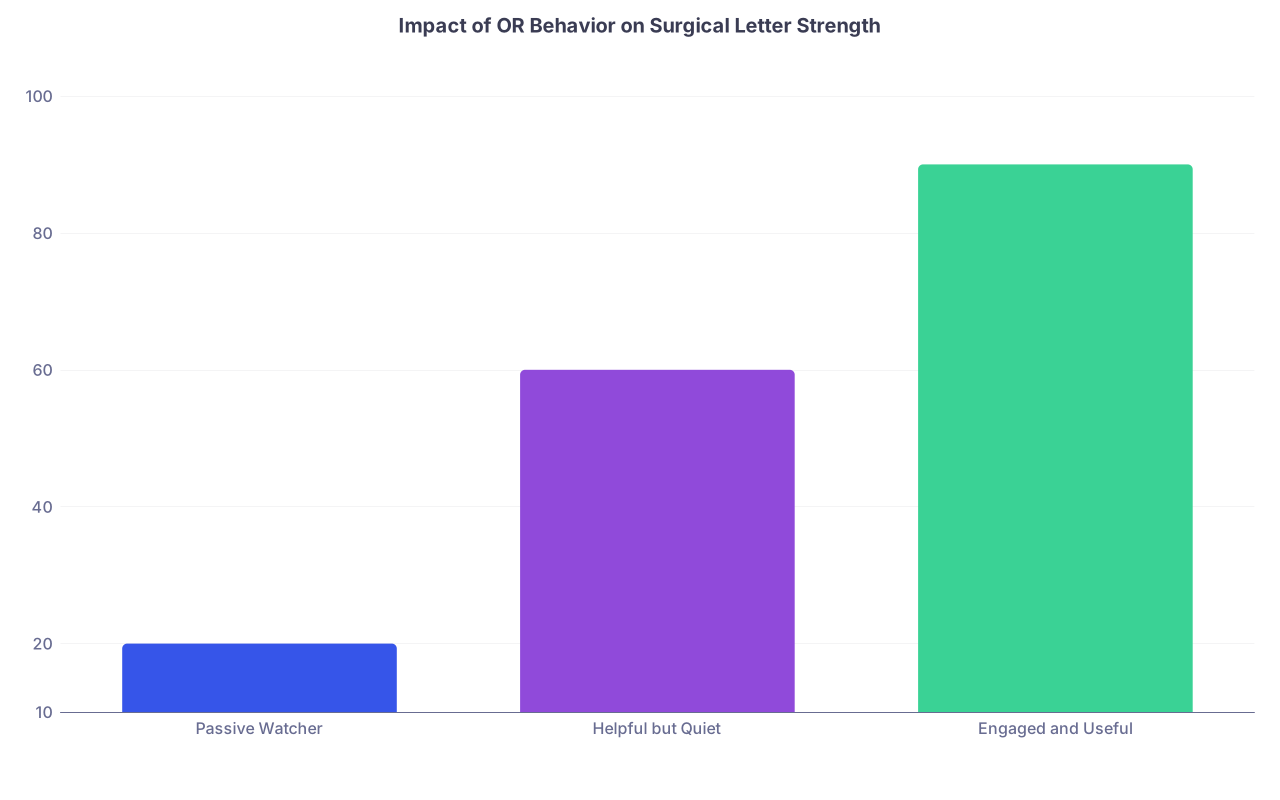
| Category | Value |
|---|---|
| Passive Watcher | 20 |
| Helpful but Quiet | 60 |
| Engaged and Useful | 90 |
No one writes this explicitly, but the subtext of many letters is: “I have seen this person in the OR. I would/would not want them on my team.”
If you’re the student who constantly scrubs just to watch but never grows, never takes initiative, and never becomes even modestly helpful, you get labeled as:
- “Nice, but not someone I’d fight for.”
- “Polite, but I don’t remember a single case they impacted.”
That’s death for a surgical application. Programs are choosing people they want at 3 a.m. with a crashing patient. Not people who stood there for 40 cases and never took a meaningful step forward.
How This Ties Into Surgical Case Volume and Your Future
Everyone’s obsessed with “case volume” now—numbers on your logs, procedures you’ve seen, exposure metrics. Students start tallying cases like Pokémon cards.
Here’s the uncomfortable truth: 100 cases you “watched” passively are less valuable than 20 where you were a genuinely integrated part of the team.
Residency programs know this. They can tell the difference between:
- “I scrubbed 80 cases” as in “I stood at the edge and watched…”
- Versus “I scrubbed 40 cases and by the end I could safely close, run the scope, and anticipate key steps.”

The future of surgical training is heading toward competency, not just counting. Simulation, structured assessments, milestone-based progression. Watching from 2 feet away won’t get you there.
If you want to be on the right side of that shift, you need to redefine case volume for yourself:
- Not: “How many operations did I stand in on?”
- But: “In how many operations did I actually grow my operative and team skills?”
That growth can start now, even as an MS3 who barely knows which end of the needle driver to hold. But only if you stop scrubbing “just to watch” and start scrubbing with intent.
A Simple Personal Rule to Save You From Being Forgettable
Here’s a ruthless but useful filter I’ve given to students:
If you cannot answer, before you scrub in, “What will I try to do in this case beyond just watching?” then you should seriously consider not scrubbing.
Your answer doesn’t have to be sophisticated. “Today I’ll focus on holding the camera better than last time” is enough. “I want to trace the path of the ureter throughout the case” is enough. “I want to practice cutting sutures at the right length” is enough.
But if you have nothing—if your entire plan is “be present and hope something cool happens”—you’re about to become wallpaper.
And attendings have enough wallpaper.
FAQs
1. Is it ever okay to scrub only to watch, especially early in a rotation?
Yes, but rarely, and you should be honest about it. Early on, for a very complex case or in a specialty you’re truly just exploring, you can say to the resident: “I’d like to scrub mainly to see the anatomy and flow, I know I probably won’t be very helpful yet.” Then pay attention like your life depends on it. Do not make this your default behavior for every case.
2. What if the attending or resident never offers for me to do anything—am I supposed to ask?
You’re supposed to offer, tactfully. “Would it be okay if I held the camera for a bit?” or “If there’s a chance later, I’d love to try closing a small portion.” If they say no or ignore it, fine—you tried. But if you never ask, many will assume you’re content just watching and won’t push you.
3. I’m not going into surgery. Should I even bother scrubbing?
Yes, but strategically. Scrub enough to understand OR culture, teamwork, and sterile technique—those matter in almost every field. But don’t scrub every single case just to stand there helplessly. Pick a few high-yield operations, be engaged and helpful, then spend the rest of the time where you’ll learn more (clinic, wards, or watching from the periphery and asking questions).
4. How do I avoid contaminating myself if I’m nervous and new to the OR?
Tell the scrub tech and resident you’re new and ask where to stand that’s “safe.” Keep your hands locked together at chest or above waist, don’t spin in place, and ask before moving around the table. Watching an experienced resident’s body positioning and copying it is underrated. Contamination happens most when students are zoning out or trying too hard to see without thinking about their elbows.
5. Can being too aggressive about helping hurt me?
Absolutely. If you’re yanking tissues, constantly asking to do more in the middle of critical steps, or grabbing instruments without permission, you become a problem. The sweet spot is proactive but respectful: you offer, you anticipate within the role they’ve given you, and you read the room. When the attending’s voice tightens and the room goes quiet, stop talking and just hold what you’re holding like stone.
Key points: Scrubbing is never a neutral act; it signals you want in, so you’re judged accordingly. If you’re going to tie yourself into a sterile field, have a plan to be either useful or clearly learning, not just existing. And when people later decide who they’d trust as a resident, they remember the ones who scrubbed with intent—not the ones who just watched.