
The way chiefs divide OR time when volume is tight is not fair, not objective, and not what anyone writes in the policy manual. It is politics, pattern recognition, and pressure management disguised as “equitable allocation.”
Let me walk you through how it actually works when there aren’t enough cases to go around—especially for residents.
The Official Story vs. The Real Algorithm
On paper, OR allocation looks clean.
You’ll hear phrases like “case mix,” “educational needs,” “block time utilization,” “RRC requirements,” and “program equity.” There will be color-coded schedules, committee minutes, and a chief resident who tells you, with a straight face, “We try to be fair.”
That’s the fiction.
When case volume tightens—electives down, hospital budget cuts, surgeons leaving, more APPs taking bread-and-butter cases—the real algorithm the chiefs use sounds more like this:
- Who can yell at me and make my life miserable?
- Which attendings will go to the PD or chair if I block their residents?
- Who needs these numbers to graduate without causing an accreditation problem?
- Who is actually reliable and won’t screw up the day?
- Who am I willing to upset this week?
Nobody writes that down. But that’s the ranking system running in the back of their mind.
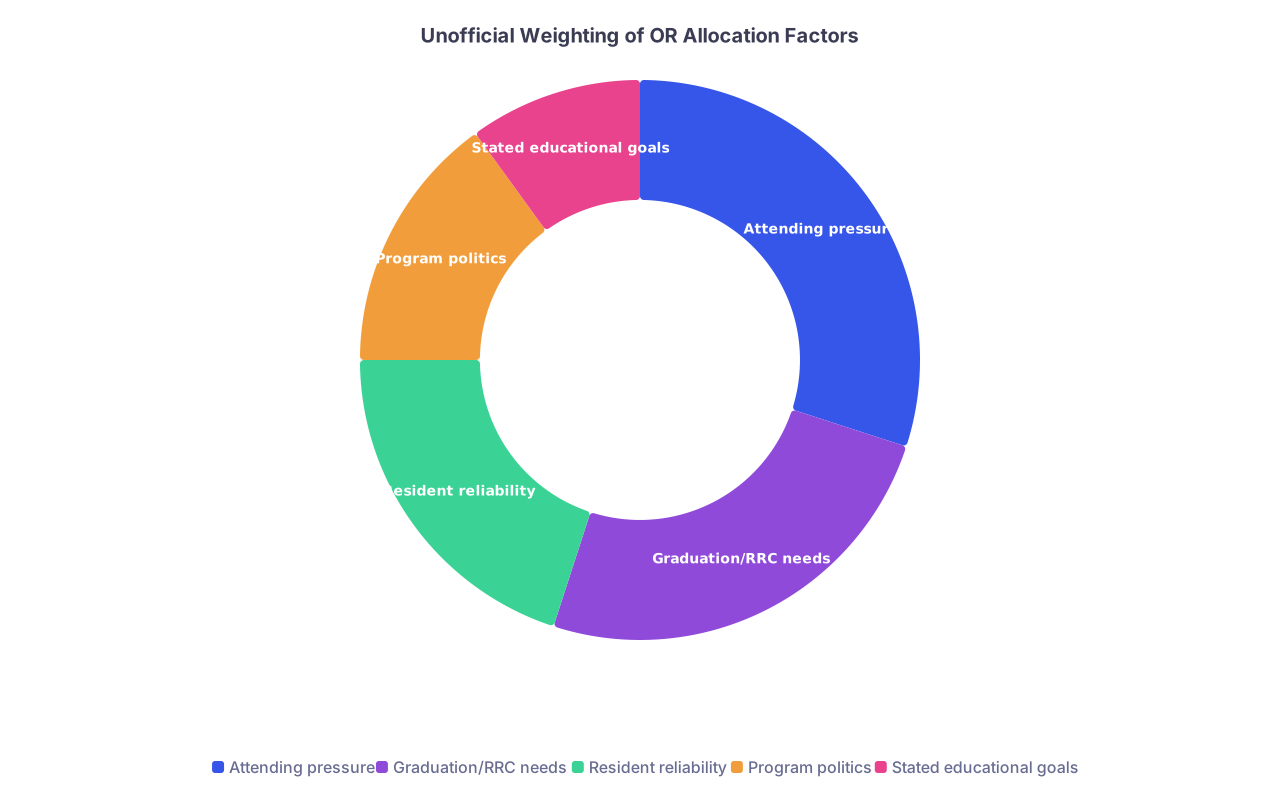
| Category | Value |
|---|---|
| Attending pressure | 30 |
| Graduation/RRC needs | 25 |
| Resident reliability | 20 |
| Program politics | 15 |
| Stated educational goals | 10 |
You’ll see the disconnect the first time a PGY-2 who’s always late gets bumped from a hernia so a PGY-5 darling of the colorectal attending can “pick up one more case.” The explanation is “she needs the numbers for graduation.” That’s partly true. It’s also code for “this attending actually called me last night about this.”
Who Actually Gets the Cases When Volume Shrinks
I’ve sat in those chief meetings where they’re staring at a half-empty elective schedule and a list of hungry residents. Here’s who gets fed first.
1. The Near-Graduation “Problem”
The biggest fear of any PD: a graduating resident whose case log is embarrassingly low in a core category. That will show up on the ACGME report. That brings heat.
So chiefs start with a mental red list:
- PGY-5 who’s light on major cases (especially index cases)
- PGY-4 who is behind on key category numbers
- Anyone the program has already had to “explain” to the Clinical Competency Committee
These residents will quietly jump the line.
That PGY-5 with 15 thyroids when the rest of the class sits at 40? She’s getting every neck case that comes through, even if a PGY-3 hasn’t seen one in months. The chief will rationalize it as “educational priority,” and in a narrow sense, they’re right. But the juniors pay the price.
And yes, chiefs do look at the logs—often selectively, often right before they start reallocating.
2. The Attending Power Map
You probably think cases are assigned “by service” or “by rotation.” That’s naïve. When case volume is tight, it’s assigned by who has pull.
Some attendings are politically radioactive. They have the ear of the chair. They write the big letters. They control fellowships or job connections. When they complain about “my room is turning into a training OR instead of a real OR,” chiefs listen.
So chiefs create a mental heat map of attendings:
- Chair / vice-chair cases: always staffed, usually with a senior, rarely with a weak resident
- Big-volume, revenue-generating surgeons: get reliable, known-quantity residents
- Chronic complainers: get enough staffing to shut them up
- “Nice” educators with no political power: they’ll get squeezed first
You’ll see it when the vascular attending who everyone fears gets a PGY-5 + PGY-4 combo in the room for a single long bypass, while the pleasant, teaching-focused breast surgeon gets stuck with a PGY-2 and an overworked PA… or sometimes, no resident at all.
The Shadow Criteria: What Chiefs Actually Look At
Forget what’s in the handbook. Here are the real criteria they talk about at 9:30 p.m. over cold pizza while trying to fix tomorrow’s schedule.
1. Reliability and Damage Control
No chief is sacrificing the efficiency of a fragile OR day so that a chronically late, disorganized resident can get “educational exposure.” When cases are scarce, reliability is currency.
They ask:
- Who shows up on time, preps the patient, and doesn’t cause delays?
- Who can handle a case relatively independently and not make it drag 2 extra hours?
- Who doesn’t disappear when the PACU is backed up?
If your name is associated with chaos, you get cut first when there’s a case squeeze. If your name is associated with “things just run smoother when they’re here,” you get invited into rooms even when you’re not “assigned.”
2. “Investment Value”
Whether they admit it or not, chiefs triage based on where they think the OR time will have the most “return.”
That return can mean different things:
- Resident going into that subspecialty → more “worth it” to load them with those cases
- Resident who’s clearly going to be an academic leader → more reason to support their numbers
- Resident who’s barely competent and may not pass boards → they’ll also get extra cases, but it will be reluctantly, and usually in lower-risk situations
The quiet-but-serious PGY-3 who’s going into community general surgery and steadily improving? That’s the one chiefs like giving more cases to. You’re clearly going to be the one actually doing these operations in two years. They want you ready—and your success reflects back on the program.
3. Program Optics and Morale
Chiefs are constantly playing morale Jenga.
If one resident has been shafted for weeks—never gets main-room cases, always stuck on floor work—that becomes a problem. Complaints to the PD. Rumors. “This program doesn’t care about training.”
So they’ll occasionally load that person up, not because the schedule allowed it, but because the politics required it.
This is why sometimes you’ll see a chronically weak PGY-2 suddenly getting a surprisingly good day in a prime room. Someone in leadership said in a meeting, “We need to make sure we’re giving him a fair shot.” That’s not about fairness in the cosmic sense. That’s about program optics and their own conscience.
The Games Residents Play—and How Chiefs Respond
You’re not the only one gaming the system. Chiefs see all of it. They talk about it explicitly.
The “Always Present” Gambit
Some residents try to be present for absolutely everything. Show up early, stand outside control, constantly ask, “Do you need another set of hands?”
Sometimes it works. For the first 2–3 weeks.
Then chiefs split that group into two categories:
- The workhorses: show up, help, don’t whine, don’t demand credit
- The opportunists: show up just to poach skin closure, then disappear when there’s post-op work or a debrief
Guess which group gets invited into the good rooms when volume is thin?
I’ve heard a chief say, verbatim: “He only appears once the drapes are up and leaves before the dressing goes on. Stop rewarding that. Put him on floor calls instead.”
The “Victim Narrative”
Another tactic: complaining loudly that “I never get any cases.”
Sometimes justified. Often not.
Chiefs don’t react to the words; they react to the logs and the history. They’ll pull your ACGME case list, compare you to your class. If you’re truly behind, they’ll quietly try to fix it. If you’re middle of the pack and just vocal, they’ll classify you as “high noise, low signal.”
Those residents get one or two “makeup” opportunities. If they squander them—show up late, underprepared, scrub out early—they’re done. Chiefs remember.
The “Favorite Attending” Strategy
Residents quickly learn: align yourself with a powerful attending, and cases appear.
You stay late with the HPB surgeon, read their papers, come in for their 7 p.m. add-ons. That person starts requesting you by name. Then when their cases are distributed, you’re automatically in the room.
Chiefs resent it slightly, but they rarely fight it. An attending request is one of the few hard currencies in this ecosystem. They’ll maybe temper it a bit—“We can’t put you with Dr. X every single day”—but they’re not going to cross a high-value faculty member over a junior resident’s sense of fairness.
What Changes When the Whole Hospital Is Tight
When it’s not just your service but the entire hospital that’s compressed—COVID backlogs, anesthesia shortages, staff cuts—the calculus shifts again.
Now OR time itself becomes premium golf course property. Leadership starts scrutinizing “throughput” and “turnover times.” The pressure filters down.
You’ll see three specific shifts:
More cases go to APPs and fellows
Administration loves predictable providers. Attendings want to protect PRVUs and efficiency. So the PA who’s done 100 lap choles with Dr. Y will quietly be preferred over a new PGY-2 who will fumble for 30 minutes at the camera.Chiefs start thinking like operations managers
They’ll schedule residents partly based on who minimizes friction. The “high-maintenance” resident with constant scheduling drama? They mysteriously get scheduled for clinic or consults on the high-pressure OR days.Educational ideals lose to revenue realities
Those “secondary” educational cases (simple hernias, port removals, straightforward scopes) get bumped first when anesthesia is short. That’s exactly what residents need to build reps in, but they’re low-priority financially. The chiefs know this and hate it, but they can’t fix the macro problem.

Where Tech and the “Future of Medicine” Actually Fit In
Everyone talks big about analytics, equity dashboards, AI-based scheduling. Some places are experimenting with it. Here’s the unvarnished truth: until the culture changes, the algorithms will just formalize the same human biases.
I’ve seen “objective” tools rolled out:
- Systems that flag residents under case targets by PGY level
- Dashboards tracking index case distribution
- Reports highlighting attendings who consistently shut residents out of cases
Sounds great. In practice?
The chiefs use the tools at 10 p.m. to justify what they were going to do anyway. “See, this PGY-4 really is behind on colorectal, so I’m putting her in Dr. Z’s room tomorrow.” That was already the plan.
And the attendings who ignore residents? Everyone already knew exactly who they were before any dashboard.
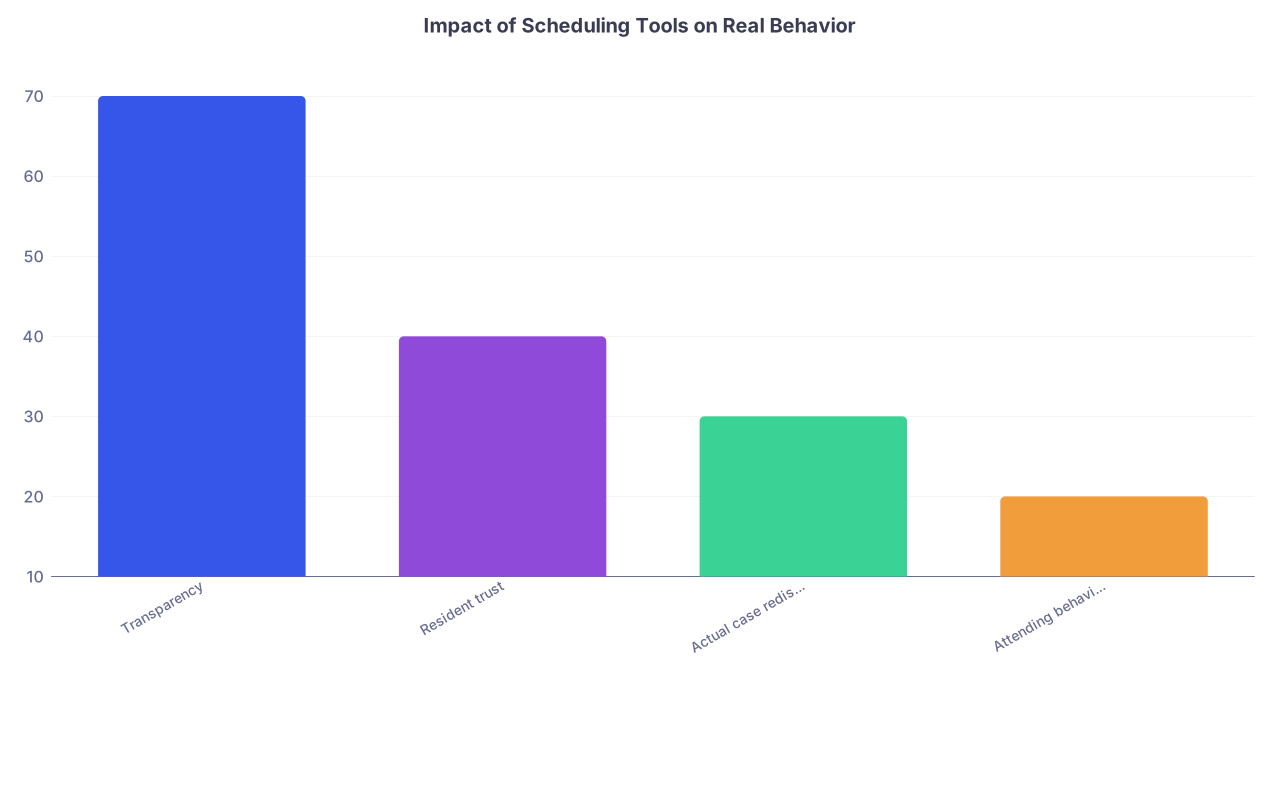
| Category | Value |
|---|---|
| Transparency | 70 |
| Resident trust | 40 |
| Actual case redistribution | 30 |
| Attending behavior change | 20 |
So will tech fix case allocation? Not on its own. It’ll just make the politics more data-flavored.
Where it might help long term is giving residents evidence. When you can show, with a clean chart, that one cohort is consistently underexposed, or one attending never has a resident in their room, it becomes harder for leadership to pretend everything is fine.
But do not hold your breath waiting for an AI scheduler to save your operative log.
How Smart Residents Actually Win in This System
You cannot control the hospital census, the chairs, or the attendings’ RVU incentives. You can exploit the way chiefs really think.
Here’s what actually works, in the real world, when OR time is tight.
1. Remove Every Excuse Not to Give You a Case
Chiefs are constantly triaging headaches. Don’t be one.
- Be relentlessly on time. Not “a little late but I texted someone.”
- Know your pre-ops cold. They notice when they don’t have to cross-examine you on basic stuff.
- Do the unglamorous work without complaint—floor calls, notes, discharge summaries—then ask for OR exposure.
When chiefs think, “If I put her in that room, my phone will be quiet,” you start winning.
2. Align Yourself With One or Two High-Value Faculty
You don’t need ten fans. You need two with clout who say your name in scheduling conversations.
You earn that by:
- Showing up for their add-ons without being asked.
- Reading their cases and coming prepared with 2–3 specific questions.
- Making their day materially easier—consents done, imaging pulled, families updated.
Then when chiefs are stuck, they’ll hear, “Can you put Alex in my room tomorrow?” And they will.
3. Ask for Cases the Right Way
Walking up at 6:30 a.m. saying, “Can I do this case?” is rookie-level.
The seasoned approach is a quiet, specific conversation with the chief before the schedule locks:
“Hey, I’m at 3 carotids. The rest of the class is around 10–12. If anything opens up this month, I’d really appreciate being considered for those cases—even to first-assist. I just don’t want to graduate light in that area.”
You’ve:
- Shown you know your own log.
- Framed it around educational gaps, not vague “I never get cases.”
- Given them a mental tag to use when a slot appears.
They will remember that.

4. Protect Your Reputation Mercilessly
Every time you leave mid-case “because the floor is blowing up” and the chief discovers later that it was something ancillary services could have handled, your perceived reliability drops a notch.
Every time you skip a late add-on that another resident then steps into—and crushes—you just lost ground.
Chiefs have long, detailed memories for who shows up for the painful cases:
- 11 p.m. lap appys.
- 7 a.m. cases after a brutal night.
- The “boring” hernias that actually build your log.
You can’t fake it for a week. You have to be that person consistently.
Where This Is All Heading
Here’s the uncomfortable future: case volume per resident is not going up. Not in most places.
More fellows. More APPs. More pressure for efficiency. More minimally invasive and interventional procedures that bypass the traditional OR entirely.
You can either:
- Cling to the idea that “the system should be fair,” and stay angry, or
- Understand the real rules, then play with your eyes open.
The residents who succeed in the next decade will be the ones who treat OR time as a scarce, political resource and act accordingly—without becoming toxic or cynical.
You do not have to like the game. But if you pretend it does not exist, you will lose it.

| Step | Description |
|---|---|
| Step 1 | Next Day OR Schedule |
| Step 2 | Follow Default Assignments |
| Step 3 | Check Senior Logs |
| Step 4 | Prioritize At Risk Seniors |
| Step 5 | Map Attending Pressure |
| Step 6 | Assign Reliable Residents |
| Step 7 | Consider Morale Optics |
| Step 8 | Final Tweaks and Emails |
| Step 9 | Case Volume Tight? |
| Step 10 | Any Graduation Risks? |