The way program directors judge your surgical case logs is harsher—and more nuanced—than anyone is telling you.
You think it is about the total number. It is not. Numbers get you in the door. Patterns get you labeled. And once you are labeled—“operator,” “bystander,” “inflator,” “weak exposure”—that label follows you into fellowship and sometimes into your first job.
Let me walk you through how this actually plays out behind closed doors.
What PDs Really Look At First (It’s Not What You Think)
Here’s the unspoken truth: nobody with real authority is scrolling your case logs like a CV. That is amateur hour.
The good PDs, the ones who know how to read a log, do 4 things immediately:
- Glance at totals to see if you clear the floor.
- Drill straight into distributions—chief year vs early years, primary vs assist.
- Scan for inflation patterns.
- Cross-check against what they already think of you from faculty feedback.
Total case numbers are screening tools, not decision tools. If your total adult index cases are catastrophically low, yes, you’re in trouble. But if you are in the broad “normal” band, they don’t stop there.
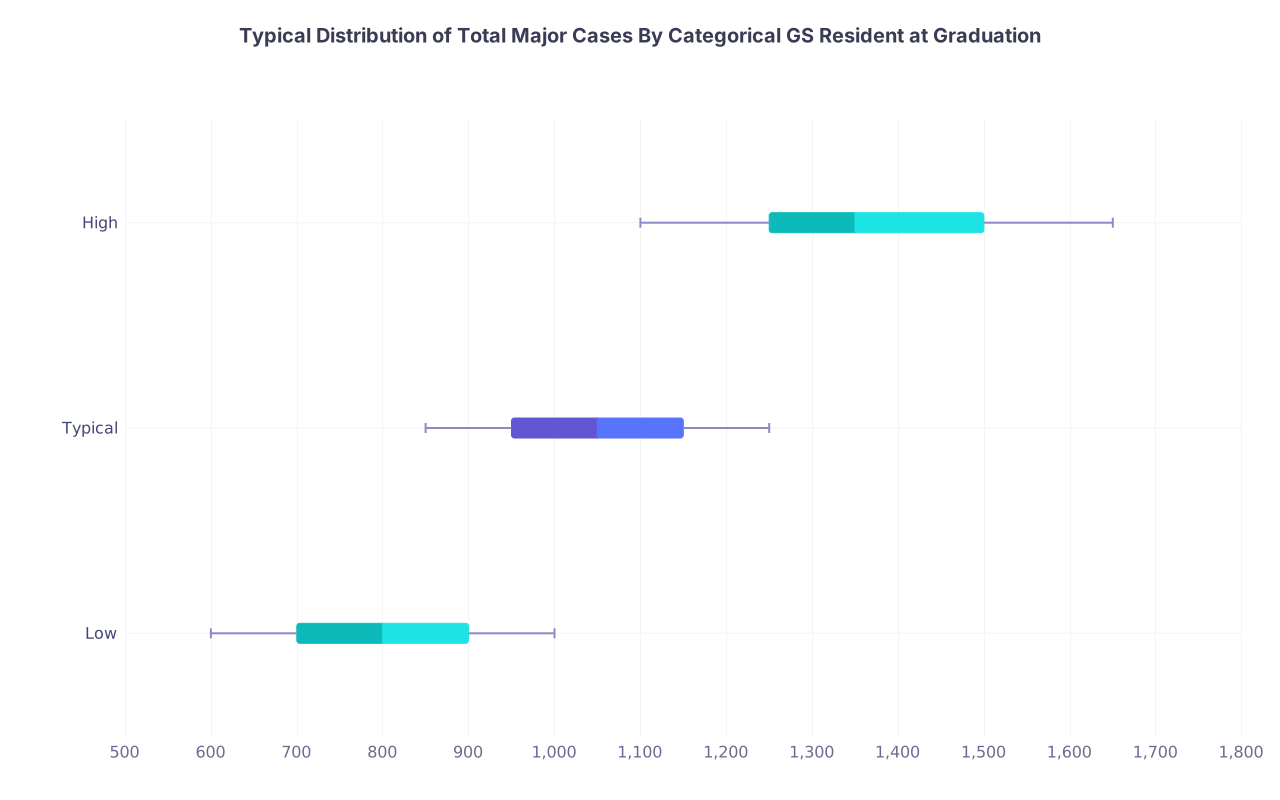
| Category | Min | Q1 | Median | Q3 | Max |
|---|---|---|---|---|---|
| Low | 600 | 700 | 800 | 900 | 1000 |
| Typical | 850 | 950 | 1050 | 1150 | 1250 |
| High | 1100 | 1250 | 1350 | 1500 | 1650 |
If you are in that “typical” box, your fate hinges on the story the shape of your log tells. That is what they are quietly judging.
I have sat in evaluation meetings where someone says, without even glancing at written comments:
“Pull her ACGME report. I want to see how much she was actually primary.”
Translation: they don’t trust the narrative. They trust the case log patterns.
The Quiet Red Flags That Make PDs Nervous
The scariest thing about your case log is this: you can be “numbers-OK” and still radiate red flags to anyone who knows how to read it.
Here are the patterns that set off alarms.
1. The “Shadow Resident” Pattern
On paper: 1100–1200 total cases. Looks fine.
In detail: assist-heavy, with primary cases clustered in the least complex categories.
You see something like this:
- Very high assist numbers on big cases (Whipples, open AAAs, complex oncologic resections).
- Primary cases skewed toward hernias, lap choles, appys, trachs, lines.
Then someone in the room says what everyone is thinking:
“So they stood in a lot of important rooms. That’s different from operating.”
This is how PDs quietly characterize it:
- “Observer, not operator.”
- “Good team player, but did not drive cases.”
- “Looks like they never fully owned the big cases.”
If you are that resident, your letters and your interview better directly counter that impression with stories of you running cases and taking responsibility. Otherwise, the case log has already framed you as a permanent first assist.
2. The Chief-Year Collapse
Every PD I know flips to the chief-year breakdown almost immediately. It is the surgical equivalent of a stress test.
Here’s the pattern that scares them:
Early years: strong numbers.
Chief year: plateau or, worse, drop.
I’ve heard the conversation more than once:
“Why are their primary colectomies and foregut cases flat or down as a chief?”
Response: “Well, they took an elective research year, then came back a bit tentative.”
Follow-up: “So they never fully ramped to independent operator?”
You do not want that question attached to your name.
Chief year should look like this: more primary, more complex, fewer “just helping.” If it does not, PDs will assume one of three things:
- Faculty did not trust you to lead.
- You avoided the tough rooms.
- You were there, but you were not driving.
None of those three helps you in fellowship selection.
3. The Inflation Pattern (And Yes, We See It)
Residents sometimes think we cannot tell when case logs are padded or “generously interpreted.”
We can.
You see a PGY-3 logging endless “primary” roles on lap choles in a program where attendings routinely scrub and run the case. You notice 3–4 “primary” advanced lap cases per day during a short rotation that is known to be brutal and attending-driven. Or someone logs “primary” for a technically complex case they clearly couldn’t have executed alone at their PGY level.
People in the room start asking:
- “Who signs off on their logs?”
- “Is this the resident or the culture of the program?”
- “Are these real cases or checkbox clicks?”
The most damning pattern is this:
A resident with average or below-average OR performance feedback but a case log that looks like they’re a monster operator. That discrepancy destroys credibility.
Once a PD decides you’re an inflator, they discount your entire log. Completely. Now they rely almost entirely on narrative letters and word-of-mouth.
4. Narrow Surgeon Syndrome
Massive numbers, but in a narrow slice of surgery. For example:
- Tons of hernias, basic lap, bread-and-butter general.
- Almost no endocrine, vascular exposure, complex HPB, or thoracic.
- Trauma numbers light or obviously superficial.
If you’re applying to a general surgery fellowship, some people shrug. “This is what general practice looks like anyway.”
But if you’re trying for complex surgical oncology, vascular, CT, or MIS at a serious center, committee members are going to say:
“This person lives in the low- to mid-complexity zone. Where’s the proof they can handle real complexity?”
The total volume doesn’t save you if the portfolio is narrow and safe.
How Case Logs Factor into Fellowship and Job Decisions
Here is the part that people sugarcoat for you: for stronger applicants, case logs are confirmatory. For marginal applicants, they are decisive.
In high-volume fellowships—HPB, complex MIS, CT—here is roughly how conversations go:
- Step 1: Letters and reputation first.
- Step 2: Interview performance and “can I stand next to this person in a room for a year.”
- Step 3: Case log used to verify that you are actually the surgeon your letters describe.
But when there is doubt—borderline interview, weaker letters, unknown program—the case log becomes a tiebreaker. And not just “how many cases?” but:
- Does this trajectory show real operator growth?
- Are they primary on a meaningful number of index cases?
- Do they look like a trainee who will start fellowship at mile 20, not mile 2?
For first jobs, especially in community hospitals, the dynamic is a little grittier. I have literally heard a chief of surgery say:
“I do not want to hire someone who has done four colon resections as primary and then shows up telling me they’re a general surgeon.”
So they pulled the ACGME log. Went straight to:
- Colectomies, foregut, hernias.
- Complicated appendicitis, bowel resections, trauma laparotomies.
- Bread-and-butter cases that define real-world practice.
What they were asking, in blunt words: “Will this person be safe and efficient in my OR on day one, or am I signing up to train them from scratch?”
| Stakeholder | Primary Use of Case Log |
|---|---|
| Program Directors | Assess growth and integrity |
| Fellowship PDs | Verify complexity and readiness |
| Hiring Surgeons | Gauge day-one operative competence |
| Clinical Competency Committee | Identify gaps and remediation |
| ACGME / RRC | Ensure minimum standards and trends |
Once you see this, you understand why some PDs get almost personally offended by inflated logs. It is not paperwork. It is a safety document and a reputation document.
The Patterns That Impress PDs Quietly (And Rarely Get Mentioned)
The positive side exists too. There are patterns that make people in the room nod without saying much. That’s the good sign—you want the quiet nod, not the loud debate.
1. The Clean Growth Curve
My favorite residents’ logs all share one thing: they tell a clean story.
Early PGY:
- Heavy on exposure and assist.
- Learning lines, scopes, basic cases.
Mid-level PGY:
- Growing primary numbers on standard general surgery cases.
- Complex cases where they’re either assist or “key portions.”
Chief:
- Clear transition to being primary on core index cases.
- Complex reoperations, revisions, and multi-step abdominal cases.
You do not need superhuman numbers. What you need is a visible progression from helper → operator → leader. A good PD can see that in 2 minutes on the ACGME report.
2. Breadth Without Chaos
The second pattern that impresses faculty is breadth with coherence.
You are not just collecting random cases like baseball cards. You show:
- Solid trauma; a real number of laparotomies and emergent cases where you’re primary or doing key portions.
- Good representation across hernia, foregut, colorectal, endocrine, and skin/soft tissue.
- Enough advanced lap and complex open work that you’re clearly not afraid of a challenging abdomen.
When a log shows that kind of spread, the unspoken conclusion is:
“This resident will not panic when they get a weird, late-night problem in a small hospital with limited backup.”
Fellowship directors, even at ivory-tower programs, care about this more than they admit.
3. Authentic Complexity
Here is what experienced surgeons love: a log where the complexity is believable for the level of training.
I’m talking about entries like:
- PGY-2: assist on open AAA, primary on fem-pop, primary on basic vascular access.
- PGY-3: primary on trauma laparotomy, key portions on colectomies.
- Chief: primary on multi-step laparoscopic foregut, open colectomies, complex hernia with mesh, revision cases.
No one expects you, as a chief, to be logging “primary” on a highly complex Whipple performed by a superstar HPB surgeon who’s still doing 90% of the case themselves. If you log that honestly—key portions, or assist—it makes the rest of your log more credible.
That is what PDs want: believable complexity, appropriately graded.
How the Future Will Make These Judgments Even Harsher
You think the current ACGME report is detailed? It is a blunt instrument compared to what’s coming.
Programs are already experimenting with:
- OR data integrations showing who was actually scrubbed, when, and on which portions.
- Direct linkage of case entries to attending verification with more granularity.
- Competency-based milestones tied to specific case types and complexity levels.
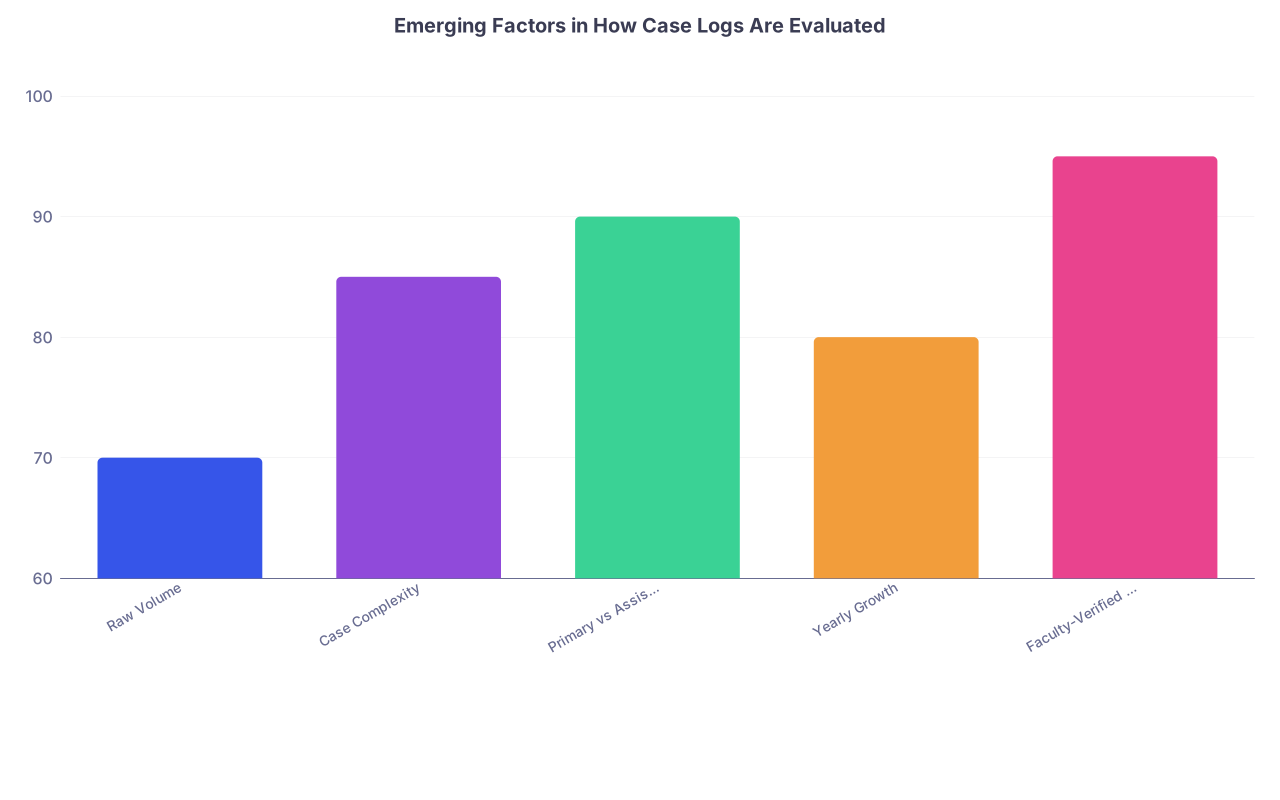
| Category | Value |
|---|---|
| Raw Volume | 70 |
| Case Complexity | 85 |
| Primary vs Assist Mix | 90 |
| Yearly Growth | 80 |
| Faculty-Verified Competence | 95 |
Those numbers are representative, not real, but the direction is accurate: raw case volume will matter less than demonstrated, verified competence. And once OR time stamps, device data, and intra-op documentation get integrated, padding your log will be suicidal.
There are conversations happening right now at major academic centers about “operative portfolios” rather than simple logs:
- Case series with linked brief notes on what you actually did.
- Objective performance ratings attached to specific procedures.
- Video capture of selected key cases for formative and summative review.
Once that becomes standard, the concept of “1 primary colectomy equals 1 primary colectomy” disappears. A clean, tension-free colectomy done efficiently with minimal attending intervention will not be viewed the same way as a chaotic one where the attending rescued you three times.
I have already seen fellowship applications where a PD says, “We watched their stapled anastomosis video. They’re better than their case log suggests.” That is where we are going.
What You Should Do Now, While the System Still Looks Like This
You are not going to change the evaluation system from your station. But you can play the game intelligently.
A few blunt guidelines, based on what PDs actually respect:
First, stop chasing raw numbers like an accountant. Chasing 20 extra lap choles that all look the same is not what gets you a good fellowship. What matters more is being primary on a representative sample of the kinds of cases you’ll need to own in the real world.
Second, protect your chief year like it is sacred. That is the year everyone cares about:
- Show up for the hard cases.
- Volunteer when things are rough, not just when they’re pretty.
- Do everything you can to be the person faculty naturally hand the knife to.
Your chief-year log is what people pull up when they’re about to decide whether you’re ready for independent practice.
Third, be ruthlessly honest in your logging. Over-calling assist as primary might feel like it solves anxiety today, but it kills your credibility long term. PDs and fellowship directors will smell the discrepancy between your log and your letters.
Fourth, if your numbers or patterns are weak, address them before someone else brings them up. I have seen residents salvage middling logs by:
- Having a PD letter explicitly explain rotations lost to illness, parental leave, or COVID disruptions.
- Demonstrating targeted remediation—extra rotations, simulation, case concentration in specific areas.
- Owning the weaknesses in interviews and pairing them with evidence of growth.
Silence makes PDs invent their own explanation. And trust me, their imagined version is rarely flattering.

| Step | Description |
|---|---|
| Step 1 | Review Application |
| Step 2 | Check Overall Case Totals |
| Step 3 | Concern for Minimum Competence |
| Step 4 | Examine Distribution By Year |
| Step 5 | Assess Primary vs Assist Mix |
| Step 6 | Look For Growth Into Chief Year |
| Step 7 | Use Log As Confirmation |
| Step 8 | Question Integrity or Training |
| Step 9 | Deeper Review or Phone Calls |
| Step 10 | Support Fellowship or Job Recommendation |
| Step 11 | Flag For Remediation or Lower-Risk Job |
| Step 12 | Below Threshold? |
| Step 13 | Patterns Match Faculty Impression? |
Finally, understand this: your case log is not just data. It is a story about who you were in the OR for five years. Whether you were there for the skin-to-skin grind or just for the “dictation and dispo” part.
Program directors, attendings, fellowship committees—they are all reading that story, even when they pretend they are only counting.
If you remember nothing else
- PDs judge patterns, not just totals—growth, primary mix, and believable complexity matter more than a single big number.
- Inflated or inconsistent logs quietly destroy your credibility; honest logs paired with strong faculty advocacy can rescue weaker numbers.
- The future is moving toward verified competence, not just volume—start acting now like every case you log might someday come with a video receipt.