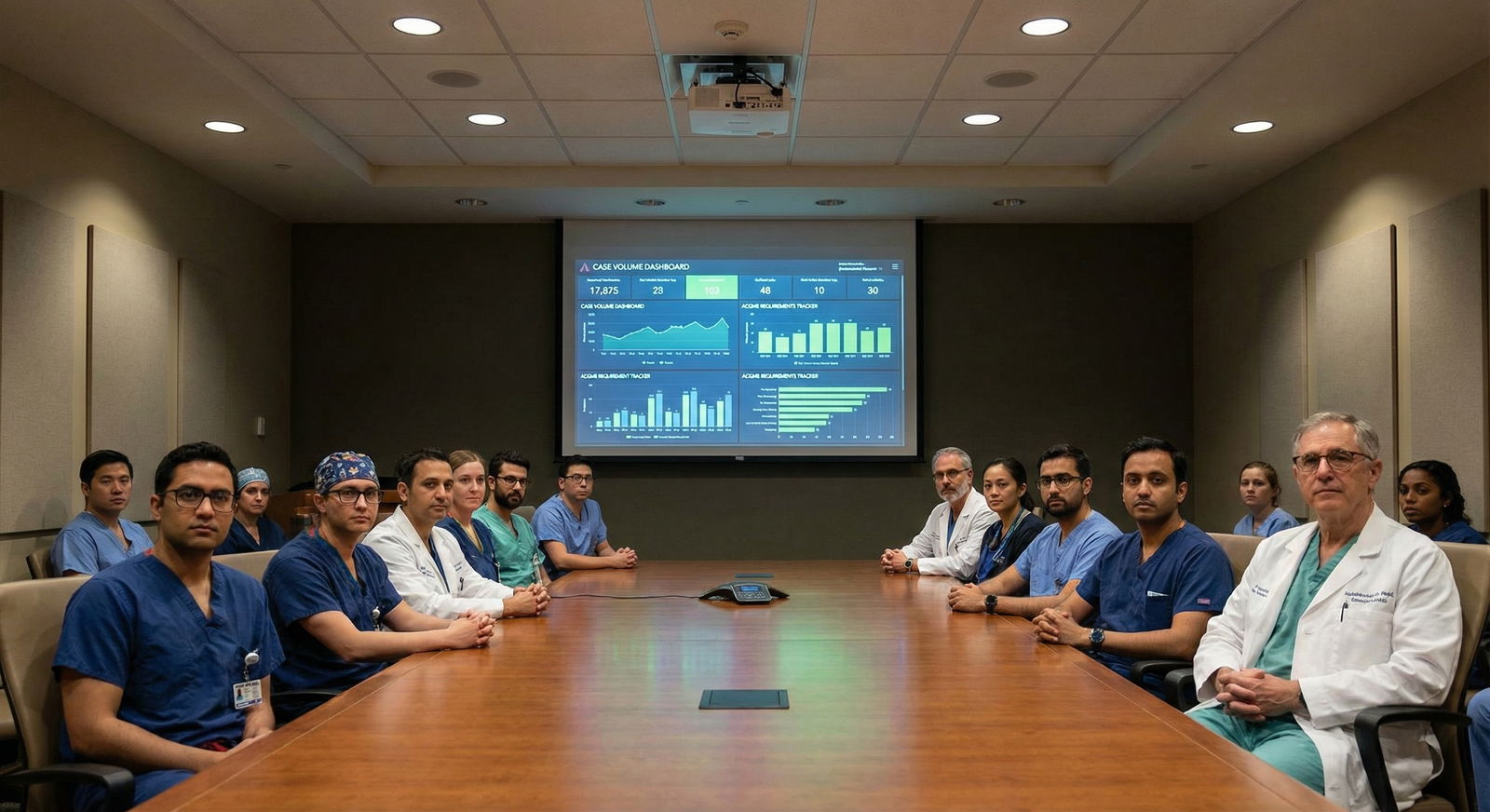
The residents with the lowest case numbers are usually not the least skilled. They’re the ones quietly sabotaging their own volume without realizing it.
You think it’s the program. Or the attendings. Or “the match.” Sometimes it is. But very often, it’s also you, in small, invisible ways that compound over months and years.
Let me walk you through seven of the most common self-inflicted wounds I’ve watched residents make with their surgical case volume—and how to stop doing them before it’s too late.
1. Being “Available” But Never Proactively Grabbing Cases
Most residents think showing up to the OR board and writing their name once is “being proactive.” It’s not. It’s the bare minimum, and it often leaves you with scraps.
The mistake:
You wait to be assigned cases instead of claiming them.
Common patterns:
- You show up at 6:30, glance at the OR schedule, and just accept whatever your chief tells you.
- You never say, “Hey, I’d like to be on the laparoscopic cases today,” or “Can I take all the hernias this month?”
- You assume chiefs and attendings remember who needs what numbers. They don’t. They remember who makes their day easier.
What this looks like in reality:
- The loud PGY-2 who says, “Dr. X, I really need more basic laparoscopic cases—can I be your default first-assist on those this block?” ends up with a full log.
- The “chill,” quiet resident who says nothing ends up logging a handful of cases and blaming luck.
Do not make the mistake of being passive in a system that rewards assertiveness.
What to do instead:
- The day before: review the next day’s cases and email/text your chief: “I’d really like to take [specific cases]. My numbers are low in [area]. Can I be primary on those if possible?”
- At sign-out: briefly say to your chief, “This month I’m trying to build my [endoscopy/hernia/breast] numbers. If there are electives that fit, I’d love to be plugged in.”
- Once in the OR: don’t just scrub and watch. Ask early: “Would you be okay if I took the camera/lead dissection on this case?”
You’re not begging; you’re signaling intention. There’s a huge difference.
2. Bleeding Your OR Time Away on Fixable Inefficiencies
You’re losing case volume not because there are no cases—but because you’re wasting OR hours on stuff you could have prevented.
The mistake:
You show up “on time” but unprepared, so you move slowly, add drag, and quietly get sidelined.
Here’s how it plays out:
- You don’t read the case until the morning of. When the attending asks, “What’s the next step?” you freeze. After two of those, they stop letting you do anything beyond retracting.
- You show up to the OR and still don’t know where anything is. So you’re constantly asking the scrub tech, “Can I have that blue thing?” instead of calling instruments by name.
- You haven’t looked at the imaging or labs. The attending realizes they’ll move faster alone and mentally categorizes you as “not yet ready to run cases.”
Result: you’re physically present but functionally passive. And your logbook shows it.
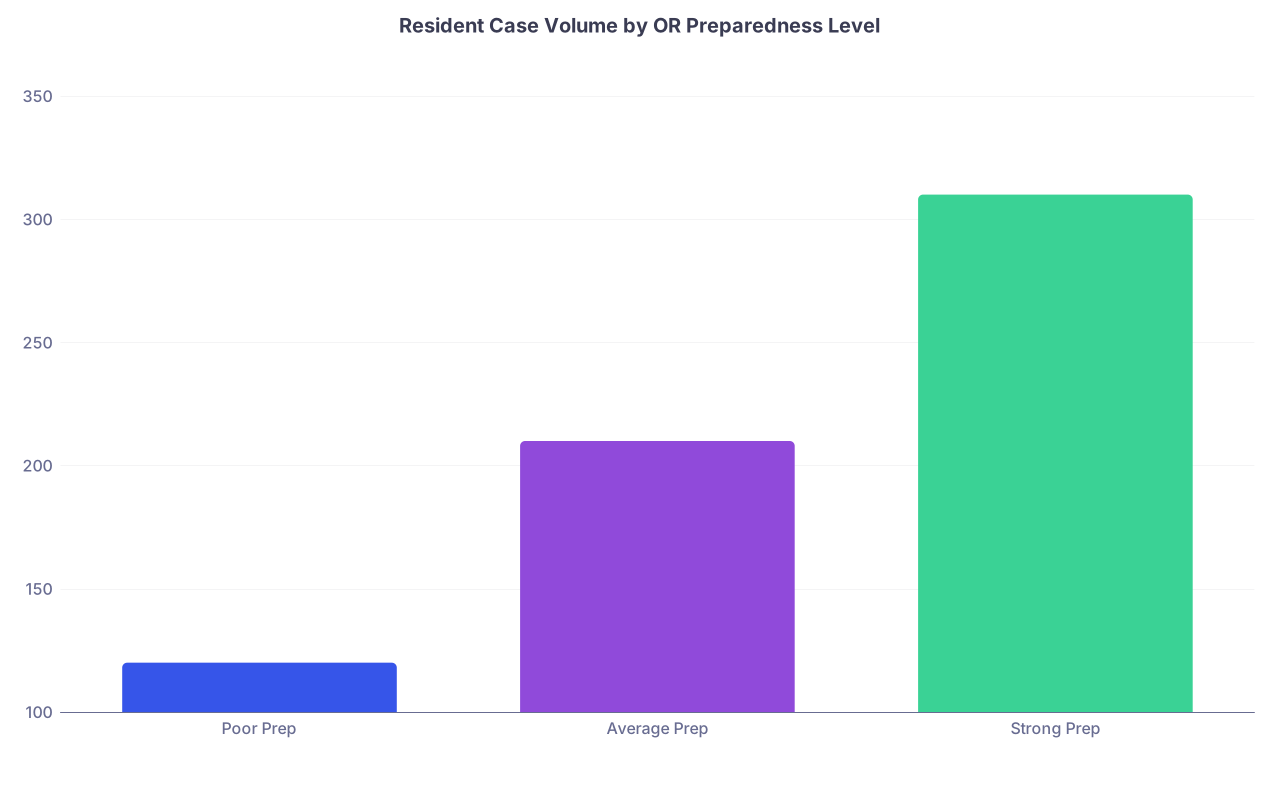
| Category | Value |
|---|---|
| Poor Prep | 120 |
| Average Prep | 210 |
| Strong Prep | 310 |
How to stop sabotaging yourself here:
- The night before:
- Read the op note template or standard approach for the procedure.
- Look at the imaging yourself. Be ready to say, “I reviewed the CT—mass is in segment 6, no obvious vascular involvement.”
- Before incision:
- Outline the steps out loud: “Port placement, explore, mobilize colon, identify plane, divide vessels…”
- Ask: “Would it be okay if I try to do steps 1–3 today?”
- During turnover:
- Don’t vanish. Help with positioning, setup, checking consents. That’s how you get trusted with more.
Prepared residents get allowed to operate. Unprepared residents just “assist.” That distinction is your case volume.
3. Ignoring the “Unsexy” Cases That Actually Build Your Numbers
You’re chasing big marquee cases—Whipples, liver resections—and walking right past the workhorses that fill your log and build your hands.
The mistake:
Seeing certain cases as beneath you or “not worth it” and giving them away too easily.
What you quietly give up:
- All the bread-and-butter: hernias, cholecystectomies, appendectomies, port placements, scopes.
- Minor procedures on call: I&Ds, washouts, bedside procedures that count if you bother to log them.
- Clinic procedures: excisions, biopsies, drains.

Reality check:
Your board certification and independent practice depend far more on thousands of “small” reps than a handful of complex prestige cases.
Here’s how you self-sabotage:
- You volunteer to give away two laparoscopic cholecystectomies so you can “see” a big oncologic case you barely touch.
- You leave early from a day of five scopes because you “don’t care about endoscopy” and then freak out in PGY-5 when you’re short on scope numbers.
- You skip clinic because you “want the OR,” missing procedures that would’ve logged and taught you decision-making.
What to change:
- Grab the workhorse cases. If a fellow doesn’t need the lap chole, you should.
- Track your numbers regularly. If you’re behind on hernias or endoscopy, you should be aggressively hunting those for months.
- Stop thinking “sexy” vs “unsexy.” Think: “Will I actually do this on my own in practice?” Those are the cases you can’t afford to miss.
4. Being Invisible to the People Who Control the Board
Another silent killer of case volume: you’re technically competent but socially invisible.
The mistake:
Assuming that working hard and not complaining is enough for people to prioritize you on the schedule.
The uncomfortable truth:
OR boards are, to some extent, political. Not in a corrupt way, but in a “who do I trust to make this day smoother and safer” way.
You’re sabotaging yourself if:
- You never check in with the OR charge nurse or scheduler. They don’t know you, so you’re not top of mind when they need an extra resident.
- You never talk to attendings about your training goals. They see you as a generic “PGY-3,” not as “the PGY-3 who’s hungry for more vascular cases.”
- You’re quiet and pleasant but not memorable. Nice to have, easy to overlook.
| Role | How They Affect Your Cases |
|---|---|
| OR Charge Nurse | Assigns rooms, knows busy days |
| Attendings | Choose who gets key steps |
| Fellows/Chiefs | Decide who scrubs what |
| Clinic Staff | Schedule procedures, add-ons |
| Anesthesia Team | Flag delays, turnover issues |
How this shows up:
- The vocal, respectful resident who says, “I really appreciate being put in Dr. Y’s room; I’m trying to build my breast numbers,” mysteriously keeps landing in those rooms.
- The silent resident who just appears and disappears stays a generic name on the board.
How to become visible without being obnoxious:
- With attendings: “Dr. Z, I’m short on basic laparoscopic numbers. If there are straightforward cases where I can run most of the operation, I’d be grateful for the chance.”
- With charge nurse: “If there are days you’re short and need a resident to fill an OR, I’d be happy to help out. I’m trying to increase my operative time.”
- With chiefs and fellows: “If you’re okay with it, I’d love to take more of the straightforward cases so you can focus on the complex parts.”
You’re not manipulating. You’re giving people a reason to remember and invest in you.
5. Letting Clinic, Rounds, and Notes Cannibalize Your OR Time
One of the dirtiest secrets of residency: you can be crushed by “floor work” and still be losing OR time you didn’t have to lose.
The mistake:
Accepting every non-OR task as immovable and sacrificing operative time without asking whether there’s a smarter way.
Patterns I’ve seen over and over:
- You stay out of the OR to “catch up on notes” that could have been done in batches or delegated.
- You’re the one who always “volunteers” to stay on the floor while others scrub, because you don’t want to seem lazy.
- You never negotiate: “I can handle these discharges if someone else can cover that one case,” so you just eat the loss.

| Step | Description |
|---|---|
| Step 1 | Start of Day |
| Step 2 | Pre-rounds |
| Step 3 | Miss First Case |
| Step 4 | Ask Team to Share Work |
| Step 5 | Scrub Cases |
| Step 6 | OR Day Lost |
| Step 7 | Higher Case Volume |
| Step 8 | Discharges and Notes? |
You’re sabotaging your own training when you:
- Treat every note as urgent when only a minority are time-sensitive.
- Don’t use templates, smart phrases, or batching to speed up documentation.
- Never ask, “Can I step out once we stabilize things to make it to that case?”
Better strategies:
- Batch work: finish pre-rounds, identify truly time-sensitive tasks, and then get to the OR. Do the low-priority notes after cases or between rooms.
- Trade smart: “I’ll take all the floor pages this afternoon if you let me scrub both lap choles.” That’s a fair swap.
- Use tech:
- Templates for post-op notes, discharge summaries, consults.
- Voice recognition when possible.
- Finish parts of notes while you’re physically walking between places.
Your job is not to heroically drown in admin. It’s to become a safe, competent surgeon. You cannot do that from the workstation.
6. Failing to Track Numbers Until It’s Almost Too Late
I’ve watched chief residents panic in January when the program director says, “You’re about eighty cases short in [category]. What happened?” What happened is they never looked.
The mistake:
Treating case logging as a bureaucratic chore instead of a training dashboard.
If your only interaction with ACGME case logs is end-of-year bulk entry, you’re undermining your own education.
Typical self-sabotage sequence:
- PGY-1–2: “I’ll log later, it’s annoying.”
- PGY-3: “I think I’m doing fine, I’ve operated a lot.”
- PGY-4: “Wait, what do you mean I’m short on endovascular cases?”
- PGY-5: Frantic last-minute case hunting or fellowship panic.
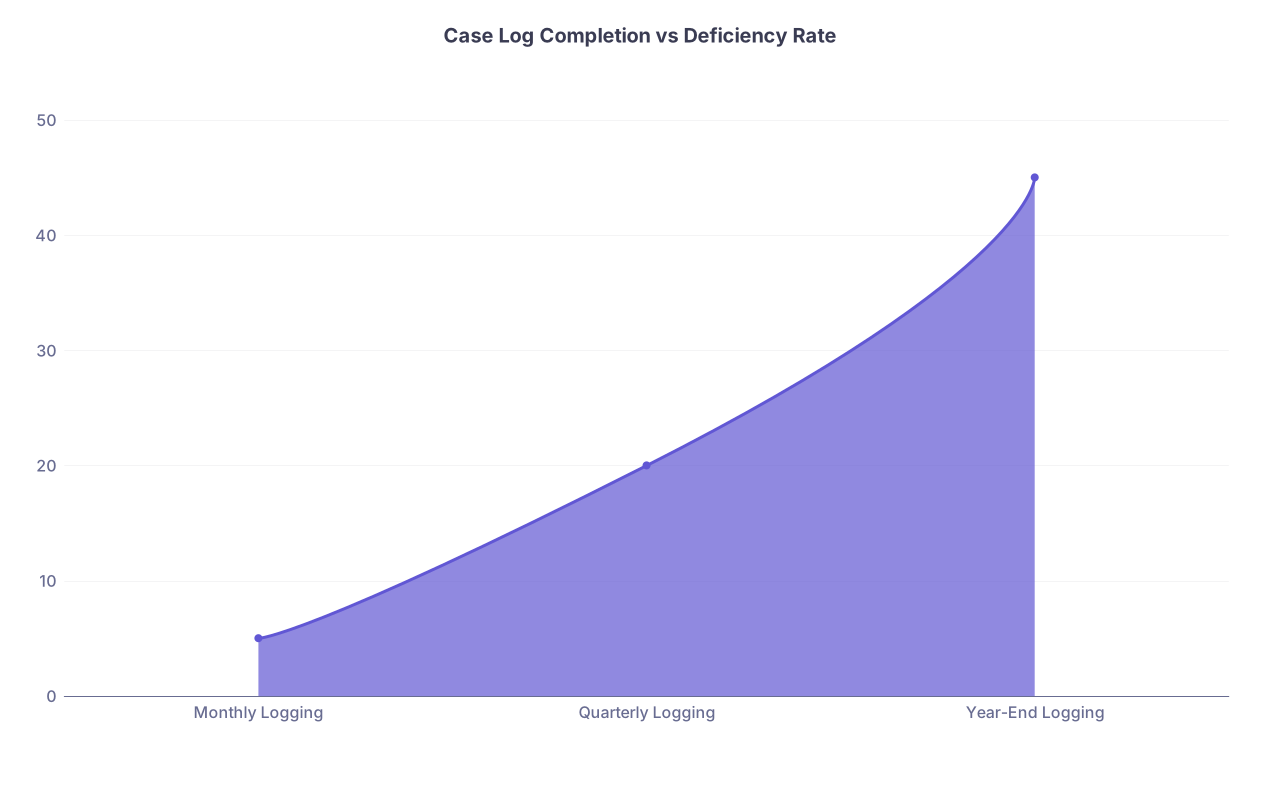
| Category | Value |
|---|---|
| Monthly Logging | 5 |
| Quarterly Logging | 20 |
| Year-End Logging | 45 |
Better approach:
- Log daily or weekly, no excuses. It takes 3–5 minutes if you keep up with it.
- Once a month, scan your numbers vs requirements:
- Where are you low?
- Which rotations were supposed to build those numbers?
- Who do you need to talk to?
Ask your PD or faculty early:
- “Historically, where do residents get their endoscopy numbers here?”
- “Which rotations are key for breast/endocrine/vascular numbers?”
Then protect those rotations and days like your career depends on it—because it does.
Ignoring your log until chief year is like never checking your bank account until the day you need a mortgage.
7. Acting Like the Future of Surgery Doesn’t Apply to You
Here’s the subtler, more modern form of self-sabotage: pretending that robotics, MIS, image-guided tech, and simulation can be optional side dishes instead of central to your training.
The mistake:
You only focus on traditional open and basic laparoscopy and ignore new platforms—then you graduate into a world that’s already moved on.
How this costs you case volume:
- Robotic days are when a lot of high-yield cases happen now—colectomies, hysterectomies, foregut work. If you aren’t trained in the robotic system, you get benched.
- MIS-heavy attendings do not want a resident at the console unless they’ve put in time on the simulator and understand docking, troubleshooting, and simple steps.
- Cases move from open to minimally invasive or endovascular, and you keep volunteering for the diminishing open cases because “that’s what I like,” shrinking your exposure.


| Step | Description |
|---|---|
| Step 1 | Residency Start |
| Step 2 | Open Skills |
| Step 3 | Laparoscopy |
| Step 4 | Robotic Basics |
| Step 5 | Advanced MIS Cases |
| Step 6 | Endoscopy Skills |
| Step 7 | Future Hybrid Techniques |
You’re sabotaging your future if:
- You blow off robotic simulation time because it’s “optional” and cuts into your post-call nap.
- You don’t bother to learn docking, stapling, or camera driving on the robot. You just want to sit at the console right away.
- You’re not comfortable with endoscopy and keep finding excuses to skip those days for “real surgery” in the OR.
Residents who will thrive in the next decade:
- Treat sim time and robotics like core, not extra.
- Ask, “What skills do I need now so attendings actually want me at the console?”
- Volunteer for the hybrid cases—laparoscopy plus endoscopy, robotic-assisted resections, image-guided interventions.
The OR is changing faster than residency curricula. If you wait for your program to drag you into the future, you’ll be behind.
How to Stop Quietly Killing Your Own Case Volume
If you recognize yourself in any of these patterns, good. That means you can change them.

Very practical reset checklist:
Audit your last 3 months.
- How many OR days did you actually get?
- How many did you skip or lose to notes, apathy, or passivity?
- Where did you give cases away?
Talk to your chief and PD.
- “Here are my current numbers. Where am I behind compared with where I should be?”
- “Which rotations coming up are critical for me to fix this?”
Pick two habits to change immediately.
Examples:- Daily logging.
- Reviewing imaging and op steps for every case the night before.
- Actively asking for bread-and-butter cases you’re short on.
Become visible and intentional.
- Tell attendings and schedulers what you’re aiming to build.
- Follow through with preparation so they see the payoff.
You can’t control every factor—case mix, call schedule, seniority, program politics. But if you fix these seven self-inflicted mistakes, you’ll stop leaving easy volume on the table.
FAQ (Exactly 5 Questions)
1. What if my program volume really is low—how do I know it’s not just me?
Compare your numbers with co-residents at the same level. If they’re consistently higher in the same program, that’s a sign you’re leaving volume on the table. If everyone is low, then it’s a structural issue and you need to talk with your PD early about away rotations, electives, or redistribution to higher-volume sites.
2. Is it wrong to push for OR time if other residents also need cases?
No, but don’t be a jerk about it. Be transparent: “I’m low on lap choles—are you okay if I take this one and you take the next?” Fair trading and honest communication are fine. Silent resentment and back-channel maneuvering are what destroy teams.
3. How early in residency should I start worrying about my case numbers?
PGY-1 is not too early to start logging and glancing at your numbers, even if they’re small. By mid-PGY-2, you should be checking quarterly and actively shaping your experiences. Waiting until PGY-4 or 5 is how people end up scrambling.
4. What if my attending keeps taking over cases even when I’m prepared?
First, quietly ask yourself if you’re really prepared—steps, anatomy, imaging, indications. If you are, talk privately: “I’d like to grow more in this procedure. Are there specific steps you’d feel comfortable letting me do next time?” Sometimes they don’t realize how little you’re getting until you say it.
5. How much does robotics and MIS really matter if I plan to practice in a small community hospital?
A lot more than you think. Community hospitals are buying robots and expecting new surgeons to use them. Even if you end up doing mostly open or basic laparoscopy, the residents who understand modern platforms will be more employable and more flexible. Ignoring them now limits your options later.
Key Takeaways:
- Case volume isn’t just about opportunity; it’s about how aggressively and intelligently you seize it.
- Most residents lose cases through quiet, fixable habits—passivity, poor prep, invisibility, and ignoring future-focused skills.
- Track your numbers early, ask for what you need, and treat every “small” case as a rep that your future patients are counting on.