
It’s late November. You just finished another brutal week on nights. You’re behind on notes, your logbook isn’t fully updated, and you’re vaguely aware that your laparoscopic cholecystectomy numbers are not where they should be. Somewhere down the hall, in a conference room you’re not invited to, your program’s Clinical Competency Committee is meeting.
Your name is on the agenda.
Let me tell you what actually happens in that room when your surgical case volume flags. Not the rosy “we’re just here to support your education” version. The real version—what’s said, what’s quietly implied, and how close you might be to a remediation plan you never saw coming.
How Case Volume Really Shows Up in CCC
Program leadership does not walk into CCC with a vague sense of “I think she’s done enough cases.” They walk in with data. Your data.
In most surgery programs, here’s what’s pulled up before your name is even mentioned:
| Data Source | What They Look For |
|---|---|
| ACGME Case Log | Total volume, distribution, trends |
| Rotation Evaluations | Comments on operative performance |
| Milestones | Level vs PGY and peers |
| ABS/ACGME Minimums | On track vs behind for year level |
| Block Schedules | Rotations that should have had cases |
There’s usually a dashboard-style view: color-coded, with thresholds. I’ve literally heard a PD say, “Scroll to the red people.” Red = you’re below expected volume or trending the wrong way.
Here’s the part residents don’t realize: it’s almost never just “total number of cases.” That’s too crude. They look at:
- Bread-and-butter cases for your level (PGY2 with low appys/choles, PGY4 with minimal hernias or foregut, PGY5 weak on colectomies)
- Index cases that the RRC scrutinizes
- Distribution of primary vs assist
- Your trend line across months—not just the snapshot
So when your volume “flags,” it’s usually because some combination of those triggered alarms on their spreadsheet.
The Quiet Triage: How They Decide If Your Low Volume Is a Problem
Picture the scene.
The coordinator has your name up, your case log summary, milestone map, and last few evaluations. There’s a short pause. Someone—usually the PD or APD—starts with: “Ok, what’s going on with [Your Last Name]’s case numbers?”
That’s the moment your fate starts to fork.
They run through a mental (and often unspoken) decision tree. It looks a lot like this:

| Step | Description |
|---|---|
| Step 1 | Low case volume flag |
| Step 2 | Service or scheduling problem |
| Step 3 | Resident-specific concern |
| Step 4 | Adjust rotations/OR access |
| Step 5 | Performance or behavior issue |
| Step 6 | Access, life events, documentation |
| Step 7 | Possible remediation |
| Step 8 | Monitoring and mild intervention |
| Step 9 | Global issue or isolated? |
| Step 10 | Any red flags? |
First question they’re trying to answer: Is this you or the system?
If multiple residents on the same service are light on certain cases, they chalk it up as a service access issue: schedule changes, more NPs/APPs doing cases, attendings hoarding cases, or a weird census year. That’s annoying to them, but it’s not about you as a problem resident.
If it’s just you—your classmates have solid numbers and yours are off—that’s when the conversation shifts and the tone changes.
The Three Narratives They Use To Explain Your Low Volume
Faculty do not pull up your chart and say, “The data show X.” They tell a story. They debate which story fits you. And that story determines whether your low volume becomes a footnote or a career issue.
There are three main narratives they reach for.
1. “Blocked Access” Narrative (System Problem)
This is the most forgiving and the one you want them to settle on.
Comments sound like:
- “He’s been on that malignant service that barely operates.”
- “She got killed with clinic and consults this block.”
- “They put him on the off-site community rotation where the APPs do most of the lap choles.”
If this is the prevailing story, what happens?
They look at your schedule and move things around. Maybe they shift you to a heavier operative service earlier. They might lean on attendings: “Stop letting the fellow do the index cases—our residents are behind.” They may explicitly flag you for priority in OR assignments on call.
You might never even hear that any of this happened. You just suddenly notice you’re “winning” more cases.
But here’s the catch: they can only use the “blocked access” story so many times before the RRC stops buying it. If by mid-PGY3 or PGY4 you are off on multiple categories, someone is going to say, “At some point, this stops being bad luck.”
2. “Resident Behavior” Narrative (You Don’t Hustle for Cases)
This is where it gets less kind.
When faculty start saying things like:
- “He’s not aggressive about getting into the room.”
- “She disappears when cases are being assigned.”
- “He is always stuck doing floor work when the rest of the team is in the OR.”
You’re no longer in a neutral story. You’re in the you’re not acting like a surgeon narrative.
This often gets paired with evaluation language like “lacks initiative,” “needs to be more proactive,” “too tentative in the OR,” or my personal favorite passive-aggressive phrase: “pleasant to work with, but…”
Once that narrative sticks, low case volume looks like a symptom of your personality or work style. Then CCC members start asking each other:
- “Have you talked to him about this?”
- “Does she actually want to be an operative surgeon?”
- “Is he more of a medicine brain in a surgery body?”
What happens next varies by program, but common moves include:
- Informal cautionary meeting: PD or APD “just checks in,” mentions your numbers, tells you to push harder for cases.
- Whisper campaign among faculty: “Give [Your Last Name] more chances in the OR, but watch to see if they actually show interest.”
- Added “professionalism” or “initiative” goals on your next evaluation cycle.
They don’t call it remediation yet. But you just got bumped onto the radar.
3. “Performance Concern” Narrative (You’re Not Safe or Skilled Enough)
This is the story no one wants their name attached to.
The comments start sounding like:
- “He’s slow and gets lost when things are complex.”
- “She panics when there’s bleeding.”
- “I don’t feel comfortable letting him drive the case.”
- “She needs a lot of hand-holding for her level.”
Here’s the ugly truth: when attendings do not trust your ceiling, you will see fewer cases. They do not want to burn OR time “teaching basic skills” to a PGY level they think should be further along. They give those cases to residents or fellows they believe can deliver.
Then your numbers fall. Then CCC sees your low volume. Then they see evaluations that say you’re not where you should be. It becomes a feedback loop.
For performance narratives, CCC discussions sound like:
- “He’s got low numbers, but the bigger issue is how he’s doing in the cases he does get.”
- “We’ve had repeated concerns from multiple faculty.”
- “Is this someone we are comfortable graduating as an independent surgeon?”
That’s when remediation plans, extra evaluations, and formal documentation start to appear. Not because someone hates you. Because from their side of the table, it’s about liability, accreditation, and the board pass rate.
What Formal “Low Volume” Consequences Actually Look Like
Programs hate formal remediation. It’s paperwork, it’s reportable, and it’s a risk if it’s mishandled. So they will usually try informal interventions first. But if your case volume stays weak—especially in combination with any whiff of performance or professionalism concerns—here’s what can happen.
Informal (You Don’t Hear “Remediation” Yet)
- You get scheduled onto higher-yield rotations “to help catch you up.”
- The PD “strongly encourages” you to update your case logs weekly. (Translation: they think your numbers may not be fully captured, and/or they want a paper trail.)
- They add a specific section for “operative performance” comments on your next few evaluations.
- You’re paired more intentionally with certain attendings who “like to teach” (and who the PD trusts to give honest, detailed feedback).
If your volume improves, this often disappears quietly. CCC will say, “Looks like that worked, they’re back on track,” and move on.
Semi-Formal (You’re Now a Documented Problem)
This is where they start keeping receipts.
- A written “development plan” that mentions case exposure or technical skills as a concern.
- Repeat milestone mapping that explicitly states “below expectations for level” in multiple operative categories.
- Required meetings at regular intervals with the PD, possibly with a summary placed in your file.
- A pointed email that copies the APD or program coordinator outlining agreed expectations: “Log X cases in Y months, focus on Z categories.”
Make no mistake: these documents are written with the ACGME, RRC, and sometimes legal counsel in the back of their minds. They are writing for a hypothetical future where they might have to justify not renewing your contract or not promoting you.
Formal Remediation / Extension
If you get here, low case volume isn’t just a number problem. It’s being used as evidence that you have not met graduation or promotion requirements.
This can look like:
- Delayed promotion to the next PGY year “pending improvement.”
- Mandatory additional operative rotations, sometimes tacked onto your training length.
- Being required to repeat a year “to gain sufficient operative experience.”
- Explicit statements in your final summative evaluation that case volume and operative competency concerns existed.
Programs know this affects your future jobs. They do not do this lightly. But I’ve seen it happen, especially to PGY5s with glaring holes in their index case exposure or residents who have danced around performance issues for years.
The Role of Documentation: Your Case Log Is a Weapon or a Liability
Let me be blunt: a half-assed case log makes you look worse than you are.
You think, “I’m busy, I’ll catch up later.” CCC thinks, “We cannot verify that this resident has had adequate exposure for their level.” And when push comes to shove, if it’s not logged, it didn’t happen.
Here’s what actually goes through faculty minds:
- “If we get audited and their log is light, that’s on us as a program.”
- “If they fail boards and complain we didn’t train them, the case log is exhibit A.”
- “The RRC does not care about our feelings; they care about numbers and evidence.”
So they care—and they care way more than you think.
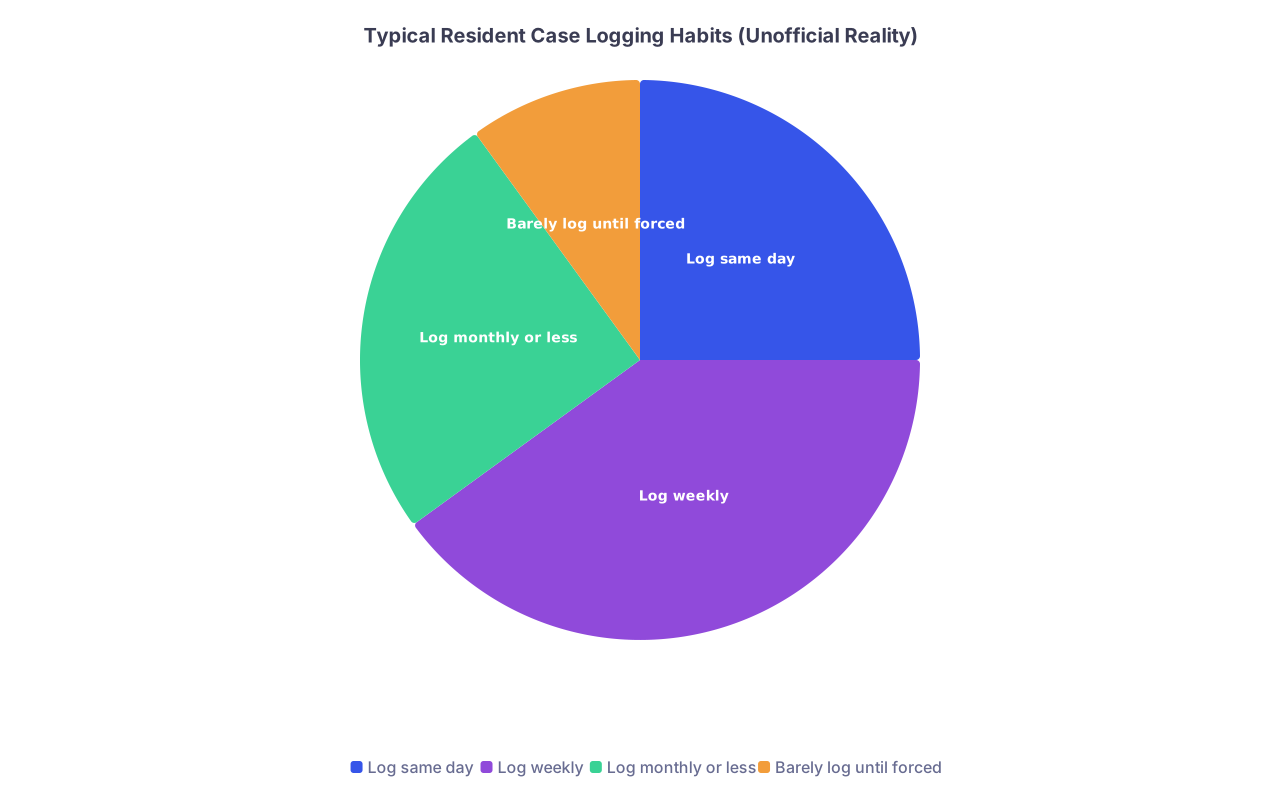
| Category | Value |
|---|---|
| Log same day | 25 |
| Log weekly | 40 |
| Log monthly or less | 25 |
| Barely log until forced | 10 |
If you’re in that bottom 35%, CCC will almost always raise the “documentation” question for you, fairly or not. Some PDs now explicitly track logging frequency as part of professionalism.
Low volume + sporadic logging = “We cannot trust this data.” That’s a bad combination.
When Case Volume Flags But You Feel Competent
This is a scenario I see often: you’re actually pretty good in the OR, your attendings generally like you, but your case numbers—especially in some subspecialty—are thin. You feel fine, but the spreadsheet says otherwise.
In CCC, that looks like this:
- “He’s technically fine, but he just hasn’t seen enough of X.”
- “Her numbers in vascular are low; she rotated during a weirdly slow month.”
- “He wants to do colorectal, but his colectomy exposure is lighter than his peers.”
Then the question they ask is not “Is this resident safe?” but “Have we fulfilled our obligation to train them broadly and adequately?”
Program directors worry about the appearance of undertraining almost as much as the reality. The ACGME does not audit your subjective competence; they look at case volumes and milestones. So PDs push your rotations around to patch the numbers.
You might end up:
- Pulled for an extra block in a particular subspecialty.
- Shifted from a clinic-heavy elective to a high-volume OR service.
- Given explicit direction: “You need X more of these cases, so whenever they’re on the board, you’re in that room.”
To you, it feels random or punitive. From their side, they’re triaging to make your case log look defensible.
Subspecialty Trajectories: How Future Plans Influence CCC Talk
Here’s a nuance no one explains to you: what you say you want to be will color how they interpret your case volume.
If you want to be a community general surgeon and your appy/chole/hernia numbers are solid but you’re light on transplant or complex HPB? CCC might shrug. “Not ideal, but okay.”
If you’re applying for complex surgical oncology fellowship and your onc cases are mediocre, CCC will feel the pressure. Faculty who have written you letters suddenly get protective of their reputation.
I’ve heard lines like:
- “If we’re sending her to a top onc program, we can’t have these numbers on her transcript.”
- “He wants vascular but he barely meets the vascular minimums—this doesn’t look good for our program.”
So for borderline volumes, your stated path matters. They’ll prioritize filling holes that line up (or conflict) with your declared goals.
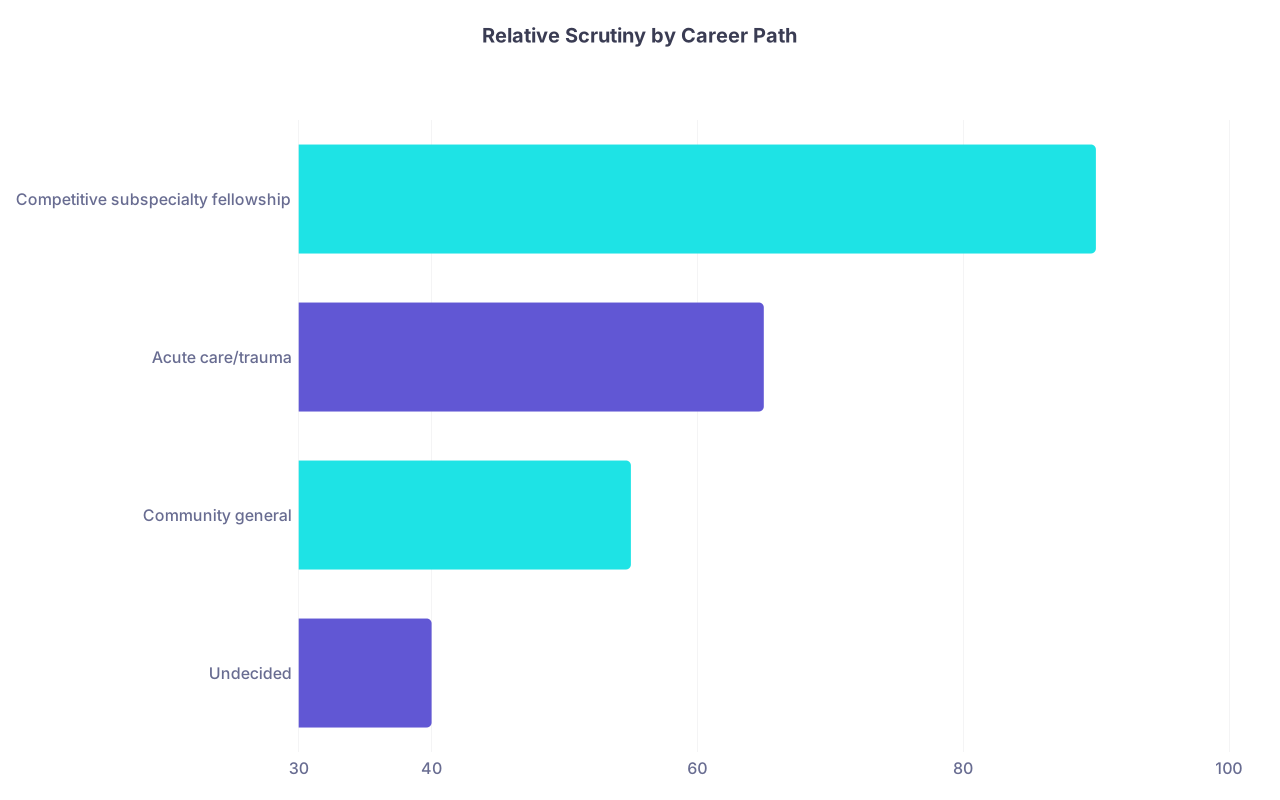
| Category | Value |
|---|---|
| Undecided | 40 |
| Community general | 55 |
| Acute care/trauma | 65 |
| Competitive subspecialty fellowship | 90 |
The more competitive or specialized your target field, the more heat your case log draws.
The Things Faculty Say About You When You’re Not in the Room
You probably wonder how harsh these meetings get. I’ll be honest: tone depends heavily on culture. But here’s the kind of language I’ve heard when case volume is low.
Supportive versions:
- “He’s a slow starter but has really grown this year. We just need to get him more reps.”
- “She got screwed by the schedule; let’s make sure she gets priority on this next block.”
- “He’s always willing to help—maybe too much. We should make sure he’s in the OR and not trapped on the floor.”
Less flattering ones:
- “I never see him fight for the room.”
- “She’s very nice, but this is surgery. You can’t just be nice; you have to take the knife.”
- “He’s invisible when there are cases. That’s not a logging issue; that’s a motivation issue.”
- “We’re at the point where we’re asking whether we’d want our own family operated on by this resident.”
When they start asking that last question, everything—your numbers, your evaluations, your professionalism—gets reinterpreted through a risk lens.
How To Keep Case Volume From Becoming Your CCC Problem
You wanted behind-the-scenes. Here’s the blunt backstage checklist that actually changes how those conversations go.
1. Do Not Let Anyone Be Surprised
If you know your volume is low for some reason—medical leave, pregnancy, family crisis, a truly dead rotation—tell your PD early and explicitly. Documents help.
A PD walking into CCC saying, “Remember, she was out for 6 weeks with X” is very different from them discovering your low numbers cold.
2. Treat Case Logging Like an Operative Skill
Update at least weekly. Daily is better.
If you walk into a meeting and your PD pulls your log and it’s clearly months behind, you’ve just made them look foolish in front of their colleagues. They will not forget that.
3. Be Visibly Hungry for the OR
You don’t need to be obnoxious. But you do need to be present.
The resident who is constantly near the board, knows the case list, and offers to help set up? That’s the one faculty remember when CCC asks, “Are low numbers a motivation issue?”
A Quick Visual: When Case Volume Alone Is Enough To Trigger Trouble
Here’s the approximate (unofficial but very real) mental thresholds many program leaders have.
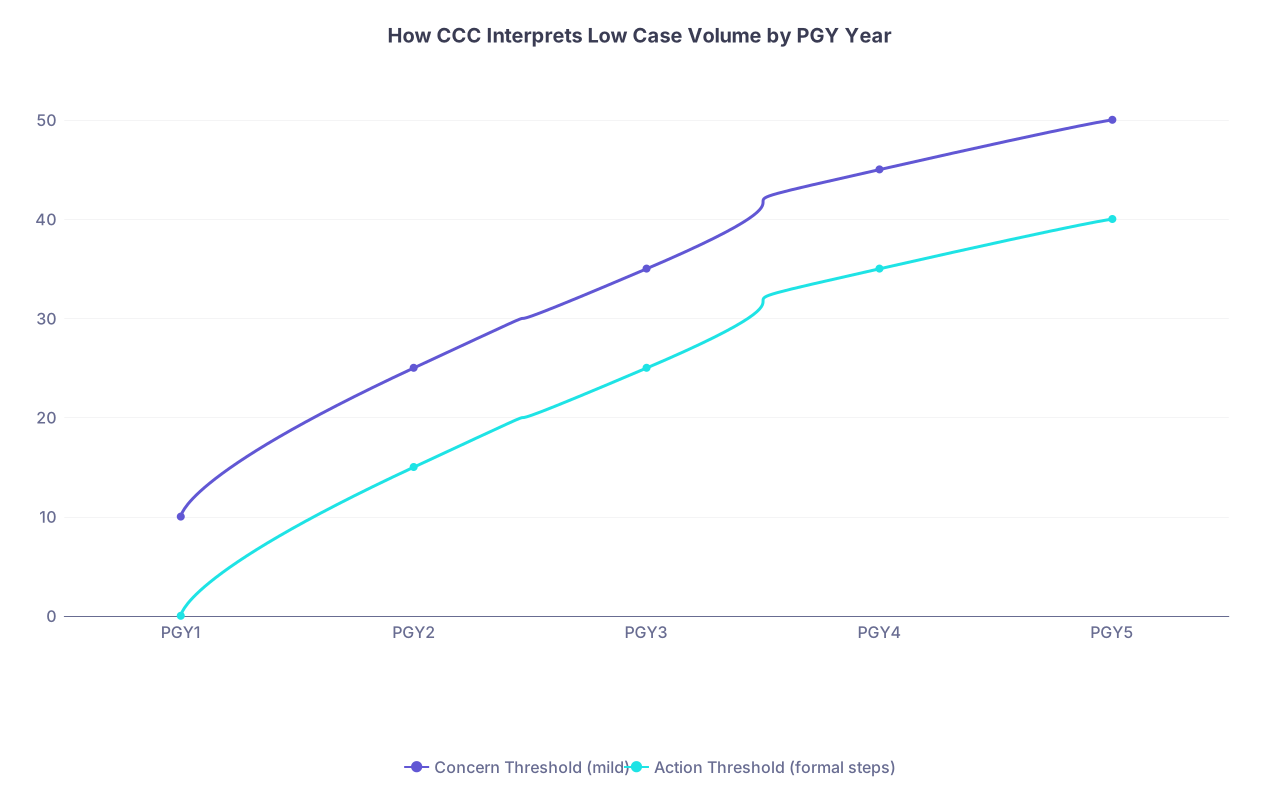
| Category | Concern Threshold (mild) | Action Threshold (formal steps) |
|---|---|---|
| PGY1 | 10 | 0 |
| PGY2 | 25 | 15 |
| PGY3 | 35 | 25 |
| PGY4 | 45 | 35 |
| PGY5 | 50 | 40 |
Interpretation:
- PGY1: No one panics over volume yet. Access issues and orientation matters.
- PGY2–3: Low volume starts to raise eyebrows; repeated patterns trigger “what’s going on?” discussions.
- PGY4–5: This is where “action thresholds” live. If you’re behind here, they start talking formal interventions, extensions, or whether they can sign off on you as ready for independent practice.
The numbers above aren’t literal case counts—they represent how many CCC members start shifting from “concerned” to “we need to act.”
The Future: How This Is Getting Tighter, Not Looser
If you think all of this sounds rigid now, wait.
The direction of travel is clear: more data, more dashboards, more external pressure. A few forces driving it:
- ACGME and RRC increasingly use objective metrics to judge programs.
- Board pass rates and case volumes are being correlated more explicitly.
- Hospitals and GME offices are more risk-aware and more documentation-hungry than a decade ago.
Programs are building increasingly sophisticated tracking tools. Some now have real-time alerts when a resident falls below expected trajectory for certain case categories. Meaning your low volume might be flagged months before CCC officially meets.
Future CCC meetings will have more charts, more threshold language, and less “gut feeling.” The era of “We think they’re fine” without hard numbers is dying.

What You Should Take From All This
You might be thinking, “So they’re watching everything and I’m basically a row on a spreadsheet.” Not exactly. But you are absolutely a combination of:
- The story faculty tell about you
- The numbers backing up (or undercutting) that story
- The program’s fear of external scrutiny
Here’s the core truth: low case volume is rarely the whole problem—but it’s often the opening argument. It gives CCC a clean, numerical way to say, “There’s something off here.” How harsh that “something” becomes depends heavily on the narrative they’ve built around you.
You cannot control census or block schedules. You can absolutely control:
- How reliably and accurately you log
- How visibly you show up for the OR
- How early you surface real life events that impact your volume
- Whether your PD walks into CCC ready to defend you or already annoyed at you
Those are not small things. Inside that closed room, they’re everything.