The way most surgeons talk about “case volume” is lazy and imprecise. For complex GI and bread‑and‑butter general surgery, that laziness directly affects training quality and patient outcomes.
Let me be blunt: counting “cases per year” without defining complexity, role, and context is meaningless. A resident who “did 900 cases” with 60% as second assist and 30% as port‑holder has a very different skill set from someone with 550 cases, 70% as primary surgeon on well‑selected bread‑and‑butter and a solid set of high‑complexity GI cases.
You asked specifically about case volume benchmarks for complex GI versus bread‑and‑butter surgery. I will break this down in a way that program directors actually use when they are honest behind closed doors.
1. First, define the playing field: what counts as “complex GI” vs “bread‑and‑butter”?
Do not argue about numbers until you agree on definitions. People skip this and end up comparing apples, oranges, and an occasional Whipple.
Bread‑and‑butter general surgery
Think of this as the core procedures you must do safely, efficiently, and mostly independently by graduation—regardless of subspecialty plans. Typical list:
- Laparoscopic cholecystectomy (uncomplicated, some acute/chronic cholecystitis)
- Laparoscopic and open appendectomy
- Inguinal, umbilical, ventral hernia repair (basic; sometimes with mesh)
- Basic skin/soft tissue: lipomas, sebaceous cysts, simple excisions
- Basic colorectal: segmental colectomies for benign disease, straightforward diverticulitis, early cancers with standard resections
- Simple small bowel resection/anastomosis (adhesions, benign obstruction)
- PEGs, basic feeding access, simple gastrostomy/jejunostomy
- Basic port placement, diagnostic laparoscopy
This is the daily revenue engine of most community general surgery practices. It is where a graduating chief will feel either comfortable or exposed.
Complex GI surgery
Now the stuff that actually keeps attendings up at night. This is what most people mean by “complex GI”:
- Major esophageal surgery:
- Ivor Lewis / McKeown esophagectomy
- Redo anti‑reflux surgery, paraesophageal hernia with Collis gastroplasty or mesh
- POEM/complex foregut endoscopic‑surgical hybrids in some centers
- Major gastric surgery:
- Total gastrectomy, D2 lymph node dissection (where applicable)
- Complex revisional bariatric (RYGB to DS conversion, sleeve complications, fistulas)
- Complex hepatopancreatobiliary (HPB):
- Whipple (pancreaticoduodenectomy) – open and minimally invasive
- Distal pancreatectomy, especially spleen‑preserving
- Major hepatectomy, anatomical liver resections, bile duct reconstructions
- Advanced colorectal / pelvic:
- Low anterior resection/TME, ELAPE, re‑operative pelvis
- Complex Crohn’s/UC with multiple prior operations
- Massive re‑operative abdomen:
- Enterocutaneous fistula takedowns
- Complex adhesiolysis with multiple small bowel resections
- Abdominal wall reconstruction with component separation for large hernias
- Complex bariatric surgery:
- Primary DS, complex RYGB revisions, band removals with reconstruction, internal hernias with reconfiguration
These are not “everyone does them” cases. A lot of community surgeons will see a handful a year, if that. They are high‑risk, resource‑intensive, and heavily team‑dependent.
So when I say “complex GI volume,” I mean real exposure to these types of cases as primary or co‑primary, not just scrubbed in for retractors while a senior faculty and a fellow do everything.
2. What the existing benchmarks actually say (ACGME and reality)
Let’s get the official numbers out first, then I will tell you where they fail.
ACGME sets minimum case requirements for general surgery residency. They are not excellence thresholds. They are the floor. Hit them and you are just “allowed to graduate.” Many residents comfortably exceed them; the problem is the distribution between easy and hard cases, and between observer vs primary surgeon roles.
Typical ACGME general surgery minimums (US, recent iterations; details evolve but trends are stable):
| Category | Minimum Cases (Resident) |
|---|---|
| Total Major Cases | ~850 |
| Abdominal | ~250 |
| Alimentary Tract | ~150 |
| Hernia | ~85 |
| Endoscopy (EGD + colon) | ~50–60 total |
| Basic Laparoscopy | ~50 |
Those “alimentary” and “abdominal” buckets mix bread‑and‑butter with some complex GI. You could, in theory, graduate having done many lap choles and appys and very few Whipples, LARs, or esophagectomies and still meet the minimum.
Program directors know this. Which is why informal benchmarks—what people actually whisper about when hiring or ranking fellows—are more demanding and more nuanced.
3. Bread‑and‑butter surgery: realistic volume benchmarks
Let me break down what a solidly trained graduating general surgery resident should have under their belt by the end of PGY‑5, if the program is functioning well and you are not constantly sidelined.
These are not ACGME minimums. These are practical benchmarks that align with what strong academic and balanced community programs tend to produce.
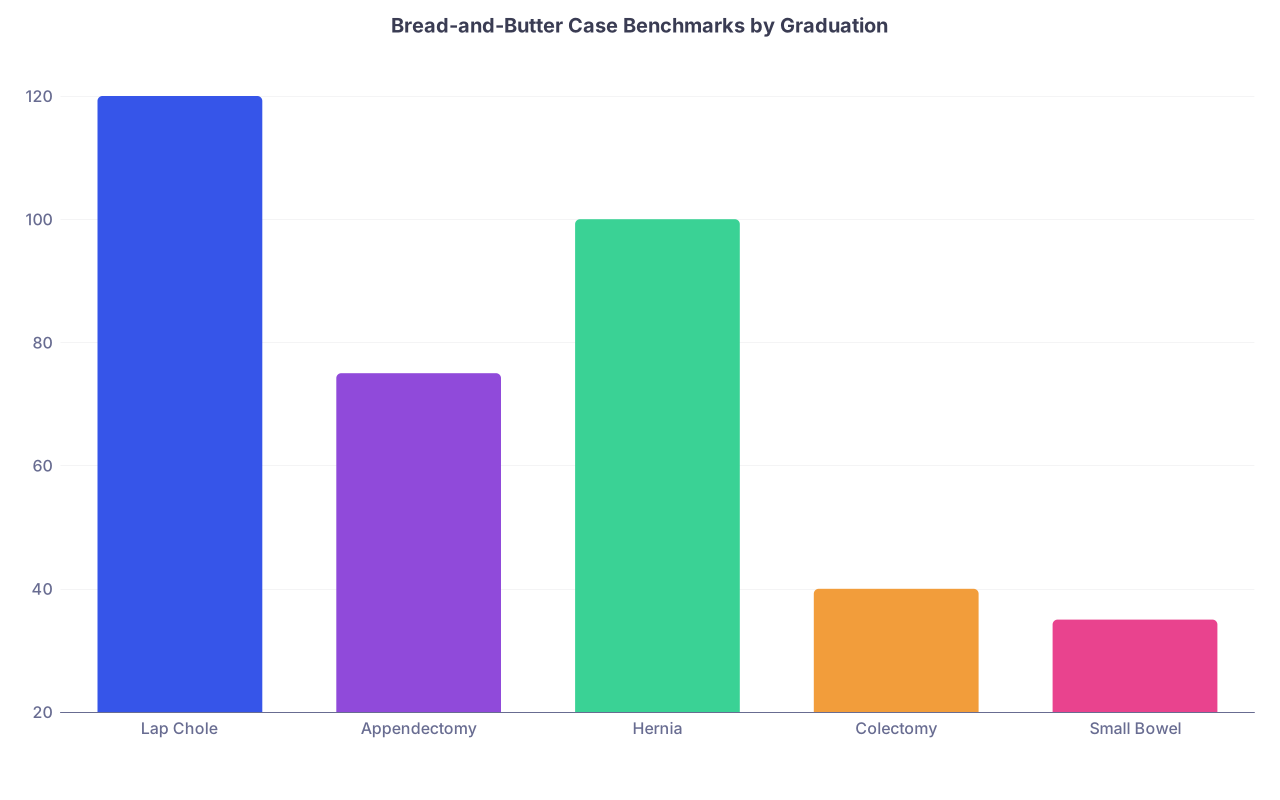
| Category | Value |
|---|---|
| Lap Chole | 120 |
| Appendectomy | 75 |
| Hernia | 100 |
| Colectomy | 40 |
| Small Bowel | 35 |
Laparoscopic cholecystectomy
Target by end of residency:
- 100–150 total lap choles
- 70–80% as primary surgeon by PGY‑4/5
- Mix of elective and acute cholecystitis
Residents who finish with fewer than ~70–80 lap choles as primary surgeon are underexposed. You do not need 300 choles to be good. You do need enough to see variation:
- Acute vs chronic inflammation
- Short cystic duct, tight triangles
- Obesity
- Mild to moderate adhesions / inflammation
Appendectomy
A decent benchmark:
- 60–80 total appys (lap + open)
- Majority as primary surgeon by PGY‑3 onward
If you are at 25 appendectomies as a chief, something is wrong with rotation structure or case allocation. Appendectomy is where juniors should be allowed to own most of the operation early, then teach as seniors.
Hernia repairs
This bucket is underrated. It covers a huge range: simple open inguinals to large complex ventral hernias.
Numbers that make sense:
- 80–120 hernia repairs total
- 30–40 inguinal (lap + open)
- 30–40 umbilical/ventral
- 10–20 more complex ventral/abdominal wall (as resident, not necessarily the lead on Rives‑Stoppa from day one)
You want to graduate having done enough to understand:
- Mesh choices and placement planes
- Basic component separation concepts
- What NOT to tackle alone as a fresh graduate
Basic colorectal and small bowel
Realistic benchmark for a non‑colorectal‑tracked resident:
- 30–50 segmental colectomies (lap/open), mixed benign and malignant
- 25–40 small bowel resections with anastomosis
Again, the number matters less than:
- Percentage done as primary surgeon
- Exposure to complications and reoperations
- Learning sound judgment: when not to anastomose, when to divert
Skin/soft tissue and minor cases
You will have dozens to hundreds. These rarely limit anyone. If you are short here, that is the least of your problems.
4. Complex GI: what meaningful exposure looks like (residency vs fellowship)
This is where people fool themselves. “I saw Whipples” is not the same as “I can do a Whipple.” For complex GI, I separate three levels:
- Observation / secondary assist (you scrubbed, held retractors, maybe did a bit of dissection)
- Substantial operative role / co‑primary (you perform major parts under close supervision)
- Near‑independent primary (fellowship level for most complex GI)
During general surgery residency, most people will live in categories 1 and 2. Fellowship is where category 3 should occur.
Complex GI case volume in residency: realistic, not fantasy
Let’s talk raw numbers seen in solid programs (high‑volume academic, mixed HPB/foregut/colorectal).
By graduation, a resident interested in complex GI who actively seeks these cases might have:
- 10–20 Whipples scrubbed
- 3–7 with substantial operative role (some vascular dissection, some reconstruction)
- 10–20 major hepatectomies observed/scrubbed
- 3–5 where they handle significant portions (parenchymal transection, inflow/outflow control)
- 15–30 low anterior resections / TME cases
- 10–15 where they do a major portion of the dissection and anastomosis
- 10–20 complex paraesophageal hernias / complex foregut
- 8–12 as co‑primary (hiatal dissection, crural closure, fundoplication)
- 10–20 complex re-operative abdomens, fistulas, or major abdominal wall reconstructions as part of the team
If you are at a community‑heavy program with low esophageal and HPB volume, you might instead see:
- 0–5 Whipples (often visiting or transferred)
- 0–5 major liver resections
- 5–10 LAR/TME
- More emphasis on complex diverticulitis, re‑operative hernias, and bariatric revisions if they exist
The honest statement is: residency alone does not make you independently qualified for most high‑risk complex GI, unless you are at an outlier program and have extraordinary exposure.
That is exactly why complex GI, HPB, colorectal, MIS/foregut, and bariatric fellowships exist.
Complex GI fellowship: what real case numbers look like
Now the real volume starts to separate surgeons.
For a good 1‑ or 2‑year fellowship focused on complex GI (HPB / MIS‑foregut / advanced GI), you should see numbers in ranges like:
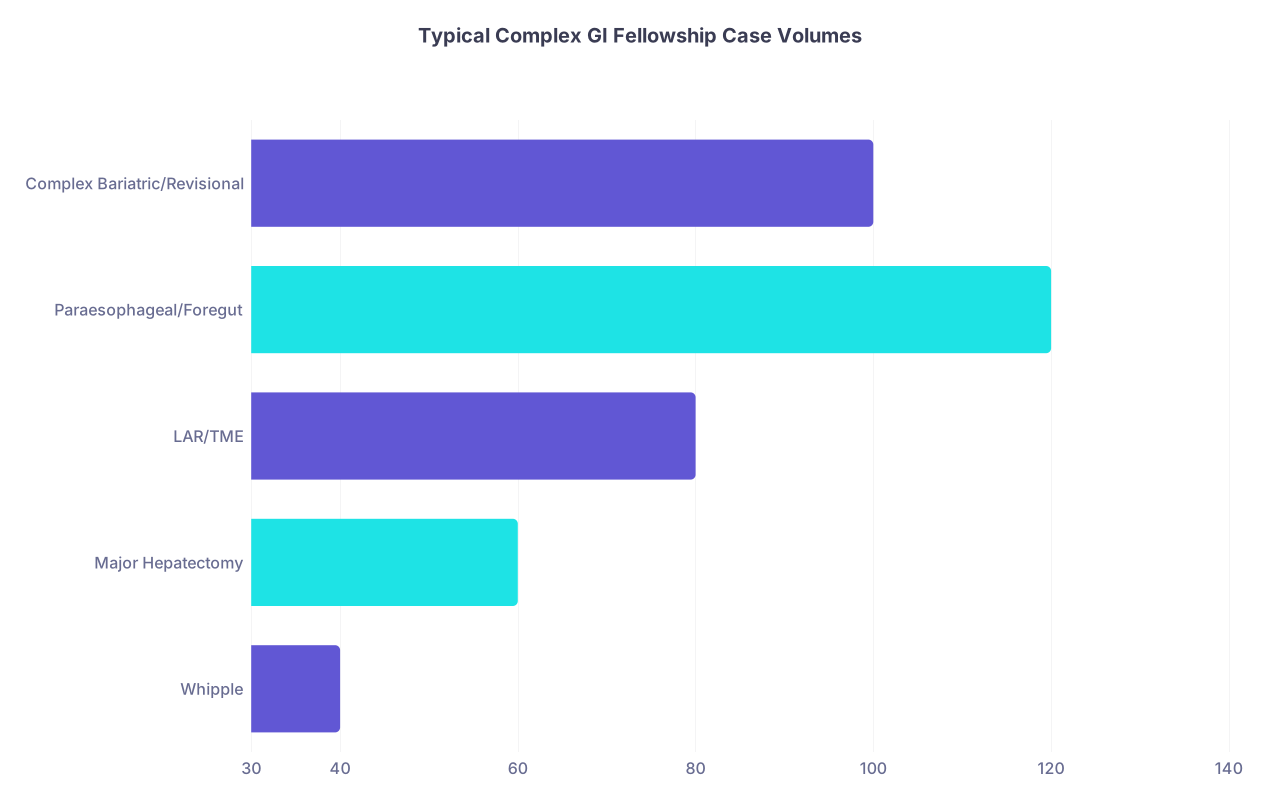
| Category | Value |
|---|---|
| Whipple | 40 |
| Major Hepatectomy | 60 |
| LAR/TME | 80 |
| Paraesophageal/Foregut | 120 |
| Complex Bariatric/Revisional | 100 |
These are approximate bands that I routinely see in programs that actually do what they claim:
- 30–60 Whipples (HPB‑focused)
- 40–80 major liver resections (HPB)
- 60–120 LAR/TME and other complex colorectal cases (colorectal fellowships)
- 100–200 complex foregut/paraesophageal/bariatric primary + revisions (MIS/foregut/bariatric fellowships)
Where should your comfort level be post‑fellowship?
- Comfortable being primary on these cases in an appropriately resourced center
- Comfortable managing the complications
If your “complex GI fellowship” logs show:
- 8 Whipples
- 12 major hepatectomies
- 20 LARs
- 30 paraesophageal hernias
…you did not train in a high‑volume complex GI setting. You trained in a program that labeled itself “advanced GI” for branding.
5. How case volume evolves: resident vs fellow vs early attending
Seeing this as a trajectory helps.

| Step | Description |
|---|---|
| Step 1 | PGY1-2 |
| Step 2 | PGY3-4 |
| Step 3 | PGY5 |
| Step 4 | Fellowship |
| Step 5 | Early Attending |
| Step 6 | Basic exposure |
| Step 7 | Growing independence |
| Step 8 | Near independent |
| Step 9 | Advanced nuance |
| Step 10 | Competent generalist |
| Step 11 | Observe big cases |
| Step 12 | Selective participation |
| Step 13 | Do key steps |
| Step 14 | High autonomy in fellowship |
| Step 15 | Complex GI surgeon |
- Bread‑and‑butter: You should be nearly independent by the end of residency. Fellowship polishes technique, efficiency, and complication management, not basic ability to do the operation.
- Complex GI: You progress from observer to partial operator in residency, then become primary during fellowship.
Anyone claiming to be “comfortable doing Whipples” right out of a standard general surgery residency (without a heavy HPB/fellowship‑like experience) is either unusually gifted, at an extreme high‑volume center, or not fully aware of what they do not know.
6. Case volume vs outcomes: it is not linear, but thresholds matter
There is a lot of literature on volume‑outcome relationships, especially for HPB and esophageal surgery. You have seen the gist—higher institutional volume correlates with better outcomes. But the individual surgeon volume matters too.
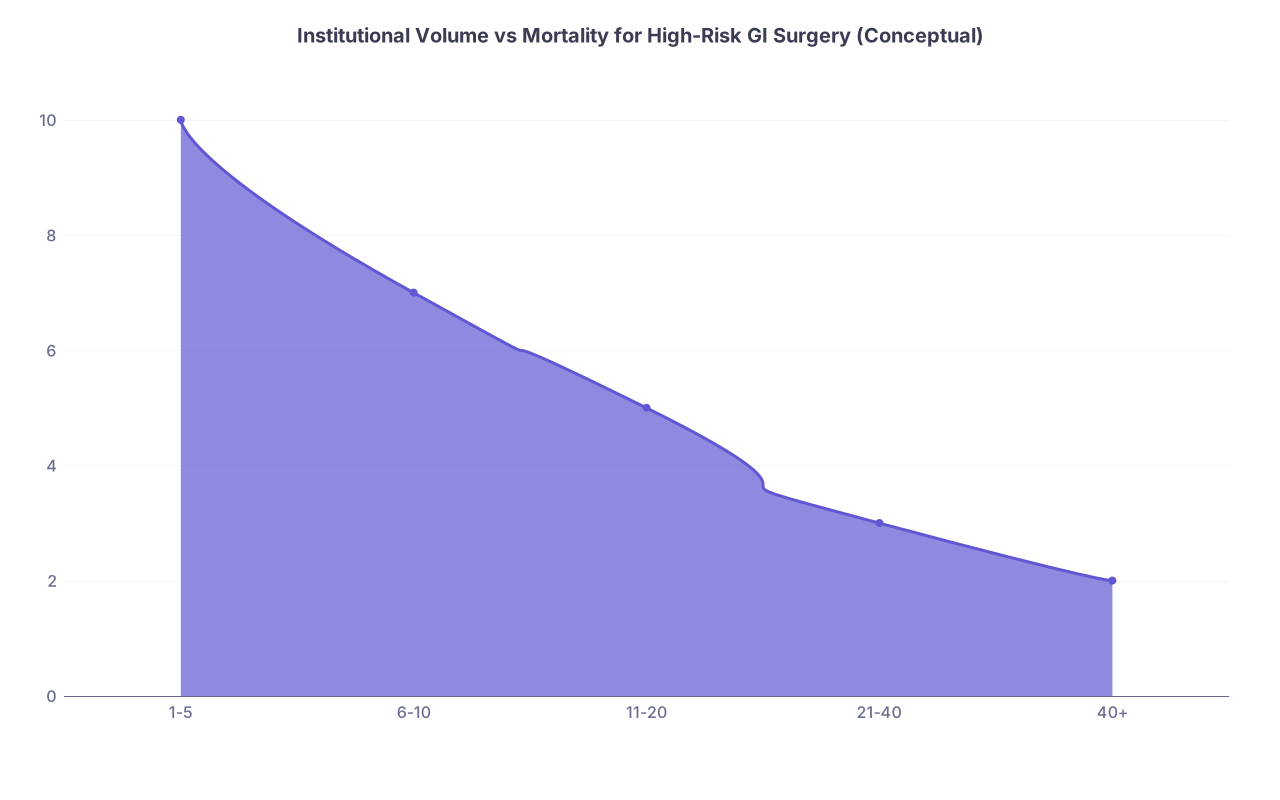
| Category | Value |
|---|---|
| 1-5 | 10 |
| 6-10 | 7 |
| 11-20 | 5 |
| 21-40 | 3 |
| 40+ | 2 |
(Conceptual numbers; different studies show different exact slopes, but the pattern holds: as annual case volume increases, mortality drops, especially in the 0–20 case range.)
What matters:
- For Whipple, once you get above ~20–25 cases per surgeon per year, outcomes typically improve.
- For esophagectomy, similar patterns: meaningful volume is not 3 per year. It is double digits.
- For major hepatectomy and complex liver surgery, again, specialized centers with higher case volume do better.
This is why:
- A surgeon who did 40 Whipples in fellowship but now does 3 per year in a low‑resource hospital is in a dangerous position.
- Conversely, a surgeon who accumulates 30–40 Whipples as a fellow and then ~20 per year in a high‑performance center will maintain and refine skills.
For bread‑and‑butter surgery, the volume‑outcome curve is flatter. Once you get past basic learning curves (typically 20–40 cases for lap chole, appy, etc.), large additional volume helps less dramatically—but it still sharpens efficiency and complication management.
7. Pitfalls in using case logs and benchmarks
The raw number of cases can lie to you. Here are the serious distortions I see repeatedly.
1. Role inflation
Residents marking “primary surgeon” on cases where they:
- Only stapled the bowel
- Closed the skin
- Did one part of a four‑hour operation while the attending and fellow did the rest
Most PDs know this happens. When fellowship directors read case logs, they glance at numbers but rely heavily on:
- Letters
- Known institutional culture
- Direct feedback from faculty
2. Complexity creep
Not every “lap chole” is equivalent. Not every “colectomy” is equal.
Four easy, straightforward sigmoid resections ≠ one obese, re‑operative pelvis LAR after pelvic radiation. Yet the log counts 4 vs 1. The harder case teaches more per unit time—assuming the resident is allowed to do a meaningful part.
3. Fellowship dilution
In services with multiple fellows and residents, cases get spread thin. A high‑volume HPB service with:
- 2 fellows
- 3 residents
- Several rotating students
…can paradoxically leave each trainee with less autonomy. I have seen residents graduate from famous “big HPB centers” with impressive exposure on paper but limited true independence, because the fellow always drove the case.
4. Logging bias: chasing numbers
Residents near graduation look at their log, panic about low hernia or colectomy counts, and then:
- Fight for every simple case, even when it undermines equity for juniors
- Focus on pushing minor volume instead of higher‑value complex experience
The better approach is calibrated:
- Ensure you hit robust bread‑and‑butter targets early
- Then aggressively seek complexity and depth later, especially if aiming for complex GI fellowship
8. Practical benchmarks: what you should aim for in training
Let us be specific. If you are a resident interested in being a strong generalist with some comfort around more advanced GI, here is a reasonable target mix by the end of PGY‑5:
| Category | Case Range (Total) | Comments |
|---|---|---|
| Total Major Cases | 900–1100 | Quality + role matter |
| Lap Chole (primary) | 100–150 | Core bread-and-butter |
| Appendectomy (primary) | 60–80 | Mostly by PGY3 |
| Hernia (all types) | 90–120 | Including 10–20 complex ventral |
| Colectomy (segmental) | 30–50 | At least half as primary/co-primary |
| Small Bowel Resection/Anastom. | 25–40 | Primary involvement in anastomoses |
| LAR/TME, pelvic resections | 15–30 | Co-primary in a substantial subset |
| Major HPB (Whipple/hepatectomy) | 5–15 with role | Observation beyond that is fine |
| Complex Foregut/Paraesophageal | 10–20 | Co-primary on hiatal work |
Then, if you commit to complex GI fellowship, add something like:
- HPB fellowship:
- 40–60 Whipples
- 50–80 major hepatectomies
- Rich experience in biliary reconstructions, metastasectomy, etc.
- MIS/foregut:
- 80–150 complex foregut cases (paraesophageal, revisional anti‑reflux, giant hiatal)
- 100–200 bariatric primary and revisional
- Colorectal:
- 100+ LAR/TME/rectal cancer resections
- Robust inflammatory bowel disease and re‑operative pelvic work
That combination—solid bread‑and‑butter residency foundation + truly high‑volume, high‑autonomy fellowship—is what actually produces surgeons who can safely handle complex GI.
9. The future: data‑driven and personalized volume benchmarks
Right now, case numbers are crude. The future is less hand‑waving and more analytics.
I expect three shifts:
1. Procedure‑level competency metrics
Not just “50 lap choles.” Instead:
- Time to critical view consistently achieved
- Complication rates (bile duct injury, conversion to open)
- Attending‑rated autonomy level
We are already seeing structured assessment tools like O‑SCORE and TRUST scores; they are poorly integrated but the direction is clear.
2. Institution‑surgeon‑specific benchmarking
Every major hospital tracks outcomes. Most do not yet tie them transparently back to:
- Individual surgeon volume per year
- Case complexity
- Risk‑adjusted outcomes
But it is coming. You will see dashboards where:
- Surgeon A does 25 Whipples/year, 2% 90‑day mortality in a high‑risk cohort
- Surgeon B does 4/year, 10% mortality
When that data is no longer siloed, the argument “I can do complex GI in any hospital because I did a few in fellowship” will not stand.
3. Dynamic training pathways
Instead of a fixed “5 years for everyone,” I suspect we will see:

| Step | Description |
|---|---|
| Step 1 | Residency Start |
| Step 2 | Core Bread and Butter Milestones |
| Step 3 | Advanced GI Focus Track |
| Step 4 | Extended Core Training |
| Step 5 | Targeted Complex GI Fellowship |
Residents who reach bread‑and‑butter benchmarks early and demonstrate aptitude can move sooner into focused complex GI exposure. Those who lag will get extended core rotations before they are allowed near major resections.
This is where competency‑based medical education is theoretically heading, if we can get past the paperwork and politics.
10. How to actually use these benchmarks if you are in training now
One last, practical section. You are not designing the system; you are operating inside it.
Here is how you should think:
Track your bread‑and‑butter volumes early.
By the end of PGY‑3, you should already be on pace for:- ~50–70 lap choles
- ~40–50 appendectomies
- ~40–50 hernias
Fix deficits aggressively.
If your appy numbers are low, you do not wait until PGY‑5 and then scramble. You talk to your PD, adjust rotations, seek community hospital time where the caseload is more “classic” general surgery.Treat complex GI exposure as layered, not binary.
You want to:- Observe enough early to understand flow and indications
- Later, deliberately seek portions of the operation (arterial dissection in a Whipple, pelvic dissection in an LAR)
- Use that exposure to decide realistically if complex GI fellowship is right for you
Call out nonsense branding.
If a “complex GI” or “HPB” fellowship cannot show you logs in the ranges I mentioned, you should be skeptical. Names do not rescue low volume.Remember that independence is context‑dependent.
Being “independent” in a high‑volume tertiary center with a strong ICU and interventional radiology is different from being alone at 2 a.m. in a critical access hospital with no endoscopy backup. Volume benchmarks tell you what you can technically do, not always what you should.
3 key takeaways
Bread‑and‑butter competence is non‑negotiable by the end of residency: think 100+ lap choles, 60–80 appys, 90–120 hernias, and a solid set of colectomies and small bowel resections as primary surgeon.
Complex GI independence almost always requires high‑volume fellowship: dozens of Whipples, major hepatectomies, LAR/TME, or complex foregut cases per year, not the handful‑level exposure that many residents quietly accept.
Raw case numbers are necessary but not sufficient; role, complexity, and institutional context determine whether your “volume” actually translates into safe, reproducible complex GI surgery—or just a padded logbook.