
Only 27% of graduating residents who “log” over 150 robotic cases are trusted by attendings to perform complex cases with minimal input.
That number tells you two things. First, raw case count is a terrible proxy for autonomy. Second, the bar for real, unsupervised robotic competence is much higher than most residents (and frankly some faculty) want to admit.
Let me break this down specifically.
You want to know: “How many robotic cases before I am actually independent?” Not “I can dock the robot.” Not “I can close the port sites.” True autonomy: you can safely run a full-case console segment in a non-trivial operation, making intraoperative decisions without your attending breathing down your neck or grabbing the controls every 90 seconds.
The answer is not a single number. But there are real ranges. And there are inflection points where your learning curve jumps—if your training is structured correctly.
What “Real Autonomy” Actually Means in Robotic Surgery
Before we talk volume, we need to be very clear what you are counting toward.
Real autonomy is not:
- Docking the robot.
- Doing 10 minutes of “busywork” at the console.
- Closing a 12 mm port.
- Cutting the omentum while someone else does all the critical stuff.
Real autonomy in robotic surgery means all three of these are true, in a specific case type:
- You can complete one or more critical steps end-to-end at the console without rescue.
- The attending is supervising, not constantly intervening or redirecting basic maneuvers.
- If something goes wrong (bleeding, poor exposure, target anatomy not as expected), you can propose and execute a reasonable plan without freezing.
For an index operation—say, robotic prostatectomy, low anterior resection, partial nephrectomy, sacrocolpopexy, Roux-en-Y gastric bypass—“autonomy” means you could:
- Set yourself up (port planning, patient position, robot side, energy selection).
- Execute the major dissection or reconstruction steps.
- Troubleshoot ergonomics, camera, and instrument conflicts.
- Recognize that you are in trouble early enough and either escalate (ask for help) or convert.
And no, that does not usually happen by 20 cases.
The Real Learning Curve: What the Data and Experience Say
There is a pattern that shows up in almost every robotic specialty: a three-phase volume curve.
Think of it as: Basic competence → Functional autonomy → High-level performance.
I will give you ballpark numbers for a single index procedure in a specific domain. These assume you are scrubbed, active, and console-first, not standing in the corner.
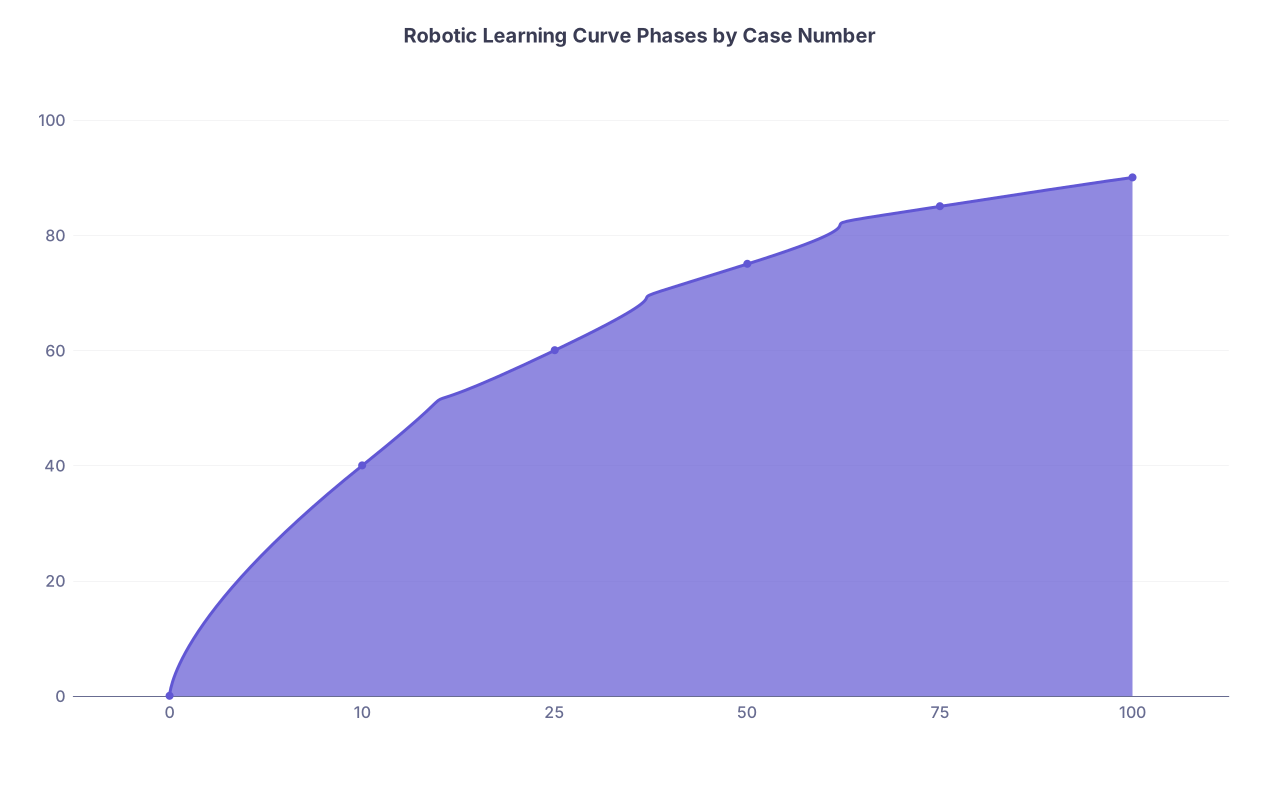
| Category | Value |
|---|---|
| 0 | 0 |
| 10 | 40 |
| 25 | 60 |
| 50 | 75 |
| 75 | 85 |
| 100 | 90 |
Interpretation: That “performance score” line is not formal, but reflects what actually happens in ORs.
Phase 1: Basic Console Competence (0–25 cases of a given index procedure)
This phase is often mistaken for “I know robotics now.” You do not. You are just starting.
By about 15–25 targeted cases in one procedure, most trainees can:
- Dock the robot with minimal assistance (but still slow).
- Maintain a steady camera and basic triangulation.
- Perform simple, non-critical dissection steps.
- Use bipolar/monopolar safely without constant “stop doing that” from the attending.
- Suture at a basic level in low-stress conditions (e.g., posterior peritoneum, omentum).
You still:
- Lose orientation easily with bleeding or heavy adiposity.
- Waste movements re-grasping and chasing tissue.
- Have poor struggle-detection: you do not recognize early when you are “off plane.”
- Need the attending to set the dissection plane, show landmarks, and fix exposure errors.
At this stage, you might get small supervised chunks of critical steps, but they are curated. You are not truly autonomous.
Phase 2: Functional Autonomy in Common Critical Steps (25–75 cases per index procedure)
This is where most residents spend too little time. Programs log “robotic experience,” but the trainee never crosses into this phase for any specific operation because their volume is spread thin across 12 different procedures.
By roughly 40–50 focused cases of the same index procedure, a motivated trainee with good instruction can usually:
- Control the camera, retraction, and working ports without coaching.
- Complete well-defined critical steps (e.g., urethrovesical anastomosis, medial-to-lateral mesocolic dissection, hiatal dissection) with minimal redirection.
- Anticipate the next move: instrument changes, energy settings, need for suction.
- Handle minor bleeding and exposure problems without panicking.
At about 60–75 focused cases, you often see:
- Shorter console times.
- Less instrument clashing.
- Cleaner movements in and out of tight spaces.
- A big drop in “attending bailout” frequency.
This is the range where “real autonomy” starts—for specific steps in a specific operation. Not for an entire service, and not for every robotic case on your schedule.
Phase 3: High-level Performance / Reliable Autonomy (75–150+ cases per index procedure)
Most residents never get here for any one operation. Some fellows do. Many attendings hit this only after several years in practice.
By 100+ cases of a single procedure, with deliberate practice:
- You are choreography-based rather than “step-list” based. The operation flows, it is not a sequence of disjointed tasks.
- Your error detection is earlier—“this feels wrong” before catastrophe.
- You adapt to variation in anatomy (obesity, prior surgery, tumor bulk) instead of falling apart.
- You can safely guide a junior through the parts you have already mastered.
This is where autonomous practice is realistic in real life: you, as a new attending, running your own robotics list without supervision.
The bottom line: true across-the-board robotic autonomy for a complex index procedure typically requires 75–100+ console cases in that procedure, not just “75 robotic cases total.”
Why Raw Case Count Misleads Everyone
Let me put something bluntly: a “Robotics Certificate” with 50 mixed cases across 8 procedure types means almost nothing about your actual independence.
I have seen seniors who logged “120+ robotic cases” who:
- Had never completed a full ureteral dissection end-to-end themselves.
- Had not done more than two full anastomoses without the attending completing half of it.
- Could not set up port placement on their own for anything beyond a cholecystectomy.
Here is why the numbers lie.
1. Mixed case logs dilute expertise
A log like:
- 10 prostatectomies
- 15 hernia repairs
- 20 cholecystectomies
- 10 bariatric cases
- 10 colorectal cases
- 5 hysterectomies
- 5 partial nephrectomies
= 75 “robotic cases”
Translates to: zero procedures where you have done enough volume to cross the 50+ threshold in a single index operation. You have breadth, not depth.
2. “Console time” is not the same as critical-step time
You can have 200 console cases where your role is:
- 5 minutes of docking.
- 10 minutes of exposure.
- Cut the omentum.
- Close the port.
That is not autonomy. That is glorified camera-holding with wristed instruments.
I care about:
- How many full anastomoses you have completed?
- How many hilar dissections you have done where you skeletonized vessels yourself?
- How many total mesorectal excisions you have carried past the problem plane?
- How many pelvic sidewall dissections you have led?
Residents rarely track this. They should.
3. Case complexity matters more than you want it to
Ten “easy” robotic cholecystectomies as your console time teach you docking and scaling, but almost nothing about operating in a narrow pelvis or deep retroperitoneum.
A single hostile abdomen or narrow male pelvis, if you are at the console for the actual problem, is worth more than ten “robotic lap choles.”
Specialty-Specific Ranges: Where Autonomy Actually Starts
Let us be concrete. These are typical volumes where I start seeing meaningful autonomy in well-trained residents or fellows, assuming:
- Good case preparation.
- Consistent console-first policy.
- Structured feedback.
These are ranges for index operations, not total robotic numbers.
| Specialty | Index Procedure | Autonomy Starts (Focused Cases) |
|---|---|---|
| Urology | Prostatectomy | 60–80 |
| Colorectal | Low anterior resection | 70–100 |
| General/Bariatric | Sleeve or RYGB | 50–75 |
| Gynecology | Hysterectomy (benign) | 40–60 |
| Gynecologic Onc | Radical hysterectomy | 70–100 |
These are not perfect. They are the ranges where attendings stop saying, “Let me just take this part,” and instead sit back with arms crossed, giving only verbal nudges while you handle real steps.
Urology – Robotic Prostatectomy
Pattern I see:
- 0–20: Docking, bladder neck, non-critical portions.
- 20–40: Posterior dissection, some of the neurovascular bundle work in easy prostates.
- 40–60: Full anastomosis consistently, often with one bailout early on.
- 60–80+: Capable of doing the whole case in favorable anatomy with minimal attending input.
Autonomy meaning: by 70 or so focused robotic prostatectomies, a fellow can usually run a standard-risk case end-to-end while the attending mainly comments on nuance.
Colorectal – Low Anterior Resection (LAR)
More demanding:
- 0–25: Medial-to-lateral dissection with guidance, some splenic flexure.
- 25–50: Pelvic dissection in non-radiated, non-obese patients.
- 50–75: Anastomosis; better pelvic work, still slower.
- 75–100+: Handling narrow pelvis, better TME quality, fewer plane violations.
Autonomy meaning: by ~80+ LARs, you can usually run a case in a standard-risk, non-radiated patient with the attending mostly monitoring and stepping in only for major judgment calls.
General / Bariatric
Sleeve gastrectomy or RYGB:
- 0–20: Docking, camera, basic stapling assistant work.
- 20–40: Full sleeve with guidance on bougie alignment and staple line.
- 40–60: Starting to troubleshoot bleeding, thick tissue, awkward anatomy.
- 60–75+: More independence, including hiatal work and revisions.
Autonomy meaning: by 50–75 focused sleeves/RYGB, most trainees can run a straightforward sleeve alone, and most of a bypass with an attending backing them.
Gynecology – Hysterectomy
For benign robotic hysterectomy:
- 0–15: Uterine manipulation, port placement, basic dissection.
- 15–30: Uterine vessel sealing, colpotomy with some guidance.
- 30–50: Handling endometriosis/adhesions with more independence.
- 40–60+: Capable of running a typical benign hysterectomy reliably.
Oncology cases take longer: radical hysterectomies, lymphadenectomies, pelvic sidewall work easily push autonomy thresholds past 70–100 cases.
Beyond Volume: 6 Factors That Actually Determine When Autonomy Starts
You can hit “100 cases” and still be unsafe if these are wrong. Conversely, a resident with “only 40–50 cases” in a single operation but all of these factors optimized can be far more autonomous than their case log suggests.
1. Case concentration vs scatter
If your 80 robotic cases are concentrated:
- 60 prostatectomies
- 20 partial nephrectomies
You are going to be legitimately strong in at least one index operation. If your 80 are scattered (10 of this, 8 of that, etc.), you are functionally early-phase in everything.
When I look at a log, I ignore the total and ask: in which 1–2 operations do you have at least 40–60 console cases where you did real steps?
2. Console priority policy
Some programs let the attending sit at the console for “difficult parts” until the resident is senior. This is backwards. It guarantees the resident will never see enough real difficulty to grow.
High-yield programs:
- Put the trainee at the console early.
- Let them struggle safely through controlled difficulty.
- Use dual console intelligently: split steps, not just “here, watch me.”
If you are doing only “easy parts,” triple the volume estimates I gave earlier.

| Step | Description |
|---|---|
| Step 1 | Robotic Case Assigned |
| Step 2 | Resident Only Simple Tasks |
| Step 3 | Resident Does Critical Steps |
| Step 4 | Slow Skill Growth |
| Step 5 | Fast Skill Growth |
| Step 6 | Functional Autonomy 50-80 Cases |
| Step 7 | Autonomy Delayed 100+ Cases |
| Step 8 | Console Priority? |
3. Quality of feedback
Silent attendings do not produce autonomous surgeons. They produce anxious, guessing ones. On the flip side, micromanaging every 5 seconds paralyzes learning.
The sweet spot:
- Specific corrections: “Your left hand is too far lateral; bring it closer and pull in line with the vessel.”
- Pattern feedback: “Each time you lose the plane, it is because you stop using countertraction.”
- Post-case debrief: 5 honest minutes about where you truly needed help.
With this, 60 cases are worth more than 120 done in a “just do it faster” environment.
4. Simulation and dry lab work
Residents chronically underuse simulators. Then complain about lack of autonomy.
If you:
- Put in 20–30 hours of deliberate simulation before and during your first 30 live cases.
- Drill suturing, needle handling, tremor control, clutching.
You shift a lot of Phase 1 learning out of the OR. Which accelerates the climb to true autonomy in Phase 2.
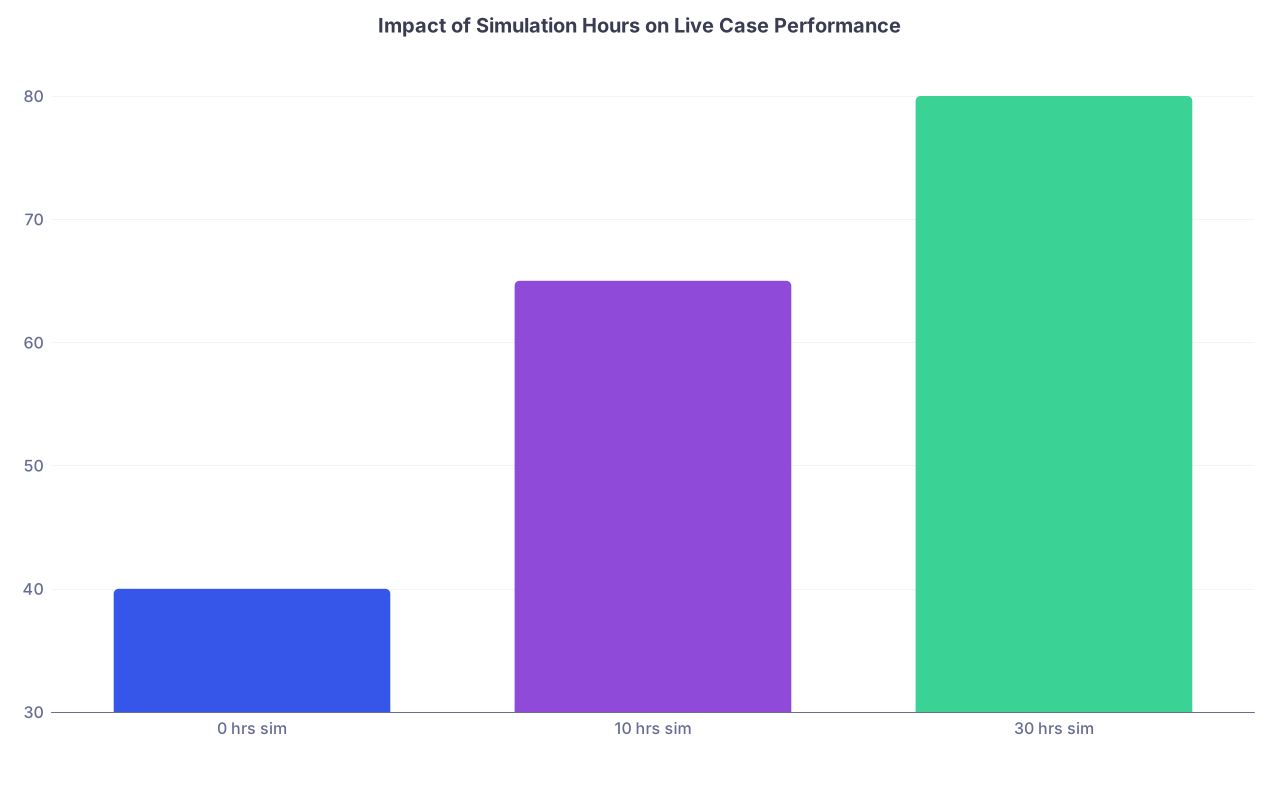
| Category | Value |
|---|---|
| 0 hrs sim | 40 |
| 10 hrs sim | 65 |
| 30 hrs sim | 80 |
(Those “performance” numbers mirror what you see: fewer errors, smoother movements, better efficiency.)
5. Case complexity trajectory
If all your early cases are “easy,” your curve flattens. If your transitions are staged:
- First 10–20 cases: low BMI, no prior surgery, benign disease.
- Next 20–40: moderate BMI, mild adhesions.
- Beyond 40–50: obesity, prior open surgery, borderline anatomy.
You keep the challenge just ahead of your skill. That is how autonomy matures.
6. Your mental model of the operation
Robotics amplifies this: people who memorize “steps” without understanding 3D anatomy and oncologic principles hit a wall.
Autonomy starts when your mind runs:
- “I need this margin because of lymphatic spread pattern.”
- “If I skeletonize this vessel, I get better mobility without devascularizing the segment.”
- “If bleeding comes from here, it is likely from this branch; suction, pressure, bipolar here.”
You get there with preop CT review, watching high-quality videos, and active mental rehearsal—not by passively being told “next, we do X” in the OR.
New Attendings: How Many Cases Before You Are Truly Safe Alone?
Different question, same disease.
Residents think “once I am an attending, I am autonomous.” Technically, yes. Practically, the real threshold for fully safe, efficient, independent robotic practice as a junior attending is higher than your resident numbers.
If your fellowship gave you, say, 80–100 focused cases of an index operation as primary console:
- You are usually safe to start that same operation solo as faculty—on low-complexity patients.
- Your comfort zone will continue to grow for another 50–100 cases in practice.
If your training gave you 30–40 scattered cases:
- You will feel like a PGY3 again in your first year as an attending.
- That is how complications happen.
I am blunt with fellows: if you are finishing with fewer than 50–60 serious console cases in your intended bread-and-butter robotic operation, you should plan to ramp up slowly. Proctoring, dual-console proctors, or choosing simpler cases early is not “optional,” it is responsible.
How to Structure Your Own Autonomy Curve (As a Trainee)
If you are still in residency or fellowship, you can influence this more than you think.
- Pick 1–2 index robotic operations you want to actually master, not just “see.”
- Fight for console time in those cases. Make it explicit with your attendings.
- Track critical steps, not just case numbers: anastomoses, hilum dissections, TME planes, vault closures.
- Use simulation before and between live cases to iron out technical flaws.
- Demand real feedback. Ask: “At what step today did you feel you had to take over for safety?”
Your target: by graduation, have at least one procedure where you have:
- 50–75+ console cases.
- Completed all major steps at least several times each.
- Handled at least a couple of difficult or complicated scenarios yourself (with attending ready).
Then autonomy is not a fantasy; it is simply a volume and pattern you have already tasted.
Where AI and Automation May Change the Volume Question
You are reading this in the “Future of Medicine” context, so let us look forward a bit.
Three trends will reshape what “how many cases” means:
Advanced simulation with real-case replay:
Systems are already in prototype where your preoperative imaging feeds into a simulator, and you practice your patient’s case before stepping into the OR. If that becomes standard, the “live case” volume needed for basic autonomy could drop, but only if people actually use these tools seriously.Intraoperative guidance and guardrails:
Think augmented reality overlays, “no-fly zones,” or AI indicating you are off the safe plane. That might reduce catastrophe rates early in the curve, but it will not replace the need for judgment. Autonomy then becomes: you plus the system, not you alone vs the anatomy.Robotic task automation:
Suturing, stapling, and some standardized dissections will eventually be semi-automated. When a robot can do a perfect running anastomosis at the press of a button, your learning curve for that specific skill might shrink. But your job shifts to supervising, error recognition, and plan modification. Different skills, still volume-dependent.
So will the magic numbers drop? Maybe somewhat for basic technical safety. The deeper cognitive and judgment components of autonomy will still require repetition on real human anatomy under real OR pressure. That part does not go away.

FAQs
1. If my program only gives me 30–40 robotic cases total, is it even worth focusing on robotics?
Yes, but with realistic expectations. You will likely leave with:
- Basic console competence.
- Ability to perform limited steps under supervision.
You will not leave as an autonomous robotic surgeon in any complex index procedure. Use what you have to build fundamentals—camera work, clutching, economy of motion—then plan to extend your curve with a robotics-heavy fellowship or early-practice proctored cases.
2. Is there a minimum number of robotic cases I need before I should touch “critical steps”?
If you have done at least:
- 10–15 basic console cases (any type) with safe camera handling and energy control.
- Several hours of simulator work on suturing and dissection.
You should start taking on critical steps under close supervision in simpler cases. Waiting until you have done 40 “easy bits” before touching anything important just delays your learning curve unnecessarily.
3. How do I convince an attending to give me more console autonomy?
Be explicit and prepared. Before the case:
- Tell them which specific steps you want to perform.
- Prove you have watched high-quality videos and understand the steps.
- During the case, verbalize your plan succinctly: “Next I will open the peritoneum lateral to the vessel and develop the avascular plane we reviewed.”
- After, ask for direct feedback and what you need to do to own the next step.
Attendings are far more likely to give autonomy to trainees who show preparation and situational awareness, not just “I want more console time.”
4. Does high laparoscopic volume shorten the robotic autonomy curve?
Yes, but not as much as people claim. A strong laparoscopic background helps with:
- 3D anatomical understanding.
- Respect for traction–countertraction.
- Economy of movement.
You will still need 30–50+ robotic cases in a specific operation to become autonomous in that robotic version of the procedure. Think of laparoscopy as giving you a head start on judgment and anatomy, but you still have to learn the instrument ergonomics and vision system of robotics.
5. As a junior attending with limited robotic training, how should I start my own cases?
Conservatively and deliberately:
- Start with lower-BMI patients, minimal prior surgery, standard anatomy.
- Use proctoring or dual-console arrangements if available.
- Limit initial case lists so you are not running late into the night while still at the steeper part of the learning curve.
- Debrief each case, track your own complications ruthlessly, and adjust case selection.
You are still on your learning curve, just with more responsibility and less of a safety net. Autonomy is not binary on graduation day; it continues to grow another 50–100 cases into your attending years.
With a clear-eyed view of what “case volume” really buys you, you can stop chasing raw numbers and start designing your own learning curve.
You have the framework now—phases, realistic volumes, and the levers that accelerate or stall your progress. The next step is more personal: mapping this against your actual logbook and training environment, then building a plan to close the gap between where you are and the level of robotic autonomy you want. But that is a conversation for another day.