Most residents are “meeting case numbers” yet graduating underprepared for independent general surgery. The problem is not volume. It is which cases, at what level of autonomy, and in what distribution.
Let me break this down specifically.
Program directors proudly quote “900+ logged cases.” Boards and RRC minimums are checked off. But when you ask a PGY-5, “Walk me letter-by-letter through how you’d manage a hostile abdomen with an anastomotic leak at 2 a.m., when you are the only surgeon in-house,” the room gets quiet.
That disconnect is what “index cases” are supposed to address. And they often fail, because people treat them like a bureaucratic checklist instead of what they actually are: the bare-minimum experiential backbone of a safe, independent general surgeon.
This is not a philosophical exercise. It is about whether your future patients live or die when something goes sideways at 3 a.m.
1. What “Index Cases” Actually Are – And What People Get Wrong
An index case in general surgery is not just a CPT code. It is a procedure or clinical situation that:
- Represents a core, non-optional competency of a general surgeon
- Has direct impact on morbidity/mortality if mismanaged
- Requires intraoperative decision-making, not script-following
- Occurs commonly enough that you will see it early in independent practice
In the U.S., the ACGME/ABS “index case” concept tends to be flattened into:
- Minimum case numbers per category
- ABS list of “defined category” requirements
- Program dashboards that turn surgery into a box-checking exercise
Residents quickly learn the game: “I need another thyroid, two more laparoscopic colectomies, and I’m short on breast.” So they chase codes, not competence.
The mistake: assuming any logged lap chole equals “ready for independent lap chole,” or that “two Whipples as assistant” make you ready for a Whipple-heavy job. They do not.
Two axes are usually ignored:
- Role – observer vs assistant vs surgeon junior vs surgeon chief
- Complexity – routine straightforward case vs bailout, reoperation, complication, or hostile anatomy
You can hit 150 logged hernias and still panic the first time you have to take down a recurrent, mesh-infected groin hernia with distorted planes when you are alone.
2. The Core Index Operations That Actually Predict Readiness
Let’s be concrete. If you strip away fluff and “nice-to-have” fellow-level cases, what cases actually define whether you can practice broad-based general surgery safely?
You can think of them in three clusters:
- Bread-and-butter elective
- “Any-hospital” emergency and acute care
- Oncologic and complex abdominal
2.1 Bread-and-Butter Elective Index Cases
This is your clinic-to-OR-to-clinic life in a community practice.
- Laparoscopic cholecystectomy
- Inguinal hernia repair (open and laparoscopic)
- Ventral/incisional hernia repair (open, underlay/bridge, component separation exposure at least once)
- Simple bowel resections (small bowel, right and left colectomy)
- Basic breast surgery (lumpectomy, mastectomy, axillary sampling)
- Basic endocrine (thyroid lobectomy, total thyroidectomy)
For each of these, raw count does not mean much until you ask three questions:
- How many as primary surgeon during your chief year, with minimal attending intervention?
- How many “ugly” ones – acute cholecystitis, prior mesh, obese patients, reoperative fields?
- Have you personally managed at least 1–2 major complications end-to-end?
If all your lap choles were on healthy same-day patients at a VA with pristine anatomy and you never managed a post-op bile leak, you are not “index-competent” no matter what your case log shows.
2.2 Emergency / Acute Care “You Cannot Duck These” Index Cases
These are the cases that define whether another surgeon would trust you to be the only person in-house.
The ones that expose unprepared training brutally:
- Emergency laparotomy (perforation, ischemic bowel, obstruction)
- Complicated appendicitis (drain vs lap vs open; interval vs immediate)
- Perforated peptic ulcer (Graham patch, definitive operation understanding)
- Bowel obstruction with hostile abdomen (lysis of adhesions, resection, stoma)
- Anastomotic leak reoperation (washout, damage control, diversion)
- Necrotizing soft tissue infection (aggressive debridement, re-look operations)
- Emergency ventral hernia with strangulation
- Hollow viscus injury (blunt and penetrating; basic trauma laparotomy skill set even if you are not a trauma surgeon)
These are where “index experiences” matter even more than index procedures.
You need to have personally:
- Opened a truly hostile abdomen
- Decided “this anastomosis is unsafe; I am doing a stoma”
- Left the abdomen open on purpose and planned staged returns
- Taken a patient back for unexplained sepsis and actually found the leak or missed injury
- Debrided nec fasc with no illusions about preserving skin for cosmetics
Watching these from the corner of the room does not count. Assisting for 5 minutes of a trauma ex-lap does not count. You need your hands on the knife when decisions are made.
2.3 Oncologic and Complex Abdominal Index Cases
You can practice “general surgery” without ever doing a Whipple. You cannot practice it safely without understanding how to handle:
- Segmental colectomies with oncologic principles (vascular pedicles, margins, nodal harvest)
- Low anterior resection with TME exposure at least once
- Gastrectomy (subtotal) or sleeve gastrectomy exposure, even if you will not do bariatrics
- Hepatic wedge resection or metastasectomy exposure
- Pancreatic resection exposure (not necessarily primary surgeon, but understanding anatomy and reconstruction)
- Retroperitoneal and pelvic dissection planes
The point here is not that you must graduate being able to independently do all HPB or advanced colorectal. The point is that common, high-stakes pathologies (colon cancer, rectal cancer, gastric pathology, liver metastases) will land in your lap. You must at least know:
- What can safely be done at your hospital vs what must be referred
- How to manage their acute complications (bleeding, anastomotic leaks, SBO in previously resected cancer patients)
3. Volume: The Numbers That Actually Mean Something
Most residents ask, “How many lap choles is enough?” That is the wrong frame. But yes, numbers matter if you interpret them correctly.
Here is a realistic set of “readiness-suggestive” volumes for a graduating broad-based general surgeon (not MIS or HPB fellow), assuming the right level of autonomy.
| Case Type | Suggested Minimum as Primary Surgeon (Chief or Senior) |
|---|---|
| Laparoscopic cholecystectomy | 75–100 |
| Inguinal hernia (all approaches) | 40–60 |
| Ventral/incisional hernia | 30–40 |
| Appendectomy (open + lap) | 40–60 |
| Emerg laparotomy (all indications) | 40–50 |
| Small bowel/colon resections | 40–60 |
That chart is not “evidence-based gospel.” It is what I would personally want to see in a resident’s case log before saying: “I would let this person take my family member to the OR unsupervised for routine general surgery.”
Notice what is absent: “Whipple: 10” or “Esophagectomy: 5.”Those are fellow-level and center-specific. They do not define baseline readiness.
Now, pair volume with escalation of responsibility.
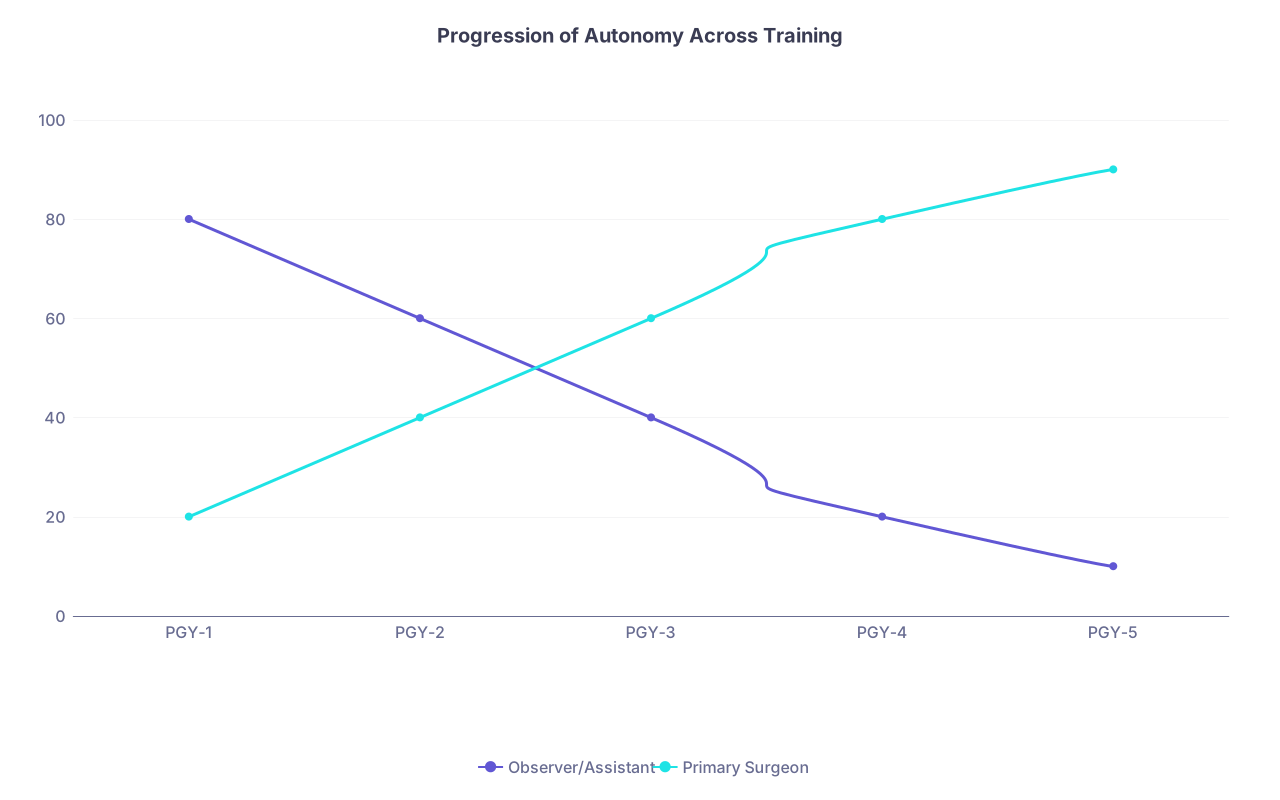
| Category | Observer/Assistant | Primary Surgeon |
|---|---|---|
| PGY-1 | 80 | 20 |
| PGY-2 | 60 | 40 |
| PGY-3 | 40 | 60 |
| PGY-4 | 20 | 80 |
| PGY-5 | 10 | 90 |
If a resident has 120 lap choles but 100 of them as “assistant” and only 20 as true primary surgeon in chief year, that is not equivalent to someone with 70 total but 50 as chief with near-full autonomy.
4. The Hidden Side of Index Cases: Context and Complexity
Numbers in isolation lie. Let me give you patterns I have seen in resident logs and what they usually mean in the OR.
Pattern 1: High Volume, Low Complexity
Common at big referral centers with subspecialty fellows.
- 120 lap choles, almost all straightforward elective
- 80 hernias, mostly outpatient inguinal and small primary umbilicals
- Few true emergencies, because trauma or ACS fellows take them
Result: Beautiful technique on clean cases. Panic when the Calot’s triangle is scarred, or the hernia sac is densely adherent, or the patient is crashing.
Pattern 2: Low Volume, High Complexity
Small community programs with heavy call and limited subspecialty support.
- 40 lap choles, but 20 of them acute cholecystitis, post-ERCP, or in sepsis
- 25 emerg laparotomies where attending is scrubbed but genuinely lets you drive
- Regular middle-of-the-night “unplanned disasters”
Result: Gritty, resourceful, but sometimes technically rough. They can bail out of trouble, but may not have seen enough elective oncologic or advanced laparoscopy.
The ideal is a hybrid: elective volume for controlled skills + real emergency experience where anatomy and physiology are unforgiving.
Complex Case Exposure That Actually Matters
Not all “complex” is equally useful for general surgery readiness.
High-yield complexity:
- Re-operative abdomens with dense adhesions
- Conversion from laparoscopy to open and managing the bailout
- Intraoperative bleeding needing real vascular control (not just suction and prayers)
- Cases with intraoperative change of plan (planned primary anastomosis → ended with stoma)
Low-yield complexity for general surgeons (valuable for niche practice, but not defining readiness):
- Multi-visceral resections for sarcoma at a major cancer center
- Combined HPB cases with vascular reconstruction that will never be done in a community setting
- Experimental or clinical trial procedures
You want just enough exposure to the latter to recognize your limitations and know when to refer, not to falsely think they define “being a real surgeon.”
5. Autonomy, Entrustment, and What Case Logs Can’t Show
Here is the dirty secret: A resident can “meet every index requirement” and still have never done a challenging case without the attending constantly intervening.
If you want to evaluate true readiness, you need to think like this:
5.1 Entrustable Professional Activities (EPAs) in Surgery
At the end of residency, you should be fully entrusted (no direct supervision required) for:
- Uncomplicated lap chole, including dealing with mild inflammation and simple variants
- All routine inguinal and small ventral hernias
- Uncomplicated appendectomy (any approach)
- Basic small bowel resection and anastomosis
- Exploration and washout for peritonitis with clear source control plan
- Initial management of necrotizing soft tissue infection
Partially entrusted (indirect supervision, attending available but not scrubbed) for:
- Emergency laparotomy for perforation/obstruction
- Management of postoperative anastomotic leak
- More complex ventral hernias and reoperative abdomens
If you would not let a chief resident take call alone at a small hospital with those as minimum EPAs, they are not ready, no matter the log.
5.2 The Autonomy Curve
If you plotted your independence across PGY years, it should not be a flat line.
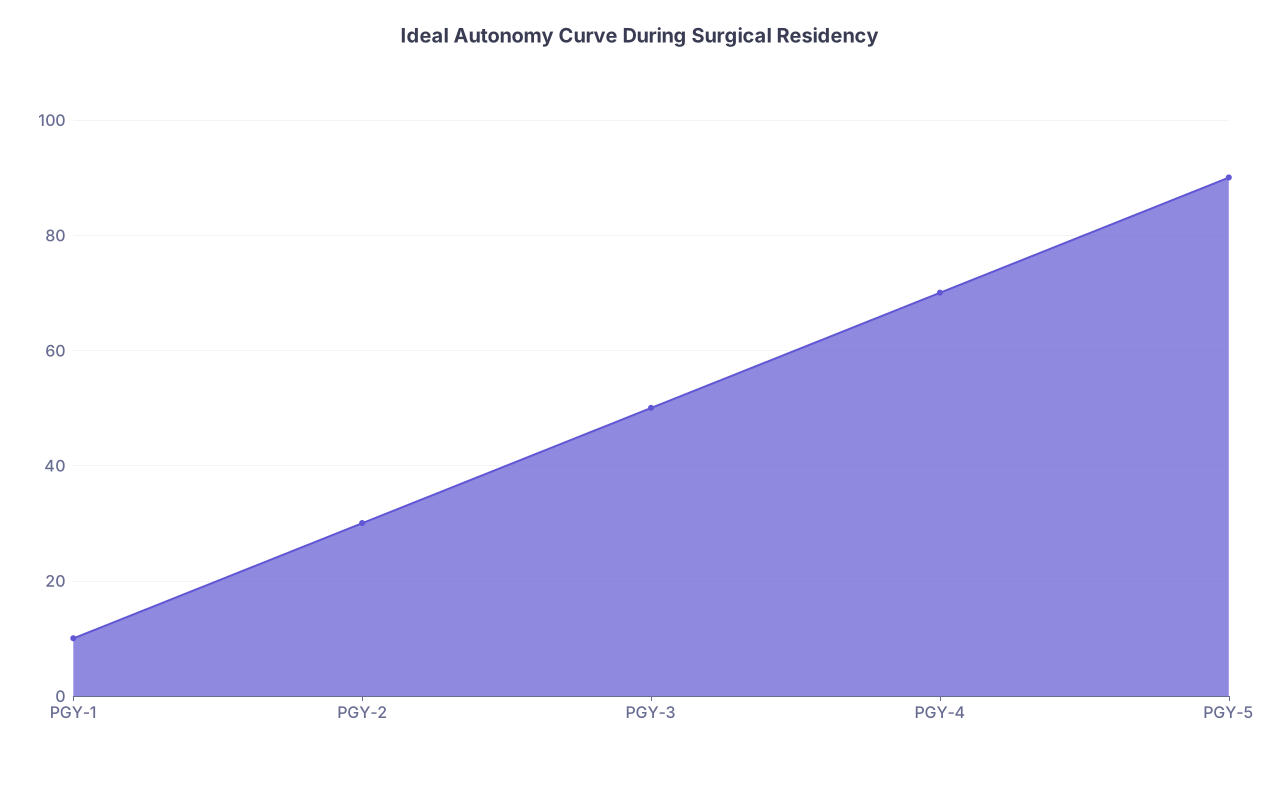
| Category | Value |
|---|---|
| PGY-1 | 10 |
| PGY-2 | 30 |
| PGY-3 | 50 |
| PGY-4 | 70 |
| PGY-5 | 90 |
If a resident is still heavily “guided” through basic cases as a PGY-5, more cases will not fix that. The index problem there is not volume, it is culture.
6. Subspecialization, Fellowships, and Distorted Case Mix
Modern reality: many academic programs are fellow-heavy. MIS, HPB, colorectal, breast, vascular, trauma. Fellows are wonderful for complex care; they are poison for resident operative autonomy if not managed aggressively.
Typical distortions:
- Fellows “own” the complex laparoscopic and cancer cases
- Residents get the bread-and-butter daytime cases and middle-of-the-night disasters
- Index numbers are met technically, but without complexity or decision-making
If you are designing or evaluating a program, you want an honest look at:
| Fellowship Type | Common Resident Loss | Resident Gain (Sometimes) |
|---|---|---|
| MIS | Advanced lap hernia, foregut | More open cases, convert/bailout |
| HPB | Complex liver, pancreas | Emergency bile duct work, drains |
| Colorectal | Low anterior resections, IBD | More small bowel, simple colectomy |
| Trauma/CC | High-level trauma laps | More minor trauma, emerg general OR |
Programs that protect resident “index complexity” do a few specific things:
- Designate certain complex cases as resident-led, even with fellows present
- Give seniors priority on re-operations and complications
- Track not just case numbers, but “primary decision-maker” status
Residents should fight for this. Quietly logging more “assistant” cases will not make up for a lack of actual autonomy.
7. The Future: Moving Beyond Crude Case Counts
The current model—“log X number of cases in Y categories”—is too primitive for what we actually care about: who can safely operate independently.
Where this is going (and should go):
7.1 Competency-Based Case Tracking
Instead of just logging “lap chole,” resident logs should track:
- Case complexity (easy / routine / complex / bailout)
- Role (observer / assistant / primary junior / primary chief)
- Autonomy level (attending scrubbed and leading, attending scrubbed but letting resident lead, attending unscrubbed)
- Complication management: did the resident participate as primary in managing related post-op complications?
Think of a lap chole matrix like this:
| Dimension | Level Expected by Graduation |
|---|---|
| Volume | 75–100 total |
| Complexity Mix | ≥20 acute or difficult anatomy cases |
| Role | ≥50 as primary surgeon (chief/senior) |
| Autonomy | ≥30 with attending unscrubbed or minimal input |
| Complication | ≥3 personally managed significant complications |
You see how ridiculous “I did 120 lap choles” sounds once you look at it this way.
7.2 Intraoperative Performance Assessment
Some programs already use structured OR assessment tools:
- Checklists for key steps
- Global rating scales (economy of motion, respect for tissue, anticipation)
- Entrustment scores per case type
Combine that with video review and you get a much sharper picture than case logs alone. A resident with 40 beautifully executed, independently graded lap choles is more ready than one with 100 passively “done” with an attending hand-over-hand.
7.3 Data-Driven Outcomes Tied Back to Training
This is the uncomfortable, inevitable future: tracking the early-career outcomes of graduates and correlating them to training patterns.
Imagine a plot of early-practice complication rates vs. case mix in residency.
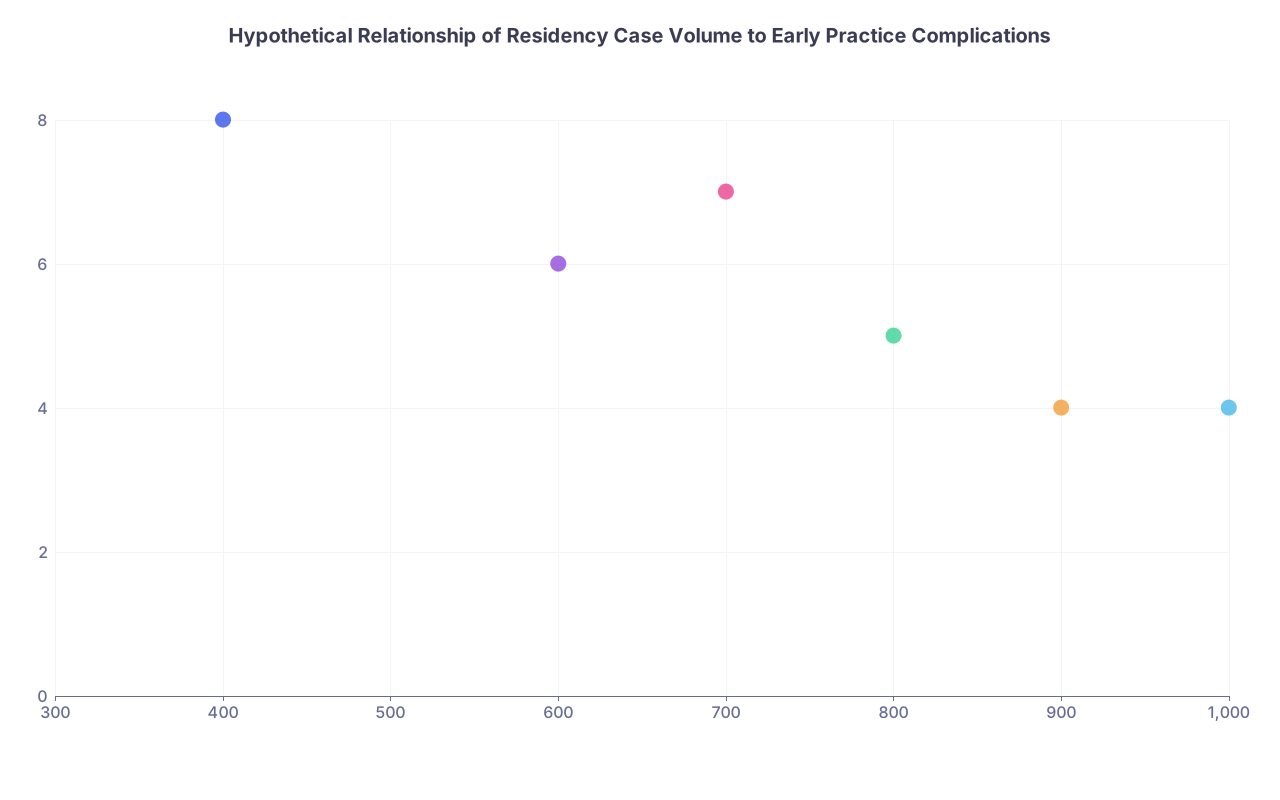
| Category | Value |
|---|---|
| Grad A | 400,8 |
| Grad B | 600,6 |
| Grad C | 800,5 |
| Grad D | 900,4 |
| Grad E | 700,7 |
| Grad F | 1000,4 |
You might see, for example:
- Below a threshold of ~700–800 total cases, complication rates rise
- Above that, there is diminishing return unless cases include sufficient complexity and autonomy
- Residents without at least ~40 emergency laparotomies or ~20 complex lap choles might have higher bile duct injury or leak rates
We are not there yet in a rigorous way. But this is where serious surgical education needs to head—linking “index case experience” to actual patient outcomes.
8. How Residents Should Think About Their Own Index Case Readiness
Let me turn this back to you, if you are a resident or early faculty evaluating trainees. Forget official minimums for a moment. Ask yourself bluntly:
For lap chole: Can I safely handle a Calot’s triangle I cannot see clearly? Do I know when to convert, when to stop, when to ask for help? Have I managed a bile duct injury or major bleed, even if only with an attending?
For hernias: Have I personally taken down prior mesh? Dealt with incarcerated bowel? Decided on mesh vs no mesh in contamination?
For emerg laparotomy: Do I have a reproducible mental algorithm for a patient with diffuse peritonitis and lactate of 5? Can I go from incision to decision—resection, diversion, open abdomen—without someone else telling me each step?
For leaks and sepsis: Have I been the one to say, “We are going back to the OR”? And then actually led that reoperation?
For oncologic resections: Do I understand the oncologic principles deeply enough that I would not compromise a cancer operation because I am in a hurry or nervous?
If the honest answer in your gut is “no” for several of these, then the real problem is not that you need “more cases” randomly. You need more specific index experiences, with real autonomy and high stakes, under supervision that allows you to stretch but not fail unprotected.
9. The Bottom Line: Which Volumes Truly Define Readiness?
Strip away all the admin language and this is what matters.
An independently safe general surgeon typically needs, at minimum:
- Total case volume in the ~800–1,000 range, but only if
- They have 70–100 lap choles with a meaningful acute/difficult subset
- 40–60 inguinal hernias and 30–40 ventral/incisional hernias with some reoperative work
- 40–60 appendectomies
- 40–60 small bowel/colon resections
- 40–50 emergency laparotomies where they actually led
- Direct end-to-end involvement in managing major complications
And underneath those numbers, the real defining features are:
- Demonstrated autonomy on index cases as a senior
- Exposure to real complexity and complications, not just “pretty” cases
- A program culture that progressively hands over the knife and expects you to think
Residents do not become ready by hitting “minimums.” They become ready by surviving and learning from a well-chosen, properly supervised sequence of index cases that stress their judgment as much as their hands.
FAQ (Exactly 5 Questions)
1. Are ACGME/ABS minimum case numbers enough to ensure I am ready for independent practice?
No. They are floor thresholds, not competence guarantees. Many residents “meet numbers” and still lack adequate autonomy or experience with complexity. You should treat them as the beginning of the readiness conversation, not the end.
2. How do I know if I have done “enough” laparoscopic cholecystectomies?
You are in the right zone if you have around 75–100 total, with at least 20–30 acute or complex cases, and at least 50 as primary surgeon with the attending mostly observing. If you have never personally managed a difficult case (severe inflammation, conversion, duct injury risk), you need more targeted experience, not just more easy cases.
3. I am at a fellow-heavy academic program. How can I protect my index case experience?
Push for resident priority on key bread-and-butter and emergency cases: lap choles, hernias, emerg laps, appendectomies. Ask faculty to clearly designate certain cases as “chief cases” where fellows step back. Aim for you, not the fellow, to lead reoperations and complication cases that match general surgery practice.
4. Does doing complex HPB, bariatric, or esophageal cases in residency make me a better general surgeon?
It can, if you gain real anatomic understanding and decision-making experience. But those cases do not substitute for bread-and-butter and emergency index work. A resident who has done 10 Whipples but only 10 emergency laparotomies is less ready for general practice than the reverse.
5. If I feel underprepared in a key index area by PGY-5, should I do a fellowship to compensate?
A fellowship can help, but it does not fix gaps in basic general surgery competence. First, aggressively seek targeted index experiences in your senior year (extra ACS rotations, community rotations, more call). Use fellowship to refine and focus, not to patch fundamental deficiencies in lap chole, hernias, emerg laparotomy, and basic bowel surgery.
Key points:
- Case volume alone is a blunt instrument; which cases you do, at what autonomy and complexity, is what truly defines readiness.
- A safe general surgeon needs solid numbers and real independence in bread-and-butter elective, emergency/acute care, and basic oncologic index cases.
- The future of surgical training must move from crude counts to competency-based, autonomy-aware tracking that ties index experiences to actual patient outcomes.