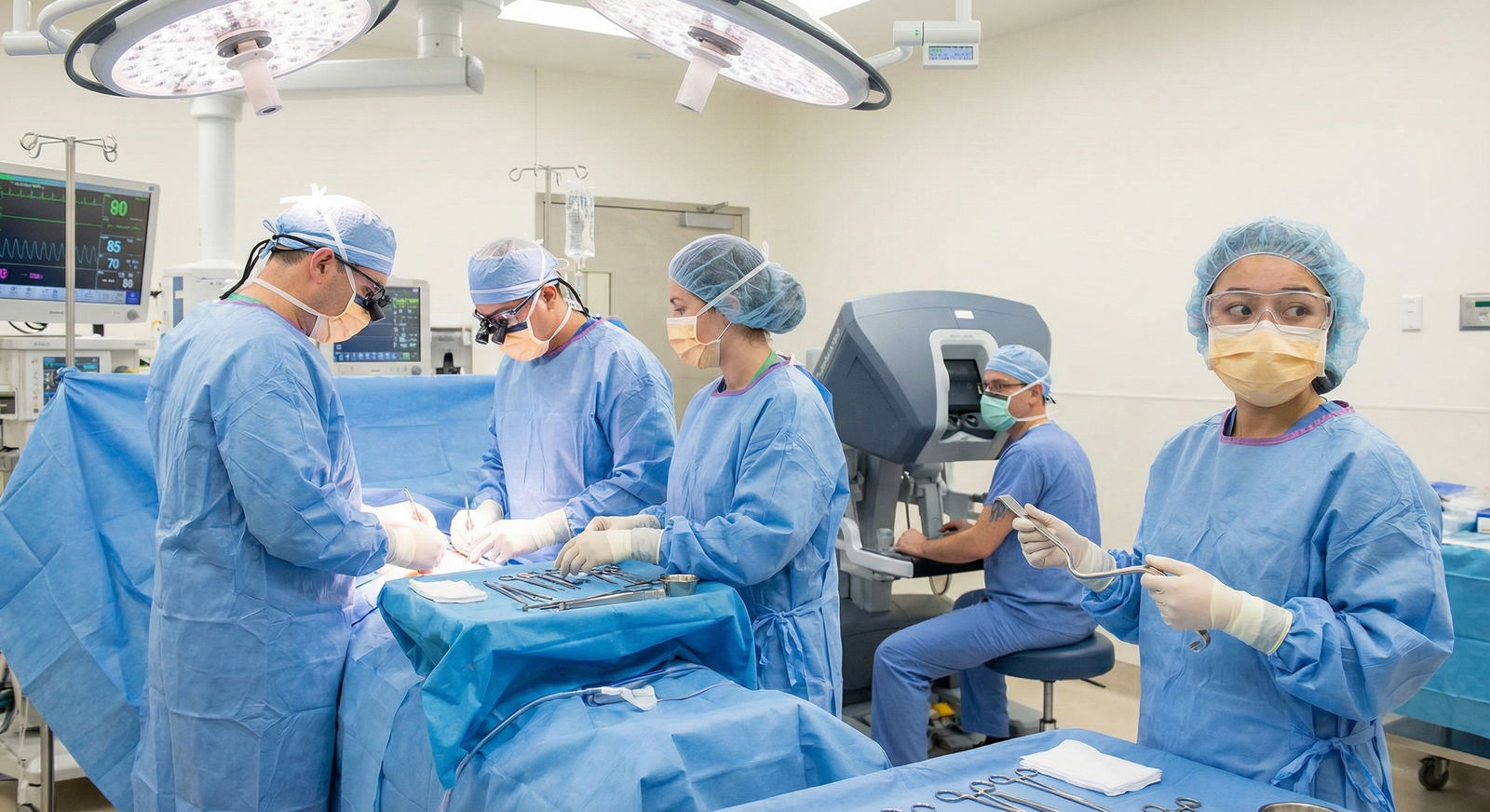
The myth that “any board‑eligible general surgeon can handle a trauma laparotomy” is dangerous. Independent, reliable trauma laparotomy performance is a volume‑dependent skill, and the volume thresholds most residents get today are often not enough.
Let me break this down specifically.
Why Trauma Laparotomy Is Not Just “Another Laparotomy”
Trauma laparotomy is its own creature. You are not doing a neat elective colectomy with bowel prep and controlled planes. You are opening a bleeding, often coagulopathic, unprepped abdomen where priorities are:
- Rapid hemorrhage control
- Rapid contamination control
- Damage control decision‑making under time pressure
You are evaluating multiple compartments, frequently with incomplete imaging, under a clock measured in minutes of allowable hypotension and blood loss.
The core skills here fall into three buckets:
- Technical: fast, safe midline entry in hostile abdomens, packing, hilar clamping, Pringle maneuver, rapid bowel resection, stapled anastomosis or stapled staple‑and‑leave, temporary abdominal closure.
- Cognitive: injury pattern anticipation from mechanism, structured exploration, triage of which hole to fix first, when to stop and get out.
- Team leadership: directing anesthesia, blood bank, nursing, and juniors while your hands are literally inside the abdomen.
You do not get that combination from a handful of “I held the retractor while the fellow did the Pringle” cases.
What the Current Volume Looks Like (And Why It Is Not Enough)
Most residents think they are “fine” because they hit ACGME minimum case numbers. That is false security.
For context, in many general surgery residencies:
- Total major abdominal cases are usually 400–600+ by graduation.
- True penetrating torso trauma is often under 30 cases.
- Trauma laparotomies as primary surgeon may be in the low double digits or even single digits at some programs.
The ACGME logs also hide the truth. A PGY‑4 may be logged as “surgeon” on a trauma laparotomy even if they opened and closed while the attending or fellow did the actual hemostasis and repairs.
So you meet the checkboxes. You are not yet independently reliable.
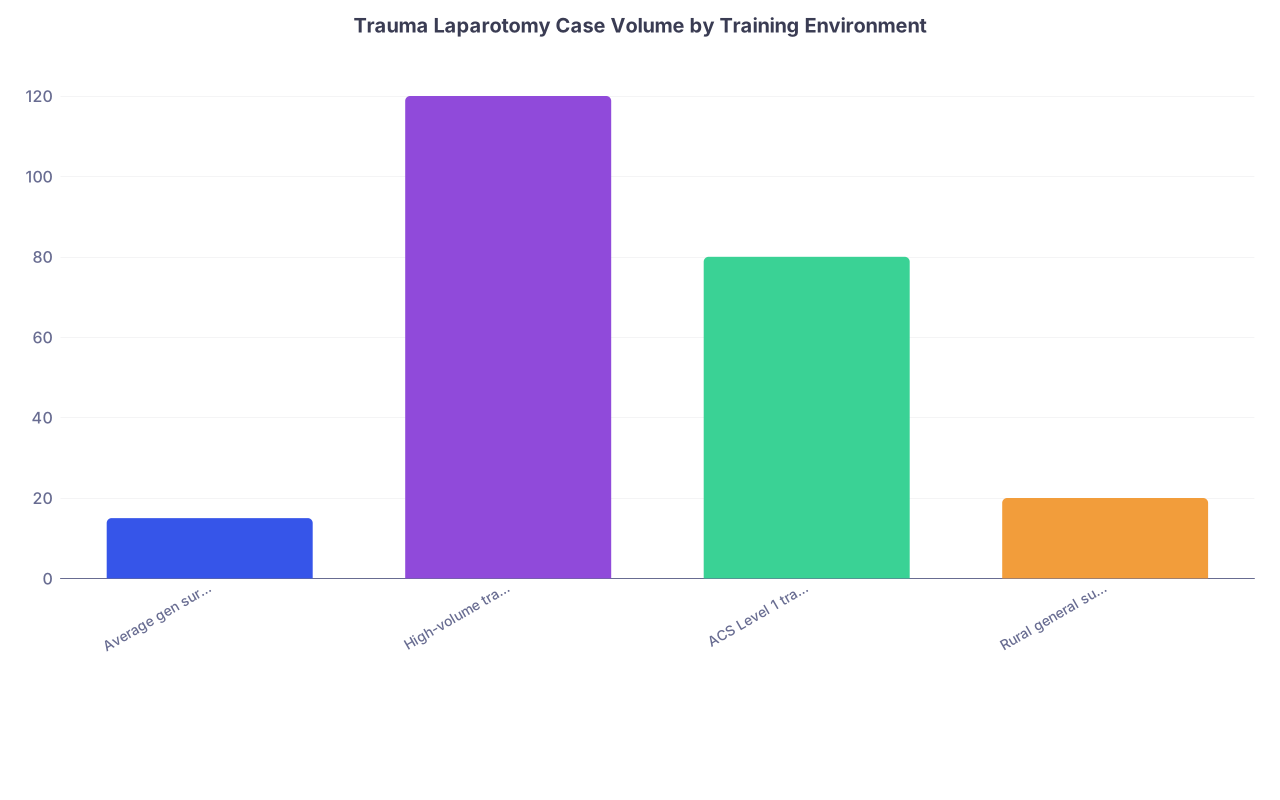
| Category | Value |
|---|---|
| Average gen surg resident | 15 |
| High-volume trauma fellow | 120 |
| ACS Level 1 trauma faculty (first 2 years) | 80 |
| Rural general surgeon (first 2 years) | 20 |
Those are realistic ballpark numbers I have seen:
- Many graduating residents: 10–20 genuine trauma laparotomies as the main operator.
- Trauma and acute care surgery fellows at busy centers: 80–150.
- New faculty at high‑volume Level 1 centers: 40–60 per year early on.
- Rural surgeons: small but steady flow over years, often without backup.
Independent, reproducible performance does not come at 15 cases. You are still in the steep part of the learning curve.
The Concept of Volume Thresholds for Independent Performance
We do not hesitate to quote volume thresholds for other procedures:
- Laparoscopic cholecystectomy: performance plateaus around 30–50.
- Laparoscopic colectomy: many surgeons quote 50–100 for reliability.
- Pancreaticoduodenectomy: serious discussions start at 50–100 personal cases.
Trauma laparotomy has the same issue, but with fewer nice RCTs. So we have to lean on:
- Published trauma performance data (complication and mortality vs surgeon and center volume).
- Extrapolation from other complex emergency operations.
- Collective experience from trauma programs and fellowships.
When I say “independent performance” for trauma laparotomy, I mean:
- You can handle a straightforward penetrating hollow viscus case end‑to‑end without another trauma surgeon scrubbed.
- You can safely perform a systematic exploration and avoid missed injuries.
- You can execute basic damage control and leave the OR at the right time.
- You can recognize when a case is beyond you and call for help early.
Not “heroic liver resection on a grade V injury with veno‑venous bypass.” That remains tertiary center and team territory even for many seasoned trauma surgeons.
Which Trauma Laparotomies Actually Matter for Competence?
Not all trauma laparotomies are equal from a training standpoint.
Here is the mistake: residents count “number of trauma laparotomies” but half of them are negative or simple two‑hole small bowel repairs on stable patients where the attending is relaxed and the case is quasi‑elective.
The volume that drives independent performance is index trauma cases:
- Unstable patient (SBP <90 or requiring pressors/blood in OR).
- Active intra‑abdominal hemorrhage.
- Multi‑cavity or multi‑organ injury (e.g., small bowel + colon + spleen; diaphragm + stomach + liver).
- Need for damage control: packing, abbreviated surgery, temporary closure.
If you have done 30 trauma laparotomies but only 4 of those involved real hemorrhage control and damage control decision‑making, your true exposure is 4 index cases, not 30.
That is why trauma fellowships track “index cases” very carefully.
| Exposure Type | Rough Volume Needed for Comfort |
|---|---|
| Systematic negative/low-yield ex-lap | 15–20 |
| Hollow viscus (small bowel/colon) repair/resection | 20–30 |
| Solid organ bleeding control (spleen/liver grade III–V) | 15–25 |
| Damage control laparotomy with temporary closure | 15–20 |
| Combined thoracoabdominal or diaphragm injury | 10–15 |
You will see overlap. One damage control case might include hollow viscus + solid organ + temporary closure.
The point is this: you do not become independently comfortable with complex trauma at 5–10 true index cases. You simply do not.
Concrete Thresholds: What Number Actually Moves the Needle?
Let me put actual numbers on this. I am not pretending these are RCT‑proven cutoffs; they are pragmatic thresholds that line up with trauma fellow experience, center volume literature, and what I have seen graduates actually do safely.
Threshold 1: Baseline “Safe but Slow” Trauma Laparotomy
This is the level a strong categorical general surgery resident at a moderately busy program might achieve by graduation.
Typical profile:
- 10–15 trauma laparotomies where they truly operated (not just opened/closed).
- Of those, 3–5 with meaningful hemorrhage or contamination.
- Comfortable with: midline entry, four‑quadrant inspection, basic small bowel repairs, simple colon resections with or without anastomosis, splenectomy, simple diaphragm repair.
At this stage, they can safely do:
- Stable or mildly unstable penetrating anterior abdominal stab with suspected hollow viscus injury.
- Blunt hollow viscus perforation with limited contamination.
- Isolated splenic laceration that fails non‑operative management, if they have seen splenectomy.
But they are not truly “independent trauma surgeons.” They should still have backup or immediate consult options for:
- Multi‑solid‑organ injuries with massive transfusion.
- Combined thoracoabdominal, high‑energy gunshots, or multiple GSWs.
- Complex liver injuries requiring packing, selective vascular control, or shunting.
Threshold 2: Functional Independent Trauma Laparotomy Surgeon
This is the level where I start to say: this person can reasonably practice as a trauma/acute care surgeon in a Level 2 trauma center or a resource‑limited environment with limited on‑site backup.
Ballpark requirements:
- Total trauma laparotomies performed as primary surgeon: 50+
- Index hemorrhagic/damage control cases: 15–20+
- Liver/splenic major injury control attempts (not just observation): 10–15+
- At least several re‑operations for planned second looks or complications.
What it looks like in practice:
- Has a clear, reproducible sequence: open → pack → temporary proximal control → systematic exploration → selective repair → decision about damage control.
- Has personally completed multiple temporary abdominal closures and second‑look operations.
- Has had enough post‑op complications to see leaks, missed injuries, abdominal compartment syndrome, and septic shock — and connect those outcomes back to intraoperative decisions.
This level usually requires:
- 1–2 years as high‑volume trauma fellow, or
- 3–5 years as faculty/independent surgeon in a Level 1/2 trauma center seeing >50 major trauma cases annually.
Threshold 3: Expert High‑Acuity Trauma Surgeon
Not the bar for “independent.” This is the bar for people leading major programs and taking the hardest call.
- Trauma laparotomies in career: 200–300+, many high‑acuity.
- Comfortable with: complex liver packing, selective vascular control, retrohepatic caval injuries (at least the early steps), multiple re‑operations, integrating hybrid OR or endovascular options.
- They have seen almost every failure mode.
This is fellowship + large‑volume faculty practice. Helpful as a reference, but not the threshold you need before you can be trusted alone at 2 a.m. in a smaller center.
Why Volume Matters Specifically for Trauma Laparotomy
Volume is not magic. It works because repetition affects particular domains that are heavily stressed in trauma:
Pattern recognition
With enough cases, you recognize the visual “signatures” of injuries immediately: bluish discoloration under a serosa, characteristic blood in a particular quadrant for retroperitoneal bleeding, how mesenteric hematomas look when they conceal a tear.Time management under shock
You internalize how long you can spend on one quadrant before you must move on or convert to damage control. Without volume, surgeons either fiddle too long with one bleeder or overshoot into unnecessary damage control.Economy of motion
The inexperienced surgeon wastes time repositioning, over‑retracting, doing repeated inspections. The experienced one has a choreographed routine. Volume breeds that choreography.Judgment of adequacy vs perfection
Trauma operations are rarely perfect. The volume‑experienced surgeon knows when “good enough for tonight” actually is good enough, and when it is not.

Simulation and Cadaver Labs: Helpful but Not Replacements
Everyone likes to claim, “Simulation makes up for low volume.” It does not. It helps, but it is not a substitute for genuine trauma volume.
Useful roles of simulation and labs:
- Teaching a standardized exploration sequence.
- Practicing fast, safe entry and aortic cross‑clamping on cadavers.
- Rehearsing communication in crisis scenarios with anesthesia and nursing teams.
But there are limits:
- Sim labs never reproduce the combination of shock, coagulopathy, and distorted anatomy caused by real high‑energy trauma.
- You cannot simulate random chaotic variability. Real trauma does that for you.
- You do not develop outcome‑linked judgment (seeing how your decisions played out days later) in a simulator.
So yes, use high‑fidelity cadaver labs and sim to accelerate the early part of the learning curve. They might shift a resident from needing 50 cases to reach comfort down to perhaps 40 because their starting technical and cognitive baseline is better.
They do not turn 10 real cases into the equivalent of 50.
Program Design: How Training Should Be Structured Around These Thresholds
If you are designing or evaluating a residency or fellowship, you should not be asking “Do they see trauma?” You should be asking:
- How many trauma laparotomies as primary operator does a graduate complete?
- How many index hemorrhagic/damage control cases at least assisted + scrubbed closely?
- Do chiefs run the room, or does the fellow/attending keep control of every critical step?
Programs that take this seriously usually do a few things:
Service structure that prioritizes resident index exposure
Chiefs and seniors are allowed to run ex‑laps, even on off‑hours, with attendings supervising but not taking the knife for every step. Fellows are there to backstop, not to steal all the big cases.Protected trauma blocks
Residents get dedicated months at the trauma center, not just scattered call nights. That is when you rack up 10+ real trauma laparotomies in a short window.Log audits with meaningful granularity
Logs distinguish “opened/closed only” from “did the repair, did the packing, led the exploration.” If everyone is pretending a second‑assistant role equals “primary surgeon,” you will graduate residents who are not ready.Intentional second‑look learning
Residents follow their own trauma laparotomy patients in ICU and at re‑operation, so they see the consequences of choices about anastomosis vs ostomy, closure vs temporary closure, etc.

| Step | Description |
|---|---|
| Step 1 | Junior resident exposure |
| Step 2 | Senior resident trauma months |
| Step 3 | High-volume trauma fellowship |
| Step 4 | Early faculty practice with backup |
| Step 5 | Independent high-acuity coverage |
A resident who stops at B may reach Threshold 1 (safe but slow). Add C and early D and you move into Threshold 2 (functionally independent) far more reliably.
Trauma Laparotomy Volume and Outcomes: What the Data Suggest
The literature is fragmented, but the trends are consistent.
Several themes recur across studies:
- Higher center trauma volume correlates with better mortality for severe torso injuries.
- Higher surgeon case volume correlates with lower complications and re‑exploration rates for emergent laparotomies.
- Institutions that centralize trauma care and maintain 24/7 in‑house trauma teams demonstrate better time‑to‑OR and more consistent damage control use.
You can argue that system factors (ICU quality, blood bank protocols) account for some of this. They do. But surgeon volume is not noise here; it is a signal.
Think about your own experience: the first few trauma laparotomies you assisted on were chaotic. Then you worked with an attending who had done 300 of them. You saw the difference:
- Less talking, more doing.
- Faster control of major bleeders.
- Quicker damage control decision when resuscitation was failing.
That is volume burned into muscle memory and mental models.
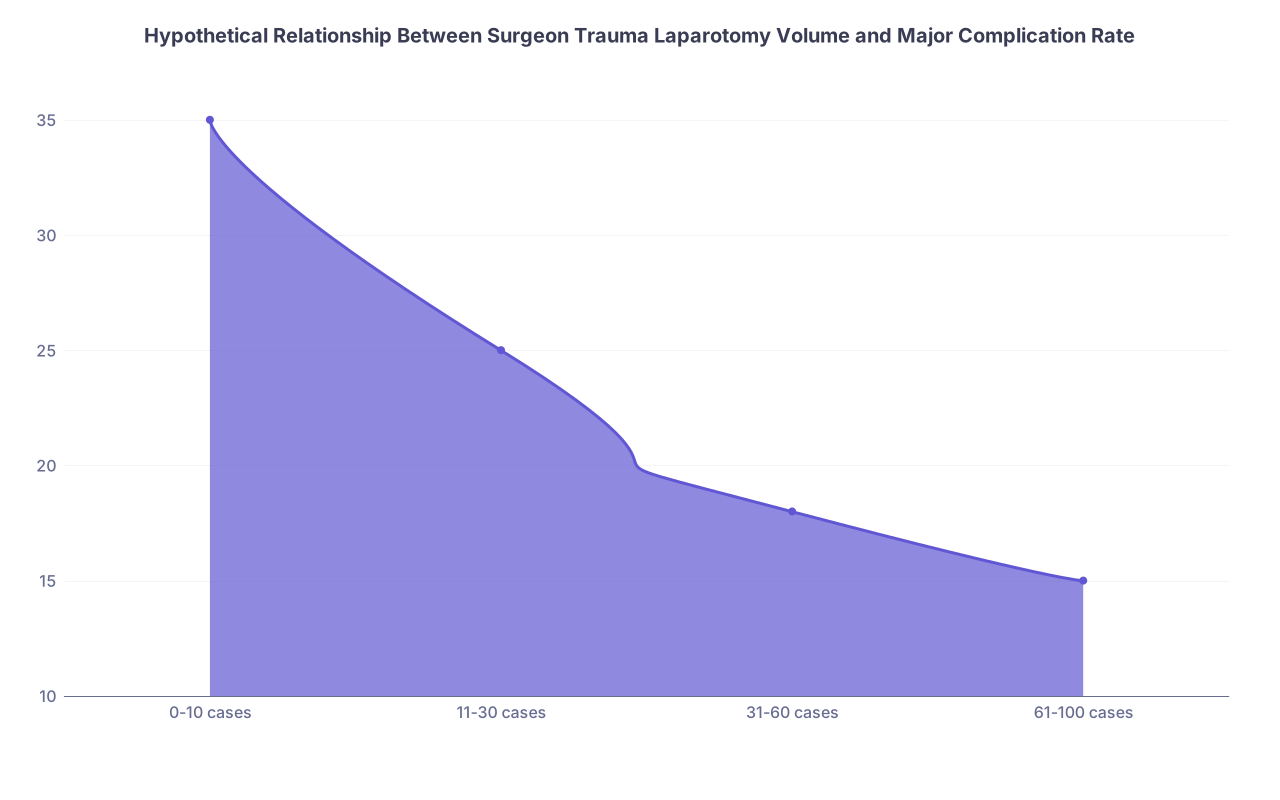
| Category | Value |
|---|---|
| 0-10 cases | 35 |
| 11-30 cases | 25 |
| 31-60 cases | 18 |
| 61-100 cases | 15 |
Even if you quibble with the exact numbers, the directional relationship holds: you do not see the complication curve flatten until surgeons have dozens of cases under their belt.
What This Means for Different Career Paths
Let me be blunt for a few likely readers.
1. Categorical General Surgery Resident Not Doing Trauma Fellowship
If you are at a medium‑volume trauma center and you graduate with:
- 10–20 trauma laparotomies logged as primary operator,
- maybe 5–8 with true hemodynamic instability or significant contamination,
then you should be honest about your independent capabilities.
You can:
- Handle straightforward intra‑abdominal trauma in stable patients.
- Be the first surgeon in the room, start the exploration, and do basic repairs.
You should:
- Have easy access to transfer options or tele‑consult for high‑acuity cases.
- Be quick to call regional trauma centers before you are in over your head.
- Maintain a low threshold for damage control and transfer rather than heroic “I will fix everything in one go” impulses.
Independent? Yes, in simple and moderate cases. But not a full‑spectrum trauma surgeon.
2. Trauma and Acute Care Surgery Fellow
If your fellowship does not give you at least:
- 60–80 trauma laparotomies,
- 15–20 clear damage control/hemorrhagic index cases,
you should be asking why you are calling yourself a trauma surgeon.
You are the one who will be covering 24/7 trauma call at a Level 1 or Level 2 center. You must be beyond Threshold 1. Aim for Threshold 2 before you leave.
3. Rural or Resource‑Limited General Surgeon
Here the equation is cruel: you may not have high volume, but you are often the only one there.
What you can do:
- Aggressively pre‑plan with regional trauma centers for rapid transfer of the highest‑risk cases.
- Use damage control as your friend: stop gross bleeding, staple off obvious bowel injuries, pack, temporary close, and move the patient.
- Use periodic visiting faculty or refresher courses at trauma centers and cadaver labs to keep your mental algorithms sharp.
You will not hit the same volume thresholds as an urban trauma surgeon. So your “independence” is different: it is about triage, early damage control, and knowing your own limits ruthlessly.
The Future: How Volume Thresholds Might Evolve
The direction of travel is clear: more regionalization, more subspecialization, more quantification of competence.
You are likely to see:
- Trauma fellowship credentialing bodies get more explicit about minimum index case numbers.
- Simulation and cadaver course participation become supplements, not replacements, with expected frequency (e.g., “advanced trauma laparotomy refresher every 3–5 years” for low‑volume surgeons).
- Use of granular operative logs and maybe even intra‑operative video review for trauma competency assessments.
Could high‑fidelity VR and haptic simulation one day compress the volume requirements? Possibly. But they will not erase them. You might shift the learning curve left — so 40 real trauma laparotomies plus superb sim exposure starts to look like today’s 60. You will not make 10 cases “enough.”
The bottom line for the future: we will increasingly tie independent trauma coverage privileges to documented exposure and outcomes, not just to “completed a residency.”
How You, Personally, Should Think About Your Numbers
If you are in training or early practice, do this honestly:
- Pull your trauma log. Separate “real” trauma laparotomies from look‑buts, negative ex‑laps for vague pain, and elective re‑operations.
- Count your index cases: substantial blood loss, clear contamination, or multi‑organ injury.
- Ask yourself: on how many of those was I genuinely in charge of the key decisions and steps?
Then map yourself roughly:
- Under 15 total, under 5 index → novice stage, Threshold 0–1. You are safe under close supervision, not independently reliable.
- Around 20–40 total, 8–15 index → solid senior resident or junior trauma surgeon. Capable in many cases, still should have easy access to help for the hardest scenarios.
- 50+ total, 15–20+ index, repeated second‑look and complication management → Threshold 2. Reasonable to call yourself independently functional in most trauma laparotomy scenarios.
If your numbers are low and will stay low (e.g., your job does not see volume), then your strategy is not “pretend I am a trauma surgeon.” Your strategy is:
- Become expert at early recognition, rapid transfer, and minimalist damage control.
- Use sim and refresher labs at Level 1 centers.
- Have zero ego about calling in help.

Key Takeaways
- Reliable independent trauma laparotomy performance is volume‑dependent. Most general surgery graduates with 10–20 cases are safe for simple and moderate trauma but not full‑spectrum trauma surgeons.
- A pragmatic threshold for functional independence in most trauma laparotomy scenarios is roughly 50+ total cases with at least 15–20 true hemorrhagic/damage control index operations as primary surgeon.
- Simulation and cadaver labs are powerful accelerators but do not replace real volume; smart training programs and individual surgeons should be honest about numbers, limits, and the heavy role of experience before taking on unsupervised high‑acuity trauma coverage.