The way most trainees think about “endoscopy case numbers” is wrong.
You are obsessing over the logbook total, when you should be obsessing over how many truly independent, technically clean, and decision-heavy cases you have actually done. The number that matters is not “I did 400 colonoscopies.” It is “I can reliably get to the cecum, manage a difficult polypectomy, and not panic when the patient desaturates.”
Let me break this down specifically.
1. What “Competent Scope Practice” Really Means
Competency in endoscopy is not a number. It is a cluster of very specific, observable abilities:
- You can consistently complete standard diagnostic upper and lower endoscopy to the intended extent (D2 for EGD, cecum/terminal ileum for colonoscopy).
- You can handle typical therapeutic tasks (biopsies, simple polypectomy, hemostasis) safely without the attending taking over most cases.
- You can recognize when a case is going wrong early enough to change course.
- You can communicate risk and findings clearly – to patient, team, and referring providers.
Notice what is not on that list: “logged X hundred cases.”
Regulators and boards care about numbers because they are proxy measures. Crude ones. Programs and fellows cling to them because they are easy to count. But if you have been in the room for 500 colonoscopies where the attending drove the scope 80% of the case, you are not 500-cases competent. You are maybe 200-cases competent. If that.
To build a competent scope practice in training, you have to align three things:
- Volume (how many)
- Mix (what types and difficulties)
- Progression of autonomy (how much of each case is truly yours)
If one of those is off, the logbook will lie to you.
2. The Real Numbers: What Different Bodies Actually Expect
Let us anchor this with something concrete. These are typical minimum thresholds, not guarantees of competence, pulled from how GI and surgical endoscopy are usually structured.
| Procedure Type | Common Minimum Target | Comment |
|---|---|---|
| Diagnostic EGD | 130–200 | Basic fellowship / surgery logs |
| Diagnostic Colonoscopy | 275–300 | GI board minimum in many regions |
| Flexible Sigmoidoscopy | 25–50 | Often underemphasized |
| PEG/Feeding Tubes | 15–20 | For GI / surgical endoscopists |
| Simple Polypectomy | 50–75 | Cold/hot snare and biopsy |
These ranges vary by country and accrediting body, but they all share the same problem: they suggest there is some magic threshold where you become “capable.”
That is wrong.
What the data actually show is a broad distribution. Some fellows hit reliable cecal intubation by case 150–175. Others still struggle after 250. Same for EGD: consistent D2 intubation and good landmark identification for some at 80–100, others take far longer. The variation is real.
So you cannot just trust the box-checking. You have to track your performance curves.
3. Skill Acquisition in Endoscopy: The Learning Curve No One Draws For You
To build a competent scope practice, understand the phases of your learning curve. Most people go through something like this:
Orientation Phase (First 20–30 EGDs, 30–40 colonoscopies)
You are figuring out scope handling, torque, rudder, how to not fight the scope. Attending is hands-on. You are losing the lumen regularly.Basic Technical Proficiency (Up to ~100 EGDs, ~150–200 colonoscopies)
You can usually reach the intended extent with coaching. You still need help with loops, tortuous sigmoid, fixed sigmoid in diverticular disease, and unusual anatomy. Your polypectomy is shaky and slow.Consolidation and Independence (~100–200 EGDs, ~200–350 colonoscopies)
You start finishing routine cases mostly on your own. Attending steps in selectively. You are more fluent in scope control, loop reduction, retroflexion, and basic therapy.Advanced Problem-Solving (after core numbers)
You start handling complex polyps, challenging anatomy, bleeding, incomplete preps, and high-risk comorbidities. Numbers do not capture this. Supervised but high autonomy.
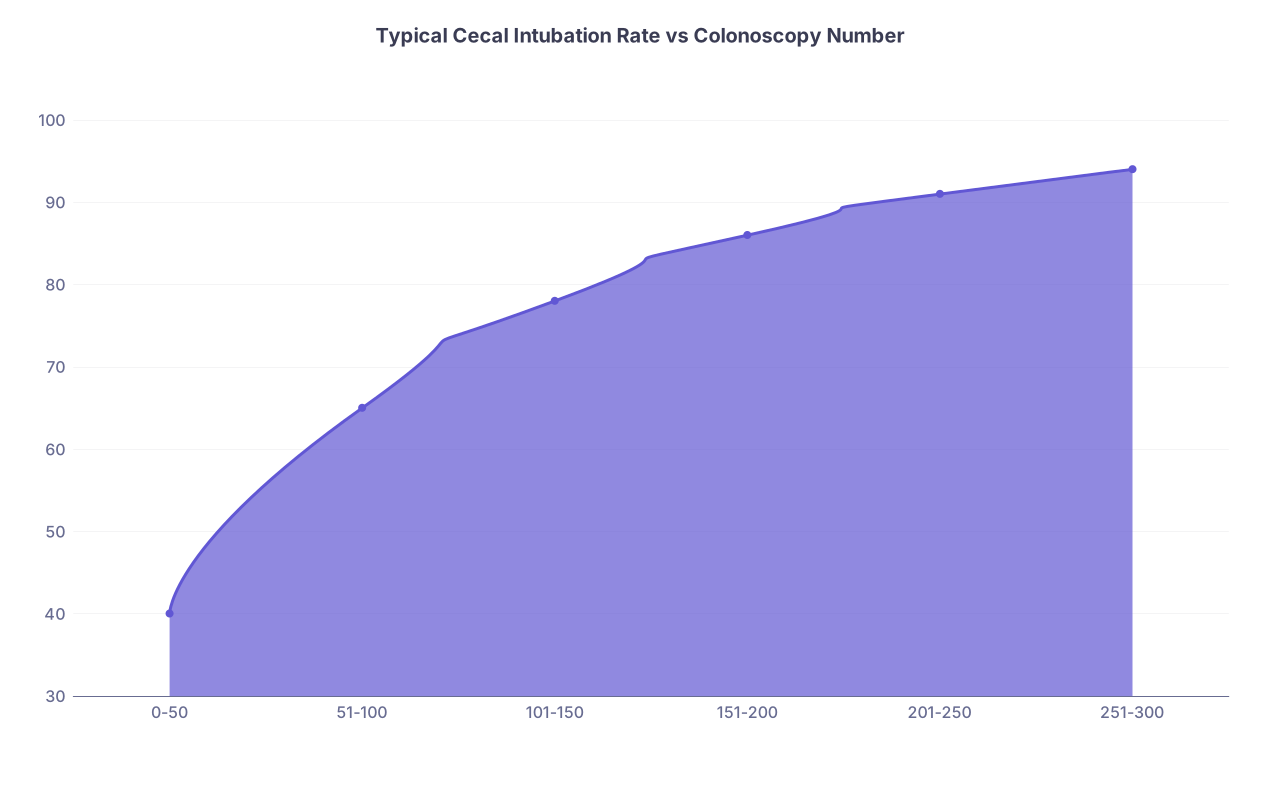
| Category | Value |
|---|---|
| 0-50 | 40 |
| 51-100 | 65 |
| 101-150 | 78 |
| 151-200 | 86 |
| 201-250 | 91 |
| 251-300 | 94 |
That chart mirrors what I have seen on endoscopy units again and again. Big gains in the first 150. Then a taper. The last 5–10% of performance improvement takes another 100–200 cases and better feedback.
If your trajectory is flatter than that, you are not getting deliberate practice. You are being used as a warm body to wedge colonoscopes while the attending “helps.”
4. Numbers That Actually Matter: Benchmarks During Training
Instead of obsessing about total case numbers, track where you stand against these specific benchmarks.
For Colonoscopy
By around your 150th–200th colonoscopy, you should be able to say:
- My independent cecal intubation rate (no attending taking over for more than brief help) is at least 85–90% in average-risk, average anatomy patients.
- My average insertion time to cecum in standard cases is around 10–15 minutes, not 30+.
- I can:
- recognize and reduce sigmoid and transverse loops
- handle mild diverticular disease without giving up
- manage reasonable patient discomfort without panicking
By ~250–300 cases, if your training is decent:
- Cecal intubation 90–95%+ of routine cases that are not anatomically extreme.
- You perform most polypectomies ≤10 mm independently, with:
- appropriate snare choice
- correct technique (no blind cutting, use of submucosal lift when indicated)
- routine use of clip closure for higher-risk stalks or large bases when appropriate
- Withdrawal time consistently ≥6–8 minutes in average cases, with systematic mucosal inspection.
For EGD
By your 75th–100th EGD:
- D2 intubation is routine, not an exception.
- Systematic inspection: esophagus, gastric body/antrum, incisura, cardia, fundus, D1/D2.
- Basic biopsies (Barrett’s, gastritis mapping, celiac) are performed properly.
By ~150–200 EGDs:
- You can scope patients with moderate hiatal hernias, distorted anatomy, or mild varices without struggling every time.
- You can manage common problems:
- food bolus (simple ones)
- typical non-variceal bleeding with at least the mechanical and injection techniques
- Your ability to describe mucosal patterns and lesions in reports is precise and reproducible.
If you have hit these benchmarks, the raw case number is less concerning. If you have not, 400 colonoscopies on paper will not impress anyone who actually watches you scope.
5. Building a Strong Case Mix: Not All “300 Colonoscopies” Are Equal
A dirty secret of endoscopy training: you can finish fellowship having done 400 colonoscopies that were all ASA II screening cases with perfect prep and straight colons. Your numbers look great. Your preparedness for independent practice in a real-world mixed population is poor.
You want a deliberately varied case mix by the end of training.
Think along these axes:
- Anatomy: long redundant colon, fixed sigmoid, prior pelvic surgery, stricturing disease.
- Indication: screening vs surveillance vs symptomatic vs IBD vs anemia vs positive FIT.
- Therapy required: cold snare, hot snare, EMR-lite, argon plasma coagulation (APC), clip placement, injection therapy.
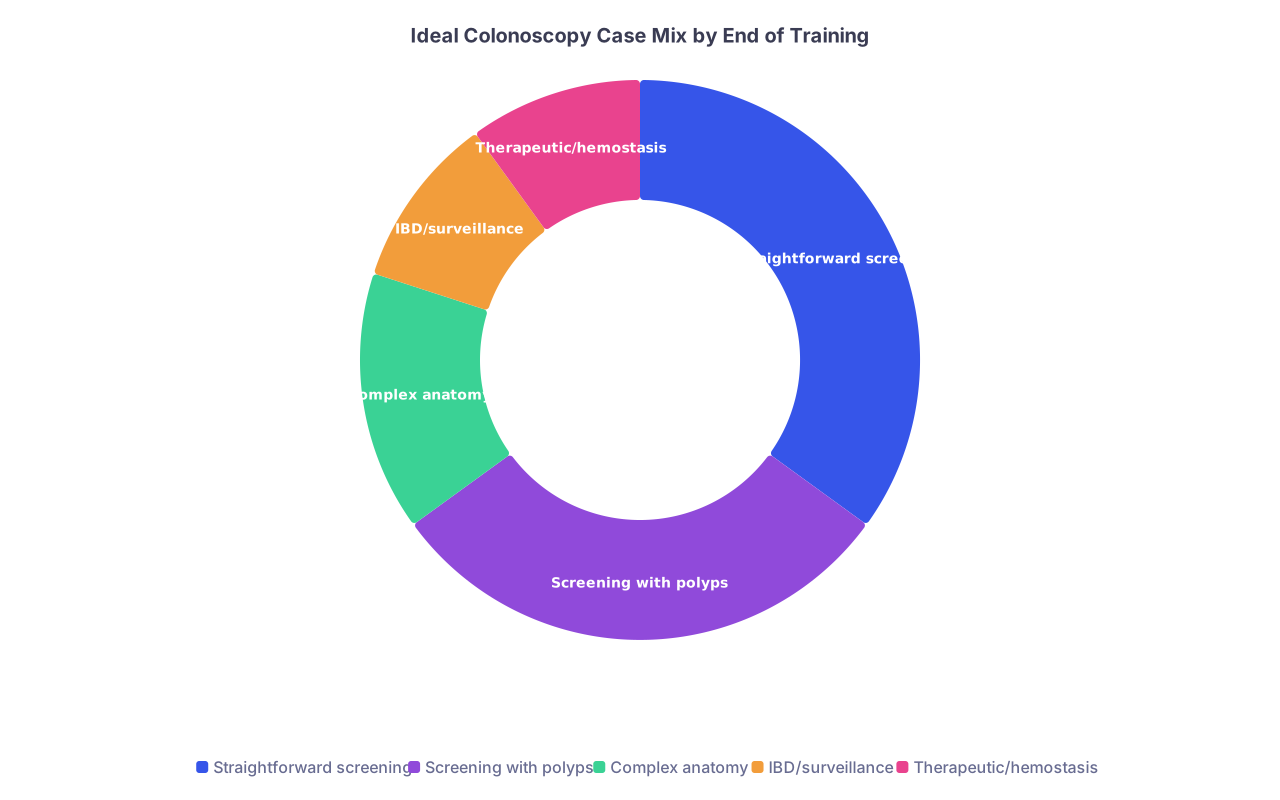
| Category | Value |
|---|---|
| Straightforward screening | 35 |
| Screening with polyps | 30 |
| Complex anatomy | 15 |
| IBD/surveillance | 10 |
| Therapeutic/hemostasis | 10 |
Many programs skew heavily toward straightforward screening and “screening with polyps.” That is not enough. If your training environment is unbalanced, you must compensate:
- Ask to be assigned to therapeutic lists or advanced attendings at least 1–2 sessions per week in your latter half of fellowship.
- Volunteer for inpatients with bleeding, incomplete prior scopes, or IBD surveillance lists when there is supervision.
- On surgical pathways, push to be there for the “difficult colon” that your surgeons dread and want the attending GI to handle – that is where you learn.
If everything in your logbook feels “routine,” that is not a compliment. It means you are missing the cases that actually stretch your skill set.
6. Structuring Your Endoscopy Training Year-by-Year
Let us be concrete about progression. Different programs structure this differently, but a sensible pattern for GI or surgically-oriented endoscopy training looks like this.
Early Training (First 3–6 months of significant scope time)
Primary goals:
- Mastery of scope insertion, torque, tip control, and loop reduction basics.
- Consistent identification of landmarks (EGD: Z-line, pylorus, D2; colonoscopy: rectum, sigmoid, splenic flexure, transverse, hepatic flexure, cecum, TI when indicated).
- Zero tolerance for unsafe behavior: blind advancement, excessive force, ignoring patient instability.
You should:
- Ask for full cases where you do the entire insertion and most of withdrawal, not “I will just do the easy half.”
- Immediately debrief each case: where did you lose the lumen, where did the loops form, what would the attending have done differently.
Mid Training (6–18 months scope-heavy time, for GI; or equivalent months in surg)
Primary goals:
- Increase autonomy in routine cases: the attending is mostly watching, giving verbal cues, occasionally stepping in briefly.
- Expand therapeutic repertoire: standard polypectomy, basic hemostasis.
- Start tracking personal quality metrics: cecal intubation rate, withdrawal time, adenoma detection rate (ADR) if your system allows.
You should:
- Push to run your “own” room with attending oversight, not share every case with co-fellows.
- Request that attendings let you struggle a bit (within safety limits) with difficult anatomy before taking the scope.
Late Training (final 6–12 months before independent practice)
Primary goals:
- Complex case handling under supervision: challenging polyps, partial EMR, bleeding patients, incomplete previous scopes, IBD dysplasia surveillance.
- Decision-making: when to tattoo, when to refer for EMR/ESD or surgery, when to abort a dangerous polypectomy.
- Efficiency without sacrificing safety: turning over a list at something close to attending speed.
You should:
- Know your data: “My last 100 colonoscopies – cecal intubation 94%, withdrawal time 8 minutes, ADR X%,” if your system tracks it.
- Demand direct feedback about “Are you comfortable with me doing this independently next month?” from multiple attendings, not just one who likes you.
7. Autonomy: The Most Mismanaged Variable in Endoscopy Training
Case volume without autonomy is inflated nonsense.
Ask yourself after each case: “How much of that case did I actually do?”
- 0–25%: troubleshooting, some withdrawal, attending did the hard parts.
- 50%: shared case. You did either insertion or majority of withdrawal/therapy.
- 75–100%: truly your case, with the attending mostly supervising, stepping in briefly if needed.
If you are logging everything as “my colonoscopy,” you are confusing “present in the room” with “operating endoscopist.”
A better approach, even if your official logbook does not support it, is to maintain a private spreadsheet where you track:
- Case type (EGD/colonoscopy)
- Difficulty (simple / moderate / difficult, by your honest judgment)
- Autonomy % (25/50/75/100)
- Complications or major attending takeovers
Over the course of, say, 275 colonoscopies, you want something like:
200 where you did ≥75% of the case.
- A subset of at least 40–60 “moderate/difficult” cases with ≥50% autonomy.
- A track record with a few scares but no preventable disasters where you ignored clear red flags.
If your true autonomy numbers look like 100 cases at 75% and 175 at 25–50%, you should not feel confident heading into unsupervised community practice, no matter what your log says.
8. Competence Beyond Technical Skill: Sedation, Safety, and Systems
A competent scope practice is not only “I can get to the cecum.” It includes everything wrapped around the procedure.
Sedation and Monitoring
You should be completely comfortable with:
- Sedation choices: propofol vs moderate sedation (fentanyl/midazolam), higher-risk patients where anesthesia is preferred.
- Monitoring basics: capnography, blood pressure trends, response to hypotension or desaturation.
- Reversal agents and airway maneuvers: how to quickly react when the oxygen saturation drops or the patient loses airway tone.
The scariest residents/fellows are the ones whose eyes never leave the monitor. They forget there is an actual living person attached to the colon.
Pre-Procedure Assessment and Consent
By the end of training, you should independently be able to:
- Risk stratify patients (cardiac, pulmonary, coagulopathy, cirrhosis).
- Adjust antithrombotic management appropriately (DOACs, warfarin, clopidogrel) depending on planned intervention.
- Genuinely consent a patient: including the relevant therapeutic risks if you intend to remove a 20 mm right-sided polyp.
Post-Procedure Management
Competent practice includes:
- Crafting clear, concise reports with actionable recommendations.
- Communicating unexpected findings (suspected cancer, severe colitis) to patient and team without hiding behind vague language.
- Arranging appropriate follow-up and surveillance intervals and documenting your rationale.
None of this shows up in your “total EGD/colonoscopy” number. But this is where real-world competence lives.
9. If Your Case Numbers Are Weak: Recovery Strategies
Some of you are in low-volume programs. Or COVID or service changes gutted your case experience. Or you spent a year on consults and wards while endoscopy time evaporated. It happens.
You still have options, but you cannot be passive.
Concrete strategies:
Redistribute your time
If your program is flexible, front-load or back-load endoscopy-heavy rotations. Trade ward-heavy blocks for endoscopy if others are willing, especially in your final year.Target high-yield lists
Ask scheduling to put you:- on days with higher-volume attendings
- on FIT-positive, polyp-heavy screening days
- on inpatient bleed lists with adequate supervision
Use simulation – but do it seriously
High-fidelity scope simulators are not toys if used correctly. They help with:- hand-eye coordination
- loop reduction strategies
- polypectomy technique without risking real patients
Log significant simulator hours and treat them like real sessions, not checkboxes.
Electives or mini-fellowships
If your core residency or fellowship did not give you numbers:- Join a focused endoscopy elective in a busier center.
- For surgeons: consider a GI/minimal access fellowship that explicitly guarantees scope volume and has the data to back it up.
Post-training proctoring
In some systems, you can start practice with provisional endoscopy privileges under proctoring:- Have an experienced endoscopist in the room for your first 50–100 cases in a new job.
- Get honest feedback and be willing to refer complex work until your performance is solid.
Do not pretend everything is fine if you know your experience is thin. That is how people hurt patients.
10. Future of Endoscopy Competence: Moving Beyond Crude Numbers
We are slowly, painfully, moving away from “you logged 275 scopes, congratulations” toward real competency-based assessment. It is long overdue.
Expect to see more of:
Objective performance metrics directly tied to your login:
- Cecal intubation rates
- Withdrawal times
- ADR
- Complication rates
tracked per operator, not per unit.
Structured assessment tools
Tools like DOPS (Direct Observation of Procedural Skills) and specific endoscopy assessment checklists are already in use in some centers. They score:- technical skill
- tissue handling
- autonomy
- safety and judgment
AI-assisted quality feedback
AI is already being tested to:- highlight insufficiently inspected segments
- estimate mucosal visualization coverage
- flag missed intervals or poor preparation documentation
Translation: in a few years, you will not be able to hide behind “I did 400 colonoscopies” if your adenoma detection rate is dismal and your withdrawal times are 4 minutes.
Structured pathways for advanced therapy
EMR, ESD, third-space endoscopy (POEM, G-POEM) are already breaking away from “learn it on the side during general fellowship.” Dedicated advanced fellowships with tracked outcomes are becoming the standard.
The direction of travel is clear: case volume will remain necessary, but not close to sufficient.
FAQ (Exactly 6 Questions)
1. How many colonoscopies do I really need to feel safe practicing independently?
Most competent endoscopists feel reasonably safe in routine colonoscopy somewhere after 250–350 cases with high autonomy and a mixed case profile. If you are at 300 mostly-attending-driven cases, you are not ready. If you are at 250 with 200+ cases where you did ≥75% of the work and your metrics are solid (cecal intubation >90%, acceptable ADR, no major unrecognized complications), you are in a much better position.
2. My program meets the minimum case numbers but I still feel weak. Is that normal?
More common than people admit. Minimum numbers are conservative and do not guarantee confidence. It usually means your autonomy was limited, your case mix was too “easy,” or feedback was poor. You can improve this with targeted elective time, simulation, and negotiating more independent cases in your final year.
3. Can simulation meaningfully substitute for real cases in endoscopy training?
Simulation will not replace real cases, but it can absolutely accelerate the early and mid curve. If you use it seriously, you will enter real cases with better scope control and loop management, which means you learn more per patient. Treat simulator sessions like real cases with goals, not like a video game you play for 20 minutes.
4. What personal metrics should I track during fellowship or residency?
At minimum: your own cecal intubation rate (for cases where you are the primary endoscopist), average withdrawal time, and any complications that occurred while you were driving. If your system allows, track ADR over time. Also keep a rough tally of how many cases were simple vs difficult and your autonomy percent.
5. I am a surgeon who wants a meaningful endoscopy practice. Do I need a GI fellowship?
Not necessarily, but you need a real endoscopy track, not token exposure. That usually means: an MIS/foregut or GI surgery fellowship with guaranteed EGD and colonoscopy volume, shared sessions with GI attendings, and clear documentation of your outcomes. Many surgeons do excellent endoscopy, but they trained somewhere that took scope competency seriously, not as an afterthought.
6. How do I know if an attending is giving me appropriate autonomy versus being unsafe?
Good attendings let you struggle technically but not in judgment. They will:
- allow you to work through loops and challenging anatomy while supervising closely
- step in early if you start using excessive force, losing orientation, or ignoring patient instability
- debrief honestly after cases.
If every difficult moment ends with “Just give me the scope,” your learning suffers. If they never intervene even when things look risky, that is not autonomy – that is neglect.
Key points: Case numbers are a rough filter, not a guarantee of competence. What actually builds a competent scope practice is a combination of adequate volume, deliberate case mix, and steadily increasing autonomy with honest performance tracking. If you want to be truly ready for independent practice, stop counting only how many scopes you have done and start counting how many you have genuinely owned.