
The way most programs run night call is wasting surgical volume. You are bleeding cases because your call structure is built around tradition, not throughput.
Let me be blunt. If you are a resident or a junior attending in a surgical specialty and you are not thinking about how your call schedule controls your access to cases, then you are leaving real operative experience on the table. The OR does not care about your curriculum. It follows the pager and the ED board. So you either align your life with that reality or you get out-competed.
This is about restructuring nights to capture those “orphan” cases — the ones that happen when nobody is looking and everyone is half-asleep.
The Core Problem: Night Call Is Randomized Volume
Night call as usually designed has three big structural failures:
Random assignment without volume logic
- PGY-2 with weak skills gets slammed. Senior hungry for cases spends the night doing admits and floor work.
- Or worse: the most capable operator is home, the least efficient is stuck on.
No tracking of case yield per call night
- Everyone says “nights are busy” or “this service is brutal,” but nobody can tell you:
- How many cases start after 5 pm.
- When they cluster (time-of-night, day-of-week).
- Which attending consistently operates late.
- Everyone says “nights are busy” or “this service is brutal,” but nobody can tell you:
Floor/ED work cannibalizes OR exposure
- Resident A spends all night doing admissions and writing notes.
- Resident B, from another service, quietly scrubs a midnight lap appy and 2 I&Ds because they walked into the right OR at the right time.
You do not fix this with “working harder.” You fix it with structure: redesigning how bodies are placed in time to intercept cases.
Step 1: Get the Data – Quantify Your Night Case Reality
Before you touch the call schedule, you need ammunition. Opinions lose. Numbers win.
A. Pull 3–6 Months of Case Data
Ask your OR manager or quality office for a list of all surgical cases starting between 17:00 and 07:00 over a defined period.
Ask for fields like:
- Date and start time
- Service (GS, Ortho, Vasc, Trauma, etc.)
- Case type (simple vs complex if available)
- Attending
- Resident(s) scrubbed (if tracked)
- Emergent vs urgent vs add-on
If they act like this is impossible, that is just laziness. The OR runs on data. It exists somewhere. Be persistent but polite.
Now, summarize it. You want high-yield patterns, not a 200-line spreadsheet recited out loud.
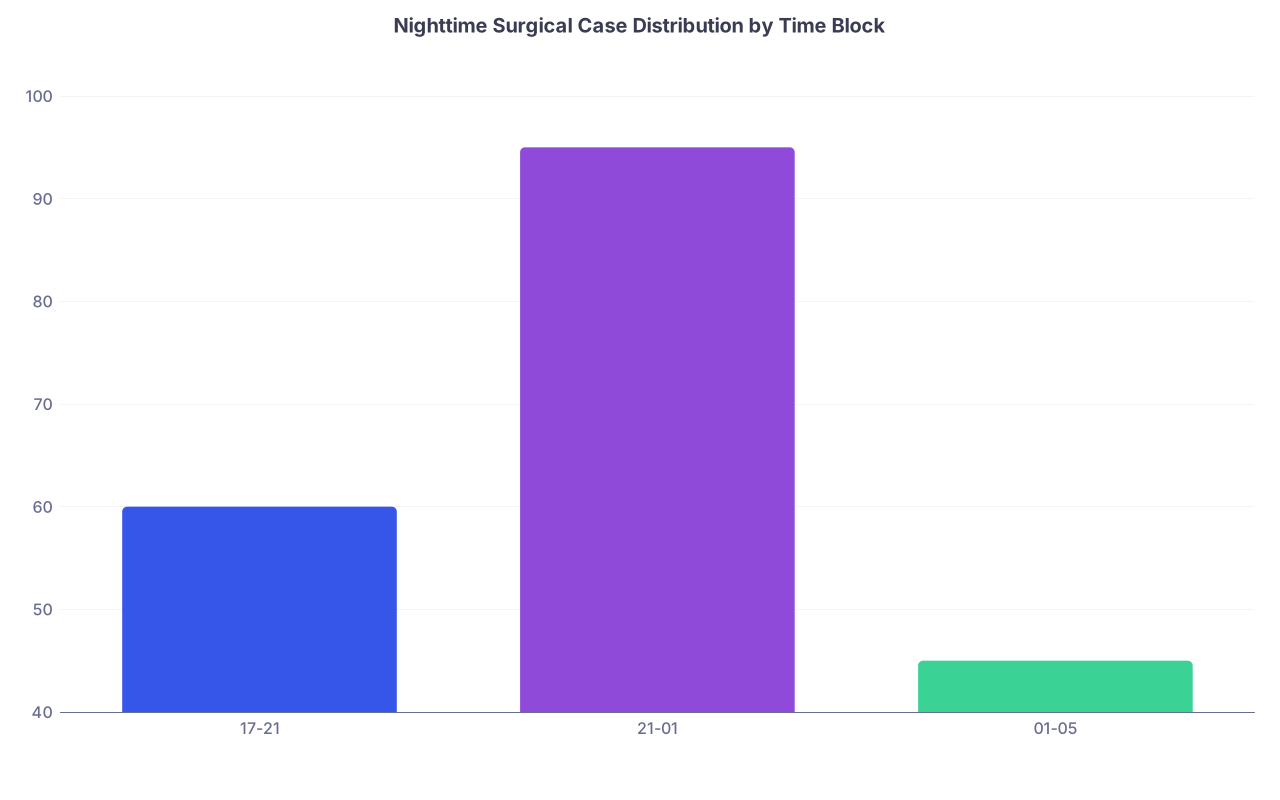
| Category | Value |
|---|---|
| 17-21 | 60 |
| 21-01 | 95 |
| 01-05 | 45 |
This type of profile is what I see a lot: a spike in the late evening, a drop in the early morning.
B. Build a Simple Volume Map
Create a one-page snapshot:
By time block (per week):
- 17:00–21:00 = X cases
- 21:00–01:00 = Y cases
- 01:00–07:00 = Z cases
By day of week (per month):
- Monday nights = average A cases
- Friday/Saturday nights = average B cases
By service:
- Trauma/ACS = X%
- Ortho = Y%
- Vascular, Plastics, etc.
Now match this against your current night coverage:
- Who is physically in house each block?
- Who is nominally “on call” but at home?
- Who covers floor/consults vs OR?
You are looking for mismatches like:
- Peak OR case time = 21:00–01:00
- Peak resident distraction time = same window (admissions dump from ED, floor cross-cover).
That tells you where to fire your first shot.
Step 2: Define the Goal – Volume First, Without Breaking Safety
You are not restructuring nights just to suffer more. You are restructuring to:
- Maximize cases per resident year
- Ensure equitable access to night cases (no “the PGY-3 always steals the appys”)
- Protect safety and duty hours (or your proposal dies immediately)
- Make it administratively simple (nobody wants a NASA-grade schedule).
You present this as a quality + education initiative, not a resident land grab. Example framing to your PD or chief:
“We noticed our 21:00–01:00 case load is high but the in-house senior is usually locked on cross-cover. We can restructure nights so one resident is protected for cases while another focuses on floor and admissions. It will increase case volume per resident without violating duty hours.”
If you go in with “I want more cases,” you look self-serving. If you go in with “The program is structurally wasting operative opportunities,” you look like the adult in the room.
Step 3: Core Structural Fix – Split the Night Roles
The standard broken model:
- One or two residents cover:
- ED consults
- Floor calls
- ICU calls
- All emergent OR cases
- Documentation + discharges + postop issues
Result: whoever is “primary” gets drowned in pages and misses cases. The “secondary” might scrub a thing or two but it is chaos.
Here is the fix: functional separation of roles. Not by PGY level, by task.
A. The 2-Track Night Model
When you have at least two in-house surgical residents at night (common in bigger programs), you do this:
Resident 1: OR-First Resident
- Primary responsibility: emergent and add-on cases.
- Secondary responsibility: consults only when OR is quiet and off peak.
- They carry a separate pager or channel designated “OR/Procedures.”
Resident 2: Floor/Consult Resident
- Handles:
- Floor pages
- New consults in ED
- Simple procedures outside the OR (bedside I&D, line placements) if OR resident is scrubbed.
- Protects the OR resident from being constantly pulled.
- Handles:
And you create a hard rule:
- If there is a case that requires any trainee, OR-First gets first right of refusal unless they are post-call or over-hours.
Is this perfect? No. Will you have nights where both are slammed anyway? Absolutely. But structurally you have stopped one of the biggest leaks: “I could not scrub that case, I was putting in orders and answering meds pages.”
B. Micro-Block the Night
Take your volume map and define 3–4 “micro-blocks”:
- 17:00–21:00 (late add-ons)
- 21:00–01:00 (true emergent cases cluster)
- 01:00–07:00 (trickle of emergencies + admissions)
For each block, define:
- Who is OR-First
- Who is Floor/Consult
- Who is backup at home (if any)
You can rotate OR-First and Floor-First by block even within a single 24-hour call. Example:
- 17:00–23:00: PGY-3 is OR-First, PGY-2 is Floor
- 23:00–07:00: PGY-2 is OR-First (fewer cases, good learning), PGY-3 can rest more, only pulled for major trauma
This does two things:
- Increases the predictability of when you are likely to scrub.
- Creates a fairer distribution of night volume over time.
Step 4: Create a “Case Hunt” Protocol
Even with better structure, you still lose cases because nobody knows they exist until they are over. So you implement a cheap, simple protocol:
A. Nightly OR Check-In
At defined times (for example, 18:00 and 21:30):
OR-First resident:
- Checks the add-on board (in person or electronically).
- Scans for:
- “Add-on after 5 pm”
- “To follow current case”
- Attending names known to operate late.
Sends a short message (group text/WhatsApp/secure chat):
- “Tonight add-ons: 1 lap appy (Trauma), 1 I&D (Ortho), 1 ex-lap pending CT. OR-First: [Name]. Others: ping if low volume and want to scrub.”
Confirms with anesthesia or OR charge:
- “Any chance of add-ons after 22:00 that we should plan for?”
Doing this consistently surfaces cases early, not after the fact.
B. ED and Consult Triage with an Eye on OR
The Floor/Consult resident must think like an air-traffic controller:
- Any consult that might go to the OR tonight gets:
- Quick but focused evaluation
- Imaging fast-tracked
- Attending looped in early
The goal: have that appy or SBO in the OR before 01:00 instead of lingering until 05:00 where it collides with your post-call meltdown.
You also create a simple rule:
- If a consult is clearly going to OR and the OR-First resident is not currently scrubbed, Floor/Consult calls OR-First to hand them the case.
- Floor/Consult then backfills the other work while OR-First is scrubbed.
This is how you avoid the “I saw it first, so I own it” nonsense that destroys efficiency and fairness.
Step 5: Rethink Who Gets What Call Nights
Some nights produce more volume. Everyone knows Friday is heavier than Tuesday. But often the call schedule pretends all nights are equal.
They are not.
| Night | Relative Case Yield | Typical Pattern |
|---|---|---|
| Sunday | Low | Few elective add-ons |
| Monday | Moderate | Heavy admits, some OR |
| Tuesday | Low-Moderate | Light trauma |
| Wednesday | Moderate | Steady but not crazy |
| Thursday | Moderate-High | Add-ons + rising trauma |
| Friday | High | Trauma + weekend cases |
| Saturday | Highest | Trauma-dominant |
A. Stop Pretending All Call Is Equal
If Friday/Saturday nights generate 50–70% more emergent cases, then the resident who pulls three weekend calls in a month vs three Monday calls is not getting the same training.
You have two options:
- Rotate weekend-heavy months so everyone gets exposure.
- Or explicitly compensate:
- 2 Friday/Saturday calls = 3–4 weekday calls in “value” when you balance schedules over the year.
Most programs do this informally. That is not enough. Put numbers and structure on it.
B. Match Level to Night Yield
Another common failure:
- High-volume trauma nights staffed by the least experienced resident in the OR because “the senior is home call.”
If you want to capture cases safely:
- High-yield nights = an in-house senior with real autonomy and speed.
- Lower-yield nights = junior-heavy, more emphasis on independent triage and floor work.
One simple improvement:
- PGY-4/5s get protected to be OR-First on high-yield nights (Fri/Sat).
- PGY-2/3s rotate through as OR-First on lower-yield nights, where there is more teaching time and less chaos.
Step 6: Protect Post-Call Time So Nights Actually Teach
You cannot just pile on night work and then have those residents doing full days after. That is how errors happen. Also how your proposal gets nuked by duty-hour police.
So you design a linked day-night structure:
- Call night followed by:
- Guaranteed early sign-out (10–11 am) if minimal OR volume
- Or complete post-call day off if:
- More than X hours scrubbed in OR (you can define a cutoff, e.g., >6 OR hours)
- Or if last case ended after 03:00
And you write this into the schedule notes, not just “unspoken culture.”
That way:
- Residents know they can push to capture that 02:00 case without worrying they will be punished at 07:00.
- Attendings know when to expect reduced staffing post-call and can plan rounds accordingly.
Step 7: Home Call Optimization – Turning “Available” Into “Present”
Some of you are on home call. Translation: you miss cases because you are asleep on your couch when the ED decides to scan the ruptured appy at midnight.
Home call can still be hacked.
A. Trigger Rules for Coming In
You and your co-residents should have a shared rule set:
- If OR-First is already scrubbed and:
- Second case is posted emergently → home call resident comes in.
- Complex index case (AAA, ex-lap for hemodynamic instability, multi-system trauma) → home call senior comes in even if not strictly required.
This is how you get exposure to rare, big cases. They almost never happen at 10:00 am when everyone is fresh.
B. Signal Early, Not When the Patient Is in the Room
Train your ED and night float colleagues:
- “If you think someone is going to OR, page the home call resident as soon as you call the attending, not after CT is read and consent is signed.”
You might not be able to institutionalize this formally, but you can absolutely soft-engineer it by being present, responsive, and grateful when they loop you in early.
Step 8: Formalize It – A One-Page Night Call Protocol
If you want cultural change, you need one clear, written protocol. Not a novel. One page.
Contents of a Good Night Call Protocol
- Definitions:
- OR-First Resident
- Floor/Consult Resident
- Night micro-blocks and who leads each
- Check-in times for OR board review
- Rules for:
- Who scrubs what when multiple services are involved
- How consults are handed off to OR-First
- When home call comes in
- Post-call expectations:
- When you hand off
- How late-night OR work modifies next-day duties
Then you present it.
Not as a complaint. As a solution.
Step 9: Pilot, Measure, Adjust
You do not overhaul an entire system in one shot. You run a pilot.
A. 4–6 Week Pilot
Pick:
- One service (e.g., Trauma/ACS or General Surgery)
- Certain nights (e.g., Thu–Sat)
- Implement:
- OR-First vs Floor/Consult split
- OR add-on board check-ins
- Clear post-call rules
Track:
- Number of night cases per resident
- Number of missed cases (should drop)
- Duty hour violations (must stay within limits)
- Subjective feedback:
- “Did you know about available cases?”
- “Did you feel stuck in scut while others operated?”
B. Show Before/After
Even rough data is powerful:
- Cases per night before: 1.1
- Cases per night after: 1.7
- Proportion of nights with zero cases for senior: dropped by 40%
- Duty hour violations: unchanged
Suddenly, your PD has a reason to expand your structure program-wide.
Step 10: Handle the Politics – Avoid the “Case Hog” Label
If you push hard for more night cases and restructure schedules, someone will mutter that you are a “case hog” or “gunner.”
You neutralize that by:
Making it obviously fair:
- Rotating OR-First
- Sharing Fridays/Saturdays
- Publishing the rules in writing.
Involving others:
- Present the proposal as a group effort by a few residents.
- Include a chief or someone with influence.
Keeping your language focused on:
- Patient safety (“The most experienced available operator should be in-house on high-yield nights.”)
- Education equity (“Currently, some residents are consistently missing night emergencies due to random call distribution.”)
Do not apologize for wanting to actually operate during a surgical residency. That is the entire point.
Practical Implementation Example: A Simple Flow
Here is what a functional, case-focused night flow can look like.

| Step | Description |
|---|---|
| Step 1 | Start Night Shift |
| Step 2 | Assign OR First and Floor |
| Step 3 | 18 00 OR Board Check |
| Step 4 | Alert Team and Plan Coverage |
| Step 5 | Routine Work |
| Step 6 | OR First Scrubs Case |
| Step 7 | Call Home Resident |
| Step 8 | Return to Baseline |
| Step 9 | 21 30 OR Board Check |
| Step 10 | Add ons or Emergencies? |
| Step 11 | Second Case Posted? |
This is not complicated. It just forces consistent behavior that aligns residents with where the cases actually are.
Advanced Move: Use Data for Attending Alignment
There is one more lever almost nobody uses.
Every program has attendings who:
- Routinely delay cases until night for various reasons.
- Routinely push cases out of the night because they hate late ORs.
Your case log will show you who generates night volume.
You can:
- Ask specifically to be on call those nights.
- Trade call with co-residents who do not care about that attending’s cases.
- Or present data to the PD: “Most complex night ex-laps are with Dr. X on Thu/Fri; can we align senior in-house coverage with those days?”
Not to manipulate. To match capacity with need.
FAQ
1. What if my program leadership is resistant to any change in the call schedule?
Start small and data-driven. Do not ask to “rebuild call”; ask to pilot a 4–6 week trial on one service with minimal structural change: formalize OR-First vs Floor/Consult, add OR board check-ins, and track case numbers and duty hours. Present it as a QI project with measurable outcomes. Once you show more cases per resident without increased violations, they have something concrete to approve, not a theoretical complaint.
2. How do I avoid conflict with co-residents who feel I am “stealing” night cases?
Write and share explicit rules about who scrubs what, rotate OR-First status fairly, and be transparent about any swaps you make. When a borderline case arises, offer it to someone who has had fewer night cases recently. People complain less when they see that the system is written down and applied consistently, rather than you “winning” by being more aggressive at 2 am.
3. Is splitting OR-First and Floor/Consult realistic in a small program with only one in-house resident?
If you are truly alone in-house, you cannot fully split roles, but you can still hack the system: schedule strict OR board check-ins, ask for an on-call backup rule (home-call resident must come in for the second simultaneous case or any big index emergency), and negotiate strong post-call protection so that when you do push to capture night cases, you are not punished the next day.
4. How do I track “missed cases” without starting a blame game?
Log them neutrally in a shared, simple spreadsheet: date, time, case type, reason missed (already scrubbed elsewhere, no resident available, duty hours, etc.). Use aggregate trends, not names, in discussion. The purpose is not to shame individuals but to show structural problems, like recurring time blocks with no resident coverage or consults that consistently reach the OR without trainee involvement. That is how you justify schedule redesign, not how you create enemies.
Open your last 4 weeks of call schedules and OR case logs. Mark every case that started between 17:00 and 07:00, then write down who was physically available and who actually scrubbed. You will immediately see where your structure is leaking cases — and that is exactly where you start your first pilot fix.