
The belief that clinic-heavy months are “lost” for surgical case volume is flat-out wrong. They are badly managed. Then they get blamed.
You are not stuck in clinic. You are sitting on a pipeline of future operative cases that most residents never bother to build. Fix that, and your clinic months turn into your highest-yield operative time six to twelve weeks later.
Below is a concrete playbook: how to turn clinic into real, countable surgical cases on your log – not vague “exposure.”
Step 1: Reframe the Month – You Are Running a Case Factory
Clinic months feel miserable when you think, “I am trapped here while my co-residents operate.” Stop that. The goal of a clinic month is not just notes and consults. It is:
- Identify operable disease
- Convert visits into booked cases
- Attach yourself to those cases
- Protect them on the schedule
- Show up and do actual portions of the operation
Think like this:
- Clinic = Lead generation
- Scheduling = Conversion
- OR day = Fulfillment
You are not a passive learner. You are junior faculty without billing privileges. Act that way.
Concrete goal for a 4-week clinic month
Set actual numbers:
- New consults personally evaluated: 80–120 (depends on specialty)
- Clear potential operative candidates you explicitly identify: 20–30
- Cases where you are listed in the comment line / assistant: 10–15
- Cases you actually scrub and do a defined portion: 6–10
If right now your “clinic month” yields 1–2 cases you actually do, the difference is not magic talent. It is system.
Step 2: Build a Simple System to Capture Operative Candidates
Most residents miss operative opportunities because their system is chaos: scribbled notes, half-remembered patients, no follow-up. Fix that first.
Use something simple and auditable. Example: a private spreadsheet or note (obviously de-identified – initials/MRN fragment only, no PHI if it leaves the hospital system).
| Column | Example Entry |
|---|---|
| Date Seen | 01/12/26 |
| Clinic | Vascular – Dr. Patel |
| Patient ID Tag | J.S. / last4 3821 |
| Diagnosis | Symptomatic carotid sten |
| Planned Op | Right CEA |
| Tentative Timing | 4–6 weeks |
| Attending | Patel |
You can keep a second column with full identifiers only in the EMR (e.g., in a personal “resident list” or smart phrase), where it is compliant.
Your objective during each clinic session:
- Rapidly triage which encounters can ever become operative.
- Record them in your tracker.
- Clarify timing and next steps before the patient leaves.
I have watched residents see the same patient three times and still not realize they just walked an elective lap chole right out the door because they never wrote the name down or followed scheduling.
Step 3: Make Clinic Encounters Operative-Focused
You are not the scheduler. But you are absolutely allowed to structure encounters in a way that leads to the OR.
Here is how you do that without being pushy or unethical.
A. Ask the right questions – every time
For any patient with potentially operable pathology, you should be asking:
- “Are your symptoms interfering with what you want to do day to day?”
- “What have you already tried? Did it help?”
- “How worried are you about this getting worse if we do nothing?”
- “If there were a procedure that could fix or significantly improve this, would you want to hear about it?”
You are not selling; you are surfacing their goals and readiness. Then you align that with your attending’s judgment.
B. Present cases to attendings with a surgical frame
Bad presentation:
“This is a 64-year-old with gallstones, some pain, ultrasound shows cholelithiasis.”
Good presentation:
“64-year-old with typical biliary colic, functional impact, failed dietary modification, ultrasound with stones and no signs of acute disease. Healthy enough for general anesthesia. I think she is a good candidate for elective lap chole within the next 4–6 weeks.”
You are not ordering the surgery. You are doing the work your attending wants: risk–benefit thinking with a clear plan. Many attendings will simply say yes.
Then say this sentence, explicitly:
“If we schedule her, I would like to be on that case and follow her through post-op. Can we add my name to the comment line?”
Stop waiting for them to read your mind.
Step 4: Learn How Scheduling Actually Works (or Your Cases Will Disappear)
Residents who do not understand scheduling mechanics lose half their potential volume.
Find the scheduler or clinic manager during week 1 and ask for 15 minutes. Literally say:
“I am on this clinic month. I want to follow my own clinic patients to the OR. What is the best way to make sure I am assigned to those cases when the date is picked?”
Then shut up and take notes. You will usually learn:
- Which fields in the template matter (e.g., comment line “Resident X follow clinic patient”)
- How far out cases are usually booked
- Which days the attending operates
- When the OR schedule “locks” for staffing

| Step | Description |
|---|---|
| Step 1 | Clinic Visit |
| Step 2 | Resident Identifies Operative Candidate |
| Step 3 | Present Plan to Attending |
| Step 4 | Scheduler Books Case |
| Step 5 | Resident Name Added to Comments |
| Step 6 | OR Schedule Released |
| Step 7 | Resident Confirms Assignment |
Then you build 3 habits:
- Always put your name where the scheduler told you to.
- At least once per week, run through your tracker and cross-check the live schedule: Were those cases actually booked? When?
- If something got booked on a day you are on a different rotation, email the chief or scheduling resident early:
“This is a clinic patient I worked up and scheduled while on Dr. Patel’s clinic. Is there any way I can be assigned to that case or at least scrub for the key portion?”
You will not get every one. You will get some. That is enough to change your log over a year.
Step 5: Convert “Nonsense” Clinic into Future Operative Work
Every specialty has clinics that feel like a time sink: wound checks, med refills, benign imaging follow-ups, “pain everywhere.” Most residents mentally check out.
There are still surgical cases hiding there if you are systematic.
Common overlooked sources of operative volume
Recurrent “minor” procedures
Example: dermatologic excisions, anorectal cases, cysts, tunneled line placements.
Action: Volunteer to be the default person who does these. Ask:“For every appropriate case that needs in-clinic excision or minor OR procedure, can I be the primary operator if I see the patient and you are supervising?”
Deferred or delayed surgeries
Example: “We’ll fix this hernia after you lose weight / get cardiac clearance / finish X.”
Action: Set concrete follow-ups in the EMR and in your tracker. When they return ready, push to slot them on a day you are free with that attending.Shared decision-making stalling
Some attendings are (appropriately) conservative but will operate once the patient has tried conservative therapy. Spell it out:“We are starting PT for 8 weeks. If there is no improvement, I recommend we re-discuss surgical options.”
Then you schedule that follow-up and put a reminder in your system. Those follow-ups are your operative on-ramp.
Step 6: Attach Yourself Longitudinally – Pre-op to OR to Post-op
You want a narrative in your training that looks like this:
“I saw this patient in clinic, helped decide on surgery, assisted with the operation, and followed them post-op.”
Not:
“I randomly scrubbed whatever came through the door.”
This is exactly what program directors want to see. They want to know you understand the whole arc, not just how to hold a camera.
Build a “continuity list”
Inside the EMR (or in a secure, program-approved system), maintain a list of:
- Patients you saw in clinic
- Their planned procedure
- Date of surgery
- Date of post-op follow-up
Promise yourself: if you see them pre-op, you will at least attempt to be in their OR and post-op.
On clinic months, when those same patients roll back in post-op, you are now the person who can:
- Recognize complications early (“This is more drainage than I expect at POD10.”)
- Correlate imaging with what you saw inside the abdomen or chest
- Learn from your own intra-op decisions
This is how you convert “clinic exposure” into actual operative judgment.
Step 7: Carve Out Time Blocks for Cases During Clinic Months
Most programs are more flexible than residents assume. They just do not want chaos.
During your first day on a clinic block:
- Look at the attending’s OR days.
- Look at any cases already booked from previous months that you are attached to.
- Propose a plan to your chief or attending:
“I will cover clinic on Monday–Wednesday. On Thursdays when you have OR, I would like to scrub the cases I booked from clinic, if we can balance resident coverage.”
You are showing two things: initiative and awareness of the service.
You may not get all day. But you may get to:
- Step out for 1–2 key cases
- Block half a day when there is adequate support
- Trade with another resident who hates clinic (this is common)
Do not be the resident who silently stews about “never getting OR time” but never actually proposes a coverage plan.
Step 8: Become Invaluable in Clinic (So Attendings Want You in the OR)
You want attendings to think: “When this resident is in clinic, I get more done and more patients are properly worked up for surgery. I want them on my cases.”
How to buy that perception:
- Show up prepared – actually review the schedule the night before
- Pre-chart key imaging and labs
- Pre-draft consent language in the note for likely surgical cases
- Have patient education handouts ready for common operations
Attendings notice when you:
- Reduce their cognitive load
- Streamline decisions
- Anticipate the workup they want
The downstream effect: they feel like you are already a junior partner. Those are the residents they pull into bigger portions of larger cases.
Step 9: Do the Boring Administrative Work That Protects Your Cases
Scheduling is fragile. Cases move. Clinics get overbooked. ORs get bumped.
You need a basic weekly “case hygiene” routine during clinic months:
Monday morning – Cross-check your tracker against the OR schedule for the next 2–3 weeks. Are all expected cases actually there?
If not booked – Message the scheduler with a very specific question:
“Mr. JS we saw on 12/02 for symptomatic carotid stenosis – did his carotid endarterectomy get scheduled yet? I do not see it on the board.”
If booked on a conflict day – Email the chief/scheduler:
“Can we discuss coverage to allow me to scrub this case? It is a clinic patient I evaluated and consented.”
Day before surgery – Confirm with circulating staff or resident in charge that you are on the case. Cases get reassigned silently all the time.
This sounds tedious. It is. But it is the difference between “I saw 30 operative candidates that month” and “I actually did 8 of their surgeries.”
Step 10: Metrics – How to Know Your Strategy Is Working
If you do not track outcomes, you are guessing.
Set a simple baseline from your last clinic-heavy month and then compare after implementing this system.
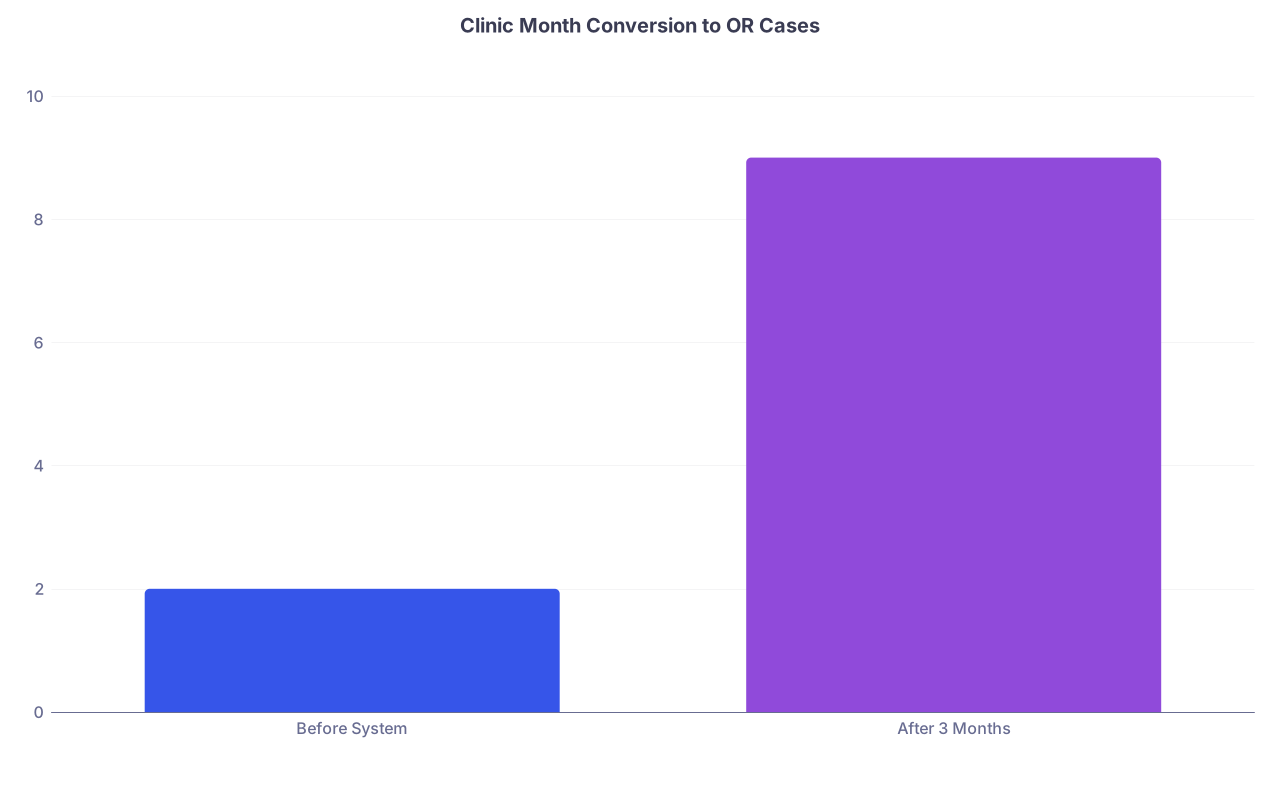
| Category | Value |
|---|---|
| Before System | 2 |
| After 3 Months | 9 |
Metrics to track each clinic month:
- Number of new patient visits
- Number of clear operative candidates identified
- Number of those with surgery actually scheduled
- Number of those where you scrubbed
- Number of those where you performed a defined portion (document in your log truthfully)
Write those numbers down. After 6–12 months, you should see a pattern:
- Fewer “random” cases
- More continuity cases
- Less frustration on clinic blocks
Specialty-Specific Tactics (Because Not All Clinics Are Equal)
General Surgery
Hernia / biliary / soft tissue mass clinics are pure gold.
- Learn your attending’s thresholds for surgery vs watchful waiting.
- Pre-screen charts so you are proposing surgery for the right people, not everyone with a stone.
Breast clinic
- Biopsy results are your pipeline.
- Track all patients with lesions that might lead to lumpectomy or mastectomy.
- Coordinate with tumor board and block those OR dates early.
Vascular
Focus on:
- Symptomatic carotids
- Disabling claudication / tissue loss
- Symptomatic aneurysms
Work the surveillance crowd:
- Stable small aneurysms today become operative tomorrow. Keep a list. When they cross size thresholds, alert your attending with a plan, not just a question.
Orthopedics
Joint clinic is straightforward:
- Identify end-stage osteoarthritis with failed conservative therapy.
- Present with a clear summary of failed interventions and functional decline.
- Aim to schedule within the attending’s usual window.
Trauma follow-up clinic:
- Many “nonoperative” fractures will need late hardware or revision operations.
- Track malunions, nonunions, or patients failing conservative care.
ENT / Plastics / Colorectal / Others
Same pattern:
- Identify recurrent, impact-heavy conditions
- Understand your attending’s criteria for surgery
- Present patients with that framework already laid out
- Persistently follow those patients back to the OR
The clinic structure varies, but the factory model does not.
Using Tech Without Violating Privacy or Policy
You will be tempted to export all your clinic data to personal spreadsheets. Do not do that with identifiable information.
Safer approach:
- Use hospital-approved lists inside the EMR (e.g., patient lists, flags, or “my surgical patients”)
- For personal tracking outside the EMR, only use:
- Initials
- Last 4 of MRN (if your institution allows this)
- Diagnosis + attending + clinic date
- Never email yourself PHI to a personal account.
If you are not sure, ask your program director or privacy officer one direct question:
“What is the approved way for residents to track continuity cases from clinic to OR?”
You would be surprised how many institutions already have a tool you simply have not been taught.
Common Mistakes That Kill Your Clinic-Derived Volume
Let me be blunt. I have seen residents repeatedly sabotage themselves in the same ways:
- Passive in clinic – They wait for attendings to mention surgery instead of proposing a plan.
- No list – They trust their memory. By week 3, half their operative candidates have vanished into the scheduler’s black box.
- Zero scheduler relationship – They act like scheduling is mystical instead of going to the person actually doing it and asking how to help.
- No follow-up – They identify cases but never check that they were booked, or when.
- Silent resentment – They feel cheated when those cases happen on days they are in clinic, but they never requested adjustments or coverage.
If you recognize yourself in any of those, fix it this month. Not “next year when I have more bandwidth.”
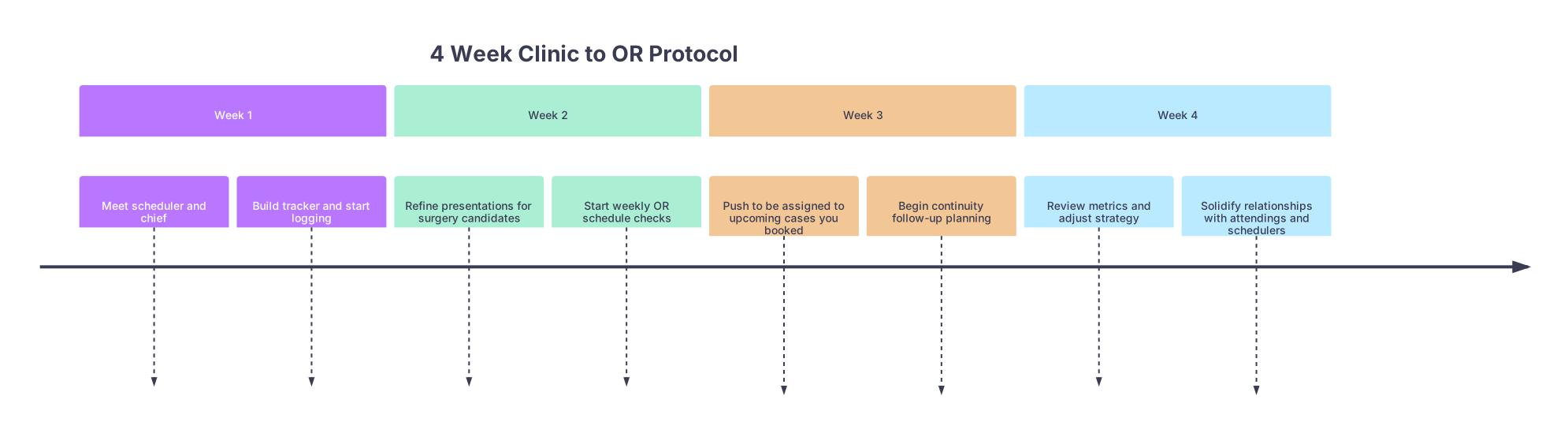
A Quick 4-Week Protocol You Can Actually Use
If you want a plug-and-play blueprint, use this for your next clinic-heavy block.
Supplement that with one visual estimate for your own improvement:
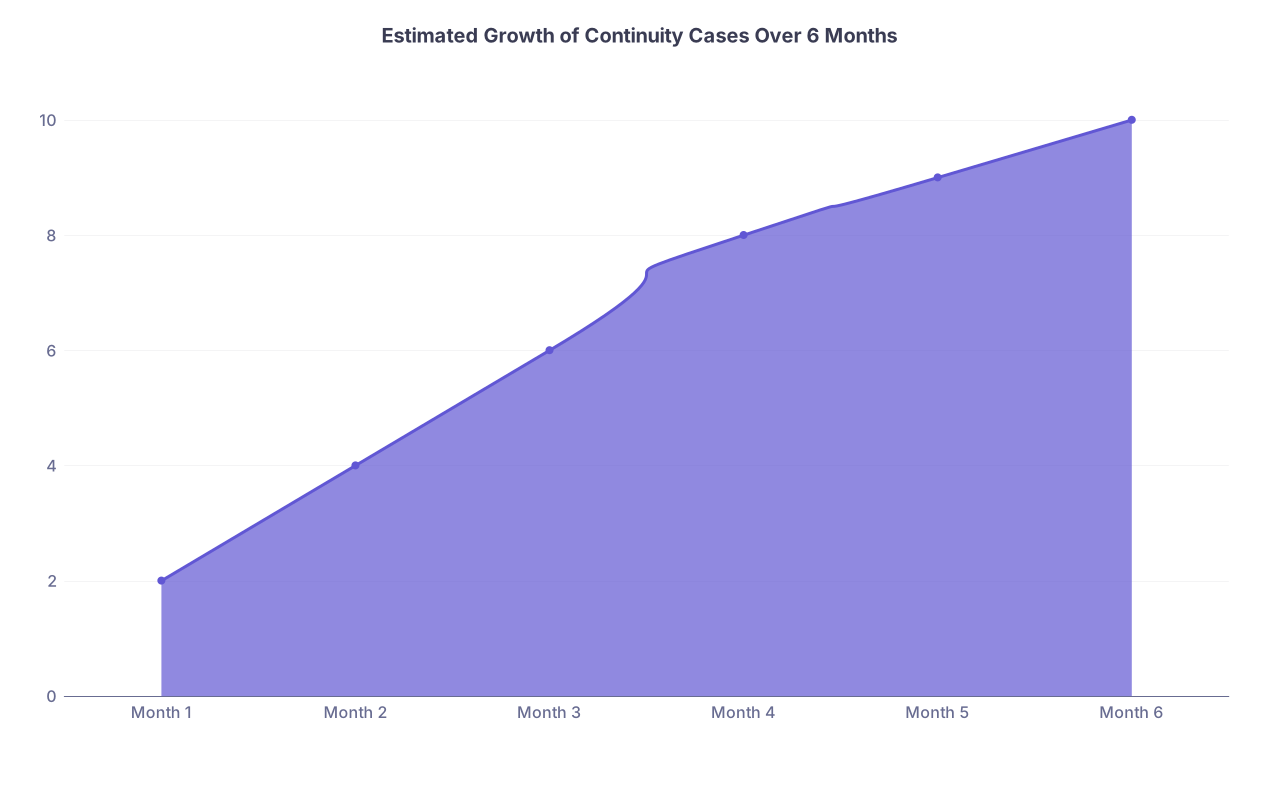
| Category | Value |
|---|---|
| Month 1 | 2 |
| Month 2 | 4 |
| Month 3 | 6 |
| Month 4 | 8 |
| Month 5 | 9 |
| Month 6 | 10 |
That is a realistic trajectory for a resident who stops treating clinic like a prison and starts treating it like a pipeline.
Final Thoughts
You turn clinic-heavy months into real surgical case opportunities by doing three things:
- Run clinic like a case factory – Identify, track, and actively convert operable disease into scheduled surgeries where you are explicitly attached.
- Own the logistics – Learn how scheduling really works, build relationships with schedulers and chiefs, and protect your cases on the calendar.
- Commit to continuity – Follow your own patients from clinic to OR to post-op, and document it. That is where real surgical judgment comes from, not just case counts.