
The way most trainees “wait” to become primary surgeon is backwards. You do not magically earn primary cases by being nice, staying late, and hoping someone notices. You earn them by running a deliberate, safety-focused escalation plan that attendings trust.
Here is how to build that plan.
1. Get Your Head Straight About Role Escalation
You are not fighting for credit. You are building a track record that lets an attending safely say: “They can run this case.”
There are three hard truths you have to accept:
No one is obligated to give you the knife.
Busy surgeons will default to what is easiest and safest for them. That usually means doing the hard parts themselves unless you give them specific reasons to trust you.“I assisted on 200 choles” means almost nothing.
Case logs lie. Being a glorified camera-holder does not make you safe as primary. The only thing that matters: what critical steps you have consistently performed yourself.You escalate safely by design, not by luck.
Hoping for a quiet list and a generous attending is a strategy for burnout. You need a structured progression that you communicate and execute.
So your job:
- Define the steps of escalation.
- Do the unglamorous foundation work.
- Signal clearly to attendings what you are ready for and how you will keep patients safe.
2. Map the Actual Progression: From Observer to Operator
Stop thinking in binary: “assistant” vs “primary.” There are at least five real stages. If you skip them, attendings feel it, even if they cannot articulate why they will not let you drive.

Here is the ladder you should be climbing, consciously:
Observer
- You understand the anatomy, indications, and sequence of the operation on paper.
- You watch with intent: constantly predicting the next step, instrument, and potential complication.
Technical Assistant
- You are rock-solid at exposure, suction, camera, retraction.
- You anticipate what the surgeon needs without being told.
- Your presence makes the case smoother and faster.
Step Operator
- You perform individual low-risk steps: closing skin, placing ports, tying superficial knots, cutting sutures, simple dissection under direct guidance.
- You follow precise instructions. You do not freelance.
Segment Operator
- You run defined chunks of the operation end-to-end:
- Example: For a laparoscopic cholecystectomy – you obtain exposure, dissect Calot’s triangle, clip and cut once the attending confirms the critical view.
- Example: For an inguinal hernia – you open the external oblique, identify cord, and help with sac dissection.
- The attending still owns the case, but you are actively operating on key portions.
- You run defined chunks of the operation end-to-end:
Primary Surgeon (with immediate backup)
- You manage the full case workflow: setup, positioning, key steps, troubleshooting, closure, and immediate post-op plan.
- The attending is scrubbed and may step in briefly for selected critical or difficult parts, but the default is: you drive.
Your goal over the next 6–18 months is to move as many core cases as possible from “technical assistant” to “segment operator” to “primary with backup.”
To do that safely, you need structure.
3. Build a Case Escalation Matrix (Your Personal Playbook)
If you do not know exactly what you want to do in a case, no attending will either.
You are going to build a simple, ruthless document: your Case Escalation Matrix.
Step 1: Pick 5–8 Core Cases
These should match your level and specialty. For a general surgery resident, for example:
- Laparoscopic cholecystectomy
- Open inguinal hernia repair
- Laparoscopic appendectomy
- Port-a-cath insertion
- Simple small bowel resection and anastomosis
- Breast lumpectomy + sentinel node
- Ex lap for perforated ulcer
- Debridements / simple soft tissue cases
Step 2: Break Each Case into Discrete Steps
Not vague fluff. Concrete, observable actions.
Example: Laparoscopic cholecystectomy
- Positioning and port placement
- Initial exploration
- Retraction / exposure of gallbladder
- Dissection in Calot’s triangle
- Identification of critical view of safety
- Clipping/cutting cystic duct and artery
- Gallbladder fossa dissection
- Hemostasis and irrigation
- Extraction and port closure
- Skin closure
Step 3: Rate Yourself Honestly for Each Step
Use a simple scale:
- 0 – Only observed
- 1 – Assisted but never performed
- 2 – Performed under heavy guidance
- 3 – Performed with minimal prompts, technically smooth
- 4 – Could safely perform as primary under supervision
| Case / Step | Current Level (0–4) | Target by 6 Months |
|---|---|---|
| Lap chole – port placement | 3 | 4 |
| Lap chole – Calot dissection | 2 | 3 |
| Lap appy – stapling base | 1 | 3 |
| Inguinal hernia – skin to cord | 3 | 4 |
| Port-a-cath – full case | 2 | 4 |
If you are honest, this matrix will sting a little. Good. It tells you where to attack.
Step 4: Convert Matrix into a 3-Month Escalation Plan
Pick 2–3 cases where you will intentionally escalate.
Example 3‑month focus for a PGY-3:
- Become segment/primary operator for laparoscopic appendectomy.
- Become segment operator for laparoscopic cholecystectomy (Calot’s triangle + clips).
- Own port-a-caths from incision to skin close.
Write that down. Print it. Bring it to your program director or trusted attending and say, “Here is what I want to be able to do independently in 3 months. Can you help me get there safely?”
That single conversation changes how they see you.
4. Pre-Op: How You Ask Determines What You Get
Most trainees ask for autonomy in exactly the wrong way:
“Uh, can I do more of this one?”
That is vague and high-risk. It forces the attending to guess your abilities and appetite for responsibility.
Instead, use specific, safety-framed requests:
- “For this appendectomy, could I run it from port placement to stapling the base, and you step in if you are not happy at any point?”
- “On this lap chole, I would like to dissect Calot’s and get the critical view, then have you confirm before we commit to clips. Does that work for you?”
- “I have done the exposure and opening for three inguinal hernias with Dr. X. Would you be comfortable if I take it from skin to cord and then we decide on the sac together?”
Notice the pattern:
- You state exactly what portion you want.
- You reference your prior experience.
- You build in a safety valve: they can step in immediately.
This is not begging. This is risk management. Attendings respond very differently to this kind of ask.
5. Intra-Op: How to Operate Like a “Safe Primary”
Being primary is not just holding the instrument. It is running the whole case.
Here is a concrete behavior checklist that makes attendings relax, not tense up.
Before Incision
You:
- Confirm the indication for surgery and major alternatives.
- Summarize the imaging and key findings out loud.
- State the planned approach and your mental map:
- “Plan is supine, infra-umbilical Hasson, three ports, identify appendix, skeletonize, staple base, remove, irrigate if needed, close fascia.”
- Ask explicitly: “Anything you want me to do differently than usual?”
During the Case
Operate with these rules:
Say what you are about to do.
- “I am going to retract laterally to open up Calot.”
- “I am going to slide under the duct here; stop me if you are not happy with that plane.”
Red-line rule: talk when you are lost or uncomfortable.
- “I am not seeing a safe plane here.”
- “I do not like how close this is to the CBD; can you show me your preferred approach?”
Pause for checkpoints.
- For lap chole: “I think I have the critical view; can we confirm together before clipping?”
- For anastomosis: “Here is the orientation of bowel; will you check before I fire?”
Protect the attending’s stress level.
- Smooth, deliberate motions > speed.
- No blind traction or deep instrument jabs.
- Respect tissue. If you are tearing through planes, you are not ready to be primary.
Know three bailout strategies.
- Example lap chole:
- Ask for senior/attending to demonstrate different view.
- Fundus-first.
- Convert to open.
Being able to state and accept a bailout earns massive trust.
- Example lap chole:
When Things Go Sideways
Complications and near-misses are where your reputation is made or destroyed.
Your script when you hit trouble:
State the problem clearly.
- “I am not happy with this bleeding; I cannot see the source.”
- “I may have taken too big a bite on this stapler; I need your eyes.”
Hand over cleanly.
- Move instruments to a neutral position.
- Announce: “I am going to pause and let you take over until we are back in a safe place.”
Watch and learn.
- Do not mentally check out. Study exactly how they fix it.
- Ask a brief question later: “Next time, what would you want me to do differently before it gets to that point?”
That is how you show that escalating your role does not put patients at extra risk. It shows you understand when to stop.
6. Post-Op: Lock in Learning and Document Your Growth
If you do not log and debrief, your growth is random and invisible.
Immediate Post-Op (Same Day)
Do three things:
Micro-debrief with attending (2 minutes):
- “What is one thing I did well today as primary?”
- “What is one thing I should change next time to be safer/faster?”
That wording matters. It anchors on safety and efficiency.
Update your Case Escalation Matrix.
- Move steps from 1 → 2 or 2 → 3 as appropriate.
- Note any complications or near misses.
Write a 3–5 line self-critique.
- “Today: first full port-a-cath as primary. Struggled with tunnel angle, needed attending to help reposition. Next time: pre-mark track and think more about patient habitus before incision.”
This takes 5 minutes and pays off huge when you talk to your PD or write fellowship applications.
Monthly Review
Once a month, sit down with your matrix and ask:
- Which steps are stuck at level 1–2? Why?
- Which attendings consistently let me operate more? What behaviors do they reward?
- Which cases am I ready to escalate from segment operator to primary?
Then set specific asks for the next month:
- “Next month, I want to be primary on at least 3 appendectomies and 2 port-a-caths with Dr. Y or Z.”
Again: intention is everything.
7. Handling Different Attending Styles (Without Losing Your Mind)
You already know this: attendings are not interchangeable. Some are autonomy machines. Others are control freaks. You cannot change them. You can adapt.
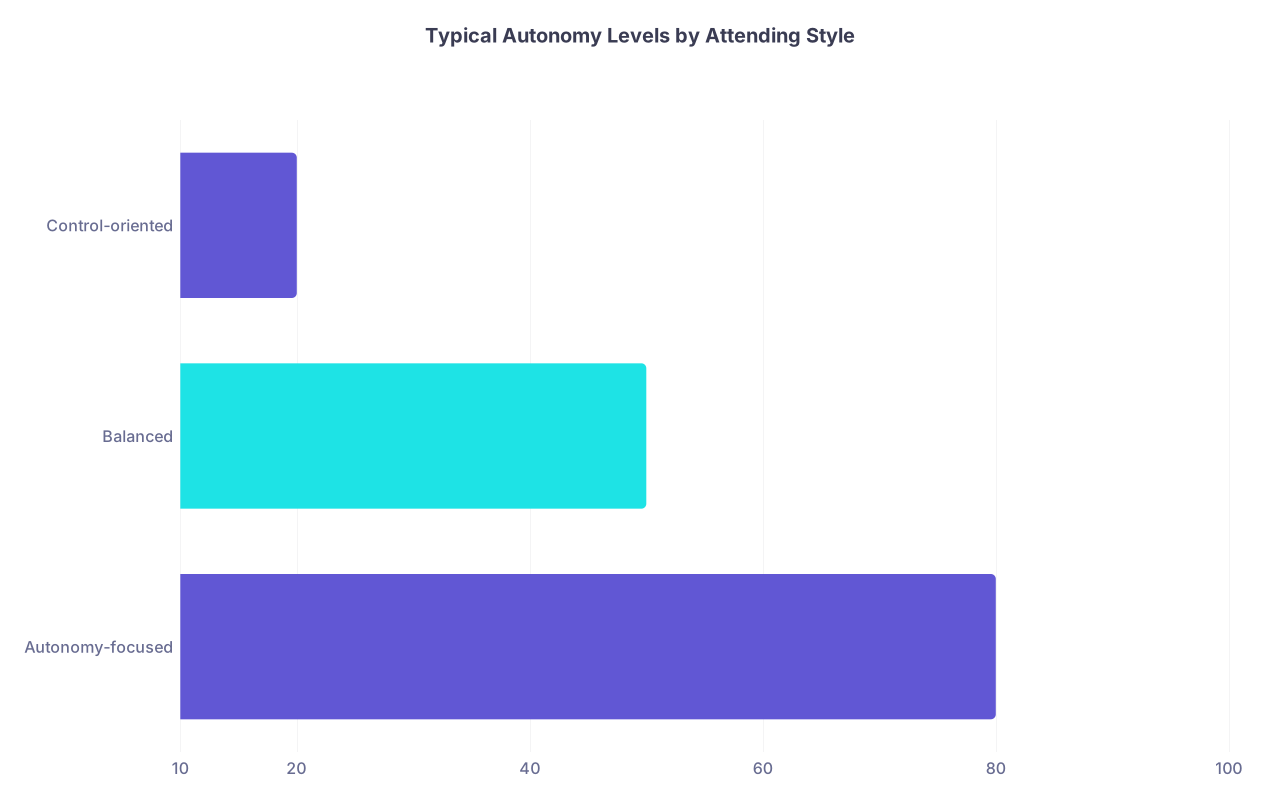
| Category | Value |
|---|---|
| Autonomy-focused | 80 |
| Balanced | 50 |
| Control-oriented | 20 |
1. The Autonomy-Focused Attending
They throw you in the deep end. Sometimes too far.
How to use them well:
- Tell them clearly what you have already done before and what you have not.
- When they say, “You got this,” but you feel over your head, say:
- “I want to try, but if I am struggling for more than 2–3 minutes on this step, I would like you to step in and show me once.”
- They will usually respect that and still give you major chunks of the case.
2. The Balanced Attending
They like to teach. They also like things done right.
Strategy:
- Pre-op, present your plan and specific ask (segment or primary).
- During the case, mirror their language and technique. If they say “always lateral-medial here,” repeat that as you work.
- Show them you can self-correct:
- “My depth is off; I am going to adjust my angle rather than keep pushing.”
Those are the surgeons who will steadily grow your responsibility if you are consistent.
3. The Control-Oriented Attending
They say they value resident education. Then they do the critical 80%.
You are not going to transform them into autonomy champions. Aim for step and segment operator status:
- Ask for specific, non-threatening steps:
- “Can I do all the skin-to-fascia opening and closing on this hernia?”
- “Can I place all ports today?”
- Be flawless at assisting. No fumbles. No confusion about their preferences.
- After several smooth cases, escalate:
- “I have done the exposure and opening on 5 of your hernias now. Would you be willing to let me do the cord dissection on this one, and you show me if I get off track?”
Some will still say no. Fine. Get what you can, keep patients safe, then focus your primary operator goals with the more flexible attendings.
8. Safety Guardrails: How Not to Hurt People While You Climb
Autonomy is not an excuse to experiment. You escalate within clear safety boundaries.
Here is a simple safety protocol that works:
The “3 Yes” Rule Before You Take on a New Role
Before you act as primary or segment operator on a new step:
Yes – Knowledge:
You can outline: indications, anatomy, variants, complications, and bailouts without notes.Yes – Technical Prep:
You have watched high-quality videos and, ideally, practiced key maneuvers on a simulator, model, or at least in your head repeatedly.Yes – Supervision:
You have an attending (or senior) scrubbed who knows you are escalating and agrees explicitly to it.
If any of those is “no,” you should not be the primary on that step.
When You Must Back Down
Make a personal rule:
“If I cannot see clearly, understand what I am doing, and visualize a safe next move, I stop and ask for help.”
Examples:
- Bile duct not clearly identified.
- Bleeding where you cannot see the source.
- Tissue planes completely lost in scar.
You will not be judged for calling in help early. You will be judged mercilessly if you bulldoze ahead into a major complication while “trying to be autonomous.”
9. Leveraging Simulation and Prep to Accelerate Autonomy
If you only learn inside the OR, your progress will be painfully slow. And unsafe.
You need a parallel track: deliberate practice outside the OR.

| Step | Description |
|---|---|
| Step 1 | Simulation Lab |
| Step 2 | Step Operator in OR |
| Step 3 | Segment Operator in OR |
| Step 4 | Primary Surgeon with Backup |
What to Focus on in Sim
Skip the random “tie knots in a box for an hour” approach. Target the steps you want to escalate:
Laparoscopic:
- Camera control, horizon management
- Two-hand dissection around a simulated duct
- Clipping at precise angles
Open:
- Layered closure on synthetic or animal tissue
- Vascular anastomosis practice if applicable
- Routine suturing and knot sequences until they are boring
Then do this:
- Record your sim sessions.
- Watch at 2x speed and critique yourself: wasted movements, unstable camera, unsafe angles.
- Pick one technical flaw to fix in the next session.
When you tell an attending, “I have been practicing Calot’s dissection on the simulator and focusing on gentle sweeping with my non-dominant hand,” they listen differently.
10. Make Your Growth Visible to the System
Programs care about case volume and competency. You can make both obvious.
Do the following:
Keep a personal log separate from ACGME/official logs.
Track:- Date, case, attending
- Your role (observer, assistant, step, segment, primary)
- Key steps you performed
- Complications / near misses
- 1–2 learning points
Share your Case Escalation Matrix with PD/mentor every 3–6 months.
- “Here is where I was, here is where I am, here is what I want next.”
This is how you get targeted OR assignments.
- “Here is where I was, here is where I am, here is what I want next.”
Align with milestones.
When asked “Are you ready to be primary on X?”, you can say:- “I have done skin-to-skin as primary on 10 appendectomies with Drs. A, B, and C, and segment operator for Calot’s on 8 lap choles. My next gap is independent Calot’s dissection and safe management of mild inflammation.”
That sounds like a surgeon in training, not a passenger.
FAQ (Exactly 4 Questions)
1. How many times should I do a case as assistant before asking to be primary?
There is no magic number. A better rule: once you can clearly describe each step, common pitfalls, and bailout options, and you have already performed key segments smoothly as operator with minimal prompts on several occasions, you are ready to ask. That might be after 5–10 assists for simpler cases (appendectomy, port-a-cath) and more for complex ones. The threshold is about demonstrated consistency, not raw count.
2. What if an attending refuses to give me more responsibility even after I ask specifically?
Accept that some surgeons will not change. Document what you have tried, continue being a flawless assistant, and redirect your autonomy efforts toward attendings who are more receptive. Talk to your chief or PD: “I consistently get limited operative opportunity with Dr. X. Is there a way to prioritize my primary cases with Drs. Y and Z, where I have already started acting as segment operator?” Focus your energy where it can actually move the needle.
3. How do I balance speed and safety when I am primary?
Early on, safety always wins. Tell the attending explicitly: “I will prioritize safe, controlled movements today, even if that means I am slower.” As your technical skills mature, speed will come naturally. What irritates attendings is not slowness per se, but lack of planning and repeated uncorrected mistakes. Plan each move, avoid flailing when things do not go perfectly, and accept coaching. That approach makes you both safer and eventually faster.
4. What if I cause a complication while acting as primary surgeon?
Own it and learn from it. Do not minimize or hide. In the immediate term, hand over cleanly when the attending steps in. After the case, ask for a structured debrief: “Can we walk through what led to that complication and how I should approach that situation differently next time?” Then review imaging, anatomy, and alternative techniques, and rework your Case Escalation Matrix. Sometimes you may need to dial back on similar steps for a few cases while you rebuild your technical and cognitive foundation. That is not failure; it is responsible escalation.
Open your current OR schedule and pick one case in the next week. Decide exactly which step or segment you will ask to run, and script the sentence you will use to ask your attending. Write it down. If you walk into that room with a clear, safety-framed plan, you are no longer “just the assistant”—you are a surgeon in training taking deliberate control of your progression.