
Only about 50–60% of high‑volume surgeons consistently hit “high‑quality outcome” benchmarks for their procedures. The rest are just…busy.
So no, high case volume does not automatically equal high competence. It never did. The data has been screaming this for years; people just like the simplicity of the volume = skill story.
Let’s break the myth.
The Origins Of The “More Cases = Better Surgeon” Dogma
The dogma didn’t come from nowhere. Early outcomes literature in cardiac surgery, vascular surgery, and complex cancer resections repeatedly showed a clear “volume‑outcome” relationship:
- High‑volume hospitals and surgeons had lower mortality for CABG, pancreatectomy, esophagectomy, AAA repair.
- Low‑volume hospitals had embarrassingly high mortality for the same operations.
Those papers were right about something important: doing a rare, technically demanding operation three times a year is a bad idea.
But then the nuance died.
Hospital administrators, policymakers, and even surgical educators ran with a simplified version:
More cases → Better surgeon → Safer care.
Real life is messier.
What The Volume–Outcome Data Actually Shows
Let me be specific, because this is where people usually overgeneralize.
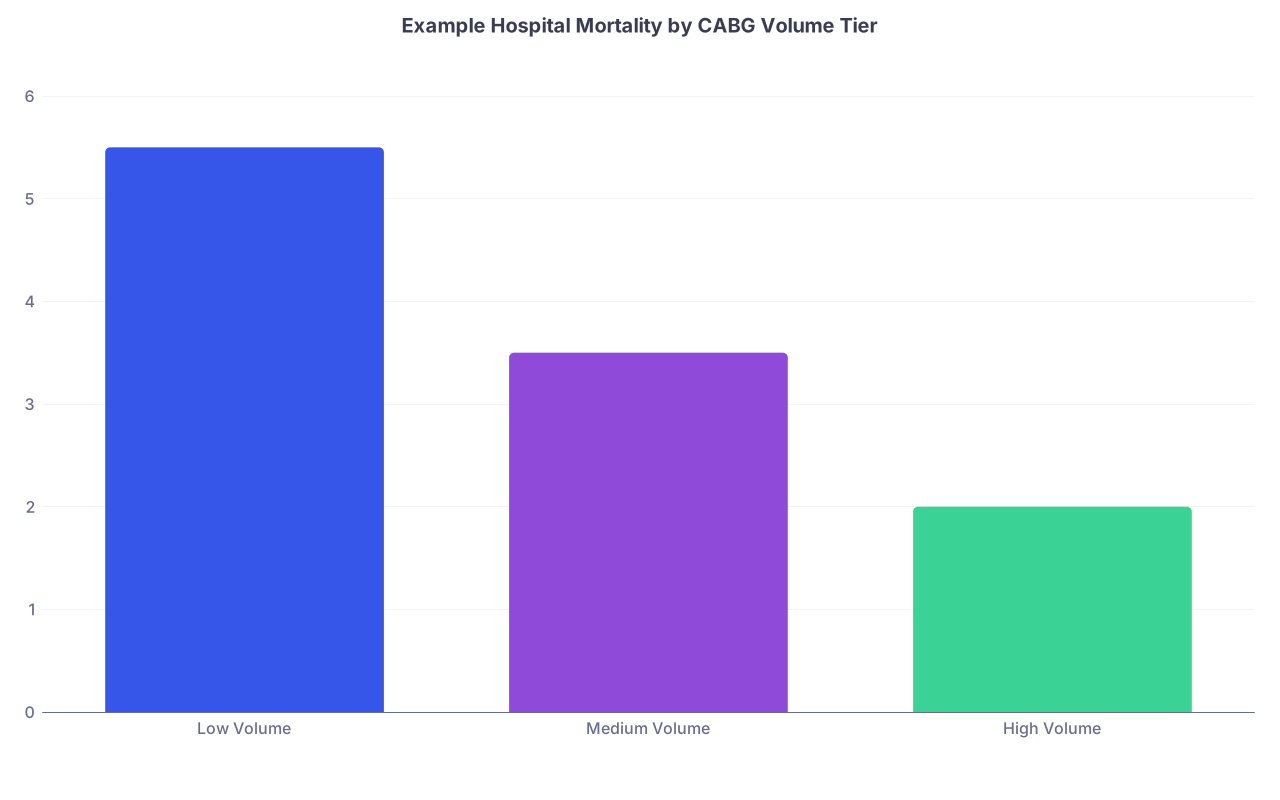
| Category | Value |
|---|---|
| Low Volume | 5.5 |
| Medium Volume | 3.5 |
| High Volume | 2 |
In multiple large datasets (Medicare, state registries, NSQIP), you see patterns like:
- Going from very low volume to moderate volume often gives big improvements in mortality and complications.
- Going from moderate to high volume gives smaller, sometimes marginal, gains.
- Inside the high‑volume group, there is a wide spread of outcomes. Not all “busy” surgeons are good surgeons.
A few key real‑world examples:
- Pancreatectomy: Studies from academic centers show that hospitals doing <5 Whipples/year have sharply higher mortality than those doing >20. Yet even within the “>20” crowd, some centers still have 2–3x the complication rates of their peers.
- Total joint arthroplasty: Higher surgeon and hospital volume correlate with lower revision and readmission rates, but the curves flatten. Above a threshold, the difference between 200 and 600 cases/year is tiny compared to differences in technique, implant choice, and peri‑op protocol.
- Trauma: Level I centers (by definition high volume) do better than small hospitals on mortality—until you adjust for system factors (24/7 staffing, blood bank, protocols, ICU capacity). The “volume” here is acting more as a marker of the system than the hands of the surgeon.
The strongest and most consistent signal in the literature is not “infinite volume is always good.” It’s:
- Extremely low volume is dangerous.
- Moderate volume is much better than low.
- Beyond a moderate threshold, volume alone is a lousy predictor of who is actually competent.
Yet people keep pretending it’s a straight line.
Why Raw Case Counts Are A Terrible Proxy For Skill
I’ve seen two residents with identical case logs graduate the same year. One was someone I’d let operate on my own family without hesitation. The other, you triple‑check everything they do on call.
Same “volume.” Completely different competence.
Here’s why raw case numbers are such a blunt, often misleading, instrument.
1. Participation ≠ Performance
Case logs rarely capture what you actually did.
- Were you primary operator or retracting in the corner?
- Did you do the key steps or only the skin?
- Were you troubleshooting complications or watching someone else salvage your mess?
Programs and credentialing bodies love ticking boxes like “100 laparoscopic cholecystectomies.” I’ve watched residents “get credit” for a lap chole where they essentially held the scope while the attending did everything.
Same case number. Very different learning.
2. Easy Cases Can Inflate Volume Without Building Judgment
A surgeon who cranks through ten straightforward inguinal hernias a day isn’t necessarily better prepared for the single obstructed, incarcerated, cirrhotic train wreck that rolls in once a month.
Volume often clusters in:
- Low‑complexity, high‑throughput procedures
- Narrow case types with scripted workflows
But judgment—actual surgical competence—shows up when the case drifts off script: distorted anatomy, hostile abdomen, aberrant vessels, comorbidities piled on comorbidities. That’s where the signal is, and pure volume doesn’t tell you how often someone sees those.
3. Systems Carry a Lot of the Weight
High‑volume centers usually have:
- Anesthesia that’s seen the procedure a thousand times
- ICU teams with playbooks for the expected complications
- Protocolized order sets, ERAS pathways, checklists, and equipment always ready
- Multidisciplinary teams pre‑tuned to a specific disease
Outcomes improve in these systems even when individual surgeons aren’t miracles of technical genius. Volume is often a proxy for system maturity, not personal mastery.
Put the same surgeon in a low‑resource environment without that scaffolding—and see how much “volume” alone protects the patient. It does not.
4. Flat Learning Curves After Proficiency
Most technical skills have:
- A steep early learning curve
- A plateau after a competency threshold
For many procedures, going from 0→25 cases is transformative. 25→100 is still meaningful. 300→1,000? Diminishing returns. There’s evidence for this in everything from laparoscopic appendectomy to robotic prostatectomy.
Beyond a certain point, more repetitions mostly maintain skill rather than dramatically improve it—unless you’re deliberately refining technique, adopting new methods, or critically reviewing your outcomes. Which many high‑volume surgeons don’t actually do in a structured way.
Where Volume Does Matter: The Lower Bound And The Wrong Context
Let’s be fair. There are places where volume has teeth.
1. The “Too Low Is Unsafe” Threshold
There is such a thing as too few cases to stay competent.
Examples:
- A rural hospital doing one open AAA repair every 2–3 years.
- A surgeon doing a Whipple every other year because patients “like to stay local.”
- A resident logging 5 laparoscopic colectomies in five years.
Below certain numbers, outcomes clearly suffer. The exact cutoffs vary by operation, but patterns recur: the rare, morbid procedures punish inexperience brutally.
This is where minimum volume standards make sense. Not to separate “good” from “great,” but to weed out the clearly unsafe.
2. Training Environments, Not Just Individuals
For residents and fellows, program volume is about opportunity density:
- More cases → more chances to operate if the culture actually lets trainees operate.
- More exposure to complications, revisions, and the ugly cases that teach judgment.
But again, the curve is not infinite. A program with 1,200 major cases per resident per year isn’t necessarily better than one with 900 if the former hoards key steps for attendings while the latter explicitly hands the hard parts over to trainees.
The Quiet Villain: Outcomes Data We Ignore Or Never Collect
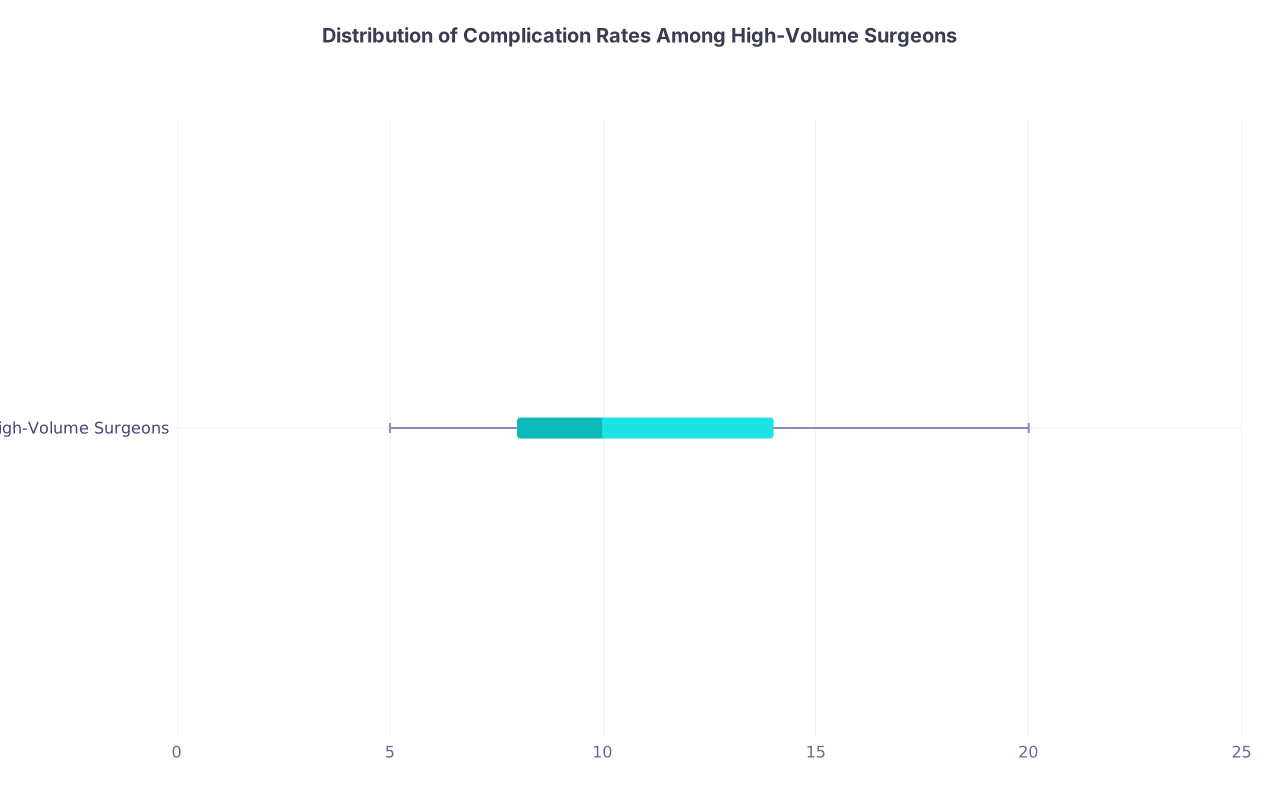
The most damning evidence against the “volume = competence” myth is that when you actually measure outcomes surgeon‑by‑surgeon, you see enormous dispersion inside each volume tier.
| Category | Min | Q1 | Median | Q3 | Max |
|---|---|---|---|---|---|
| High-Volume Surgeons | 5 | 8 | 10 | 14 | 20 |
Among surgeons all doing, say, >50 of a procedure per year:
- Some have half the complication rate of their peers.
- Some are reliably outliers on blood loss, OR time, reoperation, or readmission.
- Many don’t even know they’re outliers because nobody shows them risk‑adjusted dashboards.
Why? Because we’ve historically used volume as an easy, lazy stand‑in for quality. It’s easy to count, looks objective, and supports centralization policies. Actually collecting risk‑adjusted, patient‑centered, procedure‑specific outcomes by surgeon? That’s harder and politically uncomfortable.
So we pretend busy equals good.
Residents And Young Surgeons: How To Think About Your Own Volume
If you’re in training, you’re probably conditioned to obsess over your ACGME case minimums or logbook targets. Programs brag about “our residents graduate with 1,200+ cases” like it’s a badge of automatic excellence.
Here’s the uncomfortable truth: nobody cares that you hit 1,000 cases if your actual competence is inconsistent and your complication rates quietly spike your first attending year.
You’d be far better served to track things like:
- How often you’re primary operator for key steps.
- Your unplanned returns to the OR (even as a junior).
- Anastomotic leaks, bile duct injuries, surgical site infections in your cases.
- How many times attendings need to take over from you for critical errors.
That’s competence. Not your total case count.
I’ve seen chief residents with monster numbers who never learned efficient tissue handling or three‑dimensional thinking in the abdomen because they always bailed out when cases turned ugly. On paper they looked unbeatable. On the table, very different story.
What Actually Predicts Competence Better Than Volume
If you’re serious about separating competence from busyness, you need to look beyond raw counts.
| Factor | Why It Matters |
|---|---|
| Risk-adjusted outcomes | Direct link to patient safety |
| Complication recognition speed | Determines rescue vs failure |
| Technical skill assessment | Correlates with fewer complications |
| System/team quality | Drives consistency of results |
| Deliberate practice & feedback | Prevents plateau after proficiency |
Let me translate that into reality:
Risk‑adjusted outcomes per surgeon. Not just mortality. Think leaks, returns to OR, transfusion rates, LOS, 30‑day readmissions, patient‑reported outcomes. Adjusted for case mix. This consistently shows that some average‑volume surgeons outperform some high‑volume ones.
Technical skill ratings from real video review. There are studies where blinded experts score recorded operations; higher technical scores correlate with lower complication rates. These effects persist even after controlling for volume.
Failure to rescue. Two surgeons might have similar raw complication rates, but one recognizes and manages them early; the other spirals into septic shock and multi‑organ failure. The second may also be “high volume.” You don’t want them.
System integration. Surgeons embedded in high‑reliability organizations with strong protocols often outperform equally skilled surgeons in chaotic environments. “Competence” in practice is surgeon + team + system, not surgeon alone.
Deliberate practice and reflection. Surgeons who routinely review their own cases, track outcomes, adapt techniques, and solicit hard feedback keep improving long after the plateau others hit. You can see it in their data over time.
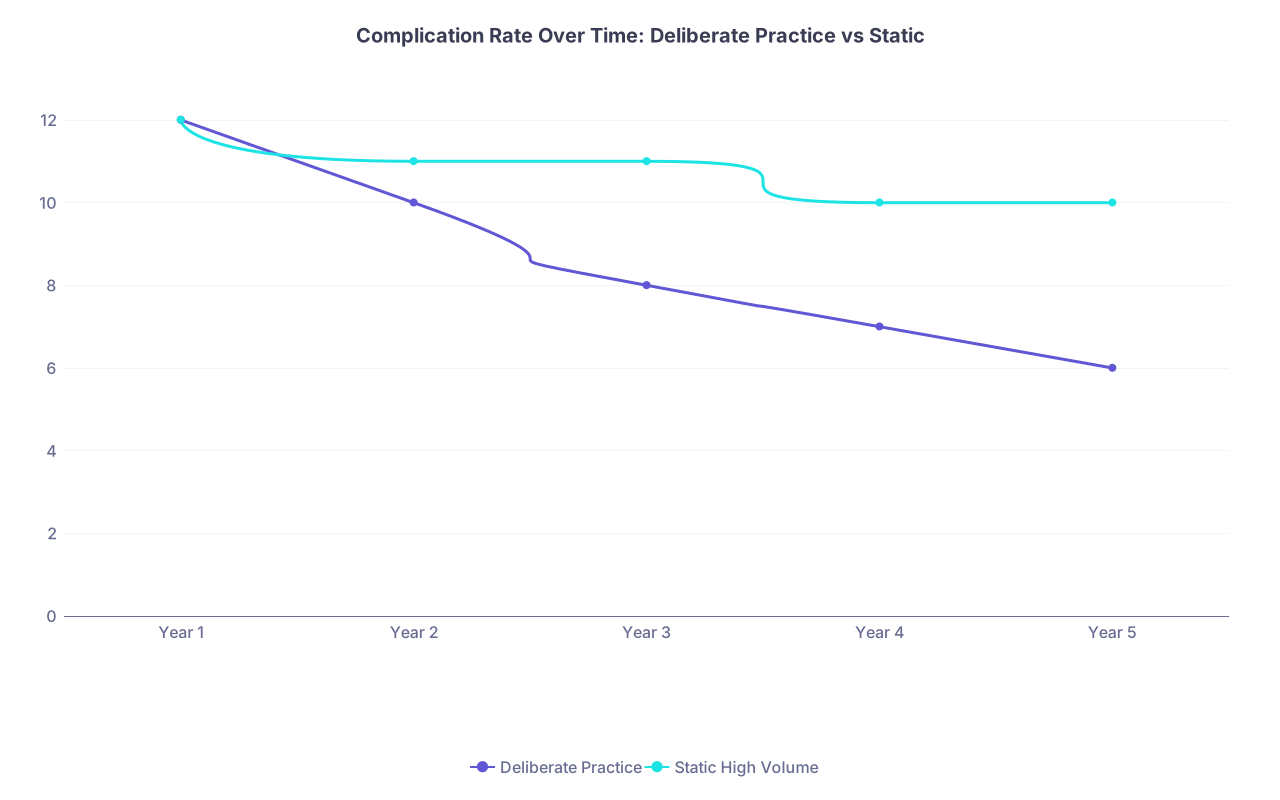
| Category | Deliberate Practice | Static High Volume |
|---|---|---|
| Year 1 | 12 | 12 |
| Year 2 | 10 | 11 |
| Year 3 | 8 | 11 |
| Year 4 | 7 | 10 |
| Year 5 | 6 | 10 |
The deliberate practitioner isn’t necessarily doing more cases. They’re just wringing more learning out of each one.
The Future: From Counting Cases To Measuring Skill
The good news is the field is already moving away from worshiping raw volume as the primary proxy for competence—slowly, painfully, but inevitably.
You can see the shift:
- Video‑based assessment in training. Some programs are requiring residents to submit unedited videos of key operations for structured feedback, not just case logs.
- National registries with surgeon‑level dashboards. Vascular, cardiac, bariatric, colorectal societies are building systems where surgeons can actually see their own outcomes compared to peers (when they’re brave enough to look).
- Competency‑based training. A few places are experimenting with promotion based on demonstrated skill rather than time or raw case numbers—progressing when you’re good enough, not when you’ve simply accumulated enough checkboxes.

| Step | Description |
|---|---|
| Step 1 | Raw Case Counts |
| Step 2 | Minimum Safe Volume |
| Step 3 | Outcomes Tracking |
| Step 4 | Video Skill Assessment |
| Step 5 | Competence-Based Training |
In that future, your value as a surgeon won’t be “I do 500 cases a year.” It’ll be:
- My 30‑day complication rate is in the top decile for my specialty.
- My patients’ functional outcomes beat national benchmarks.
- I participate in structured peer review and continuous improvement.
Volume will still matter—but as context, not as proof of excellence.
So, Does High Case Volume Guarantee Competence?
No. Here’s the blunt verdict:
- Very low volume is dangerous and should be eliminated for complex surgery.
- Moderate volume is usually enough for technical proficiency if combined with good systems and feedback.
- Beyond that, more cases mostly prove that you’re busy—not that you’re good.
The real differentiators are:
- Your risk‑adjusted outcomes, not your case log.
- Your ability to recognize and manage complications, not to avoid them on paper.
- Your engagement with continuous, data‑driven improvement, not your reputation for being “high volume.”