The “perfect” surgical case mix is a fantasy. No residency program covers everything—and the ones that pretend they do are selling a brochure, not reality.
Let me be blunt: residents obsess over case volume and breadth using numbers that are, at best, crude proxies and, at worst, misleading marketing. Programs flex their “1,200–1,500 cases per graduate” slide. Applicants trade rumors on Reddit about which place “has no vascular” or “tons of trauma” as if there’s a magical program where you walk out proficient in every procedure in the CPT book.
That program does not exist. It cannot exist. And the data back that up.
The Data: Even the Big Names Have Holes
Start with what we can actually measure: case logs and accreditation minimums.
The ACGME sets minimum numbers for general surgery and many subspecialties—hernia repairs, colectomies, mastectomies, vascular exposures, pediatric cases, etc. Residents treat those numbers like some mystical threshold of competency. Hit 85 thyroids? Congrats, you’re now “qualified.”
Reality: these are floor values so weak they’re almost safety checks, not training targets. And even then, residents don’t hit them evenly.
Look at graduating general surgery residents across the U.S.:
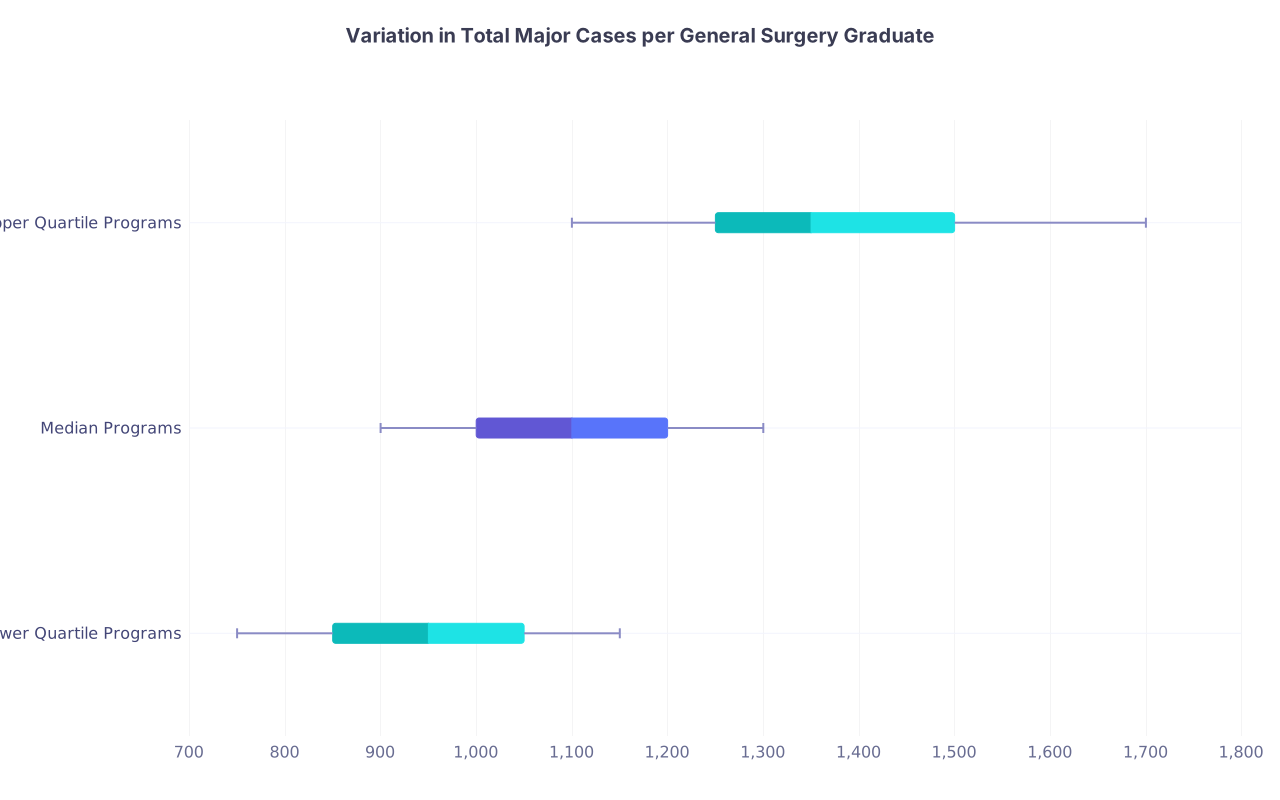
| Category | Min | Q1 | Median | Q3 | Max |
|---|---|---|---|---|---|
| Lower Quartile Programs | 750 | 850 | 950 | 1050 | 1150 |
| Median Programs | 900 | 1000 | 1100 | 1200 | 1300 |
| Upper Quartile Programs | 1100 | 1250 | 1350 | 1500 | 1700 |
What this kind of distribution (from multi‑year case log summaries) shows you:
- Total volume varies wildly.
- Even “high volume” programs differ in what those cases actually are.
- Within the same program, different residents have very different mixes based on rotations, timing, and pure luck.
I’ve watched one chief graduate with 200+ laparoscopic cholecystectomies and under 15 open colectomies, while their co‑resident had relatively few laparoscopic cases but a ton of open cancer resections thanks to one high‑volume attending who went on sabbatical halfway through the year.
Same program. Same year. Completely different experience.
There’s also this inconvenient fact: many ACGME minima are being barely met or failed in specific categories at a non‑trivial number of programs each cycle. Pediatric general surgery, vascular cases, complex HPB—chronic pain points.
So when a program claims “broad exposure to all aspects of general surgery,” translate that into English: “We cover the ACGME case log categories and hope you fill most of them. Some will be thin.”
The Myth of the “Balanced” Case Mix
A lot of residents and med students talk like there’s a perfect middle ground: enough complex cancer, enough bread‑and‑butter, some trauma, some vascular, some minimally invasive, some thoracic, a dash of endocrine. As if you can balance that like a meal plan.
You cannot. Because three hard constraints will always screw with the mix:
- Local population and referral patterns
- Institutional priorities and service lines
- Subspecialty turf and fellow presence
Let’s walk through these.
1. Geography and Referral Patterns Trump Everything
A rural catchment hospital with no nearby level I trauma center is not going to give you penetrating trauma like a big urban hospital. Period. That’s not a “strength or weakness of the program.” It’s just epidemiology and EMS routing.
Likewise:
- A community hospital in a wealthy suburb may be loaded with elective hernias, bariatrics, and gallbladders—but minimal advanced oncologic cases.
- A big referral center might drown you in pancreatic cancer, sarcomas, and redo abdomens while you barely see a straightforward, same‑day lap appy because those stay at the feeders.
- A hospital with an aggressive interventional radiology / GI culture will see fewer open vascular and complex biliary operations than a similar‑sized place where IR is weaker or understaffed.
You cannot “fix” this with scheduling. You cannot brute‑force more gunshot wounds into a low‑crime region. The local ecosystem dictates the raw material of your training.
2. Hospital Strategy Decides Which Cases Exist
Hospitals decide which service lines to build or kill based on money, politics, and regional competition, not your training needs.
Common patterns I’ve seen:
- Systems de‑emphasizing open vascular surgery in favor of endovascular, consolidating open cases at one regional hub.
- Pediatric surgery pushed out to a nearby children’s hospital, which may or may not let general surgery residents touch anything beyond appendectomies.
- Transplant services pulled entirely because the margins are ugly and the call burden is nuclear.
Programs adapt, but you feel the gaps. It’s not because anyone hates residents. It’s because you’re a rounding error in a multi‑million (or billion) dollar enterprise.
3. Fellows and Turf Wars Reshape Your Experience
Everyone loves to say “fellows enhance education.” Sometimes they do. Sometimes they stand between you and the only Whipple of the month.
The tradeoffs are real:
- High‑power HPB/onc fellowship: Great exposure, but chiefs may end up first assist rather than primary operator on the juiciest cases.
- No fellows: More autonomy for residents, but you may simply not have the case complexity or volume the fellows would’ve attracted.
- Aggressive cardiology / IR / GI: They eat cases that used to be surgical (endovascular aneurysm repair, ERCP, POEM, endoscopic bariatrics), shrinking your operative exposure.
Programs spin this both ways: “We have no fellows, so residents get everything,” vs. “We have subspecialty fellowships, so you get advanced exposure.” Both can be true. Both can also be over‑sold.
You cannot have everything:
- Tons of trauma and also a chill lifestyle
- Huge transplant volume and also normal Q3–4 call
- Robust pediatric, vascular, HPB, thoracic, and trauma at every site
That’s not how hospitals work.
What Case Logs Are Actually Telling You (And What They Aren’t)
Residents and applicants love fixating on total major cases. “Program X: 1,500+! Program Y: 900? Hard pass.”
That’s lazy thinking.
| Feature | Program A (High Trauma Center) | Program B (Cancer/HPB Center) |
|---|---|---|
| Total cases per graduate | ~1400 | ~1100 |
| Trauma cases | 350–450 | 80–120 |
| Complex HPB | 40–60 | 120–160 |
| Pediatric surgery | 30–40 | 60–80 |
| Bariatric | 50–80 | 10–30 |
Which one is “better”? Depends who you want to be:
- Future trauma/acute care surgeon? Program A.
- HPB/onc track with a fellowship in mind? Program B.
- No idea, just want broad exposure? Either is fine if they cover ACGME minima and you get solid graduated autonomy.
The key problems with how people read case data:
- They treat totals as a quality score.
- They assume anything “below national median” is a problem.
- They ignore what they can learn in fellowship.
Competence in 2026 and beyond is not “do everything by graduation.” It’s “do core general surgery well; know the anatomy; know how to think; then refine in fellowship or early practice.”
No one expects a fresh grad to be a solo HPB master, pediatric surgeon, and vascular wizard. If they say they do all that, they’re lying to you or to themselves.
The Real Threat Isn’t Missing Cases—It’s Passive Training
Here’s the part almost no one talks about when obsessing over mix: two residents can log the same case and come out at very different skill levels.
Example I’ve seen repeatedly:
- Resident 1: logs 50 laparoscopic right colectomies. But they mostly hold the camera, clip the mesentery once or twice, and close.
- Resident 2: logs 30 right colectomies—but as actual primary operator: port placement, medial‑to‑lateral mobilization, vessel control, anastomosis.
The case log treats these as “50 vs. 30 colon resections.” The second resident is better prepared for real surgery.
Same with trauma:
- Logging 200 “trauma laparotomies” where you retract and suction ≠ 80 cases where you run the bowel, control bleeding, and make decisions.
So this fantasy that there’s a perfect mix that guarantees competence? Wrong axis. The real question is:
- How often are you the surgeon, not the assistant?
- What percentage of your cases are meaningful primary operator experiences by PGY5?
And that’s much more program‑culture dependent than case‑mix‑dependent.
Where Fellows, Technology, and the Future Make “Perfect Mix” Even More Impossible
If you think the case mix problem is bad now, fast‑forward 10–15 years.
Three things are going to fragment surgical experience even more:
Escalating subspecialization and mandatory fellowships
We’re already close to de facto fellowship for complex fields: HPB, colorectal, minimally invasive, trauma/critical care, vascular, thoracic, breast. The “true generalist” who does everything from AAA repair to pancreaticoduodenectomy to congenital pediatric stuff is essentially extinct at scale.That means residency’s job is shifting from “expose you to everything” to “teach you safe general surgery, resuscitation, and fundamental technique.”
Tech cannibalizing categories of cases
Endoscopy, robotics, and IR will continue to eat cases that were once open or laparoscopic operations. Endovascular aneurysm repair. Transcatheter valves. Even some oncologic interventions.Think about that: the pool of certain open cases is shrinking. No program can “cover everything” if “everything” keeps moving away from the OR.
AI and intraoperative guidance systems
These will not eliminate surgeons, but they’ll raise the bar of what’s considered safe and standard. You’ll be expected to:- Interpret multimodal imaging
- Work within hybrid OR environments
- Adjust to platform‑specific workflows (robotic systems, navigation, augmented visualization)
Those are skills you can’t fully gain in a case mix that looks like 1995. So any program that pretends its “classic bread‑and‑butter” lineup is enough by itself is living in the past.
Here’s the punchline: the more complex and fragmented the field becomes, the less realistic the idea of a single “perfect” residency mix.
How You Should Evaluate Case Mix (Without Chasing a Unicorn)
So what do you actually look for, if not a mythical all‑encompassing case portfolio?
You focus on three questions:
- Does this program reliably meet or exceed ACGME minima across core categories, not just total volume?
- Do graduating chiefs feel comfortable handling emergencies and bread‑and‑butter independently? (Ask them directly.)
- Does the case mix align with what I might realistically want to do—or prepare me well for the fellowship I probably will need?
To make this less abstract, imagine plotting how much of your experience comes from different buckets:
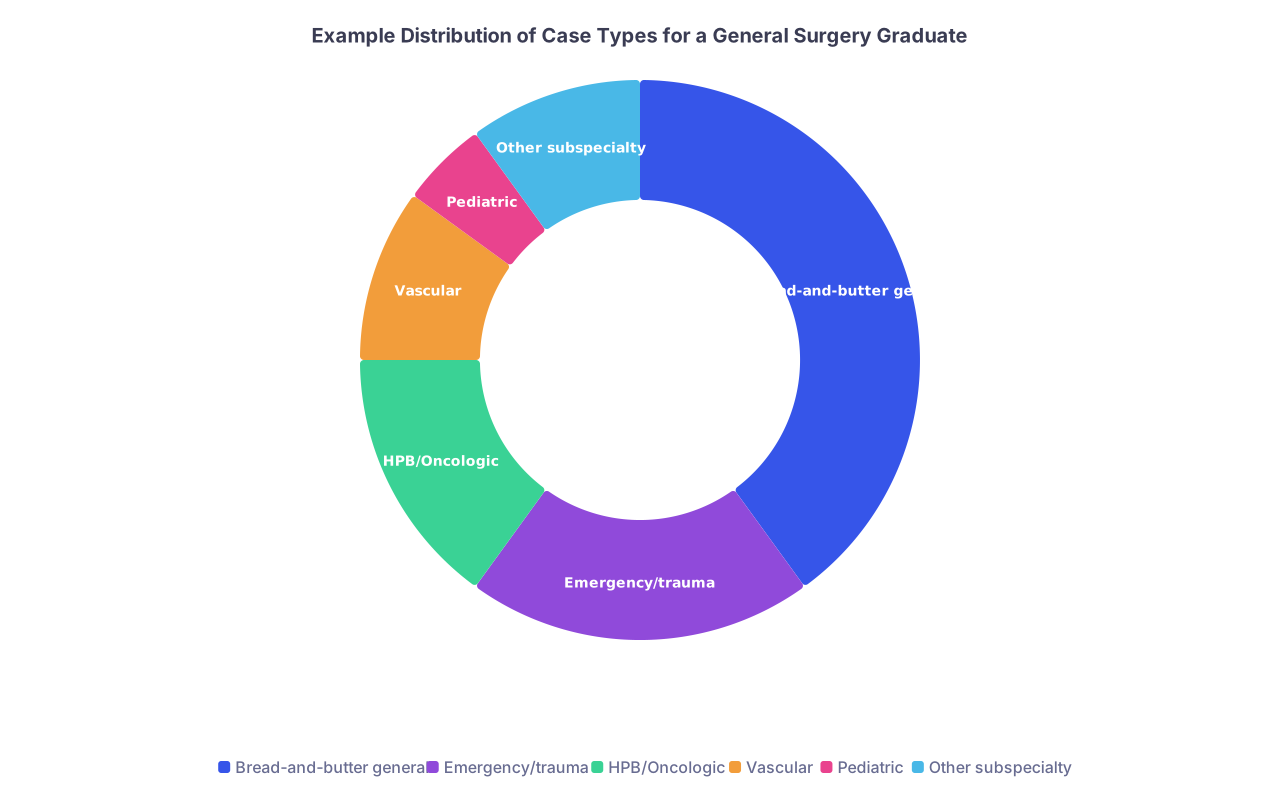
| Category | Value |
|---|---|
| Bread-and-butter general | 40 |
| Emergency/trauma | 20 |
| HPB/Oncologic | 15 |
| Vascular | 10 |
| Pediatric | 5 |
| Other subspecialty | 10 |
That’s a typical “balanced” academic program. Is it perfect? No. You might want more vascular, less peds. More bariatrics, less HPB. But it’s enough to:
- Make you safe in emergencies
- Give you solid general surgery fundamentals
- Let you compete for fellowships that deepen your chosen niche
That’s the real job of residency in modern surgery. Not to cover everything. To cover enough, well, with real autonomy.
What the Smart Applicant/Resident Actually Does
Instead of hunting for perfection, you should be doing two things:
Choose a program that:
- Is transparent about its gaps (because every program has them)
- Has a track record of grads doing what you want to do (community practice vs subspecialty fellowships)
- Has a culture of resident autonomy and graduated responsibility—not just raw numbers.
Once there, deliberately shape your own case mix:
- Volunteer for specific rotations or extra call that give you exposure you’re missing.
- Trade call or cases with co‑residents to avoid being lopsided (all trauma, no elective; or vice versa).
- Use electives—especially late PGY years—surgically (pun intended): go where your log is weakest and your interest is strongest.
And be realistic. If you’re at a place with zero transplant, you’re not going to magically become a transplant surgeon from a couple of visiting months. You’ll need a fellowship at a transplant center. That’s fine. That’s how the system actually works.
The Core Truths You Should Leave With
Let’s strip this down.
- There is no residency with a “perfect” case mix. Geography, hospital strategy, and subspecialization make that mathematically impossible.
- Raw case numbers are overrated; meaningful primary-operator experience in core general surgery is underrated.
- Modern surgery is built on residency + fellowship (often plural). Your goal is not to do everything by PGY5; it’s to be safe, competent, and ready to specialize.
Chase honest programs, real autonomy, and a solid foundation. Stop chasing the imaginary place that “covers everything.” It doesn’t exist—and you don’t need it to become an excellent surgeon.