
The dogma that “more cases always make you better” is wrong. Past a certain point, surgical case volume hits a plateau—and in some scenarios it may even slide into a performance cliff.
Everyone in surgery has heard some version of the same line: “Do 1,000 of these and you’ll finally ‘get it’.” I’ve sat in M&M where someone half-joked that residents should not graduate until they have an RVU problem, not a logbook problem. The culture worships volume. High-volume surgeons. High-volume centers. High-volume fellowships.
But if you actually look at the data—carefully, not cherry-picked to justify hero narratives—the relationship between volume and outcomes is not a straight line. It’s a curve. Steep benefit early. Then diminishing returns. Then, in some contexts, flattening. Sometimes even reversal.
Let’s pull this apart.
The Classic Volume–Outcome Story (That’s Only Half Right)
The original volume–outcome literature was compelling and, to be fair, mostly correct in broad strokes. Higher volume hospitals and surgeons had better outcomes for high-risk procedures: esophagectomy, pancreaticoduodenectomy, CABG, complex oncologic resections. That’s been replicated in multiple countries, databases, and time periods.
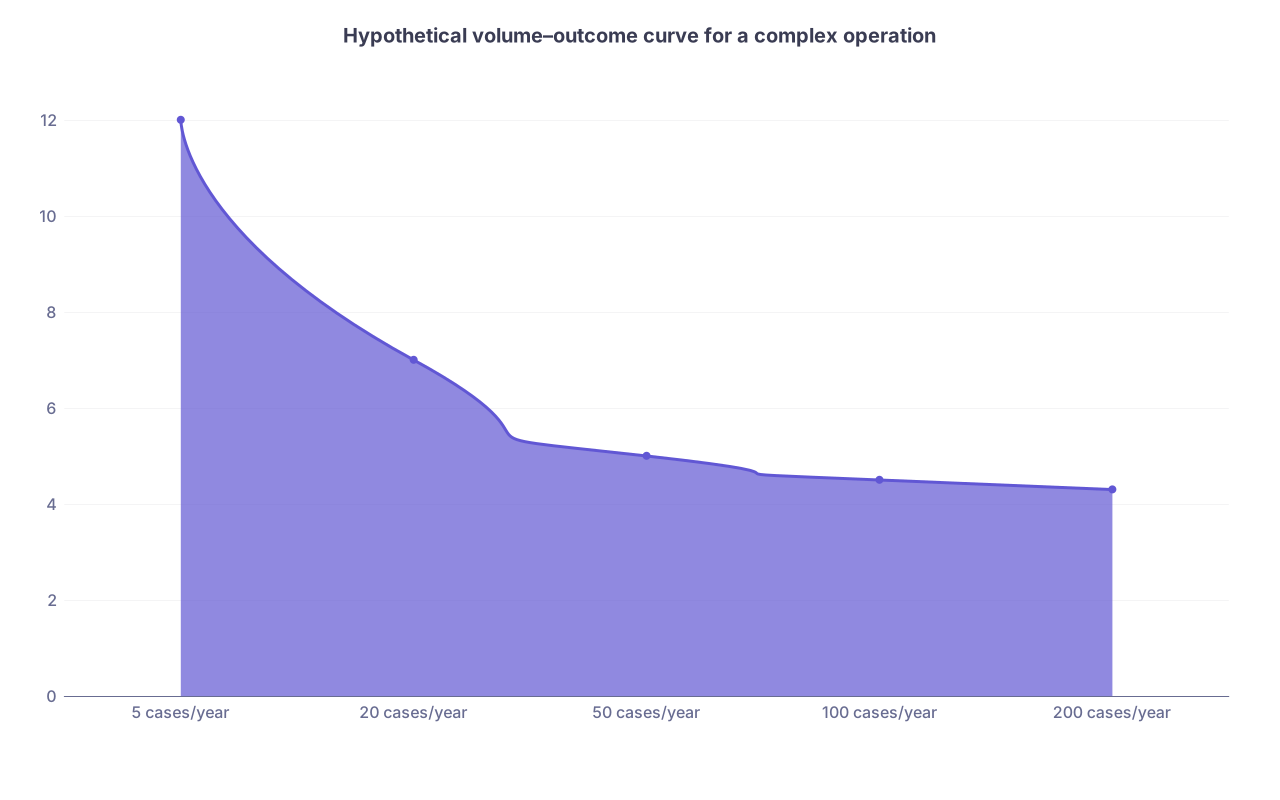
The curve in those studies looks roughly like this: terrible outcomes at very low volume, rapidly improving as you get to “moderate,” then a gentle improvement into “high,” and then… not much change.
| Category | Value |
|---|---|
| 5 cases/year | 12 |
| 20 cases/year | 7 |
| 50 cases/year | 5 |
| 100 cases/year | 4.5 |
| 200 cases/year | 4.3 |
Percent mortality drops fast between 5 and 50 cases per year. Going from 100 to 200 cases? You’re shaving off fractions of a percent. Important at a population level, yes. But for individual skill, the returns are shrinking.
Now layer on several facts the culture tends to ignore:
- Many “high-volume center” advantages are system-level, not individual-skill-level: better ICU staffing, standardized pathways, formal ERAS protocols, specialized anesthesia, better rescue from complications.
- Some of the apparent volume benefit is case-mix: sickest patients being referred to high-volume centers, but often after risk adjustment there’s still signal—just smaller than advertised.
- For common, lower-risk procedures—lap chole, elective hernia, routine ortho—outcomes flatten relatively early in the volume curve.
So yes, volume matters. But it doesn’t grow your skill forever. And “more” stops meaningfully changing your personal performance long before people admit.
The Learning Curve: Steep, Then Boringly Flat
You’ve seen real learning curves in practice. A resident does their first laparoscopic colectomy: clumsy, cautious, 4-hour case. At 20 cases they’re faster, safer, and less stressed. At 100, they’re running on pattern recognition and anticipation. So what happens at 500?
Not much.
Multiple studies across specialties show a similar shape: rapid improvement early, very slow incremental gain later.
Take laparoscopic cholecystectomy in early adopters versus later cohorts. Early in the lap era, complication rates dropped dramatically once a surgeon hit somewhere around 50–75 cases. After that, you see only small differences with further volume. Similar patterns show up in laparoscopic colorectal, bariatric, and even robotic prostatectomy.
The big lie is pretending the slope from case 500 to 1,500 is anything like the slope from case 5 to 100.
What actually happens after you’ve hit basic proficiency:
- You stabilize operative time.
- Your major complication rate levels out.
- You develop a fixed “style” of operating—good in some ways, limiting in others.
- Real improvements tend to come from system changes (checklists, imaging, better tools) more than from raw repetition.
That’s the plateau effect.
And it’s not unique to surgery. Violinists, athletes, chess players, pilots—they all hit a ceiling if they keep doing the same thing in the same way. The brain optimizes for efficiency, not continued growth. Habit beats deliberate refinement.
When More Cases Start Hurting, Not Helping
Here’s where it gets uncomfortable. There are scenarios where more volume may actually worsen performance for individual surgeons, even though the marketing brochures say otherwise.
I’ve seen it in three patterns.
1. Cognitive overload from constant throughput
Production-line OR scheduling is a real thing. Stack three major cases, back to back, with barely enough time to dictate and eat, and tell yourself your last case at 6 p.m. is the same quality as the first.
It is not.
Fatigue, micro-distraction, decision fatigue—these do not show up in your ACS NSQIP summary. They show up in subtle ways: sloppier hemostasis, less patience with tricky anatomy, lower threshold to convert or bail, and occasionally in that “how did that happen?” complication that nobody can quite explain.
There’s data linking surgeon fatigue, overnight call, and late-day cases to worse outcomes in certain settings (orthopedic, cardiac, OB). No one likes those papers because they threaten the hero narrative and the business model. But they’re there.
Beyond a certain daily or weekly case load, you’re not getting “more experienced.” You’re just more tired and less cognitively sharp.
2. Volume without variation
Doing 500 carbon-copy lap choles does not prepare you for a hostile abdomen with portal hypertension and prior biliary surgery. But surgeons talk like 500 of anything automatically equals mastery of everything.
If your case mix is narrow and the complexity is low, you will plateau earlier. You are rehearsing the same well-trodden motor program, not expanding your repertoire.
I’ve seen surgeons with 1,000+ primary hernia repairs who fall apart in the face of a multiply recurrent, mesh-infected, radiated field reconstruction. Their volume never translated into adaptive expertise because the variation was missing.
3. Volume that crowds out thinking and reflection
The cognitive part of surgery—case planning, intraoperative strategy, debriefing what went wrong—is where late-stage gains live. But that non-billable time is exactly what gets squeezed out when “more cases” is the unofficial KPI.
If you stagger from one OR to the next with your pager screaming and notes piling up in the EMR, when exactly are you rewiring your mental models? When are you reviewing videos, redesigning your approach, challenging your own dogma?
You are not. You’re just reinforcing whatever level you already reached.
More volume without protected reflection is reps without coaching. At best you freeze at your plateau. At worst you ingrain bad habits.
Volume vs. Quality: The System-Level Confusion
A lot of sloppy thinking in this space comes from twisting a population-level observation into an individual-level prescription.
At the system level, centralizing complex procedures to high-volume centers makes sense. If a pancreaticoduodenectomy is done at a hospital that does 60 per year instead of 2, risk-adjusted mortality drops. That’s real and important.
But that does not mean:
- Every individual surgeon at that center improves endlessly with more cases.
- Every resident needs to hit some arbitrary giant case number to be competent.
- You, personally, will always benefit from taking on more cases rather than optimizing how you do the ones you already have.
The system-level curves and the individual learning curves are related, but they’re not the same.
To make it concrete:
| Level | What volume mainly changes | Plateau behavior |
|---|---|---|
| Hospital | Processes, ICU, rescue | High, but real |
| Team/Service | Coordination, handoffs, norms | Moderate |
| Individual surgeon | Technical skill, judgment | Earlier, pronounced |
The myth is pretending that because hospital-level curves keep trending modestly better with more volume, the individual surgeon is on the same endless upward trajectory. They are not.
Training: The Obsession With Case Numbers Is Lazy
Residency and fellowship logbooks have turned “more cases” into a proxy for “better training.” It’s crude and shallow, but it’s easy to count, so programs lean on it.
You hear PGY-4s say, “I’ve already met my breast numbers” as if some magic threshold has been crossed and now they’re good. Or fellowship applicants brag about doing 1,000 robotic cases as a console surgeon, which sounds impressive until you watch them struggle with an unusual anatomy variation.
The core problem: case volume is a quantity metric being used to infer quality in an environment where the plateau effect is very real.
I’d rather see this kind of profile for a graduate:
- 50–100 well-supervised, progressively complex cases in a given domain.
- Documented performance metrics: time to key steps, error rates, need for attending rescue, virtual reality metrics if available.
- Video-reviewed cases showing adaptive decision-making in non-routine scenarios.
Versus:
- 300+ checkbox cases with variable supervision and no objective assessment.
One smart, well-debriefed complication teaches more than 20 routine straightforward cases done half-asleep.
The current volume fetish hides a cowardice in training design: it’s easier to demand more numbers than to build robust assessment of real competence.
The Future: From “More Cases” to “Smarter Cases”
Where this gets interesting is how technology is starting to cut across the “more is better” myth.
Video, metrics, and granular feedback
If you have structured, high-quality video and performance analytics, the need for sheer volume drops dramatically. You can compress learning by making each case count more.
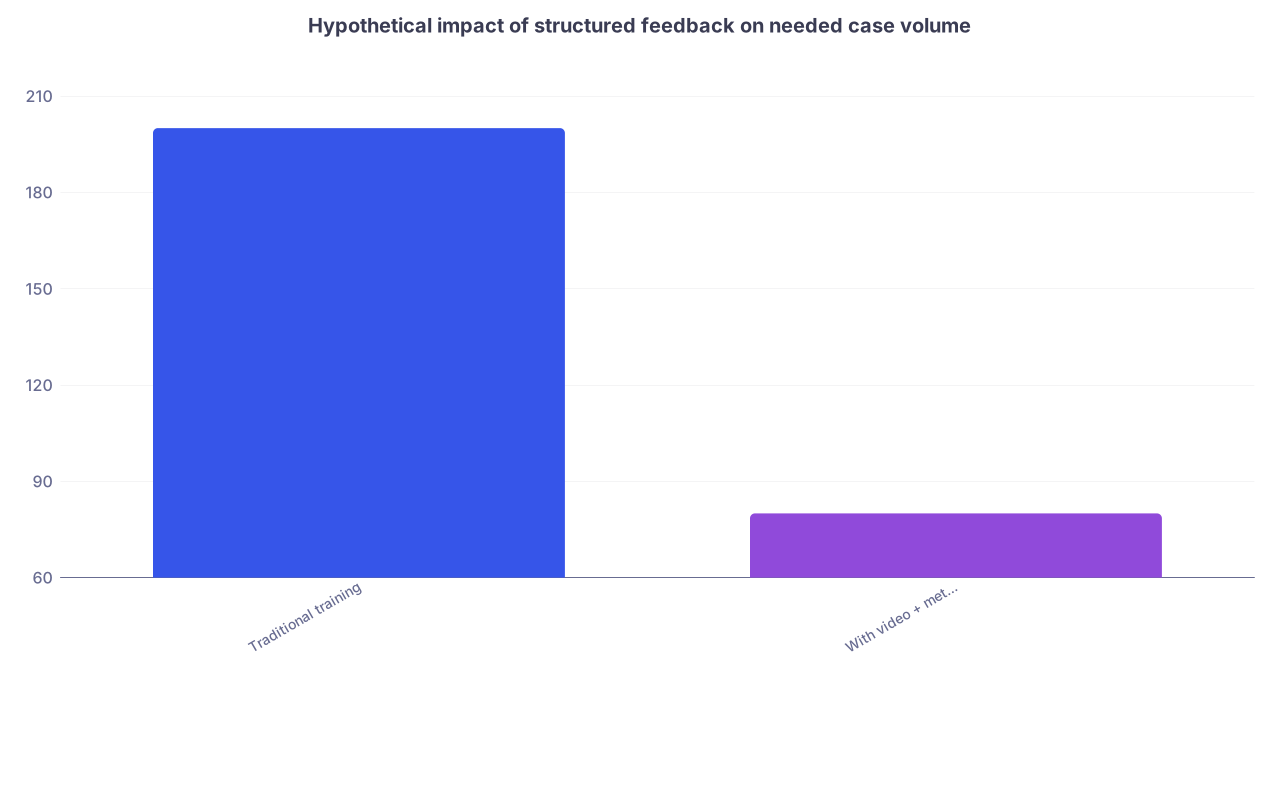
A surgeon who does 50 colon resections with detailed video review, step-specific time and error metrics, and targeted coaching may end up better than someone who does 200 with no feedback beyond “patient survived, length of stay was fine.”
There are early data in laparoscopic and robotic training showing that objective metrics and simulation can accelerate the slope of the learning curve. If the curve is steeper, you hit the plateau faster—with fewer cases. That’s not a bug. That’s an efficiency gain.
Simulation that actually matters
Most surgical simulation is still glorified warm-up. But high-fidelity, metrics-based simulators that force you into non-routine scenarios—aberrant anatomy, massive bleeding, equipment failure—let you practice rare but critical events that you may never see in hundreds of routine real cases.
You’re bypassing the brute-force volume model and going straight for the meaningful edge cases.
AI as the uncomfortable mirror
AI-assisted video analysis can already pick up things humans gloss over: instrument path efficiency, idle time, camera control, unnecessary movements. Early projects in bariatrics, colorectal, and gyn are showing correlations between these micro-metrics and complication rates.
What that means: you can get precise, actionable feedback on your technique far beyond “case went fine.” Which again reduces the need for sheer volume.
Instead of “do 1,000 cases,” the future looks more like “do 200 cases, but every one is analyzed, debriefed, and iteratively refined.”
| Category | Value |
|---|---|
| Traditional training | 200 |
| With video + metrics | 80 |
Call the numbers illustrative, not literal. The direction of effect is real.
Where Volume Still Matters (A Lot)
I’m not arguing volume is irrelevant. Some domains remain heavily volume-sensitive:
- Truly rare, complex procedures (pediatric transplant, complex congenital heart disease).
- Low-frequency but catastrophic complications where pattern recognition and rescue matter.
- New technologies where the whole field is climbing the early, steep part of the curve.
If you’re doing something tremendously complex, where each case is basically its own snowstorm, the plateau happens later. It still happens, but you may need a lot more volume to get there.
What I am saying is that the blanket mindset—“more is always better, for everyone, forever”—is lazy thinking.
You should be asking:
- Where am I on my personal curve for this operation?
- Is my constraint lack of reps, or lack of feedback and variety?
- Am I working at a volume that helps me learn or one that just exhausts me?
Those questions are almost never asked. They should be.
So, Is More Always Better?
No. More cases are better until they are not. That’s the short, impolite answer.
The plateau effect in surgical case volume is real:
Skill and outcomes improve rapidly early, then hit diminishing returns and often a true plateau at the individual surgeon level. Piling on more routine cases doesn’t magically keep pushing you upward.
Past a certain point, additional volume mainly increases fatigue and cements habits, rather than enhancing judgment and technique—especially without structured feedback, variation, and reflection.
The future of surgical excellence is not about worshiping raw case numbers; it’s about making each case smarter, better measured, and more educational, so you reach a higher level with fewer, better-used repetitions.
If your only growth plan is “do more cases,” you’re not chasing mastery. You’re just chasing throughput.