The dogma that “more robot time is always better” is wrong. So is the old-school claim that “real surgeons are made in open cases.” The data say something much less romantic and much more uncomfortable: raw robot hours or open case counts matter a lot less than how those cases are structured, supervised, and varied.
Let’s dismantle the myths and look at what actually builds a safe, independent surgeon.
The Two Competing Religions in OR Training
You’ve heard both sermons.
On one side: the robot faithful.
“Just get on the console as early as possible. Volume, volume, volume. The console is a video game—log enough hours and you’ll be fine.”
On the other: the open fundamentalists.
“You kids are soft. You don’t know how to deal with bleeding because you’ve never done a real open case. Robot is cheating. Open cases make surgeons.”
Both are selling half-truths.
The reality from the literature and from what I’ve watched in actual residency programs is this:
- Robotic volume does correlate with technical proficiency—to a point—but plateaus early if cases are repetitive and supervision weak.
- Open experience is crucial for understanding anatomy, 3D spatial orientation, tissue handling, and bailouts—but you hit diminishing returns after a certain threshold.
- Case mix, graduated autonomy, and deliberate feedback predict competence better than any simple robot vs open tally.
Let me put numbers behind that instead of vibes.
What the Data Actually Show About Learning Curves
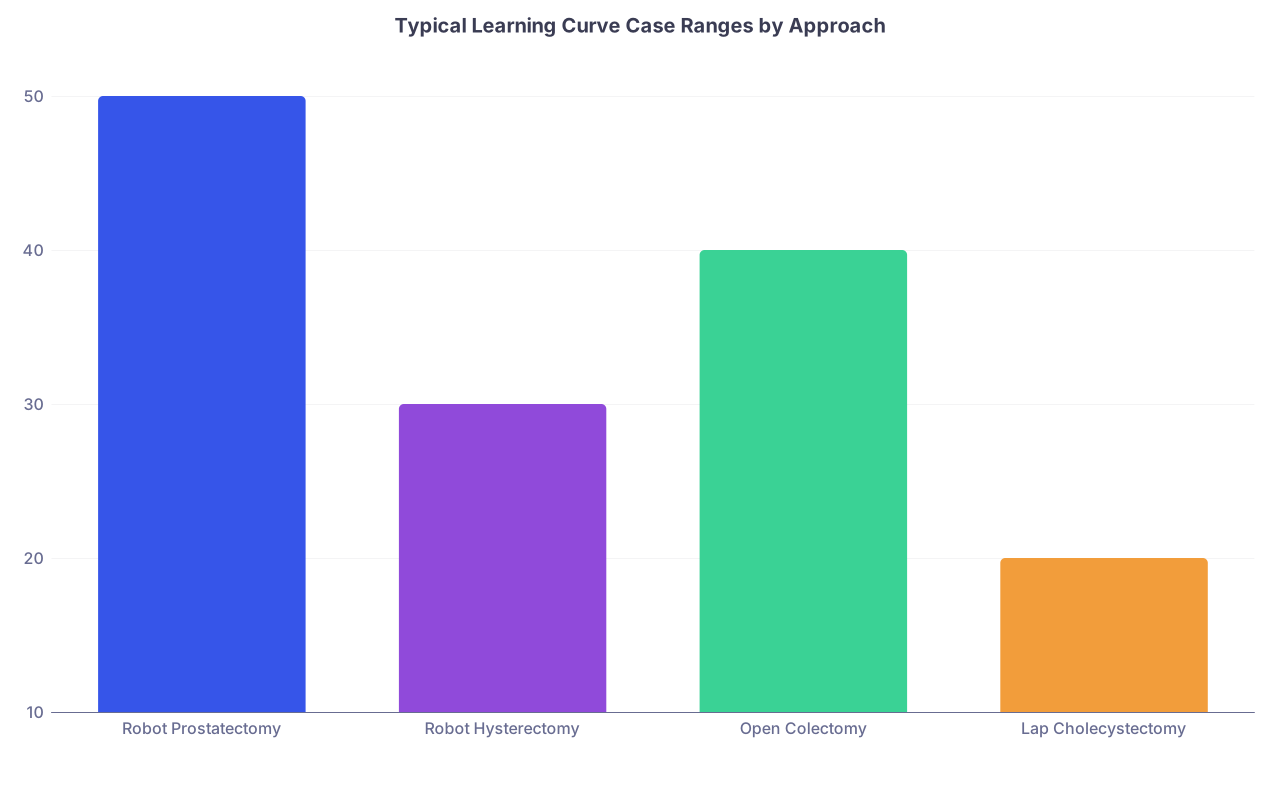
You can’t talk about “how many cases matter” without discussing learning curves. Different procedures have different curves, but the pattern is surprisingly consistent.
| Category | Value |
|---|---|
| Robot Prostatectomy | 50 |
| Robot Hysterectomy | 30 |
| Open Colectomy | 40 |
| Lap Cholecystectomy | 20 |
Those bars aren’t exact gospel—they’re midpoints from multiple series—but they reflect a pattern seen across urology, gyn, and general surgery literature:
- For many robotic procedures, measurable efficiency and complication rates significantly improve over the first ~20–40 cases, then gains flatten.
- For common open operations, major gains are often seen in the first ~20–40 independent or near-independent cases.
- Beyond that, each additional case gives smaller incremental improvement unless there’s added complexity (redo surgery, hostile abdomen, obese patient, bleeding disaster).
Robotic prostatectomy studies, for example, consistently show:
- Steep improvement in console time and complications over the first 25–50 cases
- Gradual improvement up to around 100–150 cases
- After that, tiny marginal gains per case unless the complexity mix changes (high BMI, salvage, prior radiation, etc.)
This is why you can’t just say “resident A did 150 robotic prostates, resident B did 30—A must be better.” If those 150 were all cookie-cutter, low-BMI, teaching-hospital patients where the attending “rescued” the hard parts, A may not be meaningfully more competent.
What matters is:
- Did they do critical steps themselves?
- Did they see enough variety and complications?
- Did they get real-time, specific feedback?
Volumes without those things are cosmetic.
The Open Case Myth: “You Need Tons of Laparotomy to Be Safe”
Here’s where the old guard often misleads trainees. You absolutely need open training. You absolutely do not need endless open volume to be safe in a robotic/laparoscopic era.
Let’s separate two things:
Baseline open skills:
- Midline laparotomy, entry and closure
- Basic exposure, packing, retracting intelligently
- Handling small bowel, colon, solid organs without shredding them
- Control of bleeding from small–moderate vessels, suture ligation, stick ties
- Performing at least a moderate number of common operations where you do 80–90% of the case
Rare catastrophe management:
- Suprarenal IVC tear, porta hepatis blowout, reoperative radiation-scarred pelvis from hell
The second category is romanticized as “what makes a real surgeon,” but it’s not realistic to train everyone on dozens of catastrophic scenarios. No program can manufacture that volume safely.
What you can and should get is:
- Enough open index cases where you learn tissue planes, bleeding control, hand–eye coordination, and how to think in 3D without a magnified screen.
- Enough complex or messy cases (bad choles, inflamed diverticulitis, perforations) to know how things look and feel when they’re not clean textbook anatomy.
And then you learn that open is not a religion; it’s just another tool. The question isn’t “How many open cases do you have?” but “When something bad happens in a minimally invasive case, do you recognize it early and know when and how to convert?” That’s judgment plus baseline open skill, not hero volume.
The Robot Myth: “Console Time Is All That Matters”
I’ve seen the other side too: programs bragging their chief residents have 400–600 robotic cases “logged.” You scratch the surface and discover:
- The attending did port placement, critical dissection, and anastomosis.
- The resident drove the camera, did some simple suturing, then “observed” the hard parts.
- Half the cases were variations of the same straightforward procedure.
Here’s what the evidence and common sense say:
- Simulation + focused early console exposure shortens the learning curve. Fine.
- Past a certain procedural count (often 30–50 for core operations), the value of the next 50 console cases depends entirely on case complexity and autonomy.
Multiple series in urology and colorectal surgery show:
- Residents with fewer but higher-autonomy cases perform as well or better in early practice than residents with higher raw counts but low autonomy.
- Intraoperative complication rates do not magically drop after case 200 if the trainee never actually handled difficult steps.
So “console time” as a metric is lazy. You need to know:
- Percent of case performed by the resident
- Which steps: entry, vascular pedicles, critical nerve-sparing, anastomosis
- Case difficulty: BMI, prior surgery, inflammation, radiation, etc.
Without this, robot numbers are just OR vanity metrics.
What Actually Predicts Competence: It’s Not Just Count
Let’s be blunt: the current ACGME minimum case numbers are mostly political compromises, not precise competence thresholds. Program directors know this. They privately track things the case log doesn’t show.
The ingredients that actually move the needle:
Deliberate practice, not passive repetition
Cases where:- You get specific feedback (“Your needle angle is off; rotate your wrist this way”)
- You repeat the same targeted skill in multiple cases (e.g., every anastomosis you close the posterior wall)
Ascending complexity
Starting with straightforward cases, then adding:- Higher BMI
- Prior abdominal surgery
- Severe inflammation / sepsis
- Redo operations, anatomic variants
Real autonomy with real accountability
You do full cases (or full major segments of cases) with:- Attending actually letting you struggle within a safe window
- You making intraoperative decisions, not just following instructions
- You presenting plan B and plan C when plan A is failing
Cross-modality translation
Seeing the same pathology:- In open cases (gut in your hands)
- In lap/robot (magnified, different angles)
- In imaging (CT, MRI, intra-op ultrasound)
That integration wires your brain to recognize trouble early on a screen, because you know how it feels and looks in open surgery and imaging.

| Step | Description |
|---|---|
| Step 1 | Basic Open Skills |
| Step 2 | Minimally Invasive Basics |
| Step 3 | Graduated Autonomy |
| Step 4 | Increasing Complexity |
| Step 5 | Complication Management |
| Step 6 | Independent Practice Ready |
The usual robot-vs-open argument skips this entire framework and fixates on the wrong variable: count by approach.
Where Each Modality Actually Shines in Training
Instead of pitting them against each other, use each for what it does best educationally.
Open: Foundation and Bailout
Open is unbeatable for:
3D anatomy and tactile sense
You learn how the SMA pulse feels under your finger, what edematous small bowel feels like, how friable tissue tears. No console reproduces that.Understanding how bad things get bad
You see the full picture: the pool of blood, the mesentery torn to shreds, the retroperitoneum blown open. That burns itself into your memory when you’re back on the robot watching hemoglobin quietly drop.Bailout credibility
If you’ve never:- Opened a hostile abdomen
- Taken down dense adhesions
- Controlled a bleeding vessel you can’t see clearly
you’re not safe doing “cool” minimally invasive cases alone. Period.
Robotic/Minimally Invasive: Precision and Fine Motor Control
Robot is outstanding for:
Fine suturing and precision
Urethrovesical anastomosis, intracorporeal bowel anastomosis, precise lysis around vital structures—this is where many residents actually learn consistent, reproducible suturing technique.Complex pelvic and deep-space work
Low anterior resection, deep pelvic hysterectomy, radical prostatectomy—robot magnification and articulation make these areas teachable rather than pure attending art.Early independent technical work
Attendings are often more comfortable letting residents control 80–90% of a robot case earlier in training than an equivalent open case. That increases real operative reps.
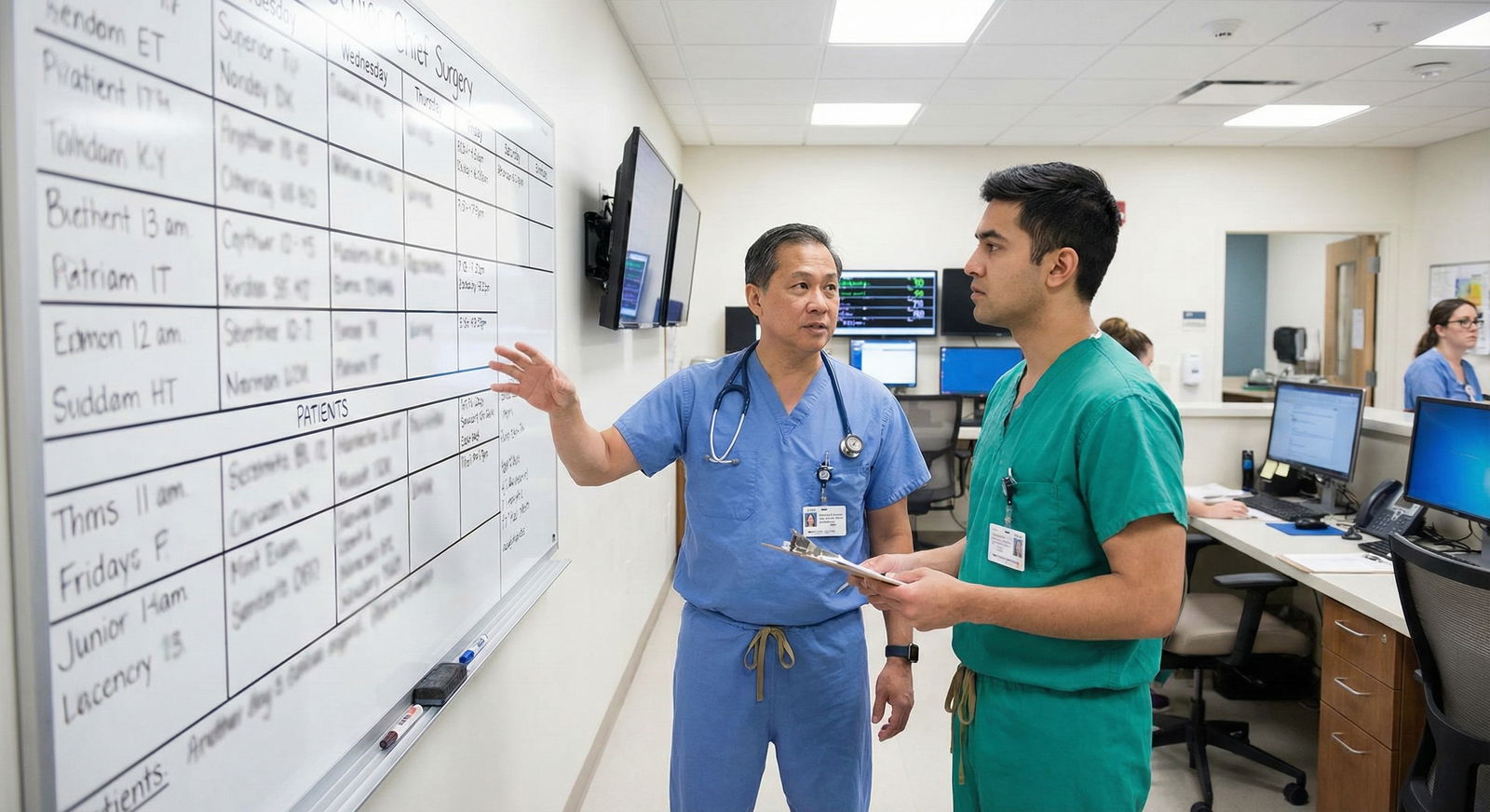
Both are tools. Good programs leverage both strategically. Bad programs turn them into turf wars.
How Much Is “Enough”? A More Honest Framework
Everyone wants magic numbers. They don’t exist. But you can define “enough” more honestly by looking at competencies instead of raw counts.
Here’s a simplified way to think about it.
| Domain | Minimum Useful Volume* | Quality Indicators |
|---|---|---|
| Open fundamentals | ~40–60 core cases | You can open/close, expose, and control bleeding in routine scenarios with minimal guidance |
| Robot fundamentals | ~30–50 primary cases | You can dock, perform basic dissection, and do standard suturing independently in low-complexity cases |
| Complex open bailout | ~10–20 real cases | You have participated meaningfully in conversions, reoperations, and major bleeding control |
| Complex robot/lap cases | ~20–30 higher-risk | You have led major steps in high-BMI, prior-surgery, inflamed or redo cases |
*Those numbers are ballpark ranges, not pass/fail thresholds. If you hit the upper end but have poor autonomy and no complexity, you’re still undertrained.
The question you should ask yourself near graduation isn’t “How many robotic cases?” or “How many open?” It’s:
- Can I safely and confidently do X category of cases alone?
- When things go sideways, have I seen that kind of disaster before in some form—on screen or open?
- Do I know when to call for help or convert, and have I actually done that under supervision?
If the answer is no, an extra 100 console hours won’t fix it.
The Hidden Problem: Case Logs Lie
One more uncomfortable truth: case logs are easy to game.
I’ve seen:
- Residents “double-logging” robot and lap roles on the same case
- Cases logged as “surgeon junior” where the resident did 10% of the work
- Conversions logged creatively to make the numbers look better
Programs know this. That’s why better ones now track:
- Percentage of case performed
- Specific key steps you did (arterial ligation, anastomosis, critical nerve-sparing, etc.)
- Level of assistance required (verbal guidance vs physical takeover)
If your program doesn’t do this, you should track it yourself. A simple spreadsheet with:
- Case ID
- Approach (open/lap/robot)
- Complexity level (1–3)
- Steps you performed
- Brief comment on any complication or bailout
That personal log will tell you far more about your readiness than the official system.
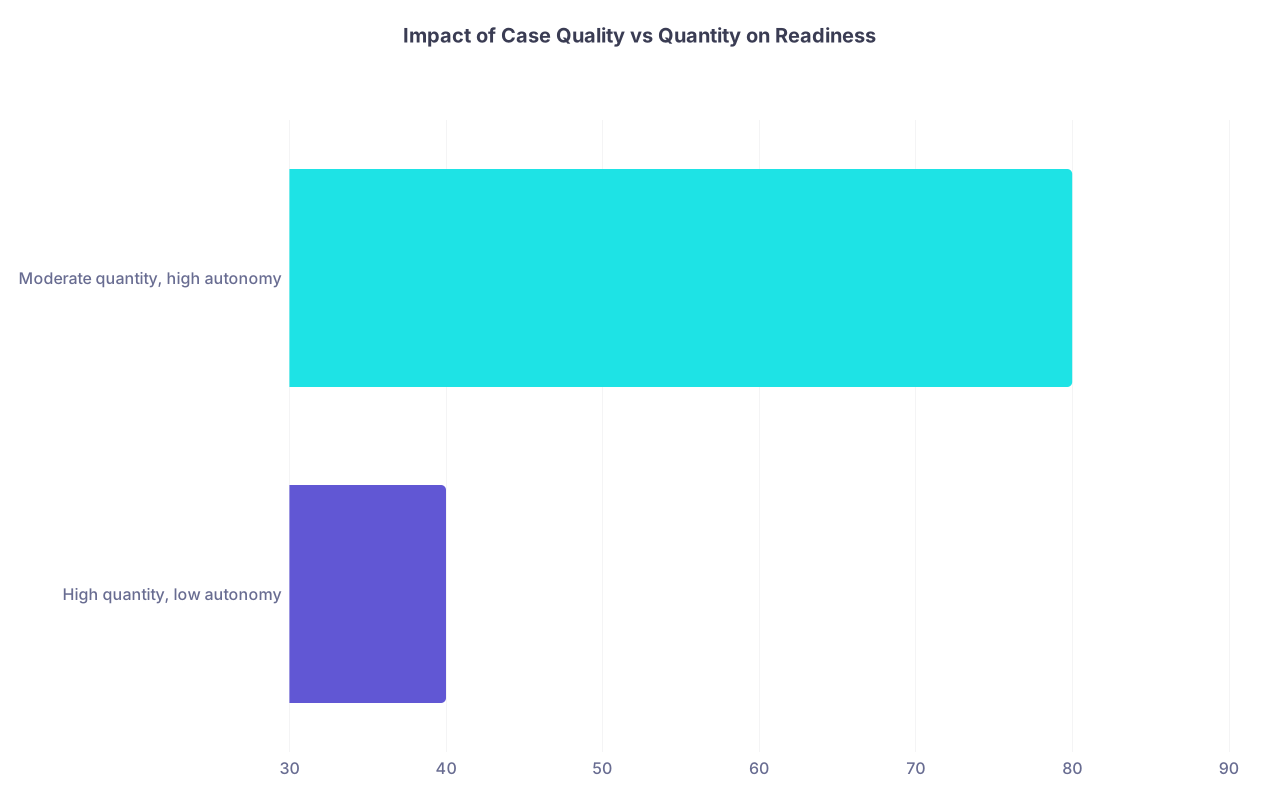
| Category | Value |
|---|---|
| High quantity, low autonomy | 40 |
| Moderate quantity, high autonomy | 80 |
Interpretation: In surveys and some outcomes data, self-reported readiness for independent practice often looks closer to the second bar—moderate volume with real responsibility beats big numbers with minimal control.
Where This Is Heading: The Future Is Competency, Not Count
The robot vs open debate is already getting outdated. Here’s where training is clearly going:
Competency-based progression:
You’ll see more milestones like “Can independently perform a standard lap chole with minimal attending input” rather than “has logged 85 gallbladders.”Simulation that actually matters:
Not just drylab check-the-box modules, but case-based simulations of complications, crisis management, and conversions that are tied to advancement.Structured graded autonomy:
OR checklists where the attending documents which steps you owned and how much support you needed, across approaches.Outcome-linked credentialing:
Hospital privileging that looks at your individual outcomes in fellowship/practice, not just your residency case count by approach.

| Step | Description |
|---|---|
| Step 1 | Simulation |
| Step 2 | Supervised Basic Cases |
| Step 3 | Autonomous Standard Cases |
| Step 4 | Supervised Complex Cases |
| Step 5 | Autonomous Complex Cases |
| Step 6 | Outcome Based Credentialing |
When that system fully matures, “Does robot time count more than open time?” won’t even be the right question anymore.
The Bottom Line: What Volume Actually Matters
Let me cut through all of it.
You need both robot and open, but not infinite of either. Enough open to build real bailout and tissue-handling skills; enough robot to be technically smooth and safe on screen. Past moderate thresholds, quality and complexity beat raw count.
Autonomy, variety, and complication exposure matter more than logs. A resident with 60 high-autonomy, mixed-complexity robotic and open cases in a domain is usually more prepared than one with 200 low-stakes, attending-driven cases.
Stop worshiping approach; start tracking competencies. Ask not “How many robots did I do?” Ask “Can I independently perform the full operation, manage common complications, and convert effectively when needed?”
Everything else is OR bravado.