What if the “high‑volume academic powerhouse” you’re chasing actually gives you less real operating time than the community place you’re ignoring?
That’s not a hypothetical. I’ve watched residents turn down community-heavy programs for “brand name” university hospitals, then message former co-residents two years later asking how to moonlight just to get more reps.
Let’s dismantle the dogma.
The mythology goes like this:
Academic = big numbers, big cases, high complexity.
Community = low numbers, bread-and-butter, limited exposure.
The data – and the lived reality of a lot of trainees and early‑career surgeons – does not support that clean split.
Myth #1: “Academic Centers Always Have Higher Surgical Volume”
Sometimes true. Often false. Depends where you stand in the food chain.
Here’s the distinction people conveniently ignore:
There’s institutional volume and there’s surgeon/trainee volume. They are not the same thing.
Academic flagships love to show you:
- “We do 1,500+ cardiac cases per year.”
- “Top decile in oncologic surgical volume.”
- “Level 1 trauma center with 3,000+ trauma activations.”
Looks impressive on a website. But the question you actually care about is:
How many cases will you touch, and how many of those will you actually do?
At large academic centers:
- Cases are divided between:
- Attendings
- Fellows (often multiple)
- Senior residents
- Sometimes advanced practice providers in the OR
- Complex cases stretch longer, so total case count per day per surgeon can drop
- Subspecialization means attendings focus tightly, which is great for outcomes, not always great for generalist trainee volume
Compare this to a busy community hospital with a few high-output surgeons:
- No fellows competing for cases
- Fewer learners in the room
- Surgeons often run 2 rooms, doing shorter but high-throughput cases
- Residents (if present) or early-career partners actually operate, not just retract
So yes, Cedars, MGH, Hopkins, Mayo – huge overall numbers. But you don’t operate as “the hospital.” You operate as one human with two hands and a limited weekly OR block.
If you want a quick mental model:
Academic = high system volume, variable per-person volume.
Community = variable system volume, often higher per-person volume, especially for bread-and-butter.
| Setting | Total Hospital Volume | Trainee/Junior Surgeon Case Volume | Fellows Competing? |
|---|---|---|---|
| Big Academic Flagship | Very High | Moderate to High (but variable) | Often Multiple |
| Mid‑size University | Moderate to High | Often Good | 0–1 per service |
| Busy Community | Moderate to High | Often High | Rare |
| Small Rural | Low to Moderate | Can be High for General Bread & Butter | None |
Notice the pattern: “High volume” doesn’t automatically trickle down to you.
Myth #2: “Community Volume Is All Bread-and-Butter and Low Complexity”
There’s some truth here – community hospitals are not doing ex vivo liver transplants or massive pelvic sarcoma resections.
But the caricature that community surgeons just do hernias and laparoscopic cholecystectomies all day is outdated and lazy.
Here’s what actually happens:
- High-acuity emergencies: perforated viscera, strangulated hernias, necrotizing soft tissue infections, complex appendicitis, septic abdomens. You see tons of this in busy community hospitals.
- Real-world comorbidity: older, sicker patients without “perfect” optimization. The ASA 4 with no PCP who shows up in extremis – that’s a community staple.
- Complex revisions: failed laparoscopic cases from ambulatory centers get bounced to hospitals that “do everything.”
- Oncologic resections: in many regions, colectomies, gastrectomies, some pancreatic resections, lung resections, and complex gyn onc cases are done at non‑academic centers by very high-volume specialists.
And the key part: you actually do them.
At an academic center, that perforated sigmoid in a train wreck COPD patient might go to a colorectal super-specialist with a fellow; the PGY‑2 holds a camera for 20% of the case and is sent out to clinic.
At a busy community place, the same case may be handled by the on‑call general surgeon with a single resident or no trainee at all. If there is a resident, they’re far more likely to be primary surgeon for substantial portions of the case once they’ve demonstrated basic competence.
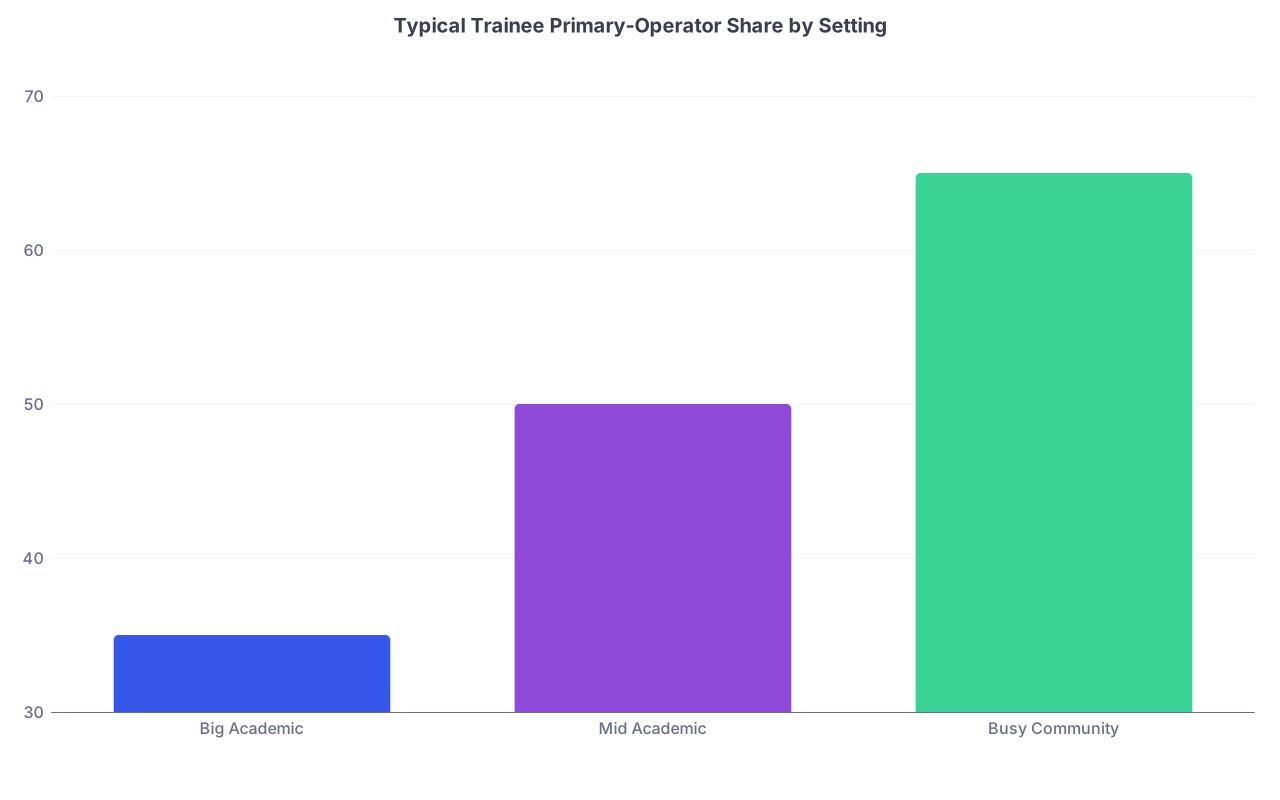
| Category | Value |
|---|---|
| Big Academic | 35 |
| Mid Academic | 50 |
| Busy Community | 65 |
Are those numbers exact? No. But if you talk honestly to chiefs who split time at a university hospital and an affiliated community site, this is the pattern you hear over and over.
Community isn’t “low complexity.” It’s “different complexity” – less exotic pathology, more real-world mess.
Myth #3: “Academic Volume = Better Surgical Skill”
This one is quietly destructive.
The assumption goes:
“If I train at a massive academic center, I’ll automatically be a better surgeon than someone from a community-heavy program.”
Evidence does not back that idea.
Let’s look at what actually drives technical skill:
- Repetition of core procedures
- Progressive autonomy (you actually do the hard parts, not just close)
- Quality of feedback and teaching
- Personality and drive of the trainee
You get no magical motor cortex upgrade just by having “University of X” stitched on your white coat.
Studies on resident case logs show wide variation within every type of program. I’ve seen chiefs at academic powerhouses who are uncomfortable with basic open colectomy because “we do everything minimally invasive with the fellow,” while chiefs from hybrid community programs run a trauma laparotomy solo at 3 a.m. without flinching.
One more harsh reality: some high-prestige services hoard the most “sexy” cases for attendings or fellows to optimize their own outcomes, publications, and reputation. Residents become spectators with good Instagram stories and weak hands.
Skill comes from:
- Doing 200+ laparoscopic choles where you handle the dissection, not just the camera.
- Managing complications yourself rather than calling five layers of backup every time something bleeds.
- Doing the full operation consistently, not just “skin to skin for learning” while the attending does the one difficult step every time.
If you want skill, you chase case ownership, not hospital branding.
Myth #4: “You Must Train Academic if You Want Complex Cases”
This is half-true and half-lie.
If you want to be a liver transplant surgeon, pediatric neurosurgeon, or advanced thoracic tracheal reconstruction specialist – yes, you’re going to need academic centers at some point.
But residents massively overestimate how much “ultra-complex” surgery they’ll do as attendings. Most surgeons – including a lot of academic ones – make their living with a core set of operations:
- Cholecystectomies
- Hernias
- Bowel resections
- Hysterectomies
- Appendectomies
- Basic oncologic resections
- Orthopedic joint replacements and fracture care
- Spine decompressions and fusions
- CABG and valve procedures
Guess where a huge chunk of those happen? Not at the ivory tower.
The more uncomfortable truth: some of the best “complex” surgeons out there did moderate‑prestige residency + high-volume fellowship and then quietly became monsters in the OR because they work in systems where they operate constantly.
What academic training often does give you that community usually can’t:
- Structured exposure to rare diseases and niche subspecialties
- Organized research infrastructure if you’re gunning for an academic career
- Multidisciplinary conferences (tumor boards, etc.) at scale
- A pipeline to certain elite fellowships
But that’s not the same as guaranteed superior hands.
Where Community Clearly Wins: Reps and Autonomy
Let’s talk about what most residents actually care about by PGY‑3:
“How many cases do I get, and how much of each case do I actually do?”
Community-heavy settings often win here, and it is not even subtle.
Patterns I’ve seen repeatedly:
- PGY‑2 at busy community affiliate runs straightforward choles and appendectomies skin‑to‑skin with attending scrubbed but quiet.
- PGY‑3 in large academic main OR still “sharing” cases with a fellow and another resident while the attending “helps on the critical parts” – every time.
- Community trauma center without a fellow: chief resident operates as primary on most penetrating traumas and emergent laparotomies.
- Academic level 1 trauma center: many interesting cases default to the trauma fellow. Resident helps, might not lead.
Autonomy is not automatic at community programs, but structurally it’s easier: fewer learners, fewer egos fighting over finite operative steps.

| Step | Description |
|---|---|
| Step 1 | High Volume Academic |
| Step 2 | Resident Assists |
| Step 3 | Resident Primary for Parts |
| Step 4 | Busy Community |
| Step 5 | Resident Primary Most Case |
| Step 6 | Attending Primary, Resident Assists |
| Step 7 | Fellow Present |
| Step 8 | Resident Competent? |
Read that again: the limiting factor at a good community site is often your competence, not hierarchical politics.
Where Academic Centers Actually Do Win
Now the flip side. There are tangible, real advantages to academic systems. Ignoring them is just as dumb as blindly worshiping them.
Academic hospitals tend to provide:
- Higher subspecialty density: colorectal, HPB, endocrine, thoracic, minimally invasive, transplant, etc. in one building.
- More formalized teaching: lectures, M&M, structured simulation.
- Depth in multidisciplinary care: real tumor boards, advanced imaging, subspecialty anesthesia, dedicated intensivists.
- Better pipeline to research careers, leadership roles, and academic fellowships.
- Exposure to cutting‑edge techniques earlier in the adoption curve (robotics, novel devices, clinical trials).
If you’re the person who wants to:
- Publish consistently
- Present at national meetings
- Secure a competitive fellowship where name recognition of your program helps
- Work long‑term in academic surgery with protected time
Then yes, academic exposure matters.
But notice the pattern again: the value is research, networking, subspecialization, and structured complexity. Not magically higher raw case counts.
The Dirty Little Secret: Hybrid Is Often Best
The smartest programs quietly figured this out years ago: send residents through both.
You’ll see rotations like:
- 4–6 months per year at main academic hospital
- 4–6 months per year at a busy community affiliate or VA
- Dedicated trauma time split between level 1 academic and high-output non‑university sites
That model works because you get:
- Exotic tertiary/quaternary cases and advanced multidisciplinary exposure
- High-volume bread‑and‑butter with real autonomy
- A sense of how “real world” practice looks outside the academic bubble
If you’re evaluating residencies or early-career jobs, this question is more useful than “Are you academic or community?”:
Where, specifically, do I operate, with whom, and who else is in the room?
Ask for data, not slogans.
- Case logs by PGY year
- Percentage of cases with fellows present
- Which sites give residents primary surgeon status and at what level
- How they handle overlapping rooms and who actually operates what
Programs that dodge these questions usually have something to hide.
Future of Surgical Volume: Centralization vs Distributed Reality
Here’s where the future complicates all of this.
Two big forces:
Centralization of complex care
Higher‑risk, high‑complexity cases (pancreatic resections, esophagectomies, transplant, some complex oncologic cases) are being concentrated at large centers. Payers and quality metrics push hospitals in that direction.Explosion of ambulatory and same-day surgery
Huge amounts of volume – scopes, small hernias, easy choles, ortho scopes – live in ambulatory surgical centers, many of which are not academic.
The result:
- Academic flagships will increasingly own the complex, resource‑intensive niche.
- Community and private settings will own massive volumes of routine and urgent surgery, often with higher efficiency and throughput.
From a volume standpoint:
- If you want to shape your hands with 1,000+ bread‑and‑butter cases, the community/ASC world is not going away.
- If you want to wrap your brain around deeply complex pathophysiology and team-based care with every subspecialist on speed dial, academic centers will remain necessary.
Neither is “better.” They’re different ecosystems. And modern surgeons often move between them during training and careers.
How You Should Actually Think About “Volume”
Forget the marketing terms and ask yourself these four brutally honest questions:
What am I actually trying to be good at?
High-end transplant? General surgery in a town of 100,000? Spine? Trauma? Robotic oncology? Your path changes what “good volume” even means.Who controls the knife in the room?
If it’s always the attending and the fellow, you’re watching more than doing. That’s not training; that’s shadowing with scrubs on.What’s the mix of bread-and-butter vs rare?
You need tons of core cases to be safe. Sprinkled on top, you get complex ones to stretch your limits. All sizzle, no steak is a problem.What data can they show me?
Generalities are useless. Ask for:- Average chief resident case numbers
- Range, not just “we meet minimums”
- Autonomy expectations by PGY level
You’re not buying a logo. You’re buying reps, complexity when appropriate, and the right kind of supervision.
Years from now, you won’t brag about where your hospital ranked on a US News list; you’ll quietly know whether you can walk into a hard case at 2 a.m. and get it done. That confidence doesn’t come from “academic” or “community” on a brochure — it comes from what you actually did with your hands, day after day, while everyone else was distracted by the hype.