
The myth that “big-name centers automatically give you better surgical case volume” is lazy thinking dressed up as career strategy. Prestige is not a proxy for how much you will actually operate. The data – and what residents quietly say when PDs leave the room – tell a much messier story.
Let me be blunt: some brand-name powerhouses will graduate you with excellent hands. Others will graduate you with a beautiful logo on your fleece and a mediocre logbook.
You have to stop treating reputation as a shortcut for volume. It is not.
What People Think “Big-Name” Means vs What Actually Happens
The standard narrative goes like this:
Bigger name → more referrals → more complex cases → more ORs → more chances to cut.
It sounds logical. It is also incomplete.
What actually determines your surgical case volume as a trainee is a nasty mix of:
- How many cases exist (raw volume, complexity mix, payor mix)
- How many residents/fellows are competing to get their hands in the field
- Program culture (who’s allowed to do what, when, and how early)
- Service design (PA/APP-heavy vs resident-heavy, night float vs 24s, clinic vs OR balance)
- Institutional priorities (billing, research, “safety,” throughput)
The logo on the main entrance doesn’t automatically tilt those factors in your favor. Sometimes it tilts them against you.
What the Data Actually Suggests About Volume and Reputation
There is no single master “volume by program” database, which is part of the problem. You get fragments:
- ACGME case logs (minimums and averages)
- ABMS/board certification data about failures related to inadequate cases
- Single- and multi-center studies on case volume and competency
- Informal NRMP and FREIDA self-reported case numbers
- Specialty society surveys (e.g., ABS, ABTS, ABOG, AAOS, etc.)
But pull those threads together, and a few patterns keep showing up.
1. Big-name ≠ always highest individual case volume
In several surgical fields, community-heavy or “regional referral” programs without top-10 name recognition routinely beat elite academic centers on individual resident case numbers.
Examples (pattern, not individual program call-outs):
- General surgery: Mid-tier state programs often report chiefs with 1200–1500+ logged cases. Some top-brand university hospitals hover closer to 900–1100 per resident, with higher complexity but more competition from fellows and subspecialty services.
- Orthopedics: Busy private-academic hybrids in the Midwest or South sometimes outperform coastal elites in bread-and-butter joints, trauma, and sports volume.
- OB/GYN: High-volume county or safety-net programs often swamp big-name private academic centers in deliveries and basic gyn surgery numbers per resident.
Here’s the kind of pattern you actually see when people compare programs honestly:
| Program Type | Approx Chief Case Count | Fellow Competition | Case Mix Complexity |
|---|---|---|---|
| Flagship elite academic center | 900–1200 | High | High |
| Regional academic/community | 1200–1500+ | Moderate | Moderate–High |
| County/safety-net hospital | 1300–1600+ | Low–Moderate | Moderate |
| Small community program | 800–1100 | Low | Lower–Moderate |
This is not universal. There are elite centers with monster volume, and there are small programs that are quiet. But the idea that “top 10 name = more cases than everyone else” is fantasy.
2. Volume is capped by one hard constraint: your hours
You have 80 hours a week by regulation. You will not operate 80 of them. Between notes, consults, clinics, conferences, cross-cover, ICU, and scut, your actual OR time is surprisingly fragile.
Multi-center time-motion studies and duty-hour data show a depressing reality: junior residents in big academic systems can spend less than 30–40% of their duty hours in the OR on some services. More time is swallowed by:
- EMR documentation
- Multidisciplinary rounds
- Pages from half the hospital
- Transport, consent, preop clearance headaches
- Research expectations and didactics
Now layer on this:
At some big-name centers, there are more learners per case – residents, subspecialty fellows, sometimes both, plus maybe a med student.
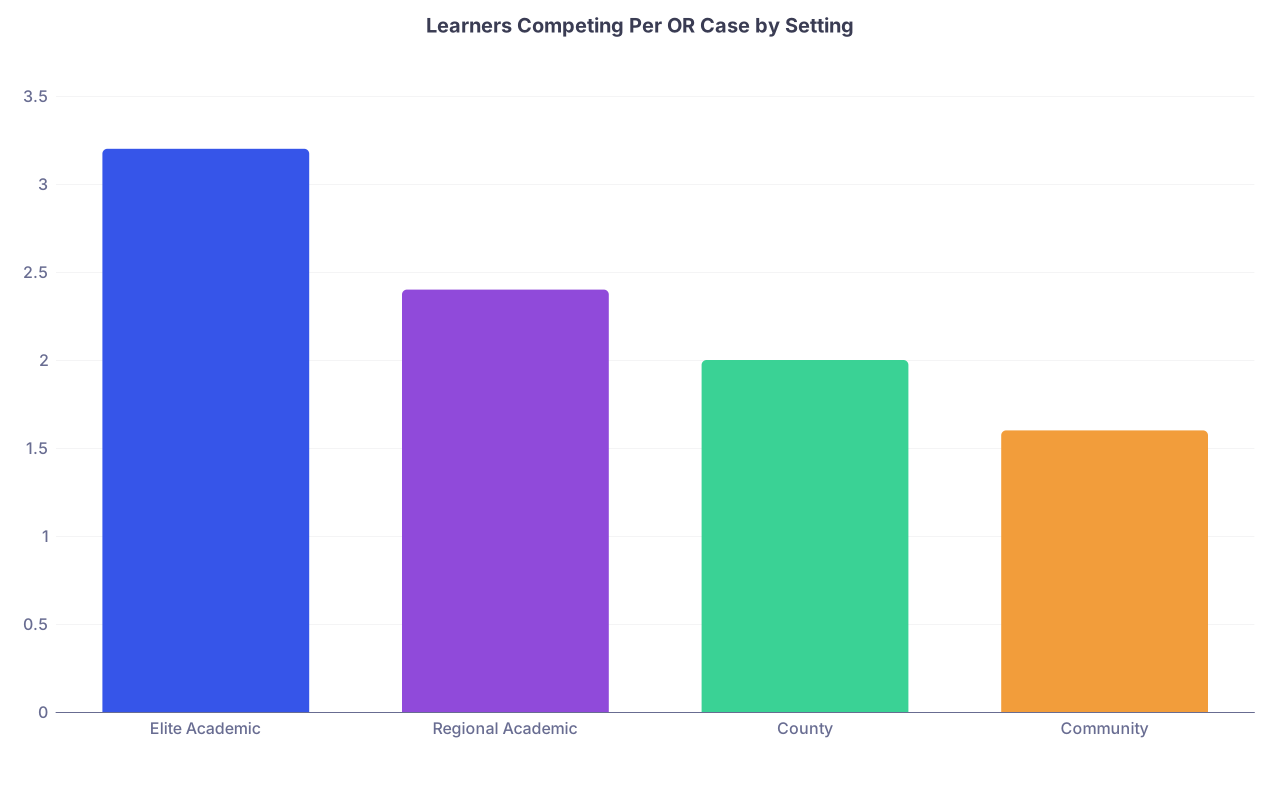
| Category | Value |
|---|---|
| Elite Academic | 3.2 |
| Regional Academic | 2.4 |
| County | 2 |
| Community | 1.6 |
Three-plus learners for one operation changes your role in that case. You might:
- Retract for 4 hours
- Close skin
- “See the anatomy” from the back corner
- Dictate the note for a case where you barely touched the field
And yes, that case still goes in your log.
The Dirty Secret: Case Logs Are Not the Same as Case Ownership
This is where most applicants fool themselves. They look at a program’s ACGME-compliant numbers and think, “Oh, they hit 1100 cases, I’m good.”
No. You are not automatically good.
Residents tell a different story when you ask what they actually did in those cases:
- “I was primary for the last 30 minutes of a 9-hour Whipple.”
- “I held the scope and advanced it but did not do the critical parts.”
- “I closed the port sites on most of those lap choles.”
- “We double-scrub everything; senior gets most of the key steps.”
Here’s the hidden dimension nobody prints on program websites: proportion of cases where you truly perform key portions versus just “assist.”
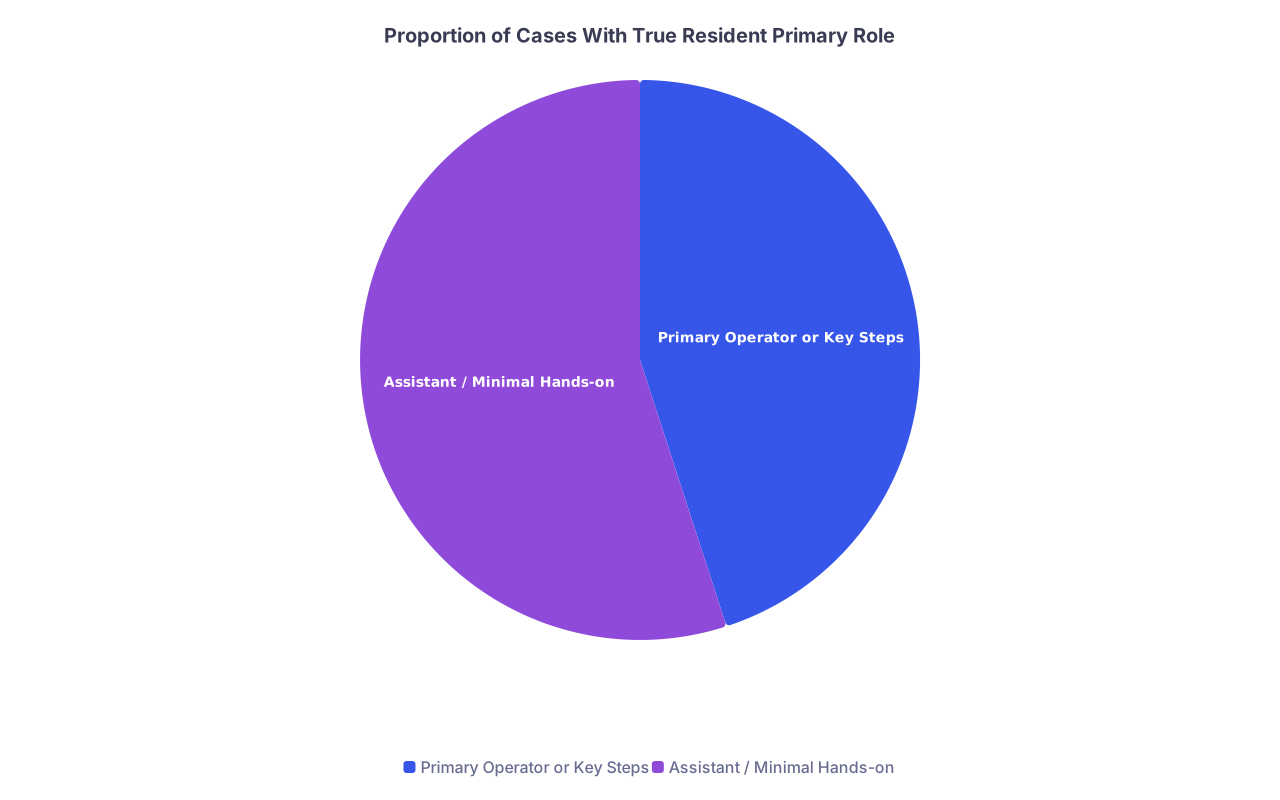
| Category | Value |
|---|---|
| Primary Operator or Key Steps | 45 |
| Assistant / Minimal Hands-on | 55 |
At some high-prestige centers, complex cases are heavily fellow-driven, with residents orbiting around the edges. At some “no-name” but busy regional hospitals, a PGY-4 might be doing:
- Entire laparoscopic colectomies
- Most of a straightforward CABG
- Full C-sections skin-to-skin
- Intramedullary nails and ORIFs almost independently
That difference is enormous. Your future confidence is built on doing real surgery, not just logging CPT codes.
Where Big-Name Centers Do Have an Edge (Sometimes)
The myth is not 100% wrong. It’s just over-generalized.
Big academic referral centers often do offer:
Breadth and weird pathology
You will see zebra cases and high-complexity reconstructions that never hit smaller hospitals. That’s good if you want to subspecialize or do academic work in a niche field.World-class subspecialty attendings
Being taught pancreatic surgery by someone who writes the guidelines is different. Even if you do not do every step, the quality of decision-making and technique you see can change how you think.Research infrastructure
If you want a T32, R01, or to run trials, the big-name centers usually have the scaffolding for that. That matters for certain career paths more than raw volume.Fellowship networking
Fair or not, graduating from certain logos opens doors. PDs know each other. That rec letter from a high-visibility attending moves weight.
So if your plan is: “I want to be a hepatobiliary surgeon at an academic center and live in data and grants,” then a big-name, fellow-heavy, complex-caseload setting may be exactly right, even if your raw numbers are lower but more subspecialty-focused.
The mistake is assuming that’s best for everyone.
Where “No-Name” or Mid-Tier Programs Quietly Crush Big Names
There are patterns I’ve seen again and again across specialties:
1. Less competition for the knife
A program with:
- Fewer or no fellows in your subspecialty
- A reasonable resident:OR ratio
- A service that actually needs you to operate to function
…can turn you into a surgeon who’s actually comfortable taking a patient to the OR on day one as an attending.
I’ve watched senior residents from modest programs run circles around brand-name graduates in basic, real-world cases: hernias, lap choles, ex-laps, bread-and-butter trauma, basic arthroscopy, C-sections, hysterectomies. Because they weren’t just watching; they were doing. Early and often.
2. Higher volume of “mundane” but critical cases
Everyone loves calling complex oncologic resections “real surgery.” But your first years in practice – especially in community or hybrid jobs – are dominated by bread-and-butter:
- Appendectomies, lap choles, hernias
- Simple fractures, joint injections, scopes
- Primary C-sections, D&Cs, hysterectomies
- AV fistulas, basic vascular access, simple bypasses
Mid-tier and community-heavy programs often flood you with this. What looks “unsexy” on paper is exactly what builds your speed, judgment, and complication management.
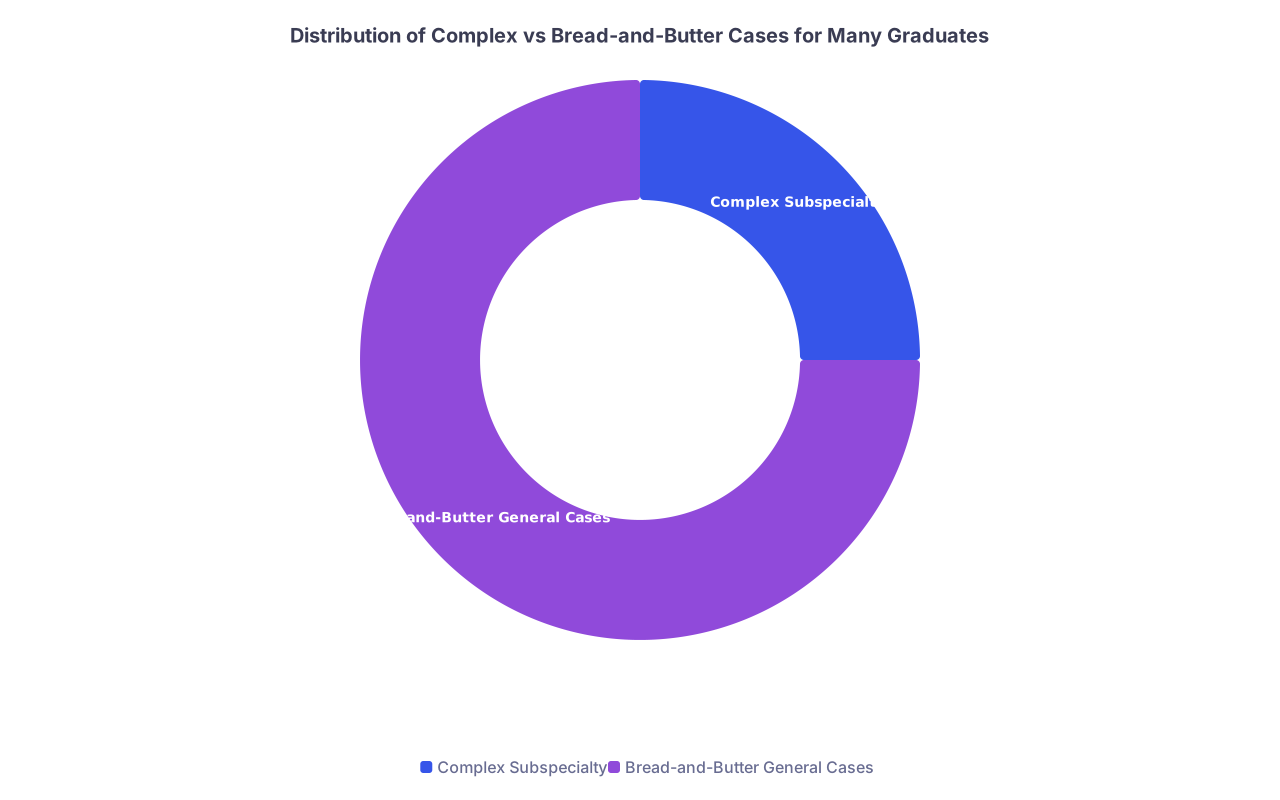
| Category | Value |
|---|---|
| Complex Subspecialty | 25 |
| Bread-and-Butter General Cases | 75 |
3. Earlier autonomy
In some less prestigious programs, a PGY-3 is basically running appendicitis nights with attending backup. In others, PGY-5s at big names are still negotiating for key portions because the fellow “needs the numbers.”
Ask residents at any program what year they first felt like, “I can run a basic case with minimal hand-holding.” The difference is dramatic. And it has nothing to do with U.S. News rankings.
How to Actually Evaluate Case Volume When You’re Applying
Stop asking, “Is this a big name?” Start asking, “What will my day-to-day look like here?”
You want concrete, uncomfortable details.
1. Ask residents these exact questions
During visits or virtual socials, ask:
- “On a typical week on [major service], how many full cases do you scrub and meaningfully operate in?”
- “Who does the critical parts of [core operations] – junior, senior, or fellows?”
- “What year did you first do a lap chole skin-to-skin? A C-section? An AV fistula? A hip/femur nail?”
- “Are there services where you mostly retract and close because of fellows?”
- “When chiefs leave here, do they feel comfortable going straight into practice, or do they all feel they need fellowship just to be safe?”
Watch their faces. The hesitation tells you more than the scripted answer.
2. Look at the mix of training sites
Best-case training structures are not “all quaternary, all the time.” Strong programs mix:
- A big academic/tertiary center for zebras and complex work
- A county or safety-net hospital for raw volume and trauma
- A community or VA site where residents get real autonomy

| Step | Description |
|---|---|
| Step 1 | Resident |
| Step 2 | Academic Center |
| Step 3 | County or Safety Net |
| Step 4 | Community or VA |
| Step 5 | Complex and Research |
| Step 6 | High Volume Bread and Butter |
| Step 7 | Autonomy and Real World Practice |
If a program is 100% dominated by a single elite site with multiple layers of learners, you’d better interrogate how they protect resident hands-on time.
3. Scrutinize fellow presence, not just case counts
Ask:
- How many fellows are on each service?
- Which key cases are “fellow cases”?
- Do residents lose any index cases to fellows regularly (like CABG, joints, etc.)?
A 1200-case program with 10 hungry fellows can feel very different from a 1200-case program with only residents.
The Future: Will Volume Still Matter 10–20 Years From Now?
There’s another uncomfortable twist. Case volume used to be the main stand-in for competence. That’s already changing.
Several trends are going to mess with the simple “more cases = better” story:
Simulation and VR
High-fidelity simulators, robotic consoles with metrics, and VR for arthroscopy/endoscopy are ramping up. You’ll see programs documenting competence via objective performance rather than just “case done with attending.” The resident who did 200 serious simulated anastomoses with performance data may be safer than the resident who logged 50 semi-supervised ones.Competency-based progression
Accreditation bodies keep flirting with models where you move based on skill, not just PGY year. That would shatter the old volume-worshipping mindset. Some people hit proficiency faster and need fewer reps; some need more.Subspecialization
Future surgeons may not need huge general case volume if they’re tracking early and deeply into a niche. The trauma-heavy, 1500-case generalist may be less suited for a highly specialized academic HPB job than someone with fewer but tightly focused cases and research.AI and decision support
As AI and advanced imaging guide intra-op choices and planning, the “number of cases” may matter slightly less than your ability to think, adapt, and integrate data quickly. That still needs real OR time – just not necessarily the brute-force “more is always better” we idealize now.
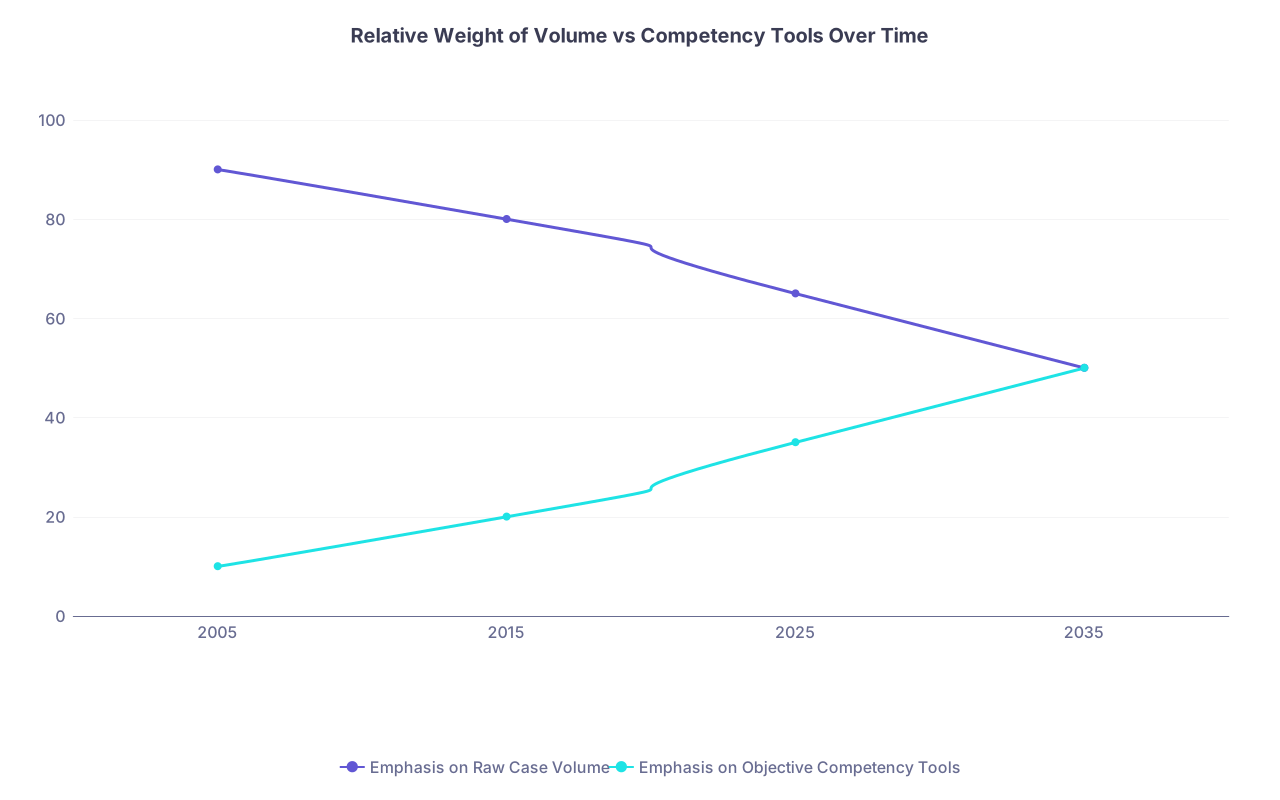
| Category | Emphasis on Raw Case Volume | Emphasis on Objective Competency Tools |
|---|---|---|
| 2005 | 90 | 10 |
| 2015 | 80 | 20 |
| 2025 | 65 | 35 |
| 2035 | 50 | 50 |
That said, we are not remotely at the point where simulation replaces real patients. For the foreseeable future, being under the lights, with a real bleeding human, time pressure, and consequences, is still non-negotiable.
So, Do Big-Name Centers Really Give Better Surgical Case Volume?
Sometimes. But not reliably. And not in the way applicants fantasize.
Here’s the real answer:
- Some elite programs give you excellent volume plus world-class complexity and mentorship.
- Some elite programs quietly shortchange you on hands-on experience because fellows, safety culture, or service design push residents out of the field.
- Some mid-tier or regional programs will turn you into a highly competent workhorse surgeon with little fanfare and a much better logbook.
- Some small or weak programs will under-train you on both fronts.
The logo does not decide which category a program falls into.
Your job is harder than memorizing rankings. You have to interrogate how each program uses its volume, how that volume is distributed among learners, and how early and often you are trusted to actually operate.
Years from now, you won’t care what brand was on your ID badge; you’ll care whether you feel calm – or terrified – when it’s just you, a scrub tech, and a patient who can’t afford for your training to have been an illusion.