
Clinic Months “Don’t Count” for Surgeons? The Continuity Myth Debunked
Why do so many surgical residents brag about “dodging clinic” like it’s a badge of honor, then complain three years later that their cases are being taken by the PA because all the patients follow them instead?
Let me be blunt: the idea that clinic “doesn’t count” for surgeons is one of the most persistent, self‑sabotaging myths in surgical training. It’s baked into resident culture, reinforced by bad incentives, and flatly contradicted by the data on outcomes, malpractice, and long‑term practice success.
You are being taught—implicitly—to chase case numbers and ignore the single environment where those numbers are actually created, justified, and followed up. That’s not efficiency. That’s short‑sighted.
Let’s tear this apart properly.
The Myth: “Clinic Doesn’t Count” Because It’s Not in the Logbook
You’ve heard all the variations:
- “Clinic is a waste, it doesn’t help my case log.”
- “Real surgeons are in the OR; clinic is for the intern or the NP.”
- “If I do more clinic, I’ll fall behind on volume. I need to hit my 850 cases.”
I’ve watched chiefs actively trade clinic sessions for “more OR time” like they’re gaming a system—then act surprised when their first job feels like malpractice whack‑a‑mole because their preop selection is sloppy and follow‑up is chaos.
The underlying assumptions are:
- Surgical competence = number of logged OR cases
- Clinic adds little to OR skill, so it’s lower value
- You can learn decision‑making and continuity “on the fly” later
Each of those is wrong. And not subtly wrong—dangerously wrong.
What the Data Actually Shows: Cases Are Not the Whole Story
Let’s start with the holy metric in residents’ heads: case volume.
Program directors love to talk about numbers. You hear, “Our graduates exceed ACGME minimums by 30%,” like it’s a flex. And yes, under‑exposure is a real problem in some places. But once you’re north of the minimums, shoving in more cases without sharpening your decision‑making is like doing more reps with garbage form. It looks productive. It’s not.
Studies on surgical learning curves and outcomes show something annoying for the “more OR, less clinic” crowd:
- Volume matters early—but it plateaus.
- After a certain point, outcomes correlate more with case selection, complication recognition, and follow‑up than with raw volume.
You know where those skills actually live? Not in the 90 minutes you’re holding the scope. In:
- The consult where you decide whether this person even should have surgery
- The preop evaluation where you catch the red flags
- The clinic follow‑up where you see your complication, own it, and understand what went wrong
Residents who avoid that pipeline become technicians, not surgeons. High‑volume technicians with shaky judgment are malpractice magnets.
, Periop management, Follow-up/complication management](https://cdn.residencyadvisor.com/images/articles_svg/chart-relative-impact-on-long-term-outcomes-8870.svg "Relative Impact on Long-term Outcomes")
| Category | Value |
|---|---|
| Technical skill | 70 |
| [Case selection](https://residencyadvisor.com/resources/surgical-case-volume/myth-of-the-perfect-case-mix-why-no-program-covers-everything) | 85 |
| Periop management | 80 |
| Follow-up/complication management | 75 |
No one is saying technical skill doesn’t matter. It obviously does. But programs already cram your days with OR. The marginal value of your 976th laparoscopic cholecystectomy is dramatically lower than the value of understanding which 10–15% of referrals you should not operate on—and why.
Clinic Is Where You Actually Learn to Be a Surgeon, Not Just a Proceduralist
Let’s break down what you actually get from clinic—when you stop treating it like punishment.
1. Case Selection: The Hidden Superpower
I’ve sat in clinics where the attending flat out says, “This is where we make or break our complication rate.”
Case selection is pattern recognition plus risk calculus. It’s not glamorous. No one posts it on Instagram. But the difference between a “good surgeon” and a “bad surgeon” over a 20‑year career isn’t whether they can technically do the operation. It’s which patients they choose to take to the OR in the first place.
Examples you see only if you’re in clinic consistently:
- The 45‑year‑old with GERD “for years” who “just wants a Nissen” but whose alarm symptoms are screaming malignancy until proven otherwise
- The “straightforward hernia” in a guy who’s had three prior failed repairs and unaddressed connective tissue disease
- The obese, frail, smoking diabetic who every “OR‑hungry” resident wants to book, and the attending quietly says, “He needs optimization, not a hero surgeon”
You miss enough of those and you don’t just get complications. You get never‑events, lawsuits, and a reputation.
2. Preop Counseling: The Part That Keeps You Out of Court
Look at malpractice case reviews for surgery. The pattern is boringly consistent:
- Yes, technical errors matter.
- But a huge chunk of settled cases involve inadequate informed consent or mismatched expectations, not “you cut the wrong thing.”
Where is informed consent done properly? Not in the hallway 5 minutes before rolling to the OR. In clinic.
Clinic is where you learn:
- How to explain realistic outcomes without scaring people away
- How to say, “No, I do not think surgery will fix this”
- How to document risk in a way that actually holds up later
Residents who never fully engage in clinic are the same ones who, as attendings, say things like “I mean, we talked about risks” and then get steamrolled when the patient says, “He told me it was routine and safe.”
That mismatch is born in clinic avoidance.
3. Complication Recognition and Ownership
There’s a very specific flavor of discomfort the first time you see your leak, your retained stone, or your wound dehiscence in clinic. You recognize your handiwork in the scars and the story. It sticks.
You can’t outsource that to the NP and still pretend you’re doing “quality improvement.”
Clinic is where you see the lagging indicators of your technique and your decisions. You’ll notice:
- Which anastomoses fail
- Which patient populations you keep underestimating
- Which quick decisions in the OR create long pain clinic legacies
This is where judgment gets calibrated. Slowly, and sometimes painfully. There is no OR shortcut for this part.
Continuity of Care: Not Some Touchy‑Feely Ideal, a Performance Multiplier
The “continuity myth” goes like this: continuity of care is nice, but in modern hospital systems with hospitalists, advanced practice providers, and shift work, it’s optional for surgeons. Anyone can see the patient preop and postop. You just need a warm body.
Reality: continuity changes three things in a way that directly affects surgical quality.
1. Diagnostic Accuracy
When you’ve seen the patient at consult, done the workup, and then see them post‑op, you’re much less likely to:
- Miss baseline function issues
- Misattribute new symptoms to “surgery” that were there all along
- Blow off subtle signs of real complications because “they look fine”
You know their baseline. You know what changed. That’s not fluff—it’s improved signal to noise.
2. Patient Trust and Adherence
Do patients absolutely need to see the same surgeon each time to follow postop instructions? No. But they’re far more likely to:
- Call early when something is wrong
- Tell you the embarrassing or inconvenient truth about non‑adherence
- Accept conservative management instead of demanding re‑operation
Continuity makes the rest of your decisions more effective. The trust wasn’t built in the OR. It was built when you sat in clinic and didn’t rush them out in 3 minutes.
3. Efficiency in the OR
Here’s the paradox no one tells residents: surgeons who do more clinic often end up more efficient in the OR over a career. Because:
- They book better operations
- They cancel or modify bad ideas before they hit the schedule
- They design more realistic postop pathways because they’ve seen what recovery really looks like in real people, not textbook cases
So yes, clinic “counts”—just not in the childish, immediate gratification way a case log does.
How Residency Culture Gets This So Wrong
You’re not crazy if you feel the system is working against you here.
Residency incentives are misaligned:
- ACGME minimums are written in case numbers, not “good decisions”
- Program reputation is publicly tied to volumes, fellowships, match lists
- Evaluations and milestones are often easier to quantify with OR stats
So residents end up playing to the scoreboard they can see: logged cases. And clinic becomes a tradeable commodity.
I’ve sat in work rooms and heard lines like:
- “Can I take your scope spot if you’re stuck in clinic?”
- “Just pre‑chart my patients, I need to be at that Whipple.”
- “Clinic is for the junior; I’m at the end, I just need more colorectal.”
This is how you build surgeons who are outstanding at “being there” but shaky at “should we be doing this at all?”
Programs that actually get it have some form of:
- Dedicated, protected clinic for seniors where they run the list like attendings
- Expectations that residents see their own postop patients whenever feasible
- Formal teaching around preop decision‑making and complication follow‑up, not just “cool cases” at M&M
The common thread? They treat clinic as part of surgical training, not filler between OR blocks.
“But I Need Numbers to Get a Job/Fellowship”
Here’s the uncomfortable truth: what fellowship directors say and what residents believe don’t always match.
Most high‑quality fellowships do look at:
- Case volume (especially in key index procedures)
- Quality of letters
- Perceived clinical judgment and maturity
And repeatedly, the feedback from attending surgeons writing serious letters sounds like this:
- “Technically advanced, but still developing judgment on who to operate on.”
- “Excellent in the OR, but limited experience in longitudinal follow‑up.”
- “Would benefit from more exposure to outpatient management and complication follow‑up.”
You can have 1500 logged cases and still get tagged as immature. I’ve seen it.
If you want a fellowship in something competitive—colorectal, surg onc, MIS, vascular—being the resident who can talk through nuanced preop decision‑making and long‑term management is a differentiator. Everyone has numbers. Fewer have judgment.
| Training Pattern | OR Numbers | Judgment Signal | Typical Letter Language |
|---|---|---|---|
| OR-only focus | High | Low | "Technically strong, still maturing clinically" |
| Balanced OR + clinic | High | High | "Ready for independent practice-level decisions" |
| Heavy clinic, low OR | Low | Medium | "Good judgment, needs more advanced cases" |
You don’t want to be in the first or third category. The second is built in clinic as much as in the OR.
The Future of Surgery Is Moving More Toward Clinic, Not Less
If you still think clinic is optional, look at where surgery is going:
- Outpatient and short‑stay surgery are expanding rapidly. That means more preop optimization done in clinic and tighter postop windows where complications present after discharge.
- Enhanced recovery protocols live or die based on patient education, expectation management, and meticulous follow‑up—clinic tasks.
- Value‑based care and bundled payments push surgeons to own the entire episode of care, not just the procedure slice. Complications and readmissions? That’s money and reputation on the line, and the best lever you have is better selection and continuity.
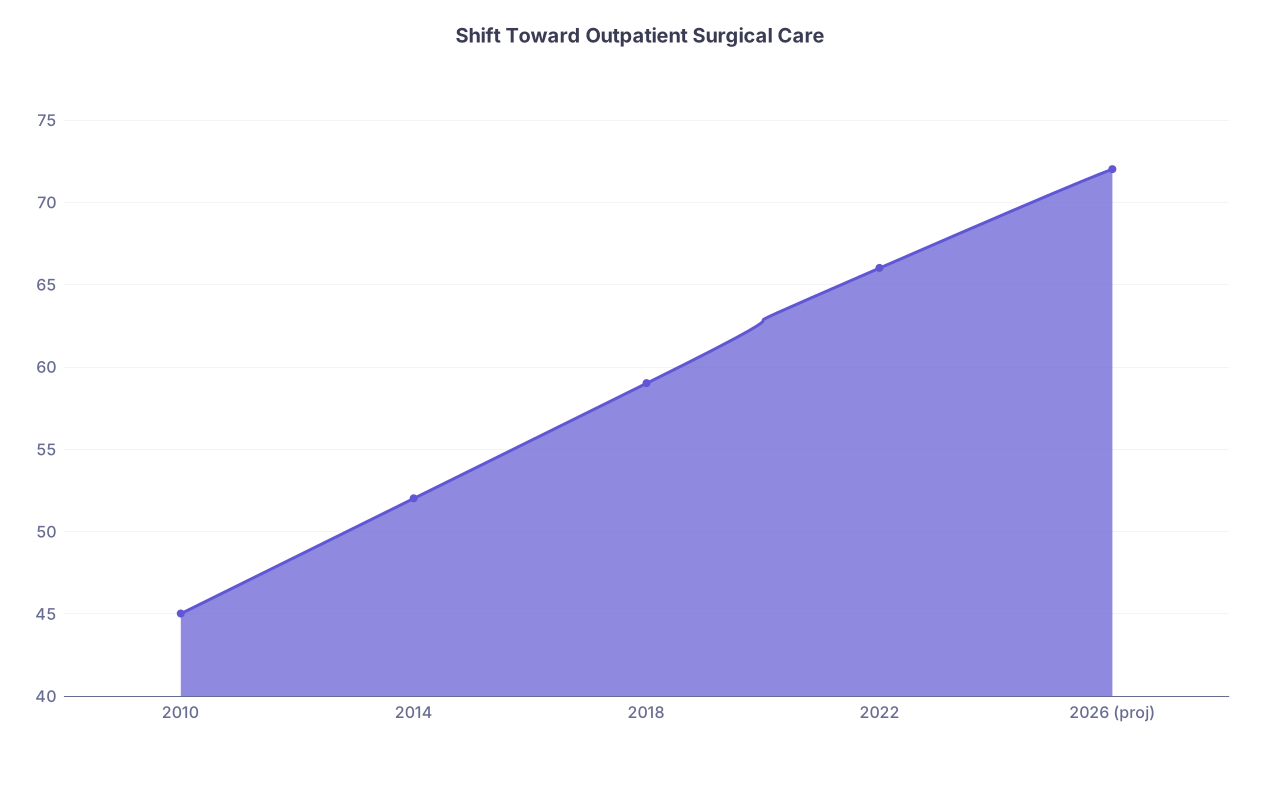
| Category | Value |
|---|---|
| 2010 | 45 |
| 2014 | 52 |
| 2018 | 59 |
| 2022 | 66 |
| 2026 (proj) | 72 |
Outpatient and virtual follow‑up are not erasing the need for clinic. They’re making it more central—and more complex.
The surgeon who is comfortable, skilled, and efficient in clinic will adapt. The one who treated clinic like a penalty box will be left behind, watching their “OR skill” increasingly mediated by systems they don’t understand.
How to Make Clinic Actually Count During Training
You can’t fix your entire residency culture alone, but you can stop sabotaging yourself. A few concrete moves:
Own “your” patients
When possible, see your own consults back in clinic. Tell the attending you want that continuity. Most will say yes. It makes their life easier too.Treat clinic like OR in your prep
Review imaging yourself. Sketch an operative plan. Guess what your attending will recommend. Then compare. That delta is where you’re actually learning.Track your complications longitudinally
Keep a private log—not just of the event, but of the clinic follow‑up. What did the patient actually experience 3, 6, 12 months later? That will change how you consent and how you operate.Practice real counseling, not checkbox consent
Use clinic to learn how to say: “I don’t think surgery will help you,” and “I recommend surgery, but here’s what I’m worried about in your case.” Those sentences are your future malpractice shield.Push for meaningful senior clinic
When you’re a chief, ask for at least one half‑day where you run a service clinic with graded autonomy. Not shadowing. Acting like a junior attending with backup.

| Step | Description |
|---|---|
| Step 1 | Show up to clinic |
| Step 2 | Pre review charts and imaging |
| Step 3 | Form your own plan |
| Step 4 | Discuss plan with attending |
| Step 5 | See patient and counsel |
| Step 6 | Track postop outcomes |
| Step 7 | Refine future decisions |
That’s how clinic stops being background noise and starts being where your real growth happens.
The Bottom Line
Three simple truths that cut through the resident lounge myths:
- Clinic months absolutely “count” for surgeons—not in raw case numbers, but in case selection, complication management, and malpractice protection. That’s where long‑term careers are made or broken.
- Continuity of care is not a sentimental luxury. It enhances diagnostic accuracy, trust, adherence, and OR efficiency. Dismissing it is how you become high‑volume and high‑risk.
- The future of surgical practice is more clinic‑centric, not less. Outpatient surgery, ERAS, and value‑based care all increase the premium on surgeons who are actually good at longitudinal care—not just heroic in the OR.
Ignore that now, and you’ll pay for it later—one “routine case” at a time.