
What if your plan isn't failing because you're lazy, what if it's failing because you're burned out?
You sit down on Sunday night and map out a flawless 60-hour study week. By Wednesday, you're three chapters behind. So you lie to yourself. "I'll catch up tonight." You don't. The guilt compounds. The deadlines shrink. The lies get bigger.
This isn't a time-management problem. It's a capacity-delusion problem. I'm the Situation Handler. When you're in this specific scenario, you need to stop treating your study plan like a wish list and start treating it like a survival tool. Here is exactly how to build a plan that survives your worst days in first-year medical school.
This article is for educational purposes only. It is not financial advice, not legal advice, and not tax advice. Figures vary by individual circumstances, so consult a qualified professional before acting.
Spot the "burnout lie": how your study plan turns into self-deception

Let's name the lies. "I'll start at 6 AM." "I only need one more pass through the slides." "I can study effectively while exhausted." "I'll just do it on my day off."
These statements feel incredibly true in the moment. Your brain runs on adrenaline for short bursts, making you feel invincible at 11 PM. Then reality catches up. Sleep debt accrues. Cognitive fatigue sets in. You stare at a page of biochemistry and the words literally don't make sense.
Look for these three red flags that your plan is pure fantasy:
- Constant catch-up. You spend more time rescheduling old tasks than doing new ones.
- Repeatedly missing the same blocks. You always skip the afternoon review session. Every single time.
- Planning in 6-8 hour dreams. You block out massive chunks of time assuming unbroken, peak focus. Nobody has eight hours of peak focus. Not even the attending.
Do a quick self-audit right now. Look at the last seven days. What did you actually complete versus what you planned? If the gap is massive, your plan is a work of fiction.
If you feel behind every week, switch from 'hours planned' to 'minimum viable learning'
If you feel behind every single week, you need to ditch "hours planned" and switch to "minimum viable learning" (MVD). Stop planning for the best version of yourself. Plan for the exhausted, slightly cynical version of yourself who just survived a three-hour pathology lab.
Here is the framework: plan for a Minimum Viable Day (MVD) and a Stretch Day.
Your MVD is the absolute smallest set of tasks that still moves your learning forward. If you do nothing else, you do this. A solid MVD looks like 25-40 targeted practice questions, reviewing the ones you got wrong, and doing flashcards for your weakest topics. That's it.
Here is a concrete daily template for first-year survival:
- Morning reset (15 min): Triage your day. Look at your calendar. Pick your MVD.
- Core block (60-90 min): Deep work. New concepts, heavy reading, or lectures at 1.5x speed.
- Active recall block (30-45 min): Questions, questions, questions. Apply what you just learned.
- Light review (15-20 min): Wrap up. Plan tomorrow's MVD.
The goal here isn't perfection. It's consistency. Consistency prevents the guilt spiral that leads to total burnout.
And you need "if you crash" rules. When you are completely wiped out and only have 20 minutes of energy left, do not try to read a textbook. Do the highest yield action. Open your spaced repetition app or do 10 practice questions. Stop when the timer ends. You kept the chain alive. That is a win.
Use a burnout-safe planning cadence: weekly plan, daily execution, hourly rescue
You need a burnout-safe planning cadence. First year is a chaotic rhythm of lectures, labs, and sudden quizzes. Your planning must match that reality.
Weekly plan rule: Build your week around assessments and time-to-exam. Do not build it around your motivation. Motivation is a liar. If the anatomy practical is on Friday, Thursday is non-negotiable review.
Daily execution rule: Commit to one "anchor" block only. This is your non-negotiable MVD. Everything else you do that day is optional bonus work.
Hourly rescue rule: If you miss a block, you do not "catch up" by staying up until 2 AM. You reattach to your schedule using the next anchor item. Overcompensation is how you burn out by Wednesday.
Stop lying to yourself in real-time. Replace "I'll do everything tonight" with an objective, cold statement: "I will do my MVD and stop when the timer ends."
Track this objectively. Use a simple 0/1 completion log. Did you complete your MVD components? 1 for yes, 0 for no. Don't track feelings. Don't track "hours studied" while staring blankly at a screen. Track execution. Look at the chart above. The ambitious hours fluctuate wildly and fail, but the MVD completion stays stable. That stability is what gets you through the semester.
What to do in the moment when burnout makes you feel 'incapable' of studying
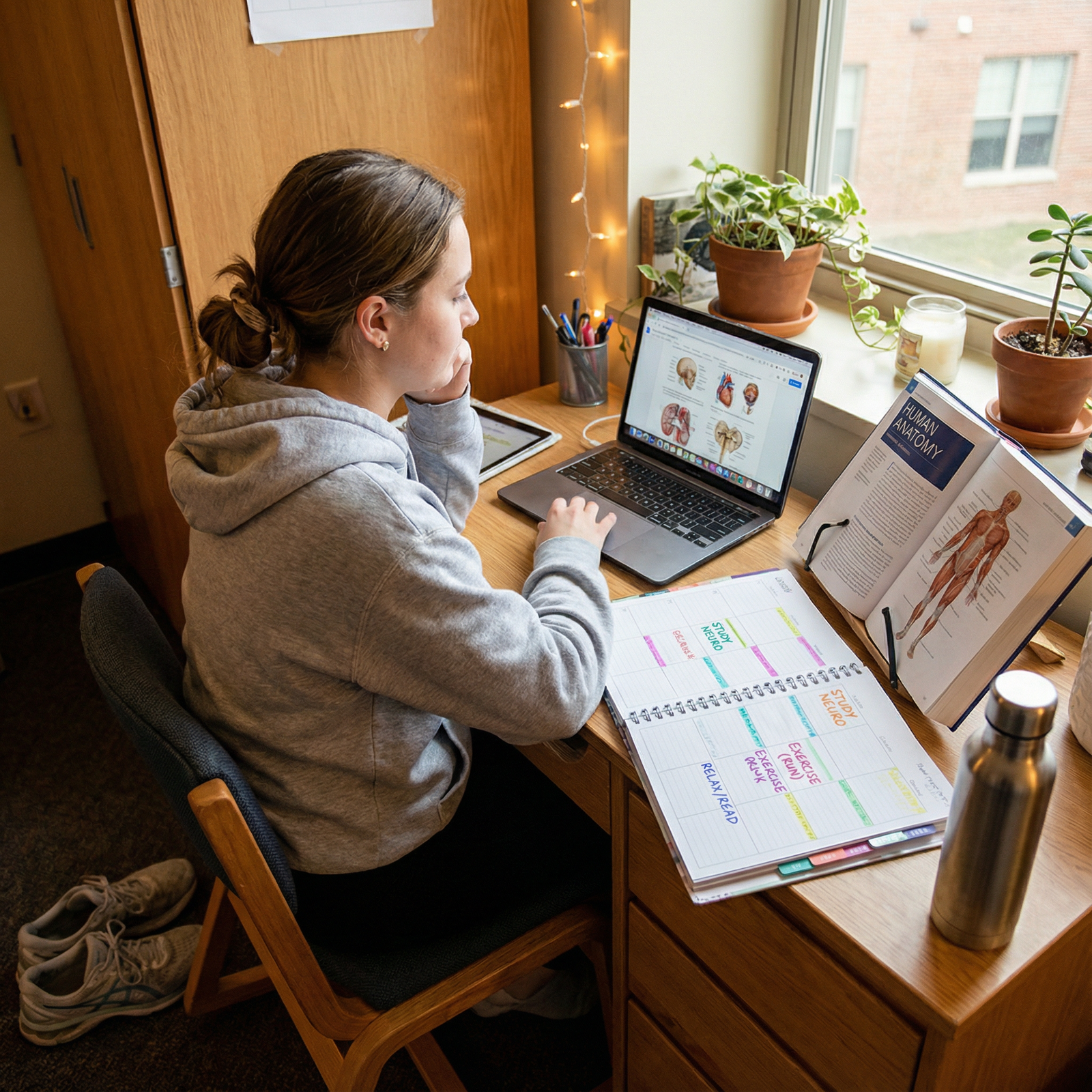
Let's talk about the exact moment burnout hits. You open your study materials and you just... can't. You experience avoidance, irritability, or complete mental blankness. Your brain physically rejects the material.
Here are your immediate steps. Give yourself 10 minutes:
- Decide the next single task. Not the whole chapter. Just the next 10 questions.
- Set a 15-25 minute timer. Make it short enough that it doesn't feel threatening.
- Remove friction. Close every tab except the one you need. Put your phone in another room.
- Start with the easiest high-yield prompt. Do a question you know you can get right just to break the paralysis.
Keep a "rescue study menu" for when you literally cannot think. Switch modes. If reading is impossible, do spaced repetition. If questions are too hard, sketch out physiology pathways on a whiteboard. Do a rapid concept flash review. Change the input method to bypass the mental block.
Set a hard boundary for guilt. You are not behind because of a moral failing. You are behind due to a capacity mismatch. Forgive yourself immediately and get to work on the MVD.
Safety note: Know when to get help. If this fatigue is persistent for weeks, if you are experiencing panic attacks, severe depressive symptoms, or an inability to function in daily life, this isn't just study burnout. Contact your campus mental health resources or a clinician immediately. Studying cannot fix a clinical problem. Support is part of survival.
Build a plan that survives honesty: reduce scope, increase recall, and protect sleep
You need to triangulate the real levers of medical school success. Reduce what you do. Increase what sticks. Protect your sleep.
Spaced repetition beats rereading every single time. Short, intense question blocks paired with a rigorous error log will improve your retention far more than passively highlighting slides. Create an error log loop: every question you miss becomes a micro-goal for your next MVD.
Enforce a sleep-protection rule. Do not trade multiple nights of sleep for one massive catch-up session. Sleep is the hidden multiplier for memory consolidation. If you are behind, shrink today's workload and recover tomorrow with a clear head.
Your study plan should be a safety net, not a performance contract. It exists to catch you when you fall, not to punish you when you're tired. Build it honestly, execute it consistently, and stop lying to yourself about how much you can do in a day.