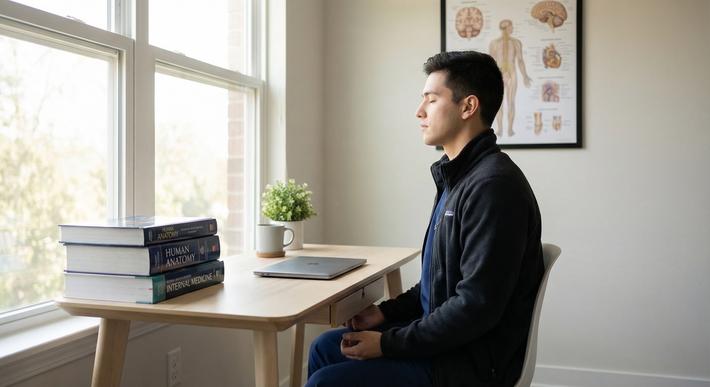
Here's the blunt truth nobody says clearly enough: anxiety meds on Step day usually do not "knock you out." What they do, when chosen well, dosed well, and tested ahead of time, is turn down the volume on adrenaline. Not erase it. Not sedate you into a fog. Just stop your body from hijacking your brain.
That distinction matters because test anxiety isn't abstract. I've seen students walk into a practice NBME with the knowledge to score well and then get flattened by physiology. Heart pounding. Hands cold. GI chaos. That unreal, floaty dissociation where the screen is in front of you but your brain feels half a second behind it. Then the cognitive collapse starts: working memory shrinks, you reread stems three times, and one hard question mutates into a panic loop that burns five minutes.
So let's set the right goal. The goal of test-day anxiety treatment is not sleep. It's not numbness. It's not becoming "chill." The goal is steadier attention, fewer adrenaline spikes, less blanking, and a better chance of performing at your actual baseline.
Why does the sedation myth survive? Easy. Bad anecdotes. Sloppy self-experiments. People borrow a pill, try a new dose the week of the exam, sleep four hours, hammer an energy drink, then blame "anxiety meds" for the train wreck. Drug class matters. Dose matters. Timing matters. Your metabolism matters. The exam doesn't care which variable you ignored.
Myth #1: "Anxiety meds will slow you down and cost you time"
Let me tell you what really happens behind the scenes. Program directors don't sit around hearing stories about students being rendered useless by standard, well-tested anxiety treatment. Proctors don't watch examinees gently sedated into oblivion. What people actually see is inconsistency. One student gets calmer and reads more cleanly. Another takes the wrong dose at the wrong time and becomes scattered, dulled, or weirdly detached.
That's the real danger. Not the category label. The mismatch.
There are two performance traps here.
First: sedation-related slowing. This is the one everyone is scared of, and yes, it's real. If the dose is too high, your reading speed drops. Your reaction time softens. You stop noticing fine distinctions in answer choices. You feel "calm," but not in a good way, more like cotton in the brain. On Step-style questions, that's expensive.
Second: anxiety rebound or untreated panic. This one gets less attention and causes just as much damage. Students who normally use a prescribed medication sometimes get nervous about "being slowed down," skip it on test day, and then spend block one fighting their own sympathetic nervous system. Or they under-dose compared with what worked in practice. Result? More rereading. More blanking. More bathroom breaks. More wasted time.
That's the irony. Mild, well-tolerated anxiolysis can actually improve pacing. Why? Because panic is slow. Panic makes you reread simple stems. Panic makes you doubt questions you already understood. Panic makes you stare at the clock and hemorrhage seconds. If a medication reduces that friction without blunting your alertness, you often move faster, not slower.
Here's the insider takeaway: the limiting factor is rarely the medication class by itself. It's the dose and timing decisions made under actual exam-like conditions. I've watched students obsess over whether a drug is "safe for cognition" while never once measuring what happened to their block timing during a full-length practice test. That's amateur behavior. You need data from your own body, on your own schedule, with your own caffeine, breakfast, and stress load.
Reality check: what med classes actually do on a cognitive level
Let's strip away the vague talk and get concrete.
SSRIs and SNRIs are not Step-day magic. They're not there to rescue you at 8:15 a.m. if you woke up shaking. They work over weeks, sometimes longer, by gradually changing baseline anxiety, reactivity, and mood regulation. On a cognitive level, the intended effect is prevention: fewer panic surges, less chronic anticipatory anxiety, better overall emotional stability. If they help your exam, it's because they made the month around the exam more functional, not because they gave you instant serenity during the tutorial screen.
Beta blockers are different. These target the body more than the mind. They blunt the peripheral adrenaline show: racing heart, tremor, shakiness, pounding chest. For some students, that physical dampening is enough to prevent the mental spiral. Cognitively, if tolerated well, they often preserve clarity because they're not trying to sedate you; they're trying to mute the body alarm that keeps tripping the brain.
Benzodiazepines are acute anxiolytics, and this is where people get burned. They can absolutely reduce panic. They can also absolutely slow processing, impair vigilance, and blur memory in a dose-dependent way. That's the secret students learn the hard way: there's no gold star for "feeling nothing" if your comprehension gets softer. Some people do fine on a very low, familiar dose. Some feel subtly detached and make bizarre reading errors they don't even notice until review.
Sedating antihistamines get underestimated constantly. Students think, "It's not a serious anxiety med, so it must be safer." Wrong. Many are more likely to produce that ugly anticholinergic, next-day, dry-mouthed, slightly stupid feeling than the student expects. Drowsiness. Slower recall. Mental drag. Not ideal for a 7-plus-hour reasoning exam.
This is the pharmacology chain in plain English: receptor effect leads to symptom change, and symptom change can help or hurt cognition. Reduce panic enough and attention improves. Reduce alertness too much and working memory drops. That's the line.
And the dose-response curve is where applicants make their worst mistakes. Too little, and the panic physiology keeps chewing through your bandwidth. Too much, and you're calm but cognitively underwater. Your optimal zone is rarely dramatic. It usually feels... ordinary. Steadier pulse. Less urgency. Cleaner reading. That's it.

The side effects students don't anticipate are often the ones that matter most on test day. Dry mouth so distracting you keep swallowing. Mild nausea that makes every block feel longer. A touch of impaired coordination or slowed motor rhythm. Short memory blips. Rare paradoxical agitation, where the "calming" medication makes you feel restless or off. I've seen all of it. Not often, but enough that I'm blunt about this: if you haven't tested a medication in advance, you are not making a treatment decision. You are rolling dice.
The insider protocol: how to choose timing and dose without gambling
Here's what faculty counseling sounds like when people are being honest: trial before test. Always. Not "maybe." Not "if you have time." Always.
Any medication plan that might touch cognition belongs inside practice exams first. Full stop. Not a random 20-question tutor block on your couch. I mean exam-like conditions: timed blocks, realistic start time, your usual caffeine, your normal breakfast, your normal nerves. That's where the truth shows up.
Timing matters as much as dose. A medication with a gentle onset may need to be taken well before check-in. Another may peak too aggressively right as you begin block one or right in the middle of your first break. That mismatch is common. Students think they're being responsible by taking something "close to the exam," but they're actually setting themselves up to hit peak effect at the worst possible moment.
Dose strategy is boring, and boring wins. Start low, under prescriber guidance. Never use test day as your first-ever exposure. Never assume a dose that worked during a quiet afternoon will behave the same after poor sleep and a cortisol surge.
Keep a written log. Yes, written. Not "I kind of remember it was okay." That's useless. Track:
- sleep quality
- anxiety rating before the block
- approximate time pressure during the block
- reread frequency
- major mistake types
- subjective focus
- side effects
Patterns show up fast when you write them down. Maybe your anxiety is lower but your accuracy in long stems drops. Maybe your timing improves only when your breakfast and caffeine are consistent. Maybe the med is fine, and the real issue is that you tested it after sleeping five hours. Good. Now you know.
You also need contingency plans. What if you feel a little sleepy? What if you feel nothing? The whole point of trialing is that these aren't surprises anymore. You already know whether a lower caffeine dose helps. You already know whether the medication should be taken 45 minutes earlier. You already know whether "none of the intended effect" actually means your anxiety is manageable once the block starts.
And coordinate with a clinician. Not Reddit. Not your class group chat. Actual contraindications matter. Interactions matter. Other CNS-active meds matter. If you're taking multiple psych meds, have a history of unusual reactions, or have ever had medication-related fog, this needs real supervision.
Step-day realities: caffeine, sleep debt, and food matter more than the myth admits
This is the part students hate hearing because it's less glamorous than "What pill should I take?"
A lot of people blame the medication when the real culprit is a wrecked routine. Sleep restriction. Skipped breakfast. Caffeine stacking. Dehydration. A sugar bomb at the first break followed by a crash in block four. That's what actually tanks a lot of performances.
I've seen the same student tolerate a medication perfectly during practice, then have a miserable test-day experience because they slept four and a half hours, doubled their coffee, and panic-ate candy between blocks. Then they say the med made them feel weird. No. The whole system was weird.
Beta blockers may blunt tremor and heart rate, but caffeine can still make you mentally jumpy and distractible. Sedating antihistamines can spill into next-morning cognition more than students expect. Benzodiazepines plus exhaustion is a bad combo if your goal is rapid reading discrimination.
Consistency rules win: same breakfast you practiced, same caffeine dose, same timing, same hydration routine, same route to the testing center, same pre-check-in rhythm.
That sounds obsessive. It's not. It's performance protection.
The environment matters too. Clock anxiety is real. So is wasting mental energy during breaks by checking your phone, doom-scrolling, or mentally grading the last block. I've watched strong students unravel because every break became a little panic conference with themselves. Don't do that. Breaks are for reset, food, bathroom, and breathing. Not autopsy.
The right mindset is simple: medication, if you use it, helps keep you inside your baseline performance envelope. That's all. It cannot rescue a chaotic routine. It cannot replace sleep. It cannot compensate for three energy drinks and no lunch. It can quiet the noise. It cannot build the signal for you.
Who should be cautious, and who should not wing it
Some situations are a hard no for improvisation.
If the medication is new, if the dose was changed recently, if you've ever had a paradoxical reaction, if you're on multiple CNS-active meds, if alcohol or other substances are in the mix, or if you've had prior episodes of medication-related cognitive fog, do not wing this. I'm not being dramatic. These are exactly the students who get surprised on exam day.
And let's kill another bad habit: leftover-pill medicine. Borrowed benzos. Random propranolol from a friend. An antihistamine because someone online said it "takes the edge off." That is dumb. Not rebellious. Not resourceful. Dumb. You are trying to optimize reading speed, question discrimination, and working memory under pressure. This is not the moment for chemistry roulette.
The practical red flags from real test experiences are memorable: memory gaps after short-term sedatives, strange disinhibition, heavy morning grogginess, feeling "too relaxed" to track details, or suddenly not trusting your own reading. Those aren't tiny issues. They're exactly the functions Step punishes.
The right goal is not "take something strong enough that I feel nothing." The right goal is a stable, rehearsed regimen that preserves your reading speed and your ability to tell a tempting distractor from the right answer.
Closing encouragement: your quiet Step Day is a systems problem, not a miracle pill
Here's the reassuring truth. You do not need to become anxiety-free to perform well. Faculty know that. Attendings know that. Anyone who has watched students through boards knows that some anxiety is normal. Expected, even.
What separates the students who hold it together from the ones who get dragged around by test day is preparation. Emotional preparation. Logistical preparation. Physiologic preparation. The quiet Step day people talk about usually isn't magic. It's rehearsed calm.
So if medication is part of your plan, make it a continuation of something proven. Not an experiment. Talk to your clinician early. Trial it during real practice blocks. Lock the timing. Protect sleep. Protect routine. Protect the boring stuff, because the boring stuff is what keeps your brain available when it counts.
That's what really works.