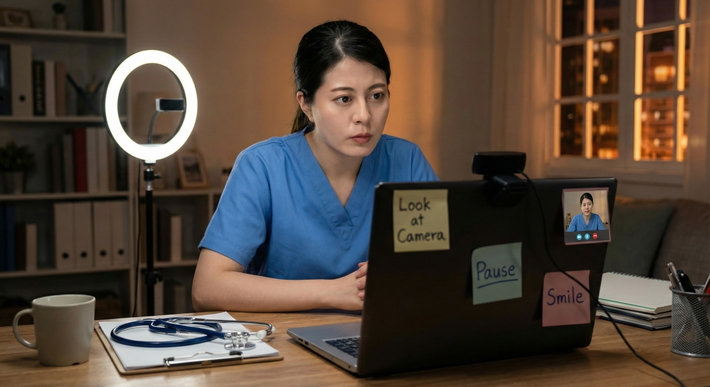
You've prepared for weeks. Your suit is pressed, your lighting is good, your signature stories are rehearsed. The interviewer's Zoom tile appears, they greet you, ask how you're doing, and then... "So, tell me about yourself."
Not the warm, specific version that references your AOA status or your research on pediatric oncology outcomes. Just the bare-bones, throwaway version. The kind they ask when they haven't looked at your file in the last twelve hours. Or ever.
Your stomach drops. The interview you'd been rehearsing for evaporates. And you're left thinking: Did they even open my application?
Here's what you need to know before you spiral. This is fixable. But only if you don't make the obvious mistakes.
The Dreaded Moment: When You Know They Didn't Read Your Application
That sinking feeling is real. Your brain cycles through worst-case scenarios in milliseconds. They don't care. They already rejected me. I'm just a checkbox on their score sheet.
Stop. Breathe.
This happens more often than you think. Program directors juggle dozens of applications, schedules shift, interviewers get assigned the morning of, and Zoom fatigue is a documented epidemic among academic physicians. The first 30 seconds of your reaction sets the entire tone of the interview. If you freeze, if you panic, if you answer with the same generic autobiography you've given twelve times that week, you've lost.
The mistake: assuming an unprepared interviewer means a lost interview.
The reality: it's actually an opportunity. Someone who hasn't read your file is a blank canvas. You get to paint whatever story you want, unconstrained by their preconceptions. That's terrifying and freeing at the same time.
This article gives you the survival toolkit. Read it before your next interview. Re-read it the morning of. Don't let one unprepared interviewer catch you flat-footed.
Identifying the Red Flags: How to Know They Haven't Read Your Application
Watch for these signals in the first few minutes. They're diagnostic.
- The generic opener. "Tell me about yourself" with zero specificity. No reference to your medical school, your specialty interest, or any detail from your ERAS.
- No callbacks to your personal statement. If you wrote about your grandmother's cancer journey and they don't ask a single follow-up question about it, they didn't read it.
- Surprise at credentials you've already submitted. "Oh, you did a research year? That's interesting." Surprise, not acknowledgment. Surprise is the tell.
- Confusion about your timeline. "So when did you rotate with us?" when you never rotated there. They've got the wrong file or no file at all.
- Asking about basic facts listed on your application. Your board scores. Your medical school. Where you grew up. These should be conversation starters, not information requests.
Notice something uncomfortable. Even in the best-case specialty, more than a quarter of interviewers admit they don't fully review applications beforehand. In psychiatry, it's nearly half. The system is broken, and you're the one paying the price. Don't take it personally. Do prepare for it.
Why This Happens (It's Not a Conspiracy Against You)
Your first instinct might be resentment. They owe you their attention. You spent months on this application.
Maybe. But blaming them doesn't help you. Understanding why this happens gives you tactical advantage.
The chain of dysfunction usually looks like this:
Here's the truth I've watched play out across hundreds of interview seasons. Interviewers are often pulled into interview duties at the last minute. A faculty member gets asked the day before because someone called in sick. They open your file at 7:45 AM for an 8 AM interview. They skim for 90 seconds. They show up.
Some programs assign interviewers outside the specialty. A pathologist interviewing a dermatology applicant. A surgeon interviewing a psychiatry candidate. They literally cannot engage with your application specifics because they don't share your specialty's lens.
Add Zoom fatigue to the mix. After their fourth consecutive interview, their attention is a flickering candle. They're not ignoring you. They're depleted.
The mistake: taking this personally and letting it derail your composure.
The fix: recognizing systemic dysfunction for what it is and focusing your energy on response, not blame.
Damage Control: Strategic Responses During the Interview
This is where your interview lives or dies. The unprepared interviewer is your problem now. What you do next determines the outcome.
Don't ever confront or accuse. Resist the urge to say, "Didn't you get a chance to review my application?" That makes you look entitled, defensive, and unaware of how academic medicine works. Don't do it.
Pivot seamlessly. When they ask a generic question, treat it as your invitation to deploy your signature story. The goal: make them forget they didn't read your file.
Use the bridge technique. When they ask a generic question, acknowledge it briefly, then redirect to your narrative. Example:
"Sure, I'd be happy to. I'm a [school] graduate applying into [specialty], and what really drew me to this field was [specific moment]. During my acting internship in [location], I managed a patient with [condition] who [outcome]. That experience cemented my interest, and it's why programs like yours, with your focus on [program-specific feature], are at the top of my list."
That's 30 seconds. It's specific. It gives them content to react to. It makes you memorable.
Answer generic questions with specific, memorable details. If they ask, "Why this specialty?" don't give the same answer you gave at your last six interviews. Give them the patient encounter, the specific moment, the visceral reason. Make them feel something.
Treat the unprepared interviewer as an opportunity to control your story. They came in blank. You're going to leave them with a vivid picture of who you are. That's the mindset shift.
Here's the playbook in sequence:
- Diagnose the situation within 90 seconds. Are they fishing for information they should already have? Yes. Move on.
- Deploy your "Tell me about yourself" answer as the opening move. Make it rich, specific, and program-aware.
- Bridge aggressively. Every generic question is an opportunity to land your signature story.
- Ask them questions that highlight your fit. "What's something you love about training here?" They answer. You respond with how your goals match.
- Close strong. "Thank you for your time. I'm genuinely excited about [specific program feature]." Specific. Memorable.
The mistake: treating unprepared interviewers as a failure mode.
The mindset: treating them as your canvas.
Post-Interview Actions: What to Do After the Call Ends
The call ends. You close your laptop. The adrenaline fades. And then the second-guessing starts.
Did I do enough? Did they even like me? Should I send a follow-up email?
Here's what not to do.
Don't spiral. One interview, even a rough one, doesn't sink your application. The Match algorithm is built around the totality of your candidacy, not any single conversation.
Don't send an angry follow-up email. Even if the interviewer was rude, distracted, or clearly unprepared. That's a fast track to a reputation you don't want.
Don't send a follow-up email at all, unless the program specifically asks for thank-you notes. Many programs explicitly say they don't want them. Sending one anyway can mark you as someone who doesn't follow instructions.
Do document what happened for your own records. A quick note: which program, which interviewer, how it went, what you'd do differently. Useful for reflection. Useless for rumination.
Do reassess your rank list thoughtfully. If the entire interview day felt like a disaster, you have data. Factor it in. If it was one bad interviewer out of three, recalibrate and move on.
Do focus on what you can control: future interviews. Every interview is practice for the next one. Refine your bridges. Tighten your stories. Keep going.
Look at those numbers. One unprepared interviewer carries roughly 15% weight in the residency selection calculus. A third of one interview's influence on your entire Match outcome. Don't let that one Zoom call occupy more space in your head than it deserves.
The mistake: catastrophizing one interview into the whole season.
The discipline: treating each interview as one data point, not the verdict.
Prevention: Making Your Application Impossible to Ignore
The best defense against an unprepared interviewer is a candidate who makes it impossible to stay unprepared.
You do this through preparation. Not the rote, memorized answers kind. The strategic kind.
Build three signature stories. Three. Not ten. Three. Each one should follow a clean arc:
Story one: a clinical patient encounter that shaped your specialty choice. Story two: a research or scholarly project with measurable outcomes. Story three: a leadership, teamwork, or adversity moment that revealed your character.
These three stories are your foundation. Any question, no matter how generic, becomes a doorway into one of these stories.
Prepare soundbite-length highlights. If they ask your research in 30 seconds, can you deliver the punchline in 30 seconds? Practice that.
Design your virtual presence to trigger recall. Wear something distinctive but professional. Place a meaningful object in your background. Make your Zoom tile visually memorable. Interviewers talk after you leave. Give them something to reference.
Practice bridging from any generic question to your strengths. Out loud. With a friend. Until it feels natural. Until you can pivot mid-sentence without thinking.
Make them remember you, not just your scores. A 260 on Step 2 is forgettable when they interview 40 applicants with 260s. A vivid story about the patient you held while they coded is not.
The mistake: relying on your application to do the work.
The discipline: becoming a candidate who carries their own narrative, application or not.
Protecting Your Peace: The Mindset That Saves You
Here's the part nobody tells you about Match season.
It will try to break you. Not because you're weak. Because the system is brutal. You'll have bad interviews. You'll have interviewers who were distracted, rude, or unprepared. You'll wonder if you picked the right specialty. You'll compare yourself to classmates with more interviews, better scores, smoother conversations.
This is where most candidates crack. Not because of one bad interview, but because they let one bad interview colonize their entire mindset.
Protect yourself.
- You cannot control whether your interviewer prepared. Let that go.
- You can control your response, your composure, and your preparation. Focus there.
- One unprepared interviewer is a data point, not a destiny.
- Match season is a marathon. Treat your mental health like the resource it is.
- This is a bump in the road, not the end of the road.

The candidates who Match well aren't the ones who avoid bad interviews. They're the ones who recover from bad interviews and show up fully present to the next one.
That recovery is a skill. Build it now.
Key Takeaways
Before you close this tab, lock these in:
- Recognize the signs of an unprepared interviewer early so you can pivot your strategy within the first two to three minutes. Generic questions, no callbacks, surprise at your credentials. These are the tells.
- Never confront or accuse. Use bridging techniques to seamlessly redirect generic questions toward your strongest highlights. The pivot is your friend.
- This happens frequently and is rarely personal. Focus your energy on what you can control: your responses, your composure, and your future interviews.
- Create three signature stories that work for any question. Patient encounter. Research project. Leadership moment. Each one makes your application memorable even to interviewers who haven't read it.
- One unprepared interviewer doesn't define your candidacy. Protect your mindset, document the experience, and keep moving forward. The Match rewards the totality of your application, not any single conversation.
The residency Match is unforgiving in small ways. It will hand you interviewers who are tired, distracted, and unprepared. It will ask you to perform under conditions you can't control.
But here's what you control: how you respond. How you recover. How you prepare for the next one.
Don't make the mistake of letting one unprepared interviewer convince you that you're unprepared. You're not. You built a candidacy worth interviewing. Now go show them, even if they forgot to read the file.