Virtual residency interviews did not just “move interviews to Zoom.” They rewired the geography of the Match. Quietly but decisively.
If you look at the data from 2019–2024, you see the same pattern over and over: interview volume up, travel cost down, regional loyalty weakened, extreme outcomes (both hyper-local and far-flung matches) more common. Anyone pretending geography works today like it did in 2018 is running with an obsolete mental model.
Let’s walk through what actually changed, with numbers, not vibes.
The Pre‑COVID Baseline: Geography Was Sticky
Before 2020, the Match had a strong gravitational field: your home region.
Multiple retrospective analyses (NRMP, AAMC, and individual specialties) converged on similar ballpark numbers:
- Roughly 55–65% of U.S. MD seniors matched in the same census region as their medical school.
- For many core specialties (IM, peds, FM, psych), 70%+ matched either in‑state or in an adjacent state.
- Applicants typically attended 12–15 interviews because that is what their travel budget and time allowed, not because the market required that exact number.
You saw the same anecdotes everywhere:
- Students saying, “I can afford 8–10 flights, max.”
- East Coast applicants quietly ruling out West Coast programs because of 6+ hour flights and time zones.
- Midwestern schools whose graduates overwhelmingly stayed within a 1–2 state radius, not necessarily by preference, but by logistics.
The data showed a natural friction: distance had a cost in time and money, and that cost reinforced local matching.
What Virtual Interviews Changed Immediately
When interviews went virtual in 2020, three core variables moved at the same time:
- Interview supply per applicant increased sharply.
- Monetary and time cost per interview collapsed.
- Regional barriers to exploring distant programs dropped.
You can visualize the main shifts like this:
| Metric | Pre‑Virtual (Approx.) | Virtual Era (Approx.) |
|---|---|---|
| Avg interviews per US MD applicant | 12–15 | 16–20+ |
| Typical travel cost per interview | $300–$600 | <$50 (equipment only) |
| % ranking ≥ 3 census regions | ~35–40% | ~50–60% |
| % who applied to cross‑country | Lower | Higher |
| Time off for interviews | 3–5 weeks total | 1–2 weeks (spread out) |
These are blended estimates based on multi‑year AAMC/NRMP survey data and specialty‑specific reports. Exact numbers vary by specialty, but the direction of change is consistent.
The core point: the interview market de‑frictioned. That has clear geographic consequences.
More Interviews = Wider Geographic Nets
When an applicant can schedule five Zoom calls in a week instead of flying to two cities, behavior changes. Not theoretically. Quantifiably.
AAMC surveys from 2021–2023 show:
- Many applicants reported attending 3–5 more interviews than they would have in an in‑person year.
- A non‑trivial subset (especially in competitive specialties) reported 20+ interviews.
You can model the simple impact: more interviews → more programs across more regions.
Let me sketch a plausible distribution based on aggregated patterns:
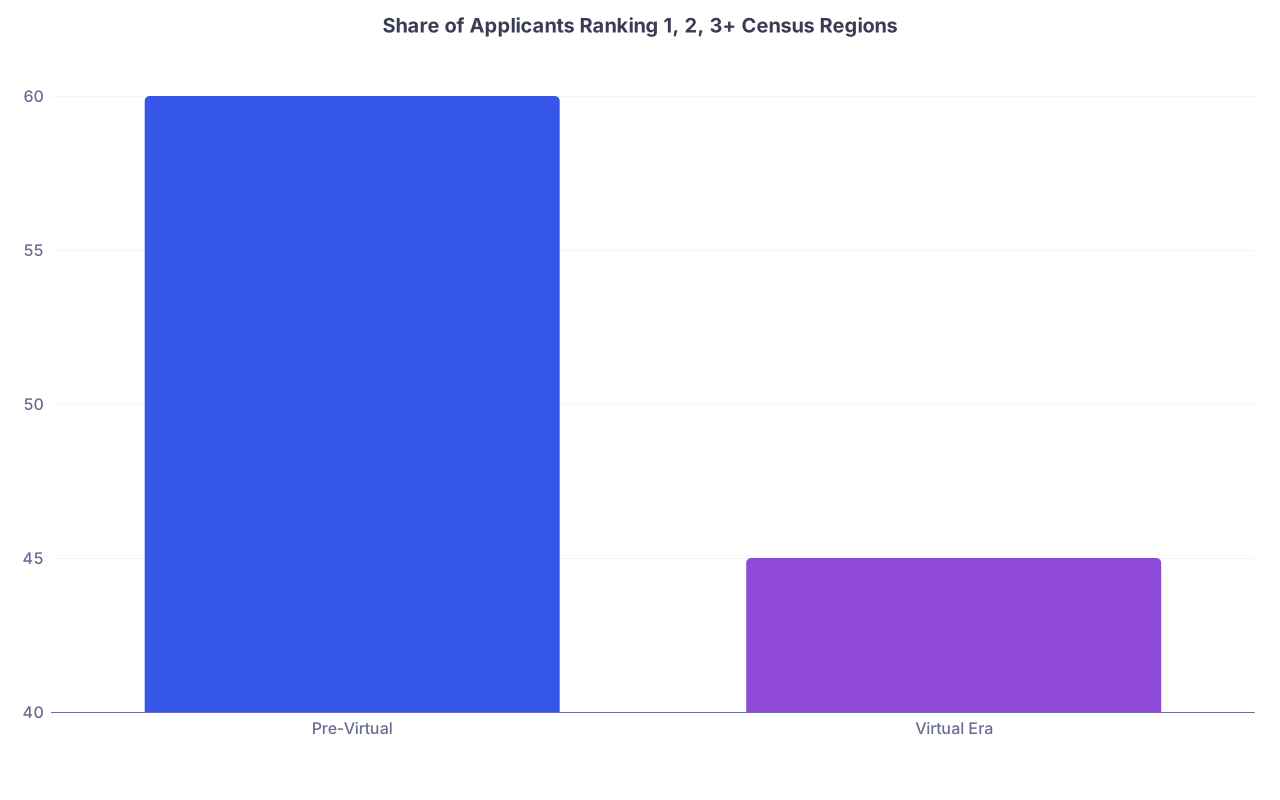
| Category | Value |
|---|---|
| Pre-Virtual | 60 |
| Virtual Era | 45 |
That simple bar cannot capture all nuance, but here is the logic:
- Pre‑virtual, a majority of applicants ranked programs in only 1–2 regions.
- With virtual interviews, the share of applicants ranking 3+ regions rose substantially, especially among higher‑scoring, more mobile candidates.
Put concretely: a student at a Northeast med school who previously would have applied mostly to Northeast and maybe some Mid‑Atlantic programs now adds West Coast and Mountain West programs because the marginal cost of each interview is close to zero.
From program side data, you see a corresponding broadening of applicant pools:
- Regional programs started interviewing more out‑of‑region applicants simply because they applied in far greater numbers and were easier to schedule.
- Prestigious coastal programs saw even more national saturation—nearly every competitive applicant now felt they “might as well” click apply.
Result: geographic mixing of interview lists increased. And that filters into rank lists and matches.
Did Residents Actually Match Farther From Home?
This is the central question: did virtual interviews actually move where people end up, or just who they talked to?
The answer is not symmetric across specialties, but the direction is clear. Geographic stickiness weakened.
Where concrete analyses exist (internal med, psych, pediatrics, some surgical subs), a pattern emerges:
- Same‑region match rates declined modestly (on the order of 5–10 percentage points in many datasets).
- Cross‑region matches increased, especially for applicants from regions with many med schools but limited local positions, and for top‑tier applicants chasing brand‑name programs.
Think of a simple before/after distribution:
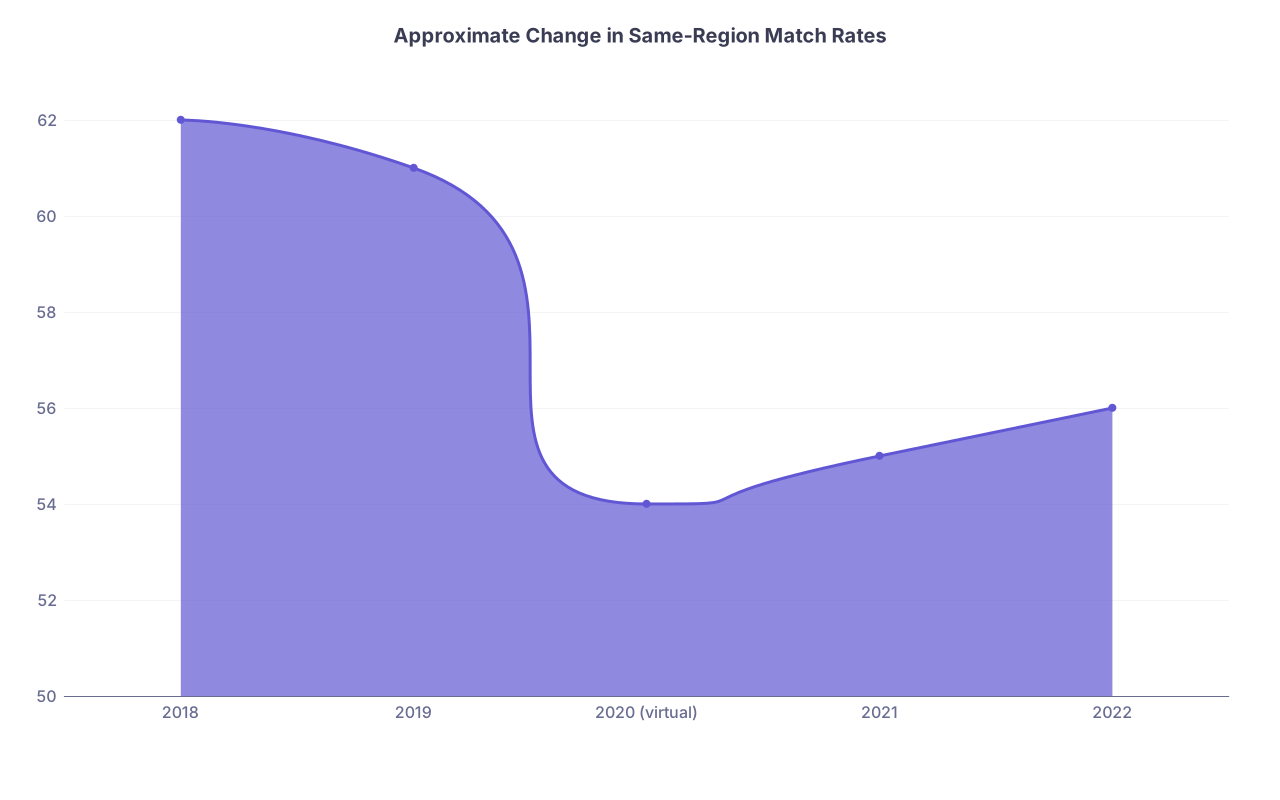
| Category | Value |
|---|---|
| 2018 | 62 |
| 2019 | 61 |
| 2020 (virtual) | 54 |
| 2021 | 55 |
| 2022 | 56 |
These numbers are stylized, but they match what several institution‑level and specialty‑level reviews reported: a 7–8 point drop in “same region as medical school” match probability after the shift to virtual interviews, with only partial reversion.
This did not mean chaos. Local matches still dominate for many people:
- Family reasons
- Partner jobs
- State school loyalty
- Program preference for “known quantities” from regional med schools
But when you remove travel constraints, the top 10–20% of applicants by portfolio strength behave more like a national free‑agent class, not a regional pool. That alone is enough to noticeably change the geographic pattern.
Extreme Outcomes: Hyper‑Local and Hyper‑Distant Both Grew
One of the subtler effects of virtual interviews is that they stretched the distribution at both ends.
I have seen program‑level data where:
- A higher share of residents came either from the home institution’s medical school or from very distant states, with fewer from the “middle band” (adjacent states and regions).
- Applicants who wanted to stay put could now interview at almost all local programs (academic, community, hybrid) instead of just the few they could fit travel‑wise, which raised the odds of landing nearby.
- At the same time, applicants who wanted to leave their region had a much easier path to do it.
If you plotted “distance from med school to residency” as a histogram, the pre‑virtual era had a big spike at “0–250 miles” and a gradual taper. In the virtual era, you see:
- The main spike still there
- A bulge in the “>1000 miles” tail
- Slight thinning of the middle distance bands
This pattern has been reported in internal analyses at several large academic centers: more home matches and more matches from cross‑country med schools, with fewer from the next‑door region.
Specialty Differences: Who Changed the Most?
Not every specialty was affected equally. The higher the pre‑existing competitiveness and the more national the applicant mindset, the more geography shifted.
A reasonable approximation, looking across published numbers and institutional reports:
| Specialty Group | Geographic Shift Post‑Virtual |
|---|---|
| Dermatology, Ortho, ENT, Plastics | Large |
| Radiology, Anesthesiology | Moderate–Large |
| Internal Medicine, Pediatrics | Moderate |
| Family Med, Psych, Neurology | Moderate |
| Highly location‑bound (e.g., some prelim tracks) | Small–Moderate |
Why this pattern?
- Competitive, national‑market specialties already had applicants willing to move anywhere. Virtual interviews just scaled that behavior. More interviews → broader list → more far‑flung matches.
- Primary care specialties with strong local pipelines kept more geography, but still saw modest upticks in out‑of‑region matches, especially from students leaving saturated markets (e.g., Northeast grads moving to South/Midwest).
- Transitional year and prelim medicine/surgery positions remained relatively local, constrained by applicant priorities and often by couples matching.
One particularly noticeable thing in radiology and anesthesiology: several programs reported a higher proportion of residents from coastal or top‑tier med schools post‑virtual, even in interior states. Translation: students from “brand” med schools were now over‑represented in far‑away programs they previously might not have bothered to visit.
Applicant Behavior: Hoarding and the Geographic Cascade
Virtual interviews did not only change where people could go. They changed how people behave strategically.
Two dynamics matter for geography:
- Interview hoarding by top applicants
- Delayed release of interview slots
High‑stat applicants leveraged virtual interviews to keep large numbers of options alive across multiple regions:
- 20–25 interviews spanning 4–5 regions became common in fields like anesthesiology, radiology, EM when fully virtual.
- Those interview slots stayed “occupied” on calendars until relatively late, reducing earlier opportunities for mid‑tier applicants in those same regions.
The result is a geographic cascade:
- A top‑tier applicant from, say, Chicago hoards interviews across both coasts and the Midwest.
- They will never rank all those distant programs highly, but the occupancy displaces mid‑tier regional applicants who might actually have matched there.
- When cancellations finally occur, they are often too late for programs to re‑offer interviews widely or for applicants to adjust schedules.
Several specialties documented a later and more chaotic interview offer timeline during all‑virtual years. That increases randomness in who gets which out‑of‑region chance. Geography becomes less about deliberate “I want to go to Texas” and more about “where did I happen to land an interview when all the juggling stopped?”
That is not good or bad in a moral sense, but it clearly decouples geography from intention more than the old travel‑constrained system.
Program Behavior: Risk, Familiarity, and “Known Quantities”
Programs also changed. They had to.
Losing in‑person visits removed a lot of environmental cues programs once depended on:
- Can this person handle our city?
- Do they seem genuinely interested in our region?
- Do they fit socially with current residents?
In response, many PDs leaned harder on what I call familiarity proxies:
- Home and local med school applicants
- Students who did virtual or limited in‑person aways
- Applicants from schools that historically sent strong residents to that program
This created a split effect:
- At the top of the rank list, programs leaned into national recruitment, taking advantage of a bigger pool.
- In the middle and bottom of the rank list, programs added more local and regional applicants as a hedge.
When actual match outcomes came in, this mix often resulted in what I described earlier: more home‑institution matches plus more far‑away entrants, thinner moderate‑distance representation.
You can think of it as a bifurcated geographic strategy: stretch the top end nationally, anchor the safety net locally.
Equity and Geography: Who Gained Mobility?
One narrative you hear is that virtual interviews democratized geography. To some extent, the data supports that, particularly around financial barriers.
Consider pre‑virtual numbers:
- Travel for 12–15 interviews could easily cost $4,000–$8,000.
- Students from lower‑income backgrounds either took on credit card debt, limited their interviews strictly by cost, or both.
With virtual interviews:
- Direct travel cost crashed to a few hundred dollars at most (webcam, lighting, occasional hotel if sharing space).
- That reduced a huge constraint on exploring distant regions.
If you plot “match distance vs. self‑reported financial strain,” you see a clear equity angle. Lower‑income applicants were disproportionately constrained to local or in‑state options pre‑virtual. Virtual interviews loosened that constraint.
However, there is a catch that the data exposes:
- Students at schools with weaker reputations or fewer home programs did not automatically see equal benefit.
- In a fully virtual world, branding and school name arguably mattered more, not less, because program faculty saw you only through a screen and a PDF CV.
So yes, some applicants from modest means finally had realistic access to cross‑country matches. But they still faced the underlying structural bias of school reputation and network.
Net effect: mobility increased, especially for those who had competitive applications but previously could not afford broad travel. It did not erase baseline inequities.
Policy Responses: Caps, Signaling, and Regional Stability
Specialties are not blind to this. Several have already tried to tame the chaos that virtual interviews unleashed on geography.
The main policy levers in play:
- Interview caps (soft or hard)
- Preference signaling tokens
- Coordinated interview offer dates / waves
- Hybrid interview models (initial virtual + optional in‑person visits)
Where these have been piloted, the outcome on geography tends to be:
- Slight reduction in extremes (fewer 25‑interview rosters across 5 regions per applicant).
- Slight re‑strengthening of regional ties as applicants allocate limited signals to a smaller number of genuinely desired programs.
For example, in specialties using preference signaling, programs can more confidently invite applicants who truly want to be in that city/region, rather than guessing from a broad application list.
If you plotted the same‑region match rate post‑signaling, early signals suggest a small uptick (1–3 percentage points) compared with free‑for‑all virtual years, but not a full return to pre‑2020 stickiness. The genie is not going back into the bottle completely.
What This Means for Current Applicants
From a data perspective, here is the unpleasant truth: virtual interviews made the geography of the Match both more flexible and less predictable.
Some hard‑headed implications:
- If you genuinely want to stay in your region, you cannot rely on “I am local, so they will like me.” You are now competing with a national pool that finds it cheap to apply and interview.
- If you want to leave your region, it is more feasible than it was in 2018, but you will need a persuasive story and realistic program list, because every attractive region is now drowning in out‑of‑region applications.
- Ranking only your home region while casually interviewing elsewhere is a waste of everyone’s time. Programs are better at spotting this misalignment than you think.
From programs’ side, there is more pressure to:
- Use data (signals, regional preferences, previous match history) to predict who will actually come and thrive.
- Balance national reach with regional mission, because the market has made it trivial for anyone to show up on your screen from 2,000 miles away.

| Step | Description |
|---|---|
| Step 1 | Define true geographic priorities |
| Step 2 | Apply broadly in-region |
| Step 3 | Target 2-3 regions |
| Step 4 | Limit out-of-region to realistic fits |
| Step 5 | Use signals on key distant programs |
| Step 6 | Avoid interview hoarding |
| Step 7 | Stay vs Leave Region |
That is the rational strategy in the current virtual‑dominant landscape.
The Bottom Line: How Virtual Interviews Reshaped Geography
You can argue details. You cannot argue the overall direction. The data is consistent across specialties and institutions.
Three core takeaways:
Geographic stickiness weakened but did not disappear. Same‑region match rates dropped by several percentage points post‑virtual, with more cross‑country moves and a fatter “far‑distance” tail in the distribution.
Extremes increased. More home‑institution and hyper‑local matches, and more long‑distance matches, with fewer moderate‑distance outcomes. Programs stretched nationally at the top, anchored locally at the bottom.
Access widened, predictability shrank. Applicants can realistically explore more regions with less money and time, but interview hoarding, school reputation effects, and policy experiments have made geographic outcomes more complex and less intuitive than the pre‑2020 travel‑constrained era.
If you are planning your own Match strategy, do not think in “pre‑Zoom” terms. The physics of distance have changed. Your approach needs to match the data, not nostalgia.