
The obsession with “more interviews is always better” is mathematically wrong in the Zoom era. The data show a steep curve of benefit for your first 8–12 interviews, then rapidly diminishing returns and rising burnout risk.
Let me walk you through the numbers instead of the folklore.
1. The Core Question: How Many Interviews Do You Actually Need?
Before Zoom, the limiting factor was simple: money and time. Flights, hotels, days off from rotations. Now, with video interviews, the bottleneck has shifted. The hard constraint is your energy, preparation quality, and schedule sanity.
Programs and applicants have adapted. But the underlying statistics of matching have not fundamentally changed:
- The National Resident Matching Program (NRMP) and specialty organizations have published consistent trends:
- For most categorical specialties, U.S. MD seniors who ranked 10–14 programs had a >90–95% chance of matching.
- Beyond about 15 ranked programs, the probability curve flattens. Extra interviews add tiny marginal benefit.
- Below 6–7 ranked programs, your risk of not matching rises quickly.
Those numbers are from the pre-Zoom world, but post-2020 data confirm the same general shape. Video interviews made volume easier, not more necessary.
The key: think in ranked programs, not just “interviews.” But since each interview is a potential rank, we can translate.
For practical purposes, interview count ≈ rank list length minus programs you end up dropping.
Let’s quantify.
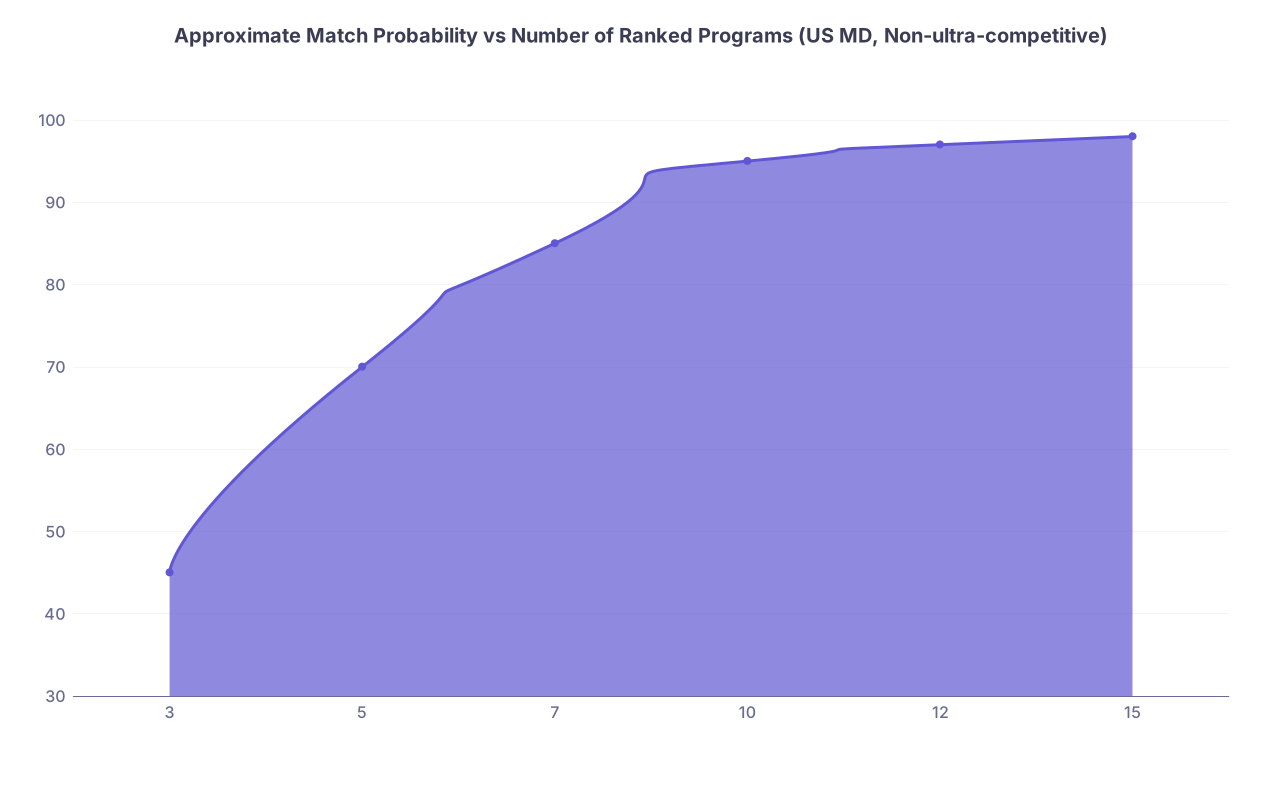
| Category | Value |
|---|---|
| 3 | 45 |
| 5 | 70 |
| 7 | 85 |
| 10 | 95 |
| 12 | 97 |
| 15 | 98 |
These are smoothed, approximate figures across common categorical specialties (IM, peds, FM, psych, anesthesia) based on repeated NRMP “Charting Outcomes” patterns. Not official exact numbers, but directionally accurate.
From that curve you can already see the story:
- Going from 3 to 7 programs ranked → roughly +40 percentage points in match probability.
- Going from 7 to 12 → maybe +12 percentage points.
- Going from 12 to 15 → 2–3 percentage points at most.
So your first 8–12 interviews matter a lot. Your 16th? Mostly noise.
2. Zoom Era Reality: More Invites, More Hoarding, More Noise
Once interviews moved to Zoom, two major behaviors emerged:
- Applicants accepted more interviews because they no longer had to fly.
- Programs sent more invites and overbooked less, because no-shows and cancellations became easier to absorb.
Result: interview inflation.
- Pre-Zoom, many solid IM applicants sat in the 10–15 interview range.
- Post-Zoom, same-level applicants often report 18–25 interviews in mid-tier or non-competitive specialties.
- In competitive ones (derm, ortho, ENT), strong applicants easily end up with 20–30+ interviews.
Yet match probabilities did not double. Because the match algorithm still forces a one-to-one outcome.
Here is the painful truth: a U.S. MD with 25 psych interviews is not likely to have a substantially higher match probability than a similar peer with 14 psych interviews. They are just more tired and less prepared per program.
The limiting factor shifted from availability to quality of engagement.
3. Recommended Interview Targets by Applicant Type
Let’s stop hand-waving and set numeric targets. These are data-informed bands, not magical thresholds, but they match what I have seen in real cycles.
Assumptions here:
- We are talking categorical positions (not prelim or advanced-only) in the Zoom era.
- Specialty competitiveness averages are used; I will flag exceptions.
| Applicant Type | Safer Range | Stretch / Ideal Ceiling |
|---|---|---|
| US MD, strong, non-competitive field | 10–12 | 14–16 |
| US MD, average, non-competitive field | 12–14 | 16–18 |
| US MD, strong, competitive field | 14–18 | 20–22 |
| US MD, average/borderline, competitive | 18–22 | 24–26 |
| US DO / US-IMG, non-competitive | 12–16 | 18–20 |
| US-IMG / Non-US IMG, competitive | 18–22 | 24–26 |
A few clarifications:
- Non-competitive here means: FM, IM (community-heavy), peds, psych in many regions, pathology, neurology (most cycles).
- Competitive: derm, ortho, ENT, plastics, neurosurg, ophtho (SF actually), urology (AUA), EM in some cycles, anesthesia/rads in hot years.
The “stretch ceiling” is not how many you can physically attend on Zoom. It is the point beyond which most people are just stockpiling interviews they do not actually need. And starting to underperform in each one.
Translating to rank lists
Not every interview becomes a rank:
- You will drop places with red flags.
- Some will drop you.
- Some will not feel safe geographically or personally.
On average, applicants end up ranking about 80–90% of places they interview at, once obvious outliers are removed.
Example:
- 14 interviews → likely 11–13 ranked programs.
- 20 interviews → likely 16–18 ranked programs.
When you overlay that with the probability curve from NRMP data, you get the answer:
- For a solid US MD in a standard field, 14 interviews (≈12 ranks) usually places you above 95% match probability.
- For a riskier profile or a very competitive field, you want to push closer to 18–20 interviews (≈16–17 ranks).
More than that is mostly psychological insurance.
4. The Diminishing Returns Curve: Why 20 ≠ Twice as Good as 10
Let’s be explicit with a rough model.
Assume the probability of matching after ranking N programs follows a saturating curve. A very simple toy function might be:
- P(match) ≈ 1 − (1 − p)^N
Where:
- p = crude “per-program” match chance, determined by how competitive you are.
- N = number of ranked programs (not applied-to, not invited).
For a reasonably competitive US MD in IM or peds, you might estimate p ≈ 0.15–0.18.
If p = 0.16:
- N = 5 → P ≈ 1 − 0.84^5 ≈ 57%
- N = 10 → P ≈ 1 − 0.84^10 ≈ 81%
- N = 12 → P ≈ 1 − 0.84^12 ≈ 87%
- N = 15 → P ≈ 1 − 0.84^15 ≈ 92%
- N = 18 → P ≈ 1 − 0.84^18 ≈ 95%
Exactly the same pattern NRMP reports every cycle: a steep rise for the first 8–12, then a slow creep toward the mid-90s.
Now translate that back to interviews. Suppose 90% of interviews become ranks:
- 12 interviews → ~11 ranks → high-80s to low-90s %, depending on specialty and profile.
- 18 interviews → ~16 ranks → mid-90s %.
- 25 interviews → ~22 ranks → maybe you gain a couple of percentage points at most.
Your 15th–25th interviews often move your match probability by only a few points. And those few points come at meaningful cost.
5. Costs in the Zoom Era: The Hidden Penalties of Excess Volume
Everyone underestimates the cognitive and emotional cost of Zoom interviewing.
Here is what actually happens once people push beyond a sane range:
Around 10–12 interviews:
- You still remember individual faculty.
- You can tailor answers to program specifics.
- Your energy on screen is reasonably high and authentic.
Around 18–20:
- Details blur. Was the VA-heavy program in Michigan or Pennsylvania?
- You start repeating generic answers because you are tired.
- Background prep per program drops from ~1 hour to 20–30 minutes or less.
Past 22–25:
- People report “Zoom hangover” and emotional flattening.
- Mock interviews stop happening; there is no time.
- You are less memorable. Which is dangerous in a field where everyone looks “qualified on paper”.
If you treat interviews like Pokémon (“gotta catch ’em all”), your average performance per interview drops. The variance in your performance goes up. That is statistically bad: the match algorithm rewards consistent ranking across several programs, not a single heroic performance and 10 forgettable ones.
The right question is not “how many interviews can I physically attend?”
It is: “At what number of total interviews does my average quality per interview start to fall off a cliff?”
For most people, that cliff starts between 14 and 20, depending on your stamina and schedule.
6. Specialty-Specific Nuance: When Numbers Need Adjustment
One-size-fits-all advice is lazy. The base math holds, but the underlying “per-program” success probability p shifts by specialty and by applicant type.
A. Family Medicine / Internal Medicine / Pediatrics / Psychiatry (typical years)
For U.S. MD seniors who are not carrying major red flags:
- 10–12 interviews → usually enough for a >90% match probability.
- 14–16 → usually puts you solidly in “I’m going to match somewhere almost certainly” territory.
- If you still feel massive anxiety at 18+ interviews, that is not a data problem. That is a control problem.
For DOs and IMGs:
- You may need to shift the target up by ~2–4 interviews, depending on how program-friendly your degree and visa status are.
- A DO with solid scores and some home/away rotations in IM reasonably targets 12–16 interviews.
- A non-US IMG in IM might want 16–20, especially if relying heavily on community programs.
B. Big-League Competitive (Derm, Ortho, ENT, Plastics, Neurosurg, Ophtho, Urology)
Here, p per program is lower. You can be a strong applicant and still not crack a program’s rank list because the field is top-heavy and full of equally shiny people.
What I see in real data:
- Successful US MD derm applicants often carry 12–18 interviews, sometimes more.
- Orthopedic applicants who eventually match commonly report 14–20 interviews.
- For ophtho and urology (separate matches), thresholds are similar; 10 interviews is good but may not feel “safe”.
But even here, the diminishing returns are real.
- The difference between 18 and 25 interviews is not the difference between 60% and 99% match probability.
- It may be the difference between 75% and 85–88%, depending on your baseline strength.
Which is significant, but not “destroy your mental health and skip all electives” significant.
If recruitment committees in your field routinely complain that “by mid-season everyone looks exhausted and flat,” that is a signal the system is over-interviewing. Do not copy the worst behavior.
7. Timeline and Scheduling: How to Avoid Self-Sabotage
The Zoom era tempts applicants to double-book, stack 3 interviews in a week, and think it is fine. The data say otherwise.
Performance, especially in conversational, high-stakes Zoom settings, tends to plateau after:
- 2 intensive interview days in a week, and
- 3–4 interviews in a rolling 7-day window, for most people.
That is not exact science, but it matches what I see in schedules and feedback patterns.
If you want to protect interview quality, build guardrails like:
- Aim for no more than 2 interview days per week whenever possible.
- Try to cap total interviews across the season in your target band (for example, 14–18 instead of 25+).
- Ruthlessly decline late, lower-priority invites once you have reached a comfortable probability band.
If you ignore this, your later interviews are heavily discounted returns with higher “error bars” on your performance.
8. When to Stop Accepting Interviews: A Data-Driven Rule of Thumb
Applicants always ask the same question mid-season:
“I have X interviews. When is it safe to stop accepting more?”
Use a structured approach instead of feelings.
Here is a simple decision flow:

| Step | Description |
|---|---|
| Step 1 | Count current interviews in specialty |
| Step 2 | Target 12-14 interviews |
| Step 3 | Target 16-20 interviews |
| Step 4 | Target 14-18 interviews |
| Step 5 | Target 18-22 interviews |
| Step 6 | Politely decline lower-priority late invites |
| Step 7 | Continue accepting selectively |
| Step 8 | US MD/DO or IMG? |
| Step 9 | Non-comp vs Comp? |
| Step 10 | Non-comp vs Comp? |
| Step 11 | Reached target AND mix of program tiers? |
Key filters before you stop:
Specialty and profile-appropriate count
- If you are below the target band above, you probably keep accepting.
Program mix
- You do not want 14 interviews all at ultra-reach institutions.
- A healthy portfolio includes:
- Some reaches
- Several mid-tier matches
- At least a few true safeties
Geography / personal constraints
- If 10 of your 12 interviews are in cities you would never live in, your “effective” count is not 12.
A working rule:
Once you have hit a numbers band that historically corresponds to >90–95% match probability for your profile and your portfolio includes real safeties, your default answer to new, lower-priority invites should be “no.”
You can obviously still say “yes” to a late invite from a dream program. That is just rational.
9. Multiple Specialties: Splitting Interview Volume Intelligently
Some applicants hedge their bets across specialties: for example, EM + IM, or neurology + IM.
This is where people wreck themselves in the Zoom era, stacking 30–35 interviews total and burning out.
You need a separate target curve for each specialty, and you need to recognize that your per-program probability p is not equal across them.
Example: EM + IM dual application for a US MD with average stats.
- Maybe your p in EM is ~0.07 (more competitive for you).
- Your p in IM might be ~0.18 (stronger relative profile).
If you get:
- 8 EM interviews (~7 ranks) and
- 10 IM interviews (~9 ranks),
Your combined probability of matching somewhere is extremely high. The exact math is messy because the match is not an independent coin flip across specialties, but practically:
- If each list alone would be, say, 70% and 85% probabilities respectively, the chance you fail both is low (product of their “not match” probabilities, simplified: 0.30 × 0.15 = 4.5%).
You do not need 20 EM + 20 IM interviews. That is overkill and a guarantee of poor performance.
The better strategy:
- Commit to a primary specialty where you stack closer to the recommended range for safety (e.g., 12–16 interviews).
- Treat the secondary specialty as a targeted hedge (e.g., 6–10 interviews).
- Cap the total across specialties at a number you can actually handle, usually ≤22–24.
10. What This Means for You, Practically
If I strip away all nuance and condense this to a practical checklist, it is this:
Identify your category:
- US MD vs DO vs IMG.
- Specialty competitiveness.
- Whether you have major red flags (exam failures, long gap, etc.)
Set an initial target band:
- Non-competitive, solid US MD → aim for 12–14 interviews.
- Competitive specialty or weaker profile → 16–20 interviews for that specialty.
- DO/IMG → shift that band up by ~2–4 interviews, depending on your situation.
Monitor quality, not just quantity:
- If you feel your prep per program dropping below ~30 minutes and your answers all sound the same, you are in the over-interview zone.
- If you hit your target band and have a reasonable mix of program tiers, start saying no to lower-priority programs.
Remember the curve:
- First 6–8 interviews: massive gains.
- 8–12: still very high-value.
- 12–18: diminishing but meaningful.
- 18–25+: marginal, often psychological, gains with tangible fatigue costs.
You do not get an extra diploma for “most interviews attended.”
The Zoom era tricked everyone into thinking interview volume is free. The data say otherwise. Your attention, preparation, and performance carry a cost that the match algorithm does not forgive.
If you treat interviews as a finite resource and aim for a rational volume instead of a maximal one, you walk into each call sharper, more present, and more rankable. That is how you convert invites into actual matches.
With your interview volume strategy grounded in numbers, the next step is obvious: optimizing what you do inside each Zoom room. Crafting answers, reading faculty signals, and leaving a strong digital impression. That, however, is another analysis for another day.